When you are specifying heated towel racks for a hotel project, a property development, or a wholesaler inventory line, the question of how long they last is not a minor consideration. It affects your warranty exposure, your replacement costs, and the reputation you build with your end customers.
The honest answer is that a heated towel rack, properly specified and maintained, typically lasts 10 to 20 years. But that range covers enormous variation, and the difference between a product that reaches 15 years versus one that fails at 5 comes down to a small number of decisions made before the order is placed.
Here is what actually determines lifespan in the heated towel rack category.
What Determines How Long a Heated Towel Rack Lasts
Heating Technology
The type of heating element inside the rack is the single biggest factor in longevity.
Electric liquid-filled (hydrothermal): These racks contain a heating element that warms a heat-transfer fluid, similar to a traditional central heating radiator. The fluid circulates by convection, so there are no moving parts and no fan to wear out. Lifespan typically runs 15 to 25 years. The tradeoff is that they take longer to heat up and are generally heavier and more complex to install.
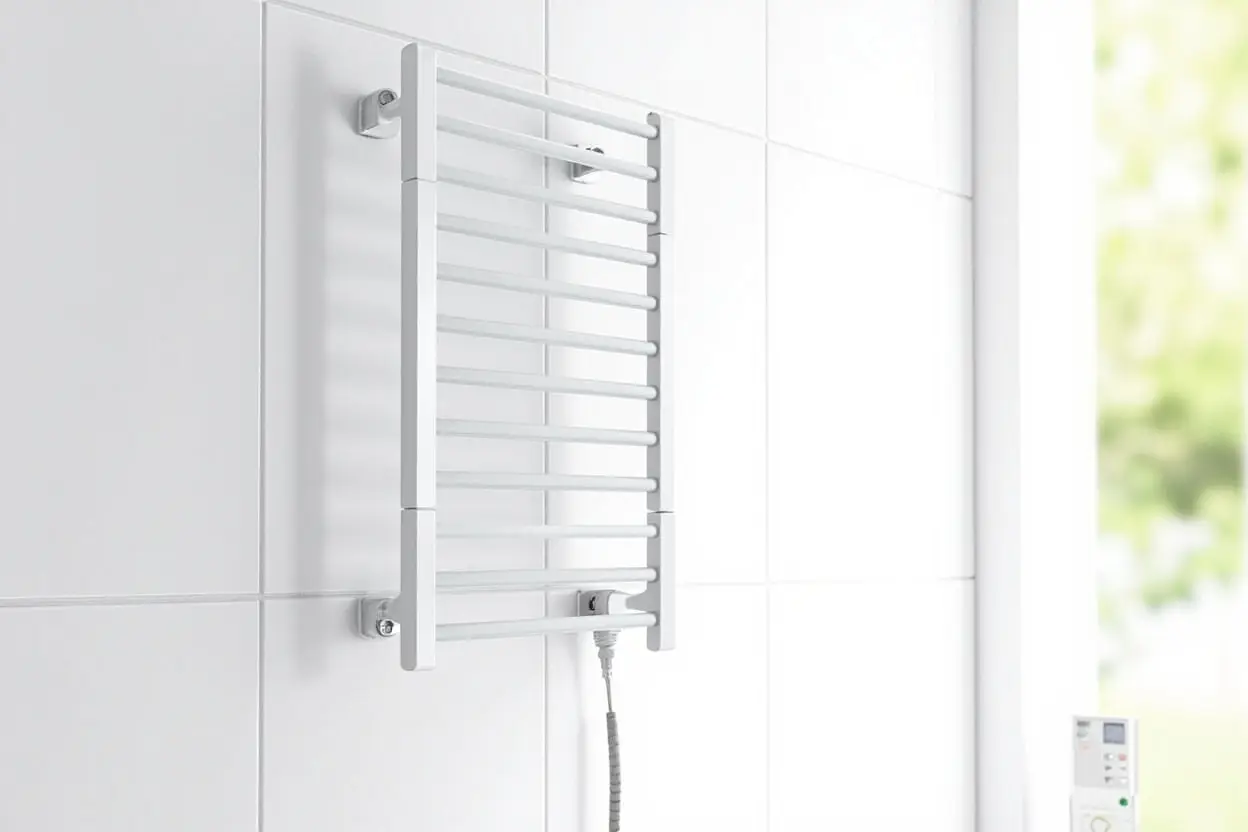
Dry element (electric rod or cable): A resistive heating cable runs through the rack, directly heating the surface. These heat up faster and are lighter. Standard dry element racks last 10 to 18 years, depending on build quality. PTC (Positive Temperature Coefficient) heating elements are a newer variant that self-regulate temperature, reducing the risk of overheating and extending functional lifespan.
Fan-assisted: A heated towel rack with an integrated fan accelerates drying and room warming. The fan motor adds a mechanical component that can fail, typically 5 to 10 years before the rack itself needs replacement. These are popular in commercial settings where fast turnaround matters.
Build Quality and Materials
Material choices make a significant difference in how the rack ages visually and functionally:
- Stainless steel (304 grade): Best corrosion resistance, particularly important in humid environments and coastal areas. Expected lifespan 15 to 25 years for the rack body.
- Aluminum: Lightweight and corrosion-resistant but softer. Anodized aluminum finishes last well; painted aluminum can chip or fade over 8 to 15 years.
- Carbon steel with powder coating: Good value option. The coating protects against rust, but once the coating is compromised, carbon steel corrodes quickly. Lifespan 8 to 15 years depending on coating quality and bathroom humidity.
- Brass: Excellent longevity and historically popular in heritage and high-end projects. Unlacquered brass develops a patina; lacquered brass maintains finish longer. Rack body can last 20+ years.
Build Quality Tiers
Not all racks in the same material category perform the same way. The difference between a product built for a 5-year lifespan and one built for 15 years comes down to:
- Welding quality: Seamless or argon-arc welded joints are less prone to cracking than soldered joints.
- Wall thickness: Heavier gauge tubing (1.5mm+ for stainless, 1.2mm+ for carbon steel) resists denting and deformation.
- Finish process: High-quality powder coating or PVD finishing is applied to cleaned, pre-treated surfaces. Budget products often skip the pre-treatment, causing finish delamination within 3 to 5 years.
- Heating element quality: Branded heating elements from established manufacturers (BJB, OE German, Heatax) last significantly longer than generic elements.
Expected Lifespan by Rack Type
| Rack Type | Heating Method | Typical Body Lifespan | Heating Element Lifespan |
|---|---|---|---|
| Premium stainless steel ladder rack | Dry element | 15-25 years | 12-20 years |
| Mid-range stainless steel rack | Dry element | 10-18 years | 8-15 years |
| Budget carbon steel rack | Dry element | 5-12 years | 5-10 years |
| Heated towel rack with fan | Fan-assisted | 10-20 years | 5-10 years (fan motor) |
| Hydrothermal liquid-filled rack | Electric/hydraulic | 15-25 years | 10-20 years |
| PTC self-regulating rack | PTC element | 12-20 years | 12-20 years |
Lifespan figures assume normal domestic use. Commercial settings with extended daily operation may reduce element lifespan by 20-30%.
Warning Signs That a Heated Towel Rack Is Nearing End of Life
Towel racks rarely fail catastrophically. The signs usually appear gradually:
- Persistent cool spots: Sections of the rack that never fully heat suggest internal scale buildup (in liquid-filled models) or element degradation.
- Increased running noise: Clicking, gurgling, or humming sounds that were not present when the rack was new.
- Visible corrosion or coating failure: Particularly around welded joints and bracket mount points.
- Excessive surface temperature: If the rack surface is significantly hotter than its thermostat setting, the thermostat or limit thermostat may be failing.
- Higher energy consumption for same output: A rack that draws more electricity to produce the same heat is working harder than it should.
- Electrical issues: Tripping the circuit breaker, residual current device (RCD/RCCB) triggers, or warm plug-in connectors are all signals that warrant professional inspection.
How Maintenance Affects Lifespan
Regular maintenance does not add years to every rack, but it prevents early failure from preventable causes:
- Keep the rack surface dry when not in use: Moisture sitting on the bars accelerates corrosion, particularly on carbon steel. Opening the bathroom window or using an exhaust fan reduces humidity.
- Wipe down the bars monthly: Dust and soap residue can be mildly corrosive over time. A soft cloth with mild soap is sufficient.
- Check electrical connections annually: For hardwired models, have an electrician inspect the connections, junction box, and earth grounding every 12 to 18 months.
- Descale liquid-filled racks: If you have a hydrothermal model and live in a hard water area, periodic descaling (every 3 to 5 years) keeps the heating fluid circulating efficiently.
- Do not overload the rack: Hanging multiple heavy wet towels overstrains the wall brackets and can distort the rack over time.
For commercial properties, a quarterly inspection schedule written into the building maintenance contract catches issues before they become tenant complaints or warranty claims.
Calculating the Real Cost of Ownership
For procurement teams and specifiers, comparing purchase price alone misses the full picture. The cost of ownership over 10 to 15 years includes:
- Purchase price: Initial unit cost.
- Installation: Hardwired units typically require an electrician; plug-in models can reduce installation cost significantly.
- Energy cost: A 100W towel warmer running 4 hours a day costs roughly $1.50 to $2.00 per month at average US electricity rates. More efficient models (PTC or thermostat-controlled) reduce ongoing energy cost.
- Maintenance: Minor fixes, descaling, electrical inspections. Budget $30 to $80 per year for a maintenance budget.
- Replacement: If a product fails within 5 years and needs replacing, the per-year cost of ownership doubles or triples.
A rack that costs $80 but lasts 8 years has a higher annual cost than a rack that costs $150 and lasts 18 years. For hotel projects with 100+ rooms, this calculation is not academic.
When to Replace vs. When to Repair
Replace the rack if:
- The heating element has failed and replacement parts are no longer available.
- The rack body shows corrosion that cannot be treated without removal.
- The rack is visibly distorted or unsafe due to physical damage.
- You are mid-renovation anyway and the existing rack does not meet current electrical or safety standards.
Repair or resurface if:
- The issue is cosmetic (coating worn, scratches) but heating performance is normal.
- The rack has sentimental or aesthetic value and matching replacements are not available.
- Replacement cost in labor and disposal is disproportionately high relative to the property scope.
What Quality Certifications Tell You About Lifespan
Certifications do not guarantee a specific lifespan, but they do indicate that a product has been tested to standards that correlate with durability:
- ETL or UL listing (North America): Confirms electrical safety for the US market. An ETL-listed heated towel rack has been tested by Intertek or ETL Solutions; a UL-listed rack has been tested by Underwriters Laboratories. Either is required for legal sale in most US states.
- IP44 or higher ingress protection: Indicates the rack is protected against solid objects over 1mm and water splash from any direction. Essential for bathroom installations and a minimum indicator of build quality.
- Energy Star certification: Indicates the towel warmer meets EPA energy efficiency standards. Energy Star models typically use 20-30% less energy than non-certified equivalents.
- Warranty period: A manufacturer willing to offer 5 to 10 years on the heating element is making a statement about expected lifespan. Be skeptical of products with only 1-year warranties when competing products offer 5-year coverage.
Final Thoughts
A heated towel rack is not a disposable purchase. It is a fixture that, when properly specified, outlasts most of the renovation that surrounds it.
The decisions that determine lifespan are mostly made before the order is placed: choosing stainless steel over carbon steel, verifying the heating element quality, confirming the certification matches your market requirements, and buying from a factory or brand that stands behind their product with meaningful warranty coverage.
For importers, wholesalers, and project specifiers, the question “how long does this last?” deserves a more considered answer than a sales sheet can give. The difference between a 10-year rack and a 20-year rack often comes down to $40 to $80 in purchase price. That is not a premium worth avoiding.
For project specifications, volume pricing, or OEM customization for your product line, contact our B2B team. We supply heated towel racks to importers, hotel groups, and bathroom brands across North America and the Caribbean.