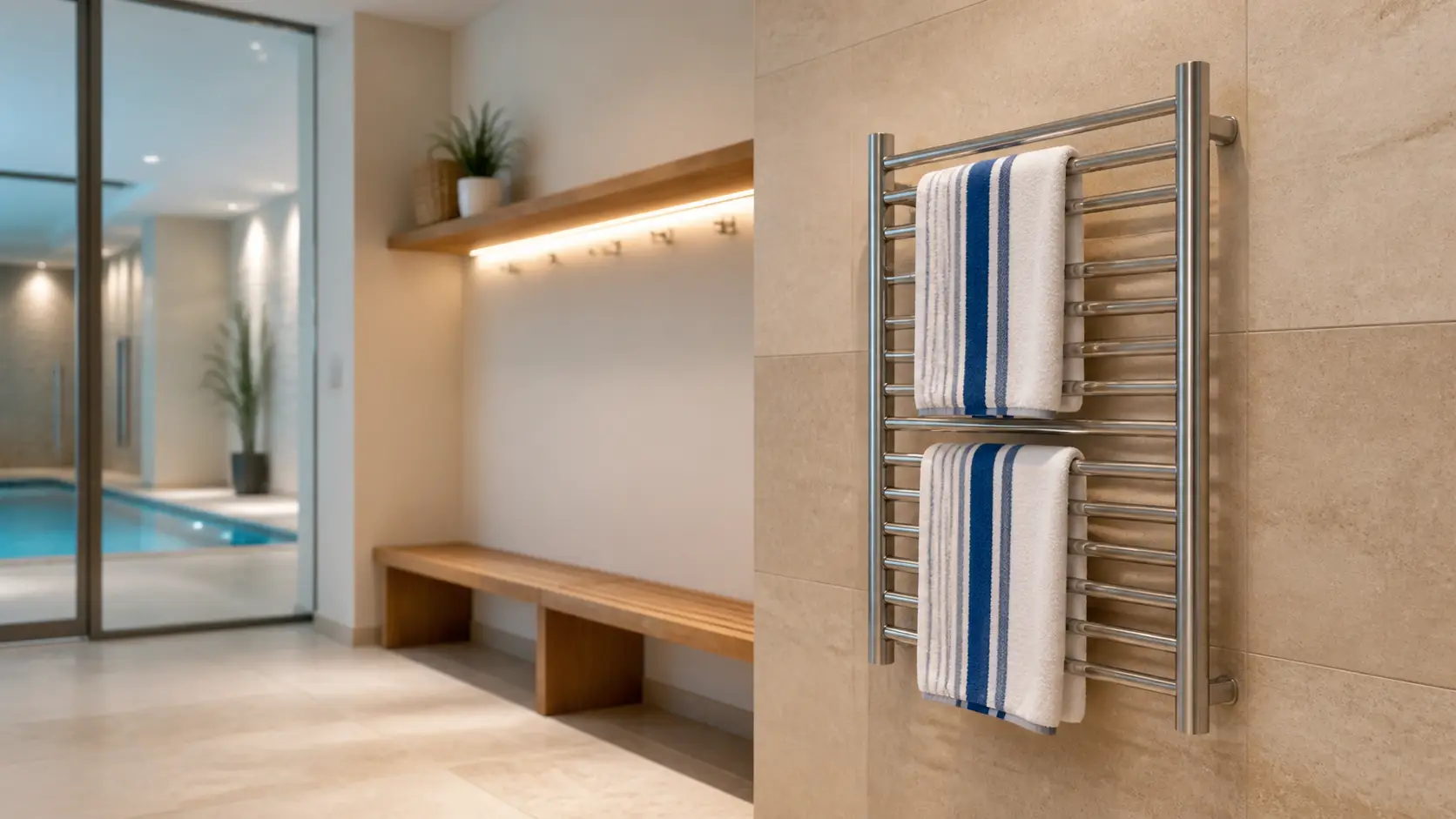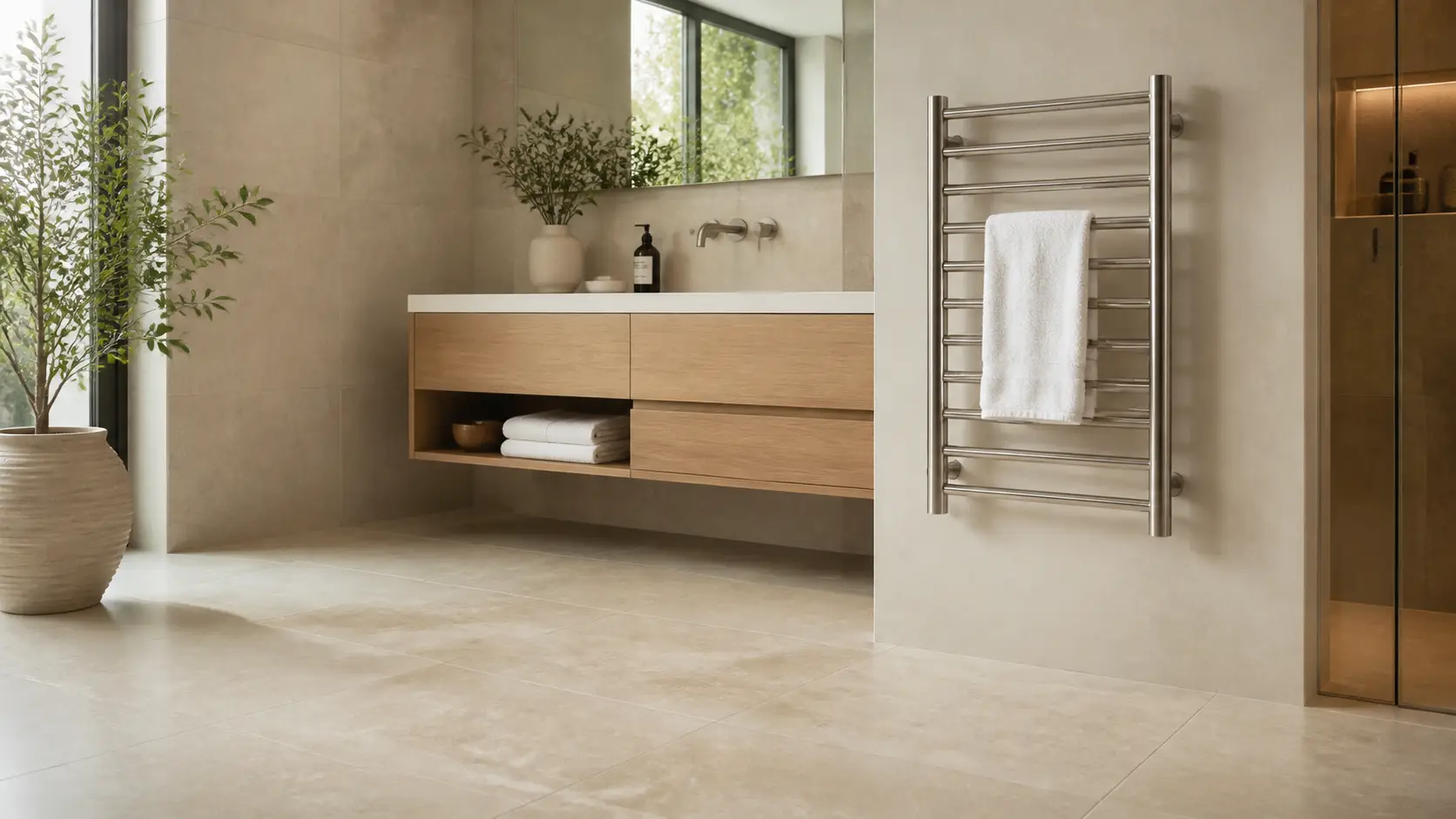
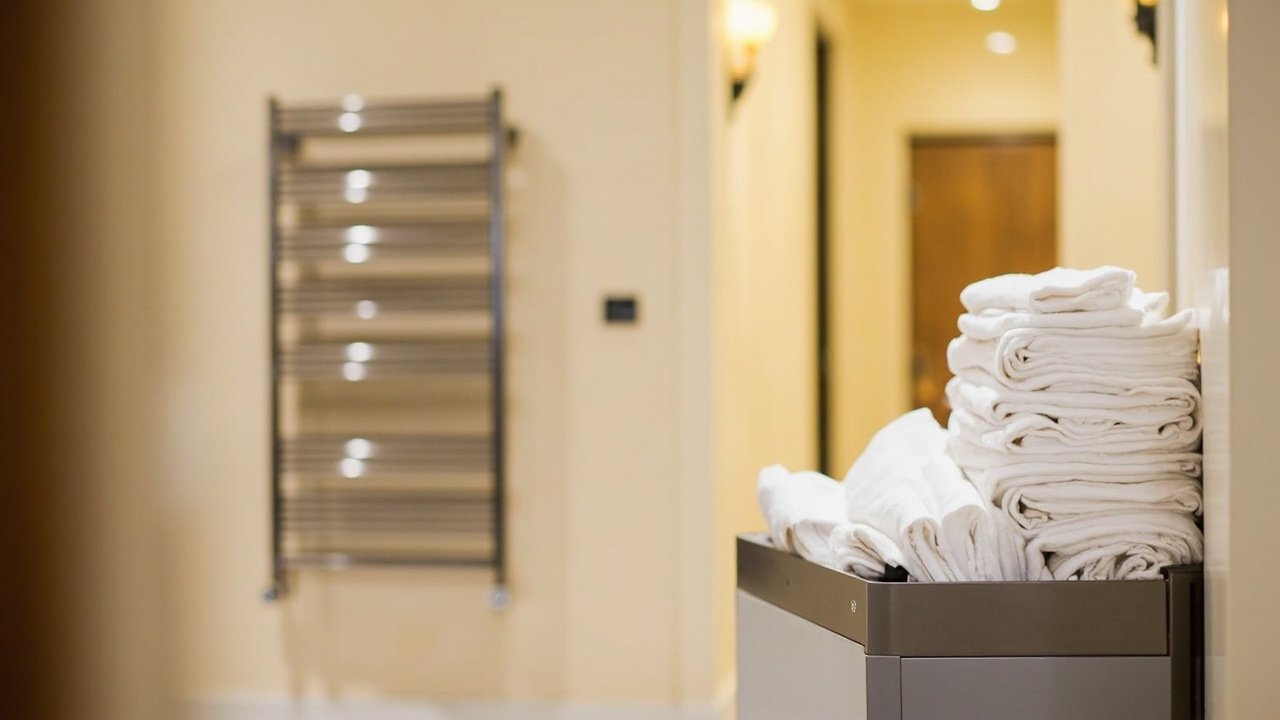
Ask a hotel operations director whether heated towel racks reduce laundry costs, and you’ll typically get a yes — but with uncertainty about how much, and why. The intuitive answer is obvious: if guests have a warm, dry towel available, they’ll use it more than once instead of requesting fresh ones every day. But the actual economics are worth examining in detail, because the math affects procurement decisions, operating cost models, and the case for installing heated towel racks in properties that don’t already have them.
This breaks down how the savings work, what the numbers look like in practice, and how hotel operators and property owners should be thinking about the ROI.
The Core Mechanism: Why Heated Towel Racks Reduce Laundry Volume
The basic logic is behavioral. A damp, cold towel is unpleasant to use twice. A warm, dry towel feels like a fresh one even if it’s been used once. This aligns with what laundry service providers and hotel managers report anecdotally.
The typical hotel guest currently generates one to three fresh towel requests per day of stay, depending on the property tier and guest profile. In properties without heated towel racks, most guests request fresh towels daily regardless of actual need — because the towel is damp by morning and guests don’t want to reuse it.
In properties with heated towel racks, the towel is warm and dry by morning. Guest behavior shifts. Many guests will use the same towel for two days, sometimes three. The laundry volume per occupied room drops accordingly.
The savings compound across the operation: less laundry volume means fewer washing machine cycles, less water, less detergent, less energy for drying, and fewer labor hours for laundry staff. Each of these line items is measurable.
The Math: What the Savings Actually Look Like
The numbers vary by property type, occupancy rate, and current towel usage patterns, but here’s a practical framework.
Baseline laundry cost per towel cycle varies significantly by market and property tier:
– Economy and mid-market hotels in the US typically pay $0.50 to $1.00 per towel cycle (wash, dry, fold, deliver) at an outsourced laundry service.
– Higher-end properties with in-house laundry operations may pay $0.75 to $1.50 per towel cycle when labor, water, detergent, and energy are factored in.
– Luxury properties with premium textile requirements may pay $1.50 to $3.00 per cycle for specialized handling.
Assumption: A standard hotel room with one guest generates approximately 2.5 towel requests per day (one bath towel, one hand towel, one washcloth). With heated towel racks, that drops to an average of 1.2 to 1.5 requests per day — guests using the same set twice before requesting fresh.
Savings per occupied room per day:
– At $0.75 average cost per cycle: roughly $0.75 to $1.00 reduction per occupied room per day.
– At $1.25 average cost per cycle: roughly $1.25 to $1.75 reduction per occupied room per day.
Annual savings for a 100-room property at 70% average occupancy:
– Low end: 100 rooms x 70% occupancy x 365 days x $0.75 = approximately $18,975 per year.
– High end: approximately $31,625 per year.
These figures don’t include the secondary savings from reduced towel procurement or labor savings if the property operates its own laundry.
The Secondary Savings: Water, Energy, and Detergent
Laundry cost reduction is the primary benefit, but it’s not the only one.
Water savings: Commercial washing machines use between 7 and 15 gallons of water per cycle depending on the machine type. Reducing towel cycles by roughly 40 to 50 percent proportionally reduces water consumption. For a 100-room property running approximately 10,000 wash cycles per month, a 40 percent reduction saves 28,000 to 42,000 gallons of water monthly.
Energy savings: Each washing and drying cycle consumes electricity. A typical commercial dryer uses 2 to 3 kWh per cycle. Fewer cycles mean lower energy consumption, reducing both cost and the property’s carbon footprint. For properties pursuing green certification, this is a measurable, reportable metric.
Detergent and chemical costs: Commercial laundry detergents and processing chemicals are a meaningful line item. Reducing wash volumes by 40 percent proportionally reduces chemical consumption.
Linen replacement rate: Towels that are washed less frequently last longer. The average hotel towel lifespan in high-turnover operations is 18 to 24 months. Lower wash frequency extends that lifespan, reducing the annual linen replacement budget. For a 100-room property, extending average towel lifespan from 18 to 24 months can represent $3,000 to $6,000 in annual linen savings.
Guest Perception and Satisfaction: The Indirect Factor
Beyond direct cost savings, there’s an indirect but measurable benefit: guest satisfaction. Heated towel racks contribute to the perception of a higher-quality experience, and guests who appreciate the amenity tend to rate the property higher in satisfaction surveys.
Higher satisfaction scores affect repeat business, online review ratings, and loyalty program participation — all of which have revenue implications that are harder to quantify but are real for hotel operators tracking lifetime customer value.
Hotel Types and Savings Variability
The savings numbers are most directly applicable to select-service and upscale hotels where towel reuse rates are already moderate.
Extended-stay properties tend to see the highest savings because guests staying five or more nights are most likely to shift behavior around towel reuse. The economics are even stronger for extended-stay because the per-night laundry cost reduction compounds over longer stays.
Luxury properties may see smaller per-towel savings because they often already have premium laundry operations — but the absolute dollar savings on a per-room basis can still be significant, and the linen lifespan extension benefit is typically larger due to premium textile costs.
Budget and economy properties may see the weakest savings case. Guests in economy properties tend to be more cost-sensitive and may request fresh towels more frequently regardless of the amenity, and the baseline laundry costs are lower, so the absolute dollar savings per room are smaller. The payback period for heated towel rack installation is longer in this segment.
Calculating ROI for Adding Heated Towel Racks
For a property considering installing heated towel racks for the first time, the ROI calculation looks like this:
Investment: Hardware cost (heated towel rack units plus installation) for a 100-room property typically ranges from $15,000 to $45,000 depending on the product tier and whether installation is new-construction or retrofit.
Annual savings: Using the framework above, $19,000 to $32,000 per year for a 100-room property at 70% occupancy.
Payback period: 9 to 18 months at the low end, 18 to 30 months at the high end — based on direct laundry cost savings alone. When linen replacement savings are factored in, the payback period shortens.
For owners evaluating this as a capital improvement, the payback period is favorable relative to most hospitality FF&E investments.
The Operational Implementation Note
One practical detail: heated towel racks need to be operating continuously — or on a programmed schedule — to deliver the guest experience and laundry savings described above. A heated towel rack that cycles off at night or runs on an irregular schedule will not produce the behavioral shift in guests that drives the savings.
When specifying heated towel racks for a hotel application, specify units with programmable timers or smart controls that maintain warmth during occupancy periods. The operational specification matters as much as the product specification.
Wrapping Up
The laundry cost savings case for heated towel racks is real, measurable, and material for most mid-market to upscale hotel operations. The mechanism is straightforward: warm, dry towels get reused. Reused towels mean fewer wash cycles. Fewer wash cycles mean lower costs across water, energy, detergent, labor, and linen replacement.
For a 100-room property at typical occupancy, the annual savings range from roughly $20,000 to $32,000 depending on laundry costs and usage patterns. The payback period on installation is typically under two years when direct savings are considered.
If you’re evaluating this for a property you operate or own, I’m happy to walk through specific numbers with actual property parameters. The savings case is generally strong enough that the conversation with your procurement or operations team is worth having.
Want to calculate potential laundry savings for your property? Contact us to discuss your property profile and get a rough ROI estimate.