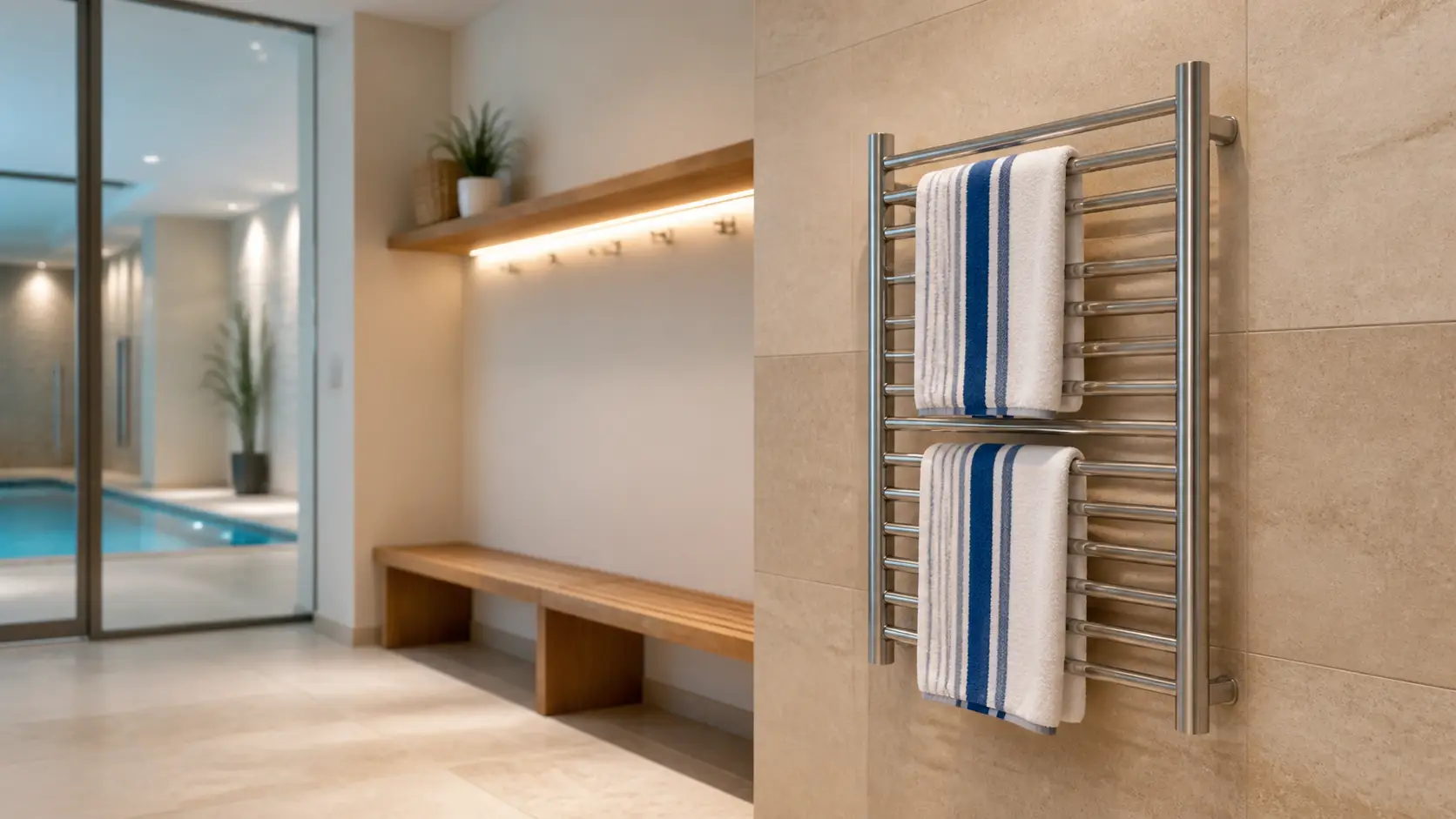
I have stood in enough hotel bathrooms holding a lukewarm towel to know this: most towel rails are bad at their one job. The top bar scalds your hand. The bottom two bars might as well be room temperature. You hang a damp bath sheet on the lower rung and come back two hours later to find it still wet.
PTC heating fixes this. It is not a buzzword. It is a different physics entirely, and after watching manufacturers shift their entire product lines to it over the past three years, I am convinced it will be the default technology for electric towel rails within the next five.
Here is why.
What PTC actually means
PTC stands for Positive Temperature Coefficient. The heating element is made from ceramic stones — mostly barium titanate — that conduct electricity well when cold and poorly when hot.
This creates a built-in speed limit. When the rail is cold, the element pulls full power and heats up fast. Once it hits its target temperature, resistance rises sharply and the power draw drops. It does not need a thermostat to stop itself overheating. The material does that on its own.
Old-fashioned wire elements do the opposite. They keep drawing the same wattage no matter how hot they get. Left alone, they would just keep getting hotter. That is why basic electric rails need thermostats, thermal cut-offs, and sometimes multiple safety switches layered on top.
PTC strips most of that out.
The three technologies compared
Most towel rails sold today fall into one of three camps: wet central heating, dry wire elements, or PTC ceramic.
Wet central heating
These are the traditional plumbed rails tied to your boiler circuit. Hot water runs through the frame, and the rail temperature follows whatever your heating is set to.
The running cost is low if you already heat the house all day. But in summer, when the boiler is off, the rail is useless unless you paid extra for dual-fuel electric backup. Warm-up is slow too — ten to twenty minutes — because water takes time to move heat around.
Dry wire elements
Standard electric rails use a heating wire embedded in the frame or hidden inside a dry thermal mass. They are cheap to make and easy to install.
The catch is uneven heat and clunky energy control. A 150W wire element burns 150W continuously until a thermostat shuts it off. That on-off cycling wastes energy during the overshoot phase, creates temperature swings, and wears out the thermostat relay over time.
PTC ceramic elements
PTC rails use ceramic heating plates, usually mounted inside the horizontal bars. Each plate self-regulates independently.
Because heat is generated at multiple points across the rail, the bars warm evenly. There is no scalding inlet bar and a lukewarm far end. Power consumption automatically tapers off once the rail is up to temperature, typically settling at 30–60% of the rated wattage.
At a glance: heating technology comparison
| Feature | Wet central heating | Dry wire element | PTC ceramic |
|---|---|---|---|
| Heat-up time | 10–20 min | 5–15 min | 3–8 min |
| Energy control | None (follows boiler) | On/off thermostat | Self-regulating |
| Summer use | No (unless dual-fuel) | Yes | Yes |
| Even heat distribution | Moderate | Poor to moderate | Good |
| Typical lifespan | 15+ years | 5–10 years | 10–15 years |
| Unit cost | Mid to high | Low to mid | Mid |
Why PTC is winning
Lower running costs — no smart thermostat required
A 100W PTC rail might draw the full 100W for the first five minutes, then settle down to 40–50W for the rest of its cycle. Over an hour, that averages out to roughly 55–65W effective consumption.
A 100W wire-element rail draws closer to 100W the entire time because thermostat cycling is inefficient. For someone running a rail four to six hours a day, the gap adds up.
Here is the math for a typical UK household at 30p per kWh, four hours daily:
- Standard 100W wire element: about £43–48 per year
- 100W PTC rail: about £26–32 per year
That £15 annual saving pays back the slightly higher purchase price within two to three years.
It is genuinely safer
PTC elements cannot overheat in free air. Resistance rises as temperature climbs, so the element naturally plateaus at its designed surface temperature — usually 55–65°C for towel rails.
Wire elements do not have that failsafe. If the thermostat seizes or a thermal fuse fails, temperatures can spike high enough to damage paintwork or create a real fire risk. That is why wire-element rails are packed with redundant safety cut-offs, and why installers handle them carefully.
For hotels, care homes, and rental properties, the inherent safety of PTC is a genuine liability advantage.
Even heat changes everything
I have measured wire-element rails with 15–20°C temperature differences across a single frame. The bar near the heating inlet runs hot. The far bars barely warm up.
PTC rails spread heating plates across multiple bars. On a decent model, every usable bar is within 3–5°C of the others. Towels dry faster and more thoroughly, especially on the lower rungs where people hang heavier bath sheets.
No noise at all
Wet rails gurgle, click, and occasionally need bleeding. Wire-element rails are silent electrically, but the thermostat relay clicks every few minutes as it cycles on and off.
PTC rails have no moving parts, no liquid, and no relay switches. They are completely silent. In a hotel guest bathroom at midnight, that matters.
Intermittent use actually works
This is where PTC shines. A good PTC rail reaches full working temperature in three to five minutes. Wire elements take eight to fifteen. Wet systems take even longer.
If you only want warm towels for an hour in the morning and another hour in the evening, that short heat-up time matters. You are not burning electricity for twenty minutes just to get forty minutes of usable warmth.
What to look for when buying
Not every rail labelled “PTC” is built well. Here is how to tell the good ones from the corner-cutters.
Real plate coverage
Some manufacturers stick a single small PTC element near the bottom and call the whole rail PTC. That misses the point entirely. Look for specs that mention multi-point or distributed PTC heating. Ideally, every horizontal bar should contain its own element.
Honest wattage claims
Because PTC rails throttle down after warm-up, brands quote numbers differently. A “100W PTC” rail might peak at 100W and average 50W, or it might average 100W and peak at 180W. Check whether the spec sheet clarifies peak versus average consumption.
IP rating
Any electric towel rail in a bathroom needs at least IP24. Good PTC rails often achieve IP44 or IP55 because the sealed ceramic plates are easier to protect from moisture than open wire elements.
Bar count and spacing
PTC heating helps most when there are enough bars to actually hang towels. Four or more usable horizontal bars is the minimum for a family bathroom. Centre-to-centre spacing of 150–180 mm works best for folded bath towels.
Timer compatibility
PTC rails pair well with simple run-back timers — press a button, get two hours of heat, then automatic shut-off. Because PTC warms up fast and runs efficiently, you do not need a complex programmable timer to keep costs down.
Misconceptions that keep coming up
“PTC is just a fancy thermostat”
No. A thermostat measures temperature and switches power on or off. PTC is the heating element itself changing its electrical resistance. The regulation happens at the material level, not through an external controller.
“Lower wattage means weaker heating”
Not with PTC. A well-designed 80W PTC rail can outperform a 120W wire-element rail because heat is distributed better and less energy is wasted in overshoot. Wattage is only part of the story.
“PTC is only for premium products”
That was true five years ago. Today, manufacturers in China and Turkey are producing mid-price PTC rails that compete directly with basic wire-element models. The gap is closing fast.
Where the market is heading
The shift is real. Industry estimates put PTC-based electric towel rails at roughly 35% of new UK electric rail sales in 2023, with that figure expected to pass 50% by 2027.
A few reasons:
- Energy prices in Europe have stayed high since 2022, so running cost now actually sways purchase decisions.
- UK and EU building regulations are tightening efficiency requirements for fixed electric heating.
- Hotel chains and developers are specifying PTC for lower maintenance and reduced insurance risk.
- Buyers are asking about it. Showroom staff and online reviews mention PTC far more often than even two years ago.
In Australia, where electric towel rails were always a niche product, PTC models are driving growth because they suit the climate: quick warm-up for winter mornings, low running cost, no dependency on central heating.
The bottom line
PTC heating is not a minor upgrade. It changes how towel rails perform, how much they cost to run, and how safe they are to leave on.
For homeowners, the appeal is lower bills and towels that actually dry. For commercial properties, the safety and maintenance advantages matter just as much. And for manufacturers, switching to PTC is starting to look less like a premium option and more like a baseline expectation.
If you are buying a new electric towel rail in 2026 and plan to keep it for a decade, PTC is one of the few choices that genuinely looks future-proof.
Need PTC heated towel rails for a hotel, development, or retail line? Contact us for technical specs, custom finishes, and OEM pricing.