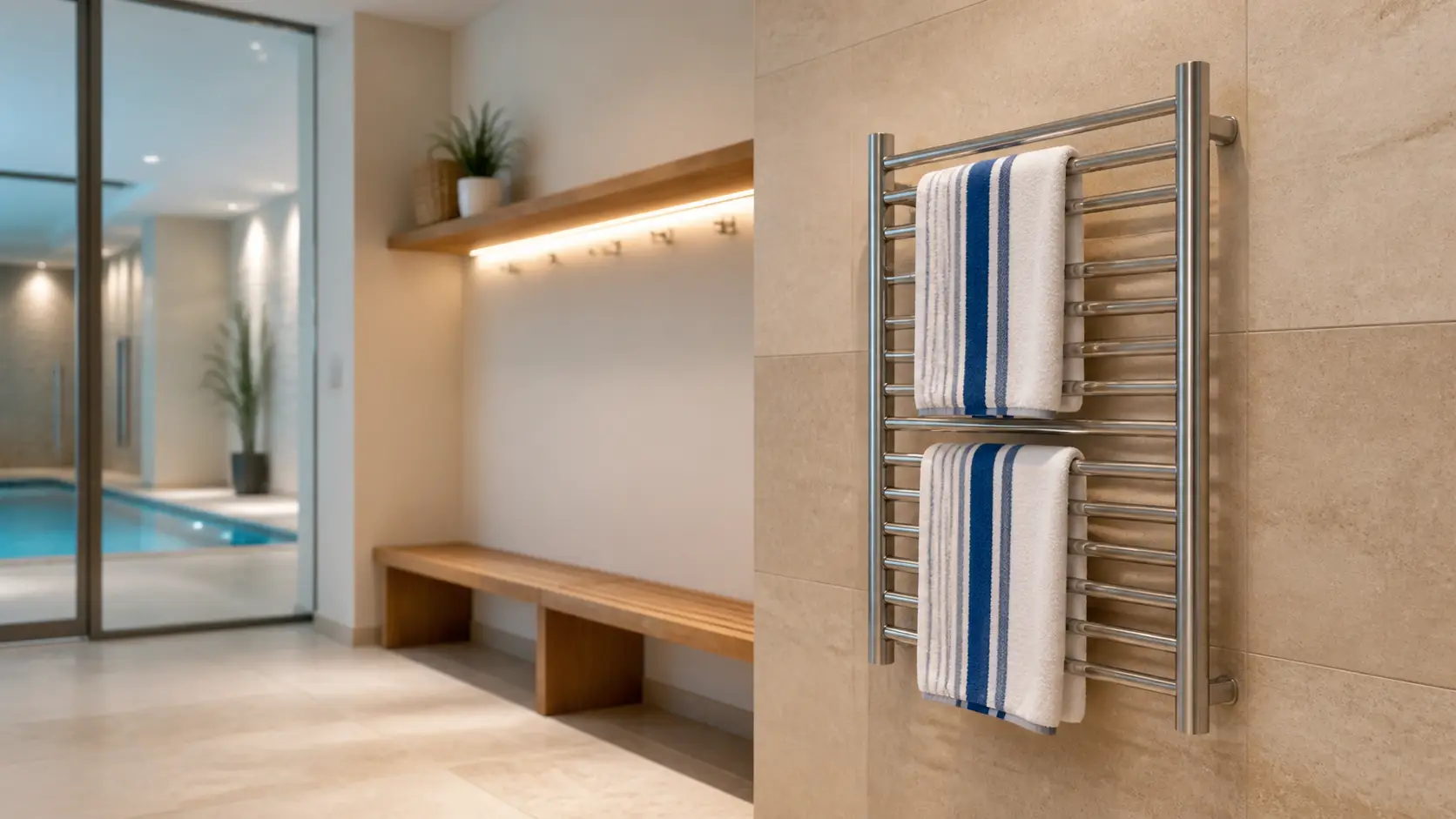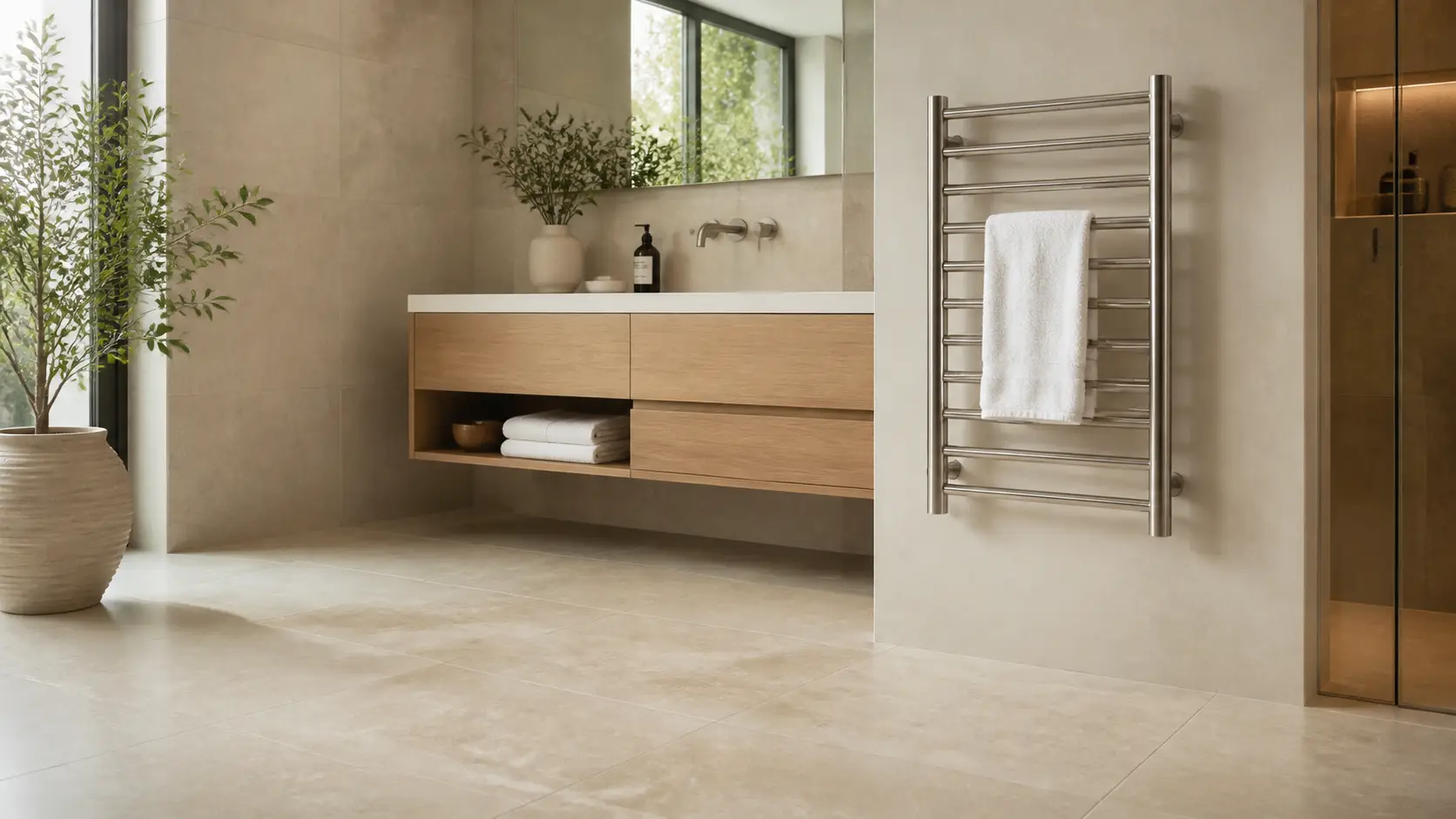
If you are buying a heated towel rail in 2026 and running costs matter to you, the conversation has changed. Three years ago most buyers asked whether the rail looked good and how fast it warmed up. Now the first question in most showrooms is: how much will this add to my electricity bill?
That shift is not subtle. With UK energy prices still sitting around 30p per kWh and similar spikes across Europe and Australia, an inefficient towel rail can easily cost £40–60 a year to run. An efficient one can cut that in half.
After comparing the real-world consumption of wet central, wire-element, and PTC ceramic models, our pick for buyers who care about efficiency is a mid-sized PTC rail with a simple timer. It heats fast, self-regulates, and does not need smart-home gadgets to keep costs down.
Here is the maths.
What “energy efficient” actually means
Efficiency in a towel rail is not about peak wattage. It is about how much of the electricity you pay for actually dries your towels — and how much is wasted as overshoot heat, standby loss, or poor distribution.
An inefficient rail might draw 150W continuously but leave half the frame lukewarm. An efficient one might average 60W and dry a full load evenly. The label on the box rarely tells you that story.
In practice, only three things matter: how the heat is controlled, whether it spreads evenly across the bars, and how long you leave the thing on. Everything else is marketing noise.
The three technologies, ranked by running cost
Most towel rails fall into three categories: wet central heating, dry wire element, or PTC ceramic.
Wet central heating rails
These are plumbed into your boiler circuit. If your central heating is already running flat out all winter, the marginal cost of a wet rail is close to zero. That sounds like the ultimate efficiency win.
The problem is seasonality. In spring and autumn — when you still want dry towels but the heating is off — a wet rail does nothing unless you paid extra for dual-fuel electric backup. Warm-up is slow too. Water has to circulate through the frame, which takes ten to twenty minutes.
So yes, cheap to run in winter. But in summer it is basically a decorative metal frame unless you paid for dual fuel.
Dry wire-element rails
These are the most common electric models. A resistive wire inside the frame draws a fixed wattage — usually 80W to 150W — until a thermostat cuts the power.
Where it wastes power is that clumsy on/off cycling. The element overshoots the target temperature, the thermostat clicks off, the frame cools, then it fires up again. You are paying for heat during those overshoots that you never actually use. And the heat distribution is usually patchy — one bar does all the work while the others loaf.
A typical 100W wire-element rail running four hours a day costs about £43–48 per year at current UK rates.
PTC ceramic rails
PTC rails use ceramic plates that self-regulate. Resistance rises as temperature climbs, so power draw tapers off automatically — usually to 30–60% of the rated wattage once the rail is warm.
A 100W PTC rail might pull the full 100W for the first five minutes, then settle at 40–50W. Over a four-hour cycle the effective average is closer to 55–65W.
That same four-hour daily usage costs roughly £26–32 per year.
At a glance: running cost comparison
| Rail type | Rated wattage | Effective average | Daily cost (4 hrs @ 30p/kWh) | Annual cost |
|---|---|---|---|---|
| Wet central | N/A (boiler) | N/A | ~£0 | ~£0* |
| Wire element | 100W | ~95W | ~£0.11 | ~£43–48 |
| PTC ceramic | 100W | ~55W | ~£0.07 | ~£26–32 |
*Wet central assumes boiler is already running. Summer use requires dual-fuel backup, which adds electric running cost.
Why wattage on the box is misleading
Buyers often assume a lower-wattage rail is automatically cheaper to run. That is only half true.
A poorly designed 80W wire-element rail can cost more to run than a 100W PTC rail because the wire element cycles inefficiently and the heat is concentrated in one spot. You end up running it longer to get the same drying result.
What matters more than the number on the box is the effective average consumption over a full cycle, whether the heat spreads across all the bars, and how fast the thing gets up to temperature. A rail that needs ten minutes just to get warm is burning money while you wait.
If the manufacturer only quotes peak wattage and hides the average, treat that as a red flag.
The timer matters more than you think
Honestly, the heating technology is not even the biggest lever. How long you leave the rail on matters far more.
Most households only need warm towels for two windows: the morning shower and the evening wind-down. That is roughly three to four hours a day. A rail left on 24/7 burns six times as much electricity for almost no extra benefit.
A basic run-back timer — press a button, get two hours of heat, then automatic shut-off — is often enough. Programmable timers are nice, but in our experience buyers set them once and forget them. A simple two-hour button gets used more consistently.
The maths:
– 100W wire element, 24/7: ~£262/year
– 100W wire element, 4 hrs/day: ~£43/year
– 100W PTC, 4 hrs/day with timer: ~£26/year
The timer is the difference between an appliance that feels expensive and one you barely notice on the bill.
What to look for on the spec sheet
If you are comparing models and want to keep running costs low, check these five things:
1. Self-regulating element
PTC ceramic is the only common technology that throttles its own power draw. If the spec mentions “PTC heating plates” or “self-regulating ceramic,” it is almost certainly cheaper to run than an equivalent wire-element model.
2. Peak vs average wattage
Some brands now quote both numbers. Look for average consumption — it tells you what you will actually pay. If only peak wattage is listed, assume it runs close to that number.
3. Bar count and spacing
More usable bars means better air circulation and faster drying. A rail with only two or three bars forces you to overlap towels, which traps moisture and extends drying time. Four or more horizontal bars, spaced 150–180 mm apart, is the sweet spot.
4. Timer compatibility
Check whether the rail has a built-in timer or can accept an external run-back timer. Some budget models force you to hardwire a separate controller. That adds installation cost and complexity.
5. IP rating
A rail in a bathroom needs at least IP24. Higher ratings like IP44 or IP55 mean the element is better sealed against moisture, which reduces corrosion and extends lifespan. A rail that fails after five years because water got inside is not efficient no matter how little electricity it used.
Common misconceptions
“Electric towel rails are too expensive to run”
A rail left on 24/7 absolutely is. A timed, efficient model running a few hours a day costs less than a cup of coffee per week. That assumption ignores the huge range in how people actually use them. A timer changes everything.
“Wet central rails are always the cheapest”
Only if your boiler runs all day anyway. If you turn the heating off in April but still want dry towels, a wet rail with no electric backup is just a decorative metal frame.
“Smart thermostats are essential for efficiency”
They help, but they are not mandatory. A £15 mechanical run-back timer on a PTC rail often delivers lower bills than a £200 smart thermostat on a basic wire-element model. Do not let gadgetry distract you from the physics of the heating element itself.
Why 2026 is different
Energy prices in the UK and EU have stayed higher than pre-2021 levels, and buyers have noticed. Running cost used to be an afterthought. Now it is often the first filter.
Retailers are noticing. Search data shows rising query volume for terms like “low running cost towel rail,” “energy efficient heated towel rack,” and “towel warmer electricity cost.” Manufacturers have responded by pushing PTC lines and clearer wattage labelling.
For commercial buyers — hotels, landlords, developers — the driver is even sharper. Annual energy costs scale directly with unit count. For a fifty-unit hotel, choosing PTC over wire-element rails can shave £800–1,500 off the annual energy bill. That is real money.
The bottom line
Energy efficiency in towel rails is not about buying the lowest-wattage model or installing the smartest thermostat. It is about matching the right heating technology to realistic daily use.
For most buyers in 2026, that means a self-regulating PTC rail with a timer, run for a few hours a day. It delivers warm, dry towels without the bill shock.
If you are specifying rails for a project and want to control lifetime running costs, the specification sheet matters. Ask for average wattage, bar coverage, and timer compatibility — and do not settle for vague marketing claims about “energy saving.”
Need energy-efficient heated towel rails for your next project? Contact us for technical specs, custom sizing, and OEM bulk pricing.