
When you’re specifying heated towel rails for a hotel project or a multi-unit residential development, the material question comes up every time. Your supplier says “stainless is best.” Your competitor just installed aluminum in their boutique property and paid 30% less. Your client is asking about brass because they saw it in a design magazine.
So what actually works? Not what looks good in a render — what performs in a real hotel bathroom after six months of maid service, hard water, and daily use.
This is a material-by-material breakdown built for procurement teams, developers, and project managers who need to make the right call before signing the purchase order.
The Three Materials in Play
Before the comparison, here is what each material actually is in the context of heated towel rails:
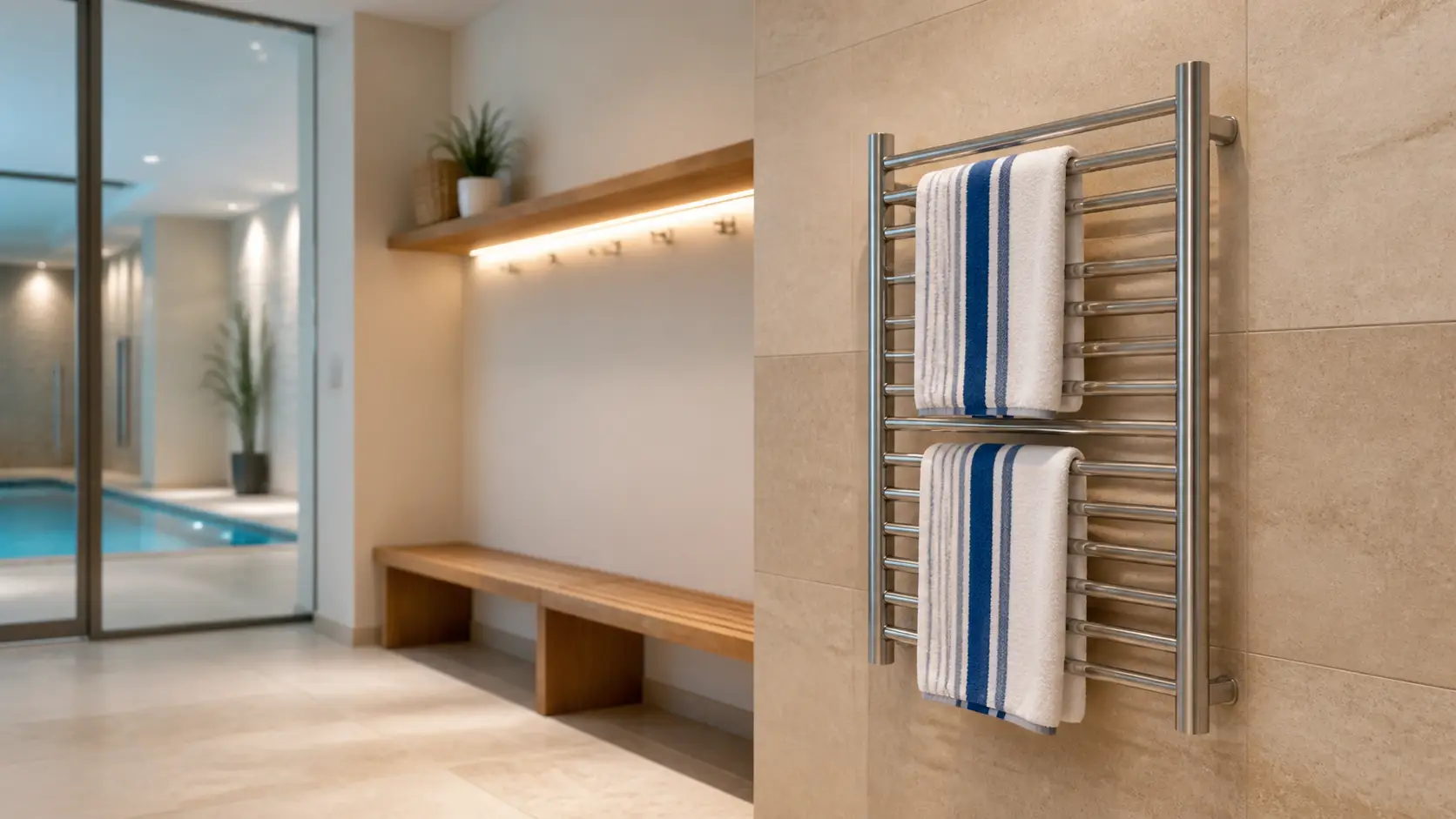
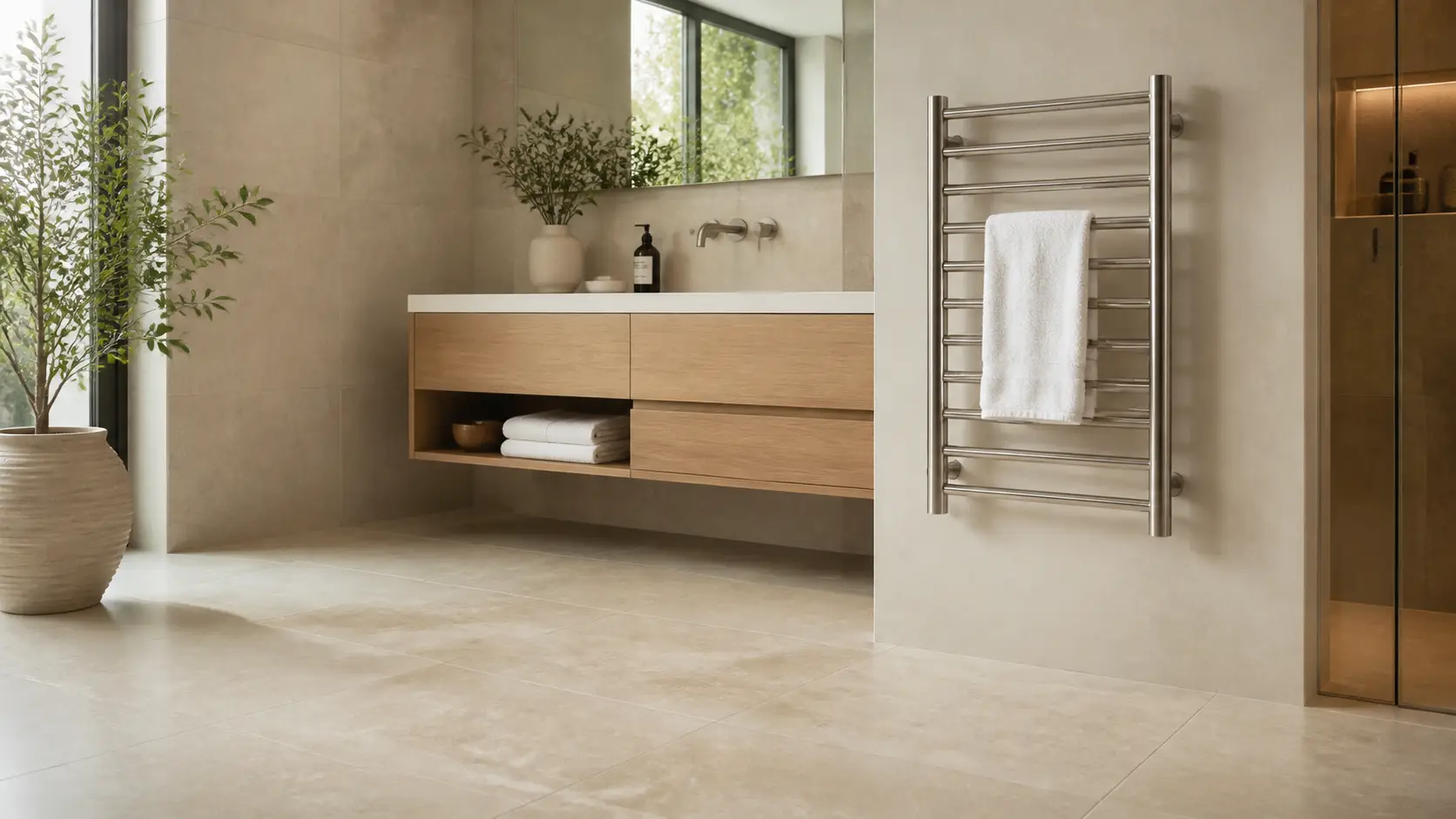
Stainless steel — An iron alloy with at least 10.5% chromium. The chromium creates a passive oxide layer that resists corrosion. Grades vary; 304 stainless is standard for bathroom environments, 316 is marine-grade and used near pools or coastal properties.
Aluminum — A lightweight, naturally corrosion-resistant metal. On heated towel rails, it is almost always finished with powder coating or anodizing, because bare aluminum doesn’t hold a polished finish well in humid conditions.
Brass — An alloy of copper and zinc. Natural brass has inherent antimicrobial properties. Most brass heated towel rails are lacquered to prevent tarnishing, which changes the maintenance picture significantly.
Each material has a different cost structure, weight, thermal performance, and long-term durability profile. The right choice depends on your project type, not a universal “best.”
Stainless Steel Heated Towel Rails
Stainless steel rails are the most common specification in international hotel brands for a reason. They perform.
Thermal performance:
– Excellent heat retention — stainless holds warmth once heated and cools slowly
– Typical wattage for a 5-bar rail: 100–150W
– Surface temperature: 55–70°C (131–158°F) depending on element type
– Works well with all heating elements: dry element, PTC ceramic, water-filled
Durability:
– 304 stainless: 10–15 year lifespan in typical bathroom environments
– 316 stainless: 15–20+ years in coastal/marine areas
– Corrosion-resistant but not corrosion-proof if the passive layer is damaged
– Scratches show but don’t propagate — the material is structurally stable
Maintenance:
– Wipe with a soft cloth and mild cleaner
– Avoid abrasive pads that scratch the passive layer
– In hard water environments, drying after use prevents calcium deposits
– For heavy-use commercial bathrooms, a monthly clean is typical
Cost:
– Mid-range to premium pricing
– 5-bar stainless rail (100W, 304): $35–60 per unit at OEM volumes
– 316 marine grade: 20–30% more than 304
Best for:
– International hotel chains requiring consistent global specifications
– Properties in coastal regions or near swimming pools
– Projects where durability and brand consistency matter more than upfront cost
– Wet rooms and high-humidity bathroom designs
The drawbacks worth knowing:
Stainless steel is heavy. A 5-bar rail weighs 5–8 kg. Shipping costs reflect this. Installation also requires proper wall fixings — a lightweight partition wall needs reinforcement.
Grade matters. Some manufacturers use 201 stainless (cheaper, less corrosion-resistant) and pass it off as standard. Ask for the grade in writing. 304 or 316 only.
Aluminum Heated Towel Rails
Aluminum rails are the cost-conscious choice. The material conducts heat well, so aluminum rails heat up faster than stainless — but also cool down faster once switched off.
Thermal performance:
– Fast heat-up time: 10–20 minutes to reach operating temperature
– Lower thermal mass means towels don’t stay warm as long after the rail switches off
– Typical wattage for a 5-bar rail: 80–120W (lower than stainless equivalent)
– Works with dry element and PTC heating elements
– Less suitable for water-filled systems due to aluminum’s reactivity with certain fluids
Durability:
– Lifespan: 8–12 years in typical bathroom environments
– Powder-coated finish is the critical factor — if the coating chips, exposed aluminum can oxidize
– Anodized aluminum is more durable but costs more
– Not recommended for coastal environments or rooms with high salinity
Maintenance:
– Powder coating is easy to clean but vulnerable to chipping from impact
– Once chipped, the exposed aluminum will oxidize (white corrosion spots) if not touched up promptly
– Avoid acidic or alkaline cleaners — they degrade the powder coating
– Check for chip damage during quarterly maintenance rounds
Cost:
– Most affordable option
– 5-bar aluminum rail with powder coat: $20–40 per unit at OEM volumes
– Anodized finish: $30–50 per unit
Best for:
– Budget-conscious projects where volume is high and specification is flexible
– Residential developments with standard finish requirements
– Properties not in coastal regions
– Projects where the upfront price difference on 200+ units justifies the tradeoff
The drawbacks worth knowing:
Aluminum rails feel different. They are noticeably lighter, which some clients read as “cheap” even when the product performs well. In luxury properties, this perception can be a problem.
The lower thermal mass also means the towel doesn’t stay warm as long after the rail is switched off. For hotel guests who expect a warm towel after a shower, this is a subtle but real difference in experience quality.
Brass Heated Towel Rails
Brass is the premium choice — both in price and in the way it looks. It is the material you see in high-end boutique hotels and luxury residential projects.
Thermal performance:
– Similar heat retention to stainless — holds warmth well once heated
– Typical wattage for a 5-bar rail: 100–150W
– Excellent for liquid-filled (wet) heating systems — brass is the traditional material in European radiator design
– Copper content gives brass natural antimicrobial properties — genuinely useful in commercial bathroom environments
Durability:
– Properly maintained brass lasts 15–25 years
– The lacquered finish is the durability wildcard — most brass rails are lacquered to prevent tarnishing
– If the lacquer fails (typically 8–15 years), the brass will tarnish naturally — some clients love this patina, others don’t
– Brass is more malleable than stainless — less brittle, more forgiving in transport
Maintenance:
– Lacquered brass: clean with mild soap and water only — no polishes or solvents
– Unlacquered (raw) brass: periodic polishing restores the shine, but some tarnishing is expected
– In commercial settings, lacquered brass is almost always specified because maintenance staff cannot be trained on proper polishing technique
– The copper antimicrobial effect only works on unlacquered exposed brass
Cost:
– Premium tier pricing
– 5-bar lacquered brass rail: $60–120 per unit at OEM volumes
– Unlacquered brass: similar price, higher maintenance cost over time
– Typically 50–80% more expensive than stainless
Best for:
– Luxury boutique hotels and high-end residential projects where design premium justifies cost
– Projects in the UK and Europe where brass is culturally associated with quality plumbing
– Boutique hospitality brands where the visual statement of brass aligns with the property’s design language
– Historical or heritage property renovations where period-appropriate materials are required
The drawbacks worth knowing:
On a 200-unit project, the difference between stainless and brass is substantial. Before committing, make sure the cost premium is genuinely justified by the project brief.
Lacquer durability is also unpredictable. In commercial environments with daily cleaning, lacquer failure is not a matter of if but when. When it fails, the aesthetic shifts — and in a branded property, inconsistent aesthetics are a problem.
Direct Comparison
| Factor | Stainless Steel (304) | Aluminum | Brass (Lacquered) |
|---|---|---|---|
| Heat retention | Excellent | Fair | Excellent |
| Heat-up speed | Moderate | Fast | Moderate |
| Lifespan (commercial) | 10–15 years | 8–12 years | 15–25 years |
| Corrosion resistance | Very high | Moderate | High |
| Weight | Heavy (5–8 kg) | Light (2–3 kg) | Medium (4–6 kg) |
| OEM cost per unit | $35–60 | $20–40 | $60–120 |
| Maintenance needs | Low | Low–Moderate | Moderate |
| Coastal/marine suitable | Yes (316) | No | Conditionally |
| Design perception | Professional | Budget-friendly | Luxury |
| Typical market | International hotel chains | Budget/residential | Boutique/luxury |
How Hotel Brands and Developers Actually Choose
Large international chain hotel (200+ rooms):
Most major brands default to stainless steel (304, sometimes 316 for pools or coastal locations). The combination of durability, global specification consistency, and reasonable cost wins. Brands like Marriott, Hilton, and IHG typically specify 304 stainless for core properties.
Boutique hotel or design-led property:
Brass is common here — the premium aesthetic justifies the cost in a property where the design story is part of the marketing. A 40-room boutique hotel spending $80 per brass rail versus $45 per stainless on 120 units = $4,200 difference. In the context of total build cost, this is rounding error.
Budget or select-service hotel:
Aluminum or budget stainless. The primary constraint is first cost. A select-service property in a non-coastal market can spec aluminum and perform adequately for its price point.
Coastal resort or marine environment:
316 stainless or marine-grade brass only. Aluminum is not suitable in high-salinity environments. This is not a cost optimization question — it is a durability question.
Multi-unit residential development:
Stainless or aluminum depending on HOA budget. In high-end developments, stainless is standard. In value-engineered projects, aluminum with a quality powder coat is a defensible choice.
The Certification Variable
Material choice affects which certifications your product can carry — it is not purely a performance decision.
For North American UL/ETL listing:
– Stainless steel heating elements have the broadest testing infrastructure
– Aluminum products with PTC elements can obtain UL listing but the testing pool is smaller
– Brass water-filled systems have specific requirements for fluid and pressure ratings
For European CE and EN442:
– Heat output declarations (watts output) must match the actual product
– Material affects thermal performance data — changing from stainless to aluminum in the same shell geometry changes the wattage
– Re-verify thermal testing when changing material, even if the external dimensions are identical
If your certifications were obtained on a stainless product and you switch to aluminum without re-testing, the certifications may not cover the new product. This is a compliance problem, not just a technical one.
What Procurement Teams Should Ask Suppliers
Before issuing a purchase order, get clear answers on these points:
- What grade of stainless? (304 or 316 — get it in writing)
- What is the powder coat specification for aluminum? (Epoxy, polyester, or hybrid — affects durability)
- Is the brass lacquered or unlacquered? (And what is the lacquer warranty?)
- Can you provide thermal output test reports for my exact specification?
- What is the IP rating? (IP44 minimum for most markets)
- Do you have third-party test reports for my target market? (UL/ETL for US, CE for Europe)
- What is the warranty, and does it cover the finish?
A supplier who can’t answer these questions clearly is not a supplier you want managing your project timeline.
The Bottom Line
No single material is “best” for every heated towel rail project. The right choice depends on your project type, budget position, and market.
- Stainless steel (304/316) is the workhorse of commercial heated towel rails — durable, widely certified, and the standard choice for international hotel brands.
- Aluminum is the value option — fine for budget projects in non-corrosive environments, with tradeoffs in heat retention and perceived quality.
- Brass is the premium design choice — expensive but distinctive, appropriate for boutique and luxury properties where the aesthetic justifies the cost.
Before committing to a material, match it to your project brief. If your brief says “international five-star hotel,” stainless. If it says “boutique design hotel,” brass. If it says “affordable comfort,” aluminum.
A bad match between material and project brief costs money either in callbacks, replacements, or client dissatisfaction.
Planning a hotel project or multi-unit development?
We supply heated towel rails to hotel brands, developers, and procurement companies worldwide. Tell us about your project specifications and we’ll provide a tailored recommendation — not just a price list. Contact our project team →