The material question comes up in almost every commercial specification conversation. A buyer in Tennessee will ask about it the same way a hotel procurement manager in Arizona will. The short answer most people give is “stainless steel is better,” and that’s mostly right — but “mostly right” isn’t good enough when you’re specifying 200 units for a property development and the difference between the two materials plays out over a 10-year maintenance cycle.
The real answer depends on the project type, the usage model, the maintenance environment, and the owner’s appetite for replacement vs. upfront cost. Here’s how commercial buyers should think about the choice.
The Two Materials in Practice
Before getting into the comparison, it helps to understand what each material actually does in a heated towel rack context.
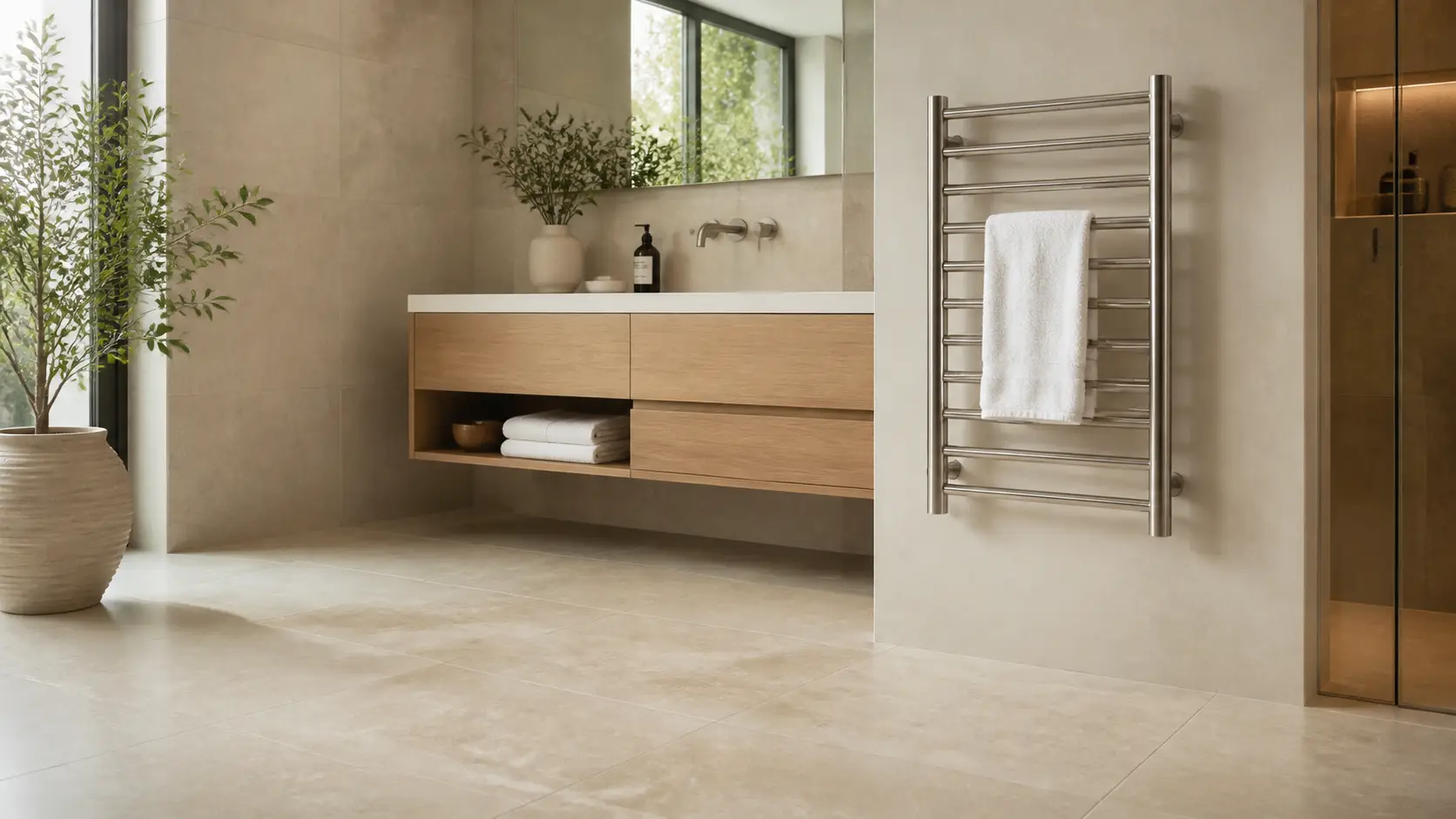
304 stainless steel is an austenitic chromium-nickel alloy. It’s what most commercial-grade heated towel rack manufacturers use for their premium lines. The material is non-magnetic, highly corrosion-resistant, and holds up well to the combination of heat, moisture, and cleaning chemicals typical of bathroom environments.
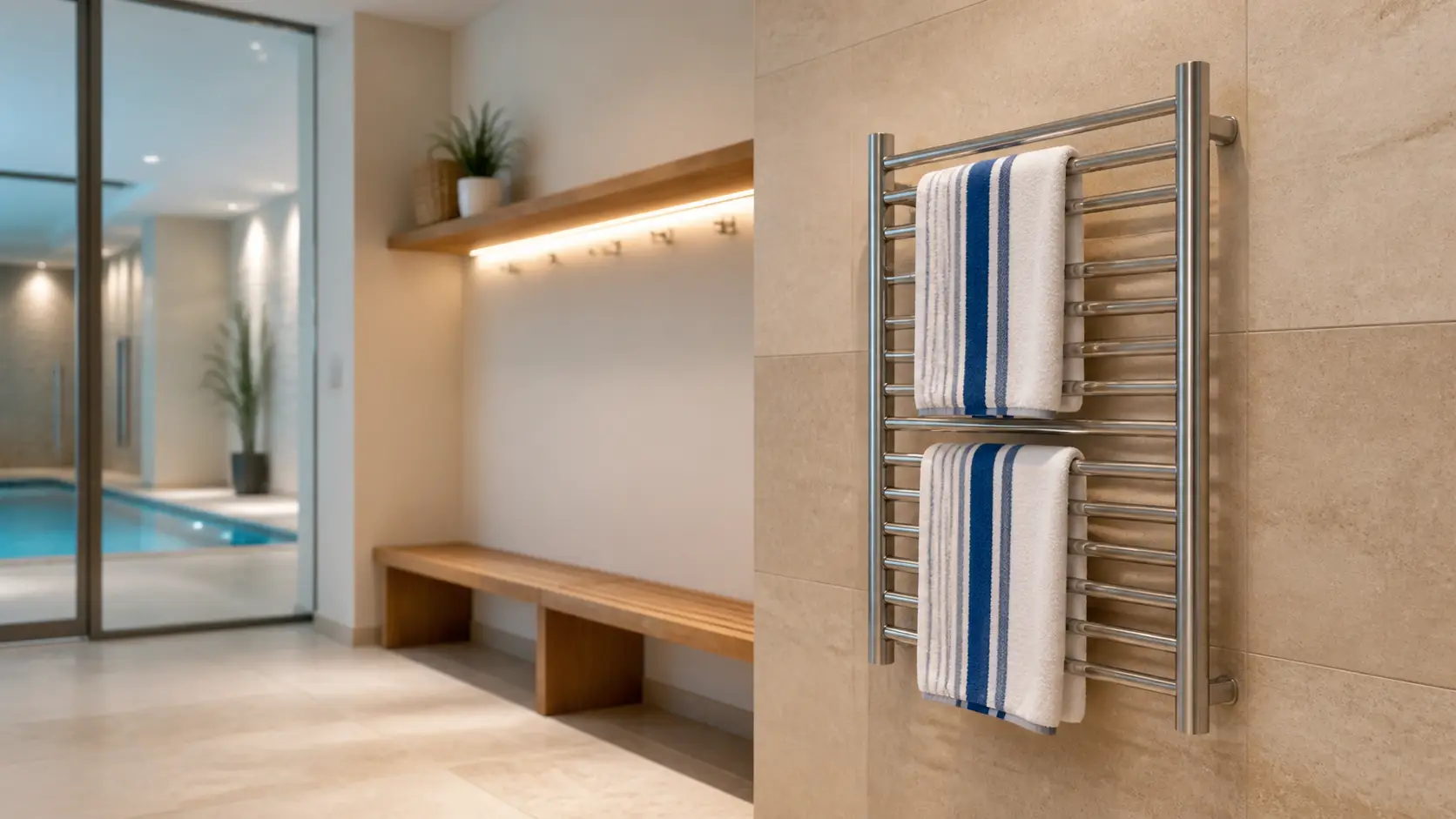
Aluminum is a lighter, softer metal with good thermal conductivity — it heats up faster than steel because it takes less energy to change temperature. But aluminum’s corrosion resistance is conditional. In pure water it forms a protective oxide layer. In environments with high chloride content — poolside bathrooms, coastal hotels, spas with salt-based cleaning protocols — aluminum can corrode faster than stainless steel.
That’s the core material difference, and it matters more in some project contexts than others.
Durability: Where Stainless Steel Pulls Ahead
The BuyItForLife community consistently rates 304 stainless steel heated towel racks as the better long-term choice. The typical reported lifespan in commercial settings is 5 to 10 years before any significant degradation in appearance or function.
Aluminum models don’t fail as quickly as some people fear, but the failure pattern is different. Aluminum doesn’t rust in the conventional sense — it corrodes, and the corrosion is often cosmetic at first (pitting, discoloration) before it becomes structural. In a commercial bathroom with high humidity and regular cleaning, an aluminum heated towel rack might start showing signs of surface degradation within 2 to 3 years. By year 5, the appearance may be noticeably compromised even if the rack still functions.
For a property developer or hotel operator planning a 10-year asset life, that difference matters. Replacing 200 units at year 5 because the aluminum racks have degraded is a significant maintenance cost that should be factored into the original specification decision.
The 304 Stainless Steel Surface Options
Not all 304 stainless steel finishes are equal. The two most common for heated towel racks are:
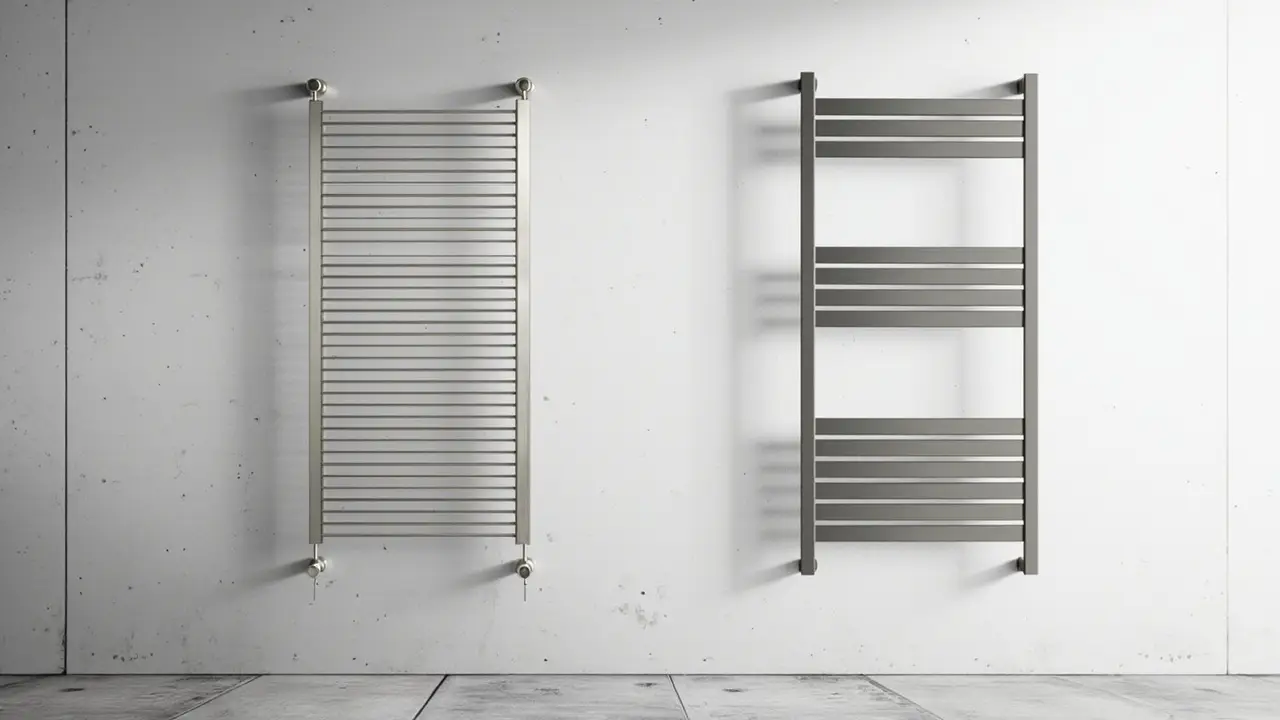
Polished stainless steel has a reflective, mirror-like surface. It looks premium and cleans up well, but it shows every fingerprint, water spot, and cleaning residue. In a high-traffic commercial bathroom, polished stainless steel requires more frequent cleaning to maintain its appearance.
Brushed stainless steel has a directional grain pattern that hides minor scratches and water spots better than polished. It’s the more practical choice for commercial bathrooms where cleaning staff are working with abrasive cleaning agents. The appearance holds up better over time with less frequent attention.
Most commercial-grade heated towel racks from quality manufacturers are available in both finishes. When specifying for a commercial project, brushed is typically the more practical choice.
Heating Performance: Where Aluminum Has an Edge
Aluminum’s thermal conductivity advantage is real. Aluminum heated towel racks reach operating temperature faster than stainless steel models of equivalent wattage — typically 10 to 20 minutes faster, depending on the design and wall thickness.
For a hotel guest who expects a warm towel on demand, that difference might matter. If the rack is on a timer cycle and the guest arrives between heating cycles, aluminum gets up to temperature faster and delivers a warm towel sooner.
But once both materials reach operating temperature, the towel warming performance is comparable. The difference is ramp-up time, not steady-state output. And most commercial heated towel rack installations use timer controls that cycle the heating elements on and off over a schedule — the ramp-up advantage of aluminum becomes less relevant when the unit is already running on a programmed schedule.
For a residential user who turns the rack on manually and expects quick results, aluminum wins on speed. For a commercial installation with programmed timer schedules, the speed advantage is marginal.
Corrosion Resistance: The Coastal and Poolside Problem
This is where the material choice becomes project-specific in ways that surprise buyers who haven’t specified bathroom fixtures for coastal or high-chloride environments.
304 stainless steel performs well in most bathroom environments, including coastal settings. However, in highly saline environments — oceanfront hotels, indoor pools with salt water, spas with high salt content in the air — even 304 stainless steel can experience “pitting” corrosion if the chloride concentration is high enough and the surface isn’t cleaned regularly.
316 stainless steel is the upgrade path for high-chloride environments. The addition of molybdenum improves corrosion resistance significantly, particularly against chlorides. For coastal hotel projects, indoor pool facilities, or any bathroom with high ambient salt or chloride exposure, specifying 316 stainless steel is the right call.
Most manufacturers offer both 304 and 316 options. The price difference is typically 15 to 25 percent. For a project in a coastal location, that’s money well spent.
Aluminum in high-chloride environments is the combination to avoid. Aluminum corrodes more aggressively in chloride-rich conditions than stainless steel does. A coastal hotel that specifies aluminum heated towel racks because the upfront cost was lower will likely be replacing those units within 3 to 4 years.
Weight and Installation Considerations
Stainless steel is denser than aluminum — roughly 2.5x as heavy for an equivalent volume. A stainless steel heated towel rack of a given size weighs more than an aluminum equivalent.
For wall-mounted installations in residential and light commercial contexts, this weight difference rarely creates a problem. Standard wall studs or appropriate anchors will support either material.
For ceiling-mounted or unusual installations, the weight difference may matter. And for projects where shipping weight affects freight cost — importing from China, for example — the difference between a container of stainless steel units vs. aluminum units is measurable. Aluminum is lighter to ship, which means lower freight costs per unit. For large orders, this factors into the total cost of ownership calculation.
The Cost Comparison: Initial vs. Lifetime
Here’s where commercial buyers often make the wrong call. Aluminum is typically 20 to 40 percent less expensive than equivalent stainless steel models at initial purchase. For a 200-unit order, that difference is significant.
But the initial cost comparison is only useful if the owner never has to replace the units. In a commercial setting with a 10-year asset life, the cost of replacing 200 aluminum racks at year 4 or 5 — including removal, disposal, new product cost, and reinstallation — typically exceeds the upfront savings by a wide margin.
For a hotel operator with a 15-property portfolio, this calculation is straightforward. For a property developer selling a building to a new owner, the calculus changes — the developer captures the upfront savings, the new owner inherits the replacement cost. In that scenario, specifying aluminum might make sense for the developer’s financial model. For the owner’s long-term interest, stainless steel is the better choice.
How Commercial Buyers Should Specify
A practical framework for making the material call:
Specify 304 stainless steel (brushed finish) when:
– The project is mid-market to upscale hotel, apartment complex, or office building
– The location is inland, away from coastal or high-chloride environments
– The owner plans to hold the asset for 10+ years
– Maintenance staff will clean the racks regularly with standard bathroom cleaning agents
Specify 316 stainless steel when:
– The project is in a coastal location
– The building has an indoor pool, spa, or salt-based water treatment system
– The specification calls for high-end finishes in a boutique or luxury property
Consider aluminum when:
– The project is budget-constrained and the owner accepts a shorter expected lifespan
– The installation is in a lower-traffic setting where aesthetic degradation won’t be noticed
– The order is for a short-term lease or temporary installation where replacement timing is already planned
Wrapping Up
Stainless steel beats aluminum for most commercial use cases. The durability advantage is real, the corrosion resistance is better, and the total cost of ownership over a 10-year horizon typically favors stainless steel even though the upfront cost is higher.
The exceptions — coastal environments, high-chloride settings, budget-constrained projects with shorter planning horizons — are real. But they’re exceptions. When in doubt, stainless steel is the safer specification.
And if you’re specifying for a project in a coastal or pool-adjacent location and you haven’t considered 316 stainless steel, that’s worth a second conversation with your manufacturer. The price premium is modest relative to the liability of specifying the wrong material.
Need help deciding between stainless steel and aluminum for your commercial project? Contact us to discuss your specifications.