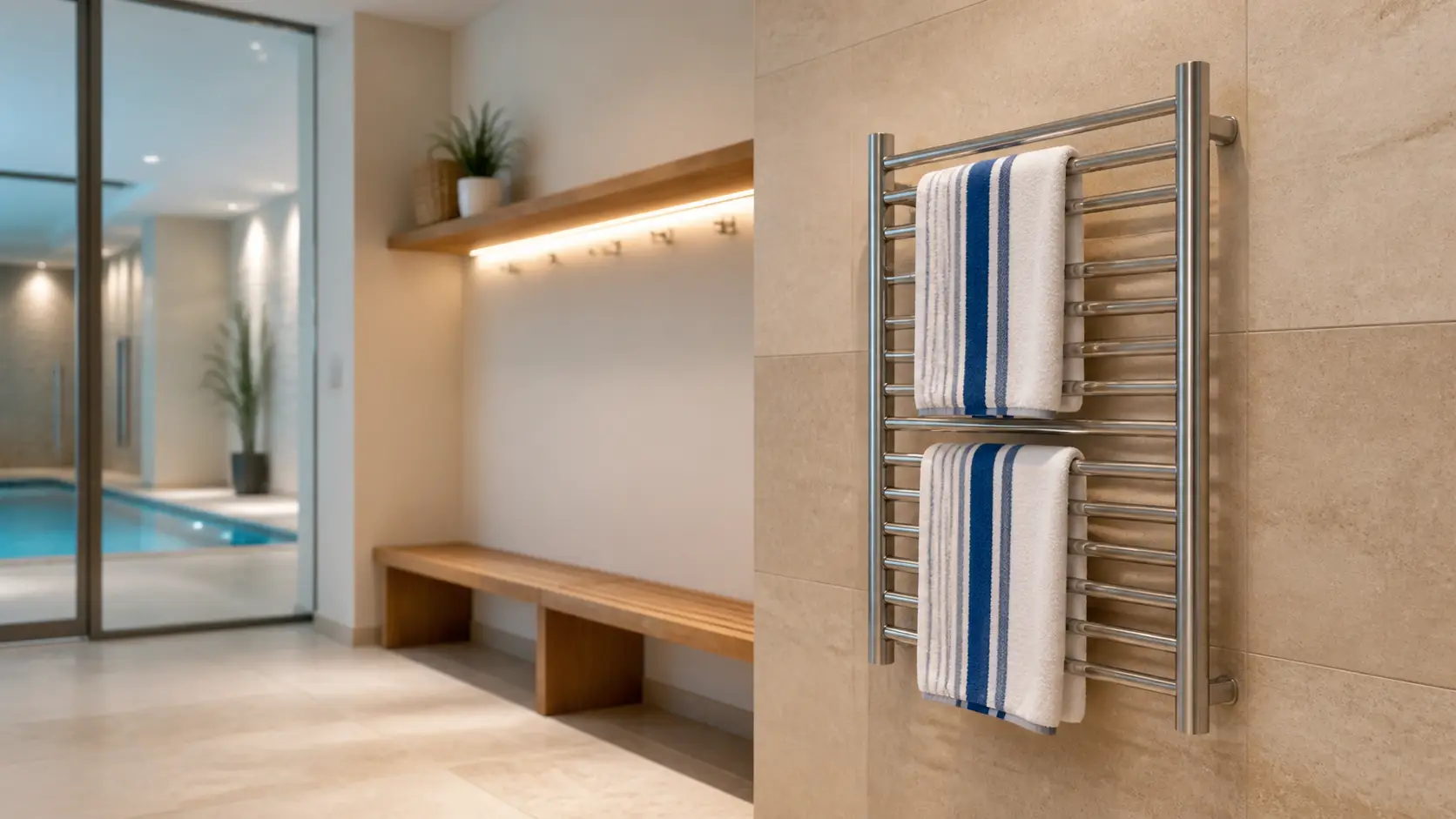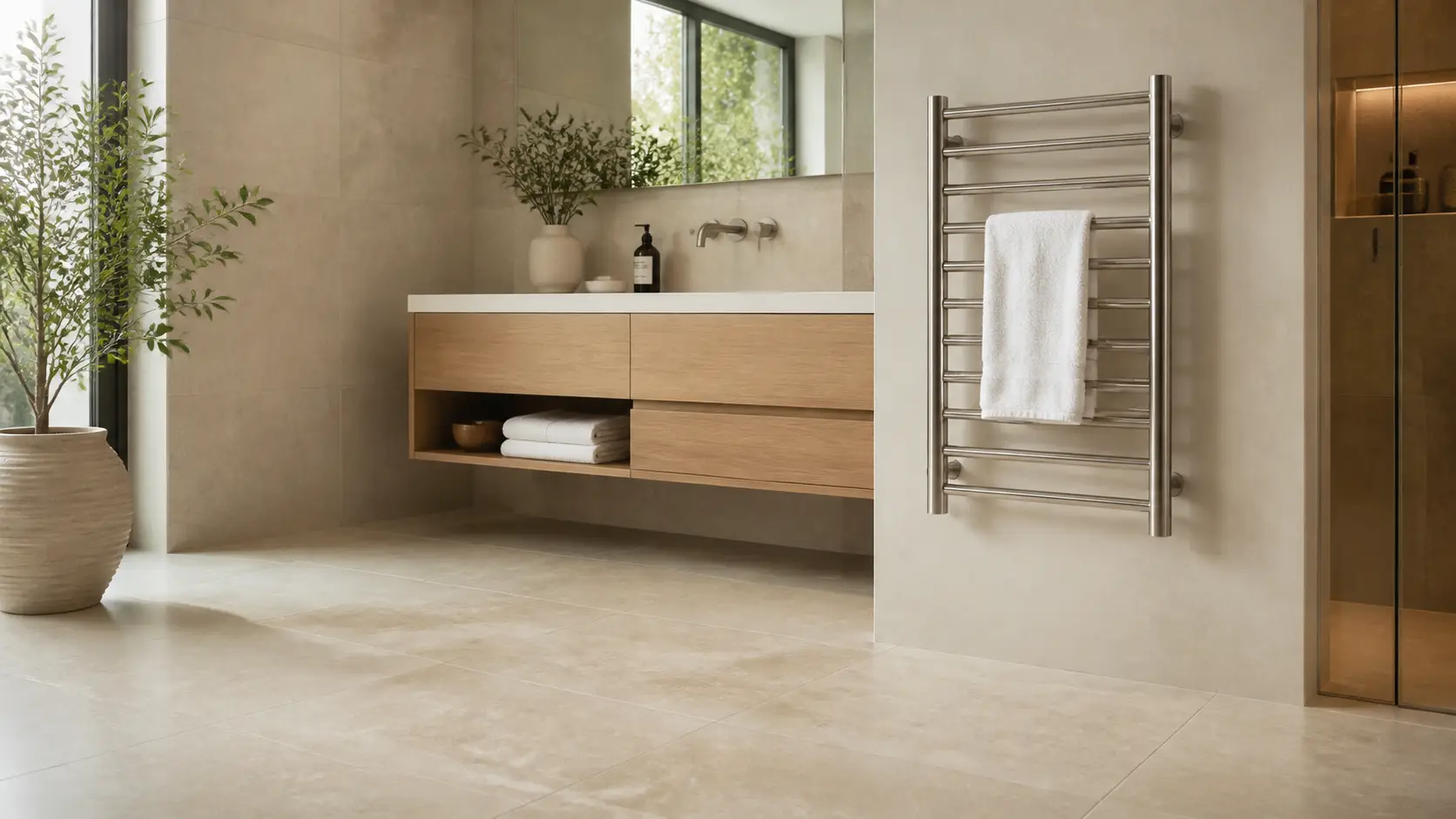
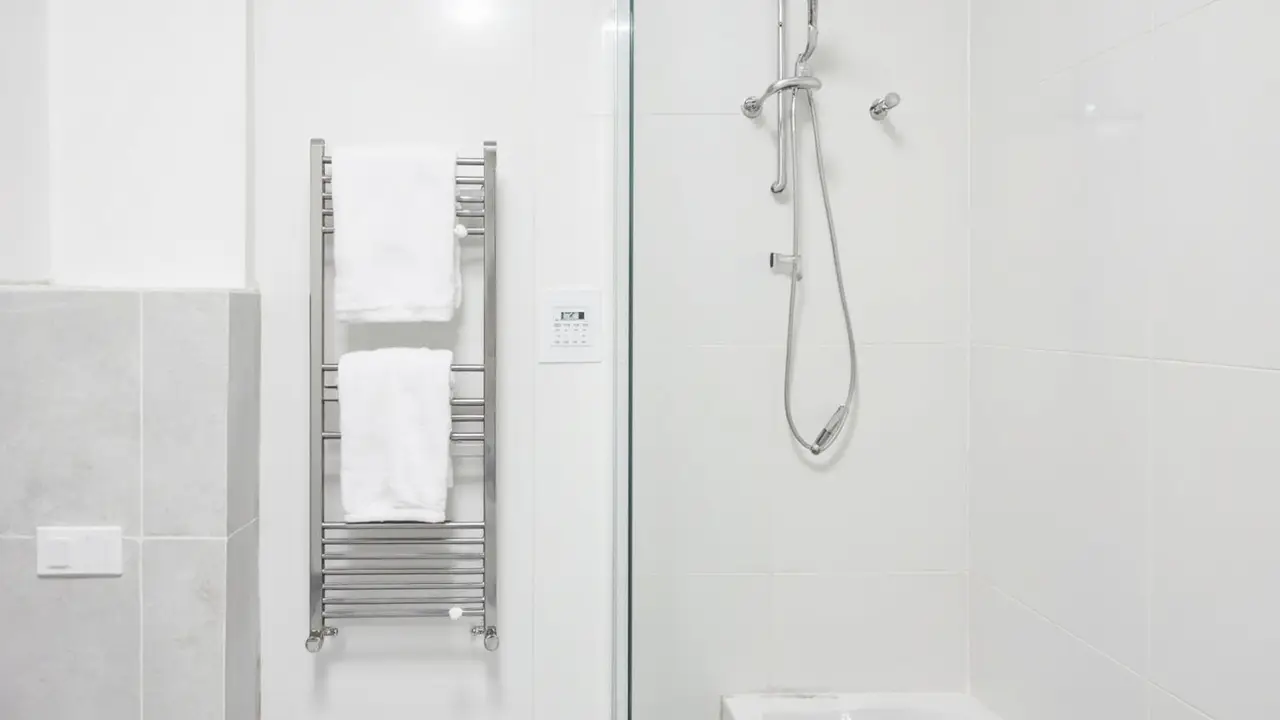
The question comes up in almost every commercial specification conversation: can I just leave the heated towel rack running all day, every day?
The short answer is yes, technically most electric heated towel racks can run continuously. The longer answer is that doing so in a commercial building is almost never the right call — and the reasons go beyond energy costs.
This article breaks down what 24/7 operation actually means in practice, what it costs, what the safety implications are, and what smarter control strategies look like for hotels, gyms, and other commercial properties.
What 24/7 operation actually means
Running a heated towel rack 24/7 does not mean the rack is at full heating output around the clock. Most electric heated towel racks operate on a thermostat cycle: they heat to a set temperature, shut off, cool slightly, and then reheat. This cycling happens continuously whether you are there or not.
A typical 100-watt heated towel rack running continuously draws about 2.4 kWh per day. At the US commercial electricity average of $0.12 per kWh, that is roughly $0.29 per day per rack. Multiply that by 100 rooms and you are looking at about $10,500 per year in electricity alone. For a larger property with 300 rooms, the figure approaches $31,000 annually.
Those numbers are not catastrophic in isolation, but they are also entirely avoidable with a basic timer.
The energy cost reality
Here is a comparison based on a 100W electric heated towel rack running continuously vs. a 12-hour timer schedule in a 100-room hotel.
| Scenario | Daily runtime | Daily kWh | Annual cost (@ $0.12/kWh) |
|---|---|---|---|
| 24/7 continuous | 24 hours | 240 kWh | $10,500 |
| 12-hour timer (occupied hours) | 12 hours | 120 kWh | $5,250 |
| Occupancy-sensor controlled | ~6-8 hours | 60-80 kWh | $2,600 – $3,500 |
| Manual on/off by staff | ~4 hours peak | 40 kWh | $1,750 |
The math tells you something obvious: running these units when guests are not using the bathrooms is pure waste.
Safety considerations
Energy cost is the financial argument. Safety is the operational one.
Overheating risk
Modern heated towel racks have thermal fuses and overheat protection built into the heating element. These safety devices are designed to cut power if the unit exceeds a safe temperature threshold. They work. But they are not invincible.
In a commercial bathroom with poor ventilation — think small en-suite rooms in an older building — the ambient temperature can stay elevated for long periods. If the thermal fuse is old or the thermostat fails in the closed position, the unit can run hotter than intended. This is not a hypothetical: UL and ETL certification reports for heated towel racks both document thermal cutoff failure as a known failure mode in poorly maintained older units.
Cord and plug wear
In plug-in commercial installations, a cord that is permanently live 24/7 is under constant electrical and thermal stress. The prongs oxidize, the insulation degrades, and the connection at the outlet loosens slightly over time. Loose plug connections generate heat — and heat generates fire risk.
In hardwired commercial installations this is less of a concern, but the principle holds: any device running continuously without rest has a shorter lifespan than one that cycles.
Guest safety and liability
A heated towel rack at full operating temperature can reach 55-65 degrees Celsius (131-149F). That is hot enough to cause a burn, particularly on sensitive skin. In a hospitality environment where you have no control over who touches the rack — elderly guests, children, anyone with reduced skin sensitivity — leaving the unit running at full heat when housekeeping is not present is a liability exposure.
What smart control looks like
Most commercial heated towel rack installations in 2026 should be controlled by one of three methods.
Hardwired timer
A 7-day programmable timer wired into the circuit is the most cost-effective baseline solution. Set it to activate 2-3 hours before the first expected check-in and shut off 1-2 hours after the last expected checkout. For most hotel properties that means roughly 14-16 hours of runtime per day instead of 24.
The hardware cost: $30-$80 per unit. The installation cost: $100-$200 per unit through an electrician. Payback period on a 100-room property: under 6 months.
Occupancy sensor
For higher-end properties, occupancy sensors add a layer of intelligence. The rack activates when someone enters the bathroom and shuts off after a set period of vacancy. This approach naturally matches runtime to actual usage and eliminates the question of 24/7 operation entirely.
Occupancy sensors work particularly well in all-suite properties, extended-stay hotels, and vacation rentals where check-in times are unpredictable.
Building management system integration
For larger portfolios or new construction, integration with the property management system or BMS allows centralized control. Facility managers can adjust rack schedules across all rooms from a single dashboard, receive alerts when a unit runs continuously for an unusually long period, and generate energy reports by floor or wing.
This level of control is standard in new-build select-service and upscale hotels and is increasingly included in renovation specs for extended-stay brands updating their building systems.
What about 24/7 in specific commercial settings?
The calculus shifts somewhat depending on the type of property.
Hotels — The case against 24/7 is strongest here. Guests check out, rooms sit vacant for hours, and the property has clear off-peak periods. Use timers.
Gyms and health clubs — A 24-hour gym presents a genuine case for extended runtime, but that does not mean 24/7. Set the timer to 20 hours or use an occupancy sensor in smaller studios where bathrooms may be unoccupied for long overnight stretches.
Spas and resorts — High-end resort properties with all-day occupancy may find that a 16-18 hour schedule covers actual use patterns adequately. The goal is to have warm towels available whenever a guest enters the bathroom, not to run the unit at 3am when every guest is asleep.
Student housing and dormitories — Shared bathrooms in dormitories are notoriously hard to optimize. Occupancy sensors make more sense here than timers, since student schedules are unpredictable.
Commercial office buildings — If the heated towel rack is in a private executive bathroom used sporadically, an occupancy sensor is the right call. If it is in a common-area bathroom with regular foot traffic, a simple timer matching business hours is sufficient.
The warranty angle
Most commercial-grade heated towel rack manufacturers specify maximum continuous runtime in their technical documentation. Running a unit 24/7 when the spec sheet says 16 hours may not void the warranty outright, but it will be used against you in any warranty claim related to heating element failure.
If the manufacturer offers a 5-year warranty on the heating element, that warranty assumes the unit is operated within published specifications. Read the fine print.
The bottom line
24/7 operation is technically possible. It is also technically possible to drive your car at full throttle everywhere. Neither is a good idea.
For commercial properties, the energy cost is real, the safety liability is real, and the equipment lifespan argument is real. A simple 7-day timer costs less than two months of the wasted electricity and pays for itself in the first year. Occupancy sensors cost more upfront but are the right solution for high-end properties or irregular-use settings.
Running these units 24/7 because it is easier than programming a timer is not a trade-off — it is just leaving money on the table and adding unnecessary risk.
Need help selecting the right control strategy for your commercial heated towel rack installation? Contact our team for specification sheets, energy comparison data, and OEM pricing for commercial orders.