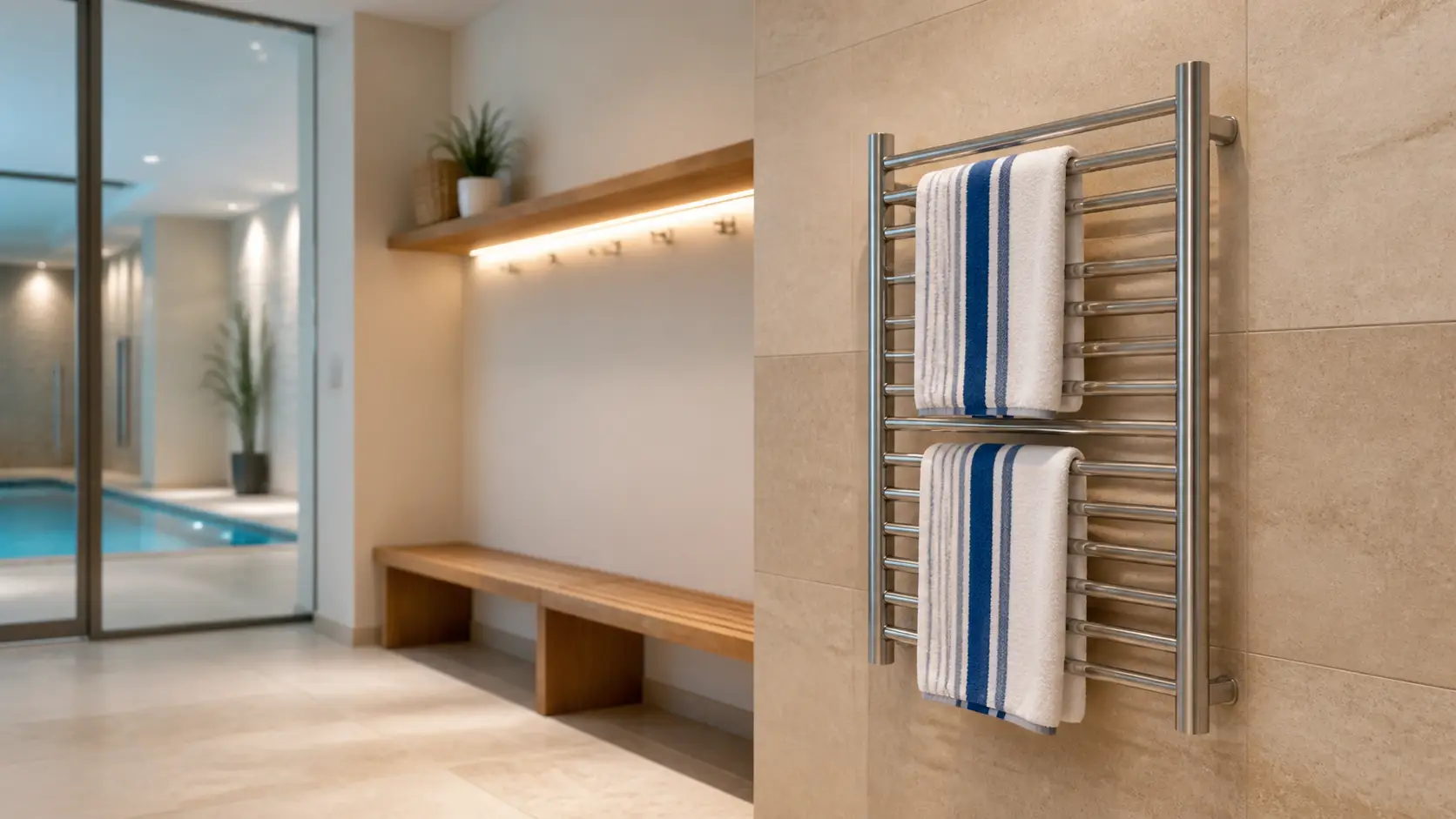

One of the first decisions a hotel project manager or contractor faces when specifying heated towel racks is deceptively simple: should the rack be plug-in or hardwired?
It looks like a purely electrical question. It is not. The answer affects everything from your installation budget and timeline to the guest experience and long-term maintenance costs. Get it wrong and you either create a safety hazard, fail a building inspection, or spend thousands of dollars in unnecessary rewiring.
This guide breaks down what each option actually means, where each one makes sense in a hotel renovation context, and how to decide for your specific project.
What do these terms actually mean?
Plug-in means the heated towel rack comes with a standard power cord and plug, similar to a household appliance. You plug it into an existing 120V or 240V outlet and it works.
Hardwired means the rack is connected directly to the building’s electrical wiring, with no visible cord or plug. The power connection is hidden behind the wall and typically wired through a dedicated switch or timer. This is the standard for permanently installed commercial fixtures.
Comparing the two options
Here is a direct comparison across the factors that matter most in a hotel renovation.
| Factor | Plug-In | Hardwired |
|---|---|---|
| Installation cost | Lower (no electrician, no wall chase) | Higher (electrician required, permits often needed) |
| Installation time | Minutes | Hours to half a day per unit |
| Aesthetics | Cord visible; may affect bathroom design | Clean, cord-free look |
| Code compliance (US) | Generally acceptable for residential; commercial code varies by jurisdiction | Standard practice in US commercial builds |
| GFCI protection | Required; typically built into the plug adapter | Required at the breaker level |
| Future removal | Easy | Requires an electrician |
| Control options | Limited to plug-in timer or smart plug | Full integration with building management system |
| Guest tampering risk | Higher (unplugging, cord damage) | Lower |
When plug-in makes sense
Plug-in heated towel racks are worth considering in specific scenarios:
Limited electrical work allowed — In older properties undergoing renovation, hardwiring may require bringing old wiring up to current commercial code. That is expensive and time-consuming. If the existing circuit can safely handle the load, a plug-in rack may be the practical choice.
Phased renovations — If you are renovating guest room by room without taking the property fully offline, plug-in units minimize downtime. A housekeeper can swap a rack in 10 minutes without scheduling an electrician.
Budget constraints — The all-in cost difference between plug-in and hardwired is real. For a 100-room property, wiring every bathroom hardwired can add $15,000 to $40,000 to the electrical budget depending on the property age and existing infrastructure.
Retrofit in historic buildings — Some landmark or historic properties have restrictions on modifying electrical infrastructure. A plug-in rack may be the only approved option.
Important code note
Even for plug-in use in US commercial properties, the National Electrical Code (NEC) requires GFCI protection for cord-connected heated towel racks in bathrooms. Make sure the outlet you use is GFCI-protected or use a GFCI adapter. This is not optional.
When hardwired is the better choice
For most new hotel construction and full-scope gut renovations, hardwired is the standard for good reasons.
Guest experience — No visible cord means a cleaner, more premium look. In a bathroom where you are trying to create a spa-like impression, a dangling power cord undermines the design.
Safety and liability — A hardwired connection is more secure. Guests cannot unplug the rack, tug on the cord, or damage it. In a commercial setting where liability is a real concern, every point of potential failure matters.
Building inspection — Many US jurisdictions require hardwired connections for heated fixtures in commercial bathrooms. Using plug-in equipment that does not meet local commercial code can cause a job to fail inspection.
Integration with building systems — Hardwired racks can be controlled through a timer, occupancy sensor, or building management system. This is essential for properties running energy management protocols. A plug-in rack on a smart plug is a workaround, not a solution.
Long-term maintenance — Hardwired connections are more durable over years of guest use. Plug-in connections loosen over time, and cords degrade.
The hidden cost of hardwiring
Do not let the upfront cost alone drive your decision. Consider the full picture:
- A properly hardwired rack tied into a programmable timer can reduce energy consumption by 30-40% compared to a rack running continuously.
- Hardwired racks connected to occupancy sensors only heat when the bathroom is in use. For properties with high turnover, this adds up quickly.
- If you ever sell or rebrand the property, hardwired fixtures are considered part of the building; plug-in appliances are not. This affects your asset valuation.
The 2026 US hotel market context
A few current trends are influencing this decision in the market right now:
Energy codes are tightening. ASHRAE 90.1 and California Title 24 are pushing commercial buildings toward smarter, metered energy use. Hardwired racks with timer or occupancy-sensor control are easier to bring into compliance.
Labor costs are high. Finding qualified electricians in many US markets is harder and more expensive than it was five years ago. If you have electrical rough-in already planned in a renovation, locking in hardwired racks now avoids later retrofit costs.
Guest expectations are rising. OTA surveys consistently show bathroom quality is among the top three drivers of guest satisfaction scores in limited-service and extended-stay hotels. Visible cords register as cheap.
How to decide for your project
Work through this checklist:
What does your local jurisdiction require? Call your city or county building department and ask specifically about heated towel rack installation in commercial guest rooms. This is the fastest way to eliminate wrong options.
What is the electrical existing condition? If the property has 1970s or earlier wiring, a full hardwire may require a panel upgrade. Get an electrical assessment before specifying.
What is the renovation scope? A room-by-room refresh with minimal electrical work? Plug-in is defensible. A full gut renovation with open walls? Hardwire it now while you have the chance.
Who is the end user? Extended-stay or limited-service properties where housekeeping sees heavy daily use may tolerate plug-in. For a select-service or upscale property where the brand standard calls for premium fixtures, hardwired is the expectation.
What is your energy management strategy? If the property has a BMS or energy management system, hardwired racks integrate. If not, consider whether adding that infrastructure is worth the cost.
The bottom line
For most US hotel renovation projects, hardwired is the better default choice — cleaner aesthetics, easier code compliance, better energy management, and lower long-term liability. The upfront installation cost is real but manageable, especially when walls are already open.
Plug-in makes sense as a practical workaround for older properties, phased renovations where electrical work is limited, or budget-constrained projects where code allows it.
The worst outcome is choosing plug-in to save money, then failing a building inspection or dealing with guest complaints about dangling cords in a bathroom you spent millions renovating.
Planning a hotel renovation and need help specifying the right heated towel rack configuration? Contact our team for technical specifications, code compliance documentation, and OEM pricing for commercial projects.