When a heated towel rack stops working in a 200-room hotel, it is not a minor inconvenience. Housekeeping gets delayed. Guest complaints stack up. Maintenance teams scramble. For facility managers and procurement officers spec’ing hundreds of units across multiple properties, knowing how to diagnose problems quickly — and understanding what maintenance prevents them — is just as important as choosing the right product in the first place.
This guide covers the most common heated towel rack failures in commercial settings, how to troubleshoot them, and what a solid preventive maintenance program looks like.
Common problems and how to diagnose them
Before calling a technician or replacing a unit, run through this checklist. Most issues fall into four categories.
The rack does not heat at all
This is the most common service call. Work through these causes in order:
Power supply — Check that the circuit breaker has not tripped. In large buildings, a rack on a dedicated 15A or 20A circuit may share with other high-draw items. Reset the breaker and monitor.
Wall switch or timer — Many commercial installations use a timer or occupancy sensor to control power. Verify the switch is in the ON position. If there is a digital timer, check that the programming has not been wiped by a power outage.
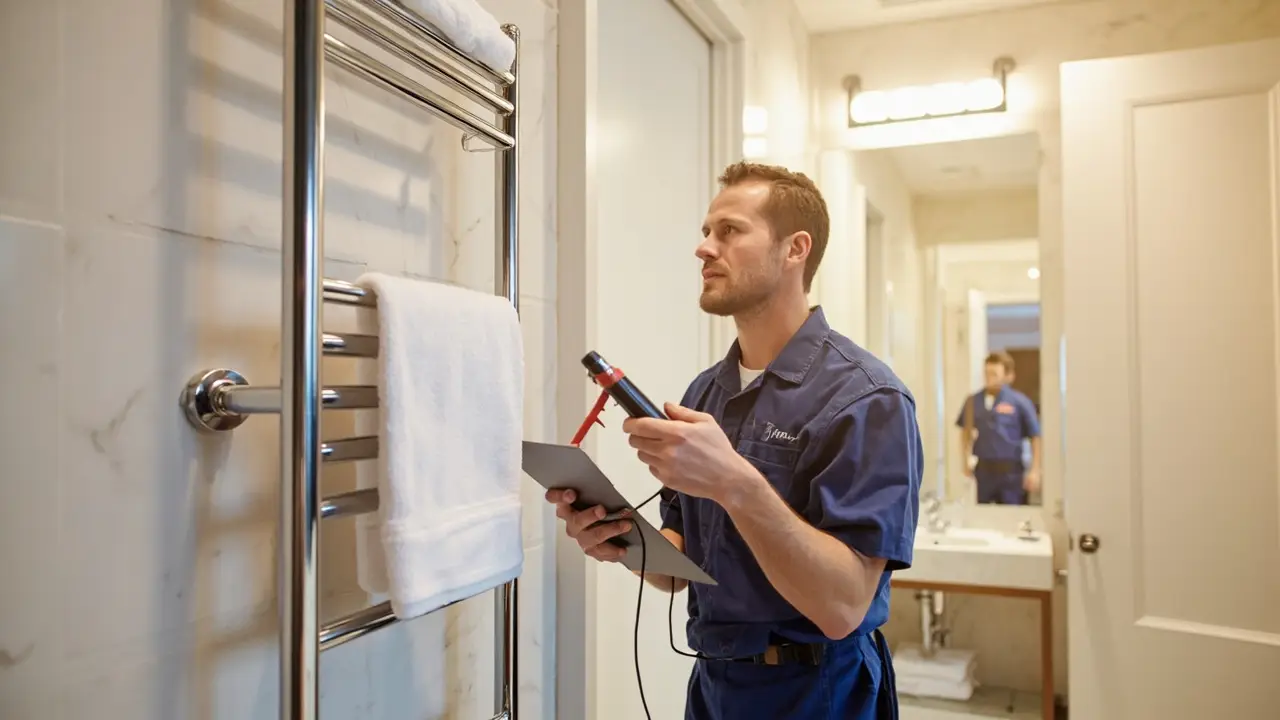
Heating element failure — If power reaches the unit but the rack stays cold, the heating element has likely failed. This is more common in units older than 8-10 years. Resistance can be checked with a multimeter: a reading of infinity (open circuit) confirms failure.
Thermostat or thermal fuse — Some models have a built-in thermal fuse that blows if the unit overheats. This is a safety feature, not just a glitch. Finding and replacing the fuse requires opening the column. If you are not comfortable doing this, hire an electrician.
For specifiers: Specify models with accessible junction boxes and clearly labeled components. It cuts service time dramatically.
The rack is warm but not hot
Guests often report this. The rack feels heated but does not effectively dry towels. Possible causes:
Ambient temperature too low — If the bathroom is below 15 deg C (59 deg F), the rack surface temperature will feel lukewarm even at full output. This is a design limitation, not a defect. Consider a higher-wattage model or supplemental bathroom heating.
Timer running only during off-peak hours — Check the timer settings. Some buildings program the rack to run at 50% capacity during unoccupied hours to save energy.
Aging element — A heating element that has been running continuously for several years will produce less heat. This is normal wear and tear.
The rack is noisy
Buzzing, clicking, or hissing sounds point to specific problems:
Humming or buzzing — Usually a valve issue in water-filled (hydronic) models. Air trapped in the system causes vibration. Bleeding the valve often resolves it.
Clicking sounds — Common in electric models with a bimetallic thermostat. The thermostat cycles on and off, producing a clicking noise. Occasional clicking is normal; constant clicking suggests the thermostat needs replacement.
Hissing — May indicate a slow water leak in hydronic systems or a pressure issue. Do not ignore hissing in a hydronic rack — call a plumber.
Water leaking from the rack
In electric models, any water leak is serious. Do not operate the unit.
- Check all connection points and fittings. Hand-tighten any loose unions.
- Inspect the surface for pinhole leaks, which are common in older stainless steel units that have experienced corrosion.
In hydronic models, minor seepage from valves is manageable; weeping at the body of the rack is not. Isolate the unit and call a plumber.
Preventive maintenance schedule
A written maintenance schedule prevents most of the problems above. Here is a practical cadence for commercial properties.
| Interval | Task |
|---|---|
| Monthly | Wipe down the rack with a soft cloth and mild cleaner. Check for visible corrosion or rust spots. |
| Quarterly | Test all wall switches and timers. Verify the rack heats normally. Check wall anchors and mounting brackets for tightness. |
| Every 6 months | Inspect electrical connections at the junction box. Look for discoloration or looseness. Clean any dust from the heating columns. |
| Annually | Full functional test: measure surface temperature with an infrared thermometer, compare to specifications. Document results for property management records. |
Cleaning and care
- Do not use abrasive cleaners or steel wool. They damage the protective coating on stainless steel and aluminum.
- Do use a soft cloth, warm water, and a pH-neutral cleaner. Dry the rack after cleaning to prevent water spots.
- In coastal or pool-area installations where chlorine exposure is high, rinse the rack monthly with fresh water to reduce corrosion risk.
When to repair vs. replace
This is a question procurement and facility managers ask constantly. The answer depends on three factors.
Age of the unit — If the rack is more than 10 years old and the heating element has failed, replacement is usually more cost-effective than repair. Newer models are also significantly more energy-efficient.
Cost of downtime — In a high-occupancy hotel, a day without heated towels in 50 rooms creates more cost (housekeeping delays, refunds, negative reviews) than the price of a replacement unit. Do not let a broken rack limp along for months.
Availability of matching parts — If the model has been discontinued and parts are no longer available, replace the unit. Custom-matching an older model from multiple suppliers is rarely worth the hassle.
Rule of thumb: if the repair cost exceeds 40% of the replacement cost, replace the unit.
Specifying for maintainability
If you are procuring heated towel racks for a new project or a large-scale replacement, think about serviceability from the beginning. Here is what to ask your supplier.
Look for:
– Removable heating elements (so the whole unit does not need to be uninstalled for repair)
– Standard, commercially available components (avoid proprietary parts that go end-of-life in 3 years)
– Clear documentation and wiring diagrams in English
– At least a 5-year warranty on the heating element
Ask the supplier to confirm:
– Whether replacement parts are stocked separately or only available as part of a full unit repair kit
– Whether they offer a maintenance training package for in-house facility staff
The bottom line
Most heated towel rack failures in commercial buildings are preventable with a simple quarterly inspection and prompt attention to early warning signs — unusual noises, reduced heating performance, or loose mounting. Specifying products with accessible components and standard parts makes repairs faster and cheaper when they do happen.
For property managers overseeing multiple properties, the real value is consistency: a rack that works every time a guest walks into the bathroom is one less complaint to manage.
Need help specifying maintenance-friendly heated towel racks for your next project? Contact our team for OEM pricing, lead times, and technical documentation.