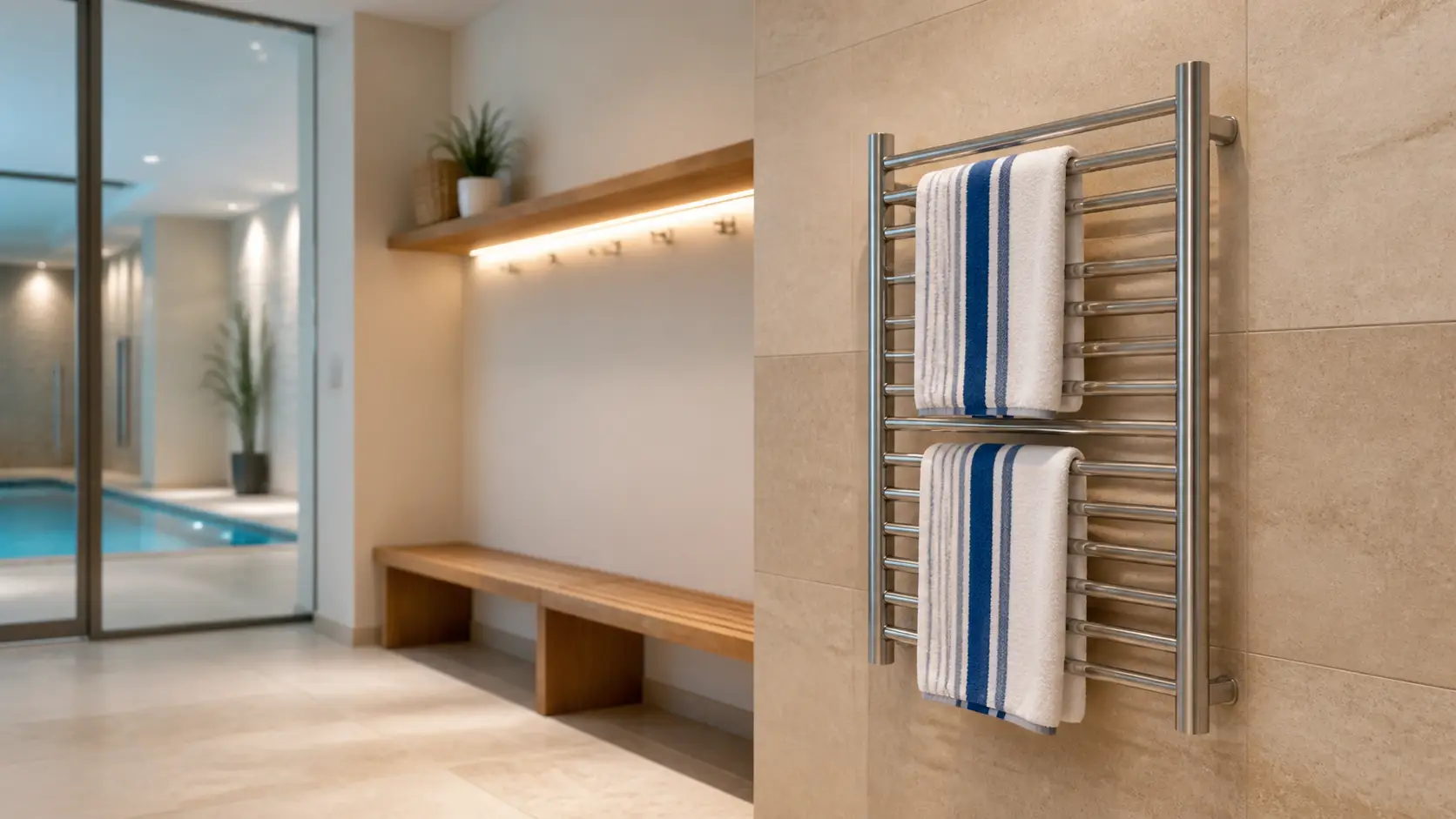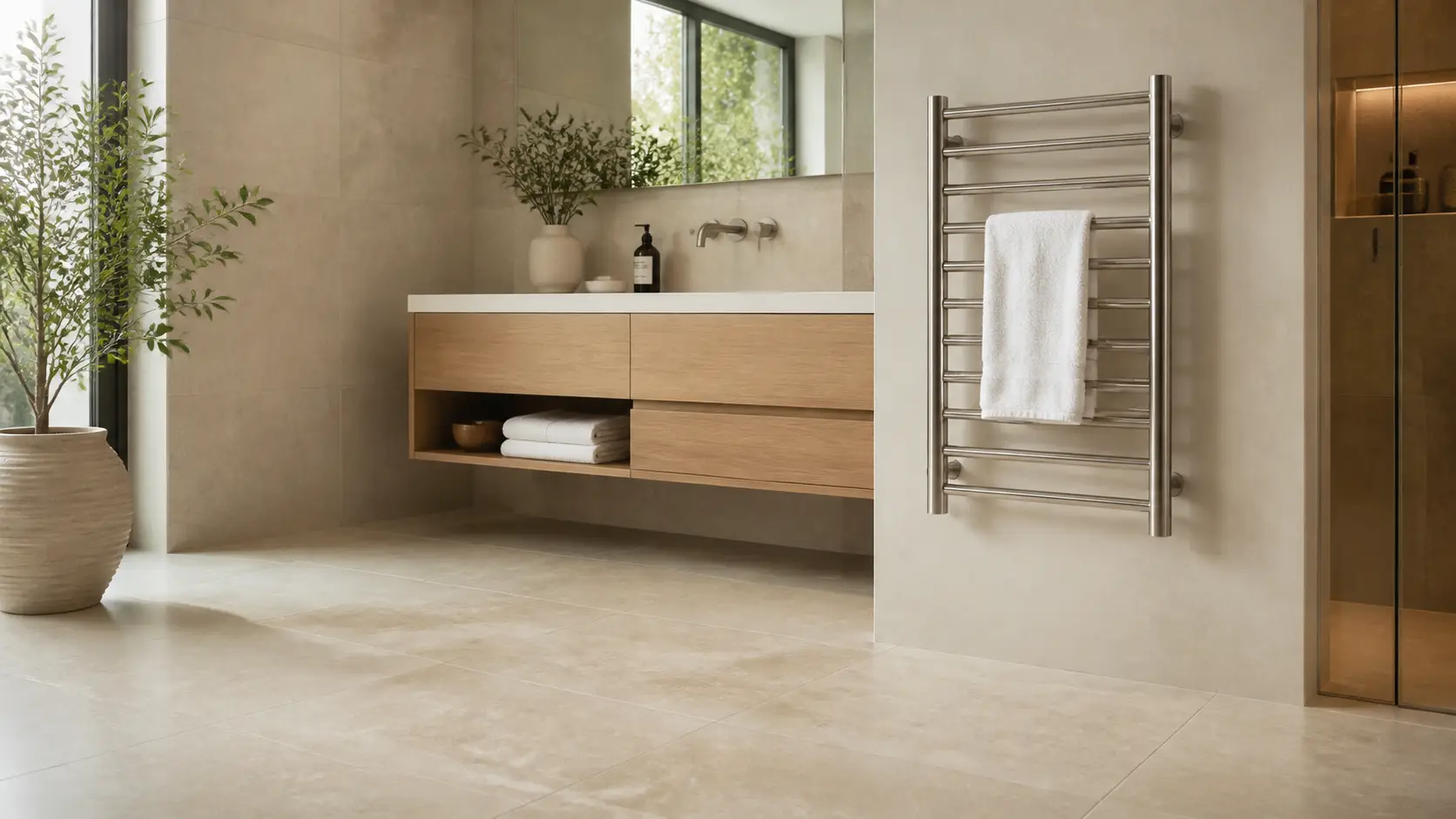

If you’re sourcing heated towel racks for a commercial project — a hotel renovation, a property development, or a retail inventory push — the first two questions most buyers ask are the same: What’s the MOQ, and how long does production take?
These answers matter more than most importers realize. A wrong MOQ assumption can strand you mid-project with half the inventory you need. A missed lead time can throw off your entire installation schedule. And if you don’t factor in OEM customization lead times upfront, you might end up with standard stock that doesn’t quite fit your project specifications.
This post covers what wholesale buyers encounter when sourcing from manufacturers — mostly in China — including real numbers, common pitfalls, and a planning checklist you can use right now.
Understanding MOQ: What Manufacturers Actually Require
There’s no universal standard for minimum order quantity on heated towel racks. What you get depends on three things: the manufacturer, the product line, and whether you’re customizing anything.
Standard Stock Orders
Most Chinese manufacturers set MOQ for standard models at 50 to 100 units per SKU. If you’re ordering an off-the-shelf product — a 304 stainless steel heated towel rack in brushed nickel, say — and you want it exactly as it appears on their website, the minimum is usually on the lower end of that range.
Some manufacturers will go as low as 20 to 30 units for established models if you’re willing to pay a slightly higher unit price. Lower MOQ means higher per-unit cost, since the manufacturer can’t optimize production runs the same way.
OEM and Custom Orders
This is where it gets more complicated. If you want your logo on the product, a custom color finish, different dimensions, or modified heating elements, the MOQ typically jumps to 100 to 300 units, sometimes more.
Custom-finish orders — anything that requires non-standard painting, coating, or plating — often require the full MOQ even for a single colorway, because the setup costs (masking, color matching, cure time) don’t get amortized across SKUs the way standard finishes do.
A practical example: a boutique hotel chain in the Pacific Northwest ordered 180 units of a matte black heated towel rack with their property logo engraved on the mounting plates. Their MOQ was 150 units, and they needed three colorway variations (black, brushed brass, and white), which pushed the total order to 450 units across all SKUs. Total lead time was 9 weeks from deposit to ready-to-ship.
Mixed SKU Orders
Some manufacturers will reduce per-SKU MOQ if you consolidate across multiple models. If you’re ordering four different heated towel rack designs, they might accept 30 units per SKU instead of 50, as long as the total order value hits a threshold — usually around $15,000 to $25,000 USD.
This is worth negotiating explicitly. MOQ is not as fixed as many buyers assume. It’s more like a lever the sales rep can pull if your total order is large enough to make the production run worth their while.
Lead Time: What to Actually Expect
The typical lead time for a standard wholesale order of heated towel racks from a Chinese manufacturer falls into a specific window, but the actual number varies based on order size, customization level, and time of year.
Standard Stock Orders
For orders with no customization — same specifications, same finish, same packaging — the baseline looks like this:
- Sample production: 7 to 14 days
- Bulk production: 25 to 40 days
- Internal quality inspection and packaging: 3 to 5 days
- Shipping preparation (documentation, container loading): 2 to 4 days
That puts you at roughly 5 to 7 weeks from deposit to ready-to-ship, assuming no production delays and assuming the manufacturer has the components in stock. If the heating elements or tubing need to be cut from raw stock, add 5 to 10 days.
Custom/OEM Orders
Custom orders extend the timeline significantly:
- Custom color or finish: add 2 to 4 weeks (paint/electroplating cure and QA)
- Custom dimensions or heating element specifications: add 1 to 3 weeks (component sourcing and retooling)
- Custom packaging (branded box, retail insert): add 5 to 10 days
For a fully customized OEM order — custom dimensions, custom finish, custom packaging, custom logo — you’re looking at 8 to 14 weeks from deposit to ready-to-ship, with 10 to 12 weeks being a reasonable midpoint for most buyers.
Peak Season Slowdowns
Chinese manufacturers — especially those in Foshan and Zhejiang — typically experience production slowdowns during two periods:
- Chinese New Year (late January to mid-February): Factory shut down for 2 to 4 weeks, then a ramp-up period of 1 to 2 weeks. Orders placed in December or early January get caught in this gap.
- National Day holiday (early October): Typically 1 to 2 weeks of reduced staffing.
If your project deadline falls between March and May, avoid placing orders in the December-to-January window unless you’re already accounting for the Chinese New Year gap in your timeline.
The Hidden Variables That Affect Your Timeline
Most buyers plan for the stated lead time and then get surprised when the actual delivery is later. Here’s why that happens.
Component Shortages
Heated towel racks rely on several components that can experience supply chain disruptions: heating elements (especially PTC ceramic elements), thermostats, timer switches, and specific grades of stainless steel tubing. If a key component is out of stock at the manufacturer, they’ll either substitute a different component (which may affect performance specs) or wait.
Ask your supplier directly: “Do you have all components for this order in stock right now?” If they hesitate, that’s a warning sign.
Color Matching Delays
If you’re matching a specific finish — say, you want the towel rack to match the brushed brass faucet you specified from a different manufacturer — color matching alone can add a week. The manufacturer mixes the coating, applies it to a sample rack, ships the sample to you for approval, you approve or request adjustment, and then they commit to the full run.
For commercial projects where aesthetic consistency matters across multiple product categories, build this loop into your timeline. It catches problems before 500 units are finished in the wrong shade.
Documentation and Compliance Prep
If you’re importing into the US and need UL certification documentation, or into the UK and need WRAS/BEAB documentation, the manufacturer needs to prepare the paperwork. This is often done in parallel with production, but if certifications are missing or need correction, it can hold up the shipment.
Buyers in the UAE or Saudi Arabia dealing with ESMA/Passport regulations face similar documentation loops. Budget an extra 5 to 7 days for cert prep and correction cycles.
A Realistic Planning Timeline
Here’s how a well-planned wholesale order looks from start to finish:
Week 0-1: Identify manufacturer, confirm specifications, negotiate MOQ and per-unit pricing, agree on payment terms (typically 30% deposit, 70% before shipment).
Week 1-2: Send deposit, confirm all specifications in writing. Get the sample order going if you haven’t already qualified the product.
Week 2-3: Receive and review pre-production sample. Approve or request changes.
Week 3-7 (or 3-13 for OEM): Production run. Stay in communication with the manufacturer’s QC contact. Request photos of in-process production if available.
Week 7-8 (or 13-15 for OEM): Inspection and packaging. Some buyers arrange third-party inspection (companies like QIMA, Bureau Veritas, or local inspection firms in Guangzhou/Foshan). This is especially worth it for orders over $30,000.
Week 8-9: Container loaded and shipped. Standard freight to US West Coast: 12 to 18 days by sea. East Coast: 20 to 28 days. Add customs clearance: 1 to 3 days.
Total: roughly 11 to 13 weeks from deposit to installation-ready, for a standard stock order. OEM/custom: 15 to 20 weeks.
How to Reduce Risk on Your First Order
A few practical steps that experienced importers take that first-time buyers often skip:
Get a physical sample before the full order. Yes, it adds cost and 7 to 14 days. It’s also the only way to verify that the product quality, finish, and dimensions match what the manufacturer described. One bad container load costs more than a sample order ever will.
Negotiate a quality agreement. Specify acceptance criteria in writing: finish quality, functionality test results, packaging standard. If the shipment arrives and doesn’t meet agreed specs, you have recourse written into the contract.
Clarify who bears the cost of non-compliance. If a heated towel rack arrives and fails UL inspection because the manufacturer used the wrong wire gauge, who’s responsible for the replacement cost and the project delay cost? Get this in writing before you pay the deposit.
Use a freight forwarder with customs experience. US customs for bathroom fixtures can involve review for proper tariff classification (heated towel racks typically fall under HS code 8516, with applicable duties). A forwarder who knows bathroom fixtures will prevent avoidable clearance delays.
Wrapping Up
Most importers underestimate what a wholesale order of heated towel racks actually involves. The stated lead time assumes everything goes smoothly. Reality has component shortages, color matching loops, and port congestion.
Buyers who avoid schedule disasters plan for the worst case: assume 8 weeks for standard stock, assume 12 to 14 weeks for OEM/custom. Add 2 to 3 weeks for shipping and customs. Build in a buffer before your installation date.
And if your project is in hospitality — a hotel renovation where the opening date is fixed — work backward from that date, not forward from “when we get the product.” The manufacturer’s lead time is just one variable in a chain that includes design spec, procurement, production, shipping, customs, and installation.
Need a second opinion on your sourcing timeline or help drafting a supplier inquiry brief? Reach out and we can walk through your project specs.
Looking for a supplier who can meet your MOQ and lead time requirements? Contact us to discuss your project specifications.