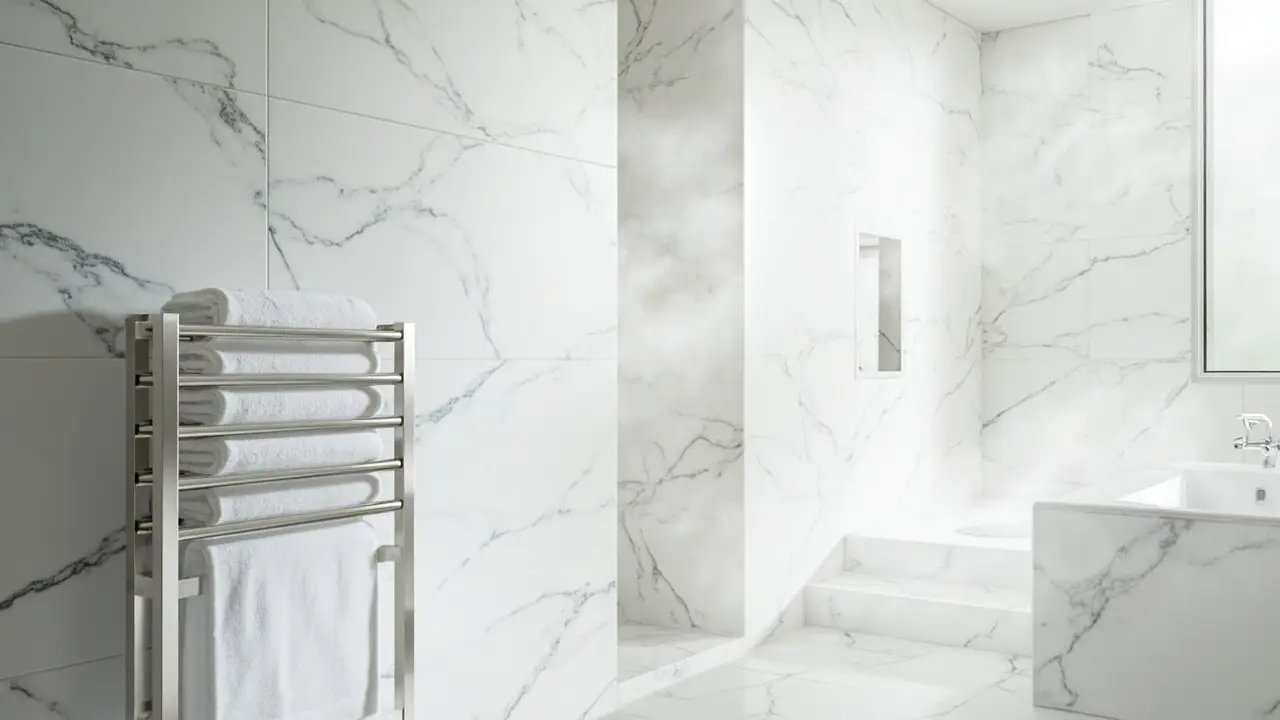
A commercial bathroom that stays consistently damp isn’t just an aesthetic problem. High humidity creates conditions where mold and mildew establish themselves in grout lines, behind tiles, and in the silicone seals around fixtures. For hotel operators, property managers, and building maintenance teams, recurring mold issues mean expensive remediation, guest complaints, and in severe cases, regulatory attention.
The question of whether heated towel rails do meaningful work in high-humidity commercial bathrooms comes up regularly from buyers specifying for hotels, gyms, pool facilities, and spa properties. The short answer is yes — they contribute to humidity management in ways that go beyond the obvious towel-warming function. But the extent of the benefit depends on the specific conditions of the bathroom and how the heated towel rail is being used relative to the ventilation system.
This post covers the mechanism, the actual performance limits, and how commercial buyers should be thinking about heated towel rails as part of a broader bathroom humidity strategy.
How Heated Towel Rails Actually Affect Humidity
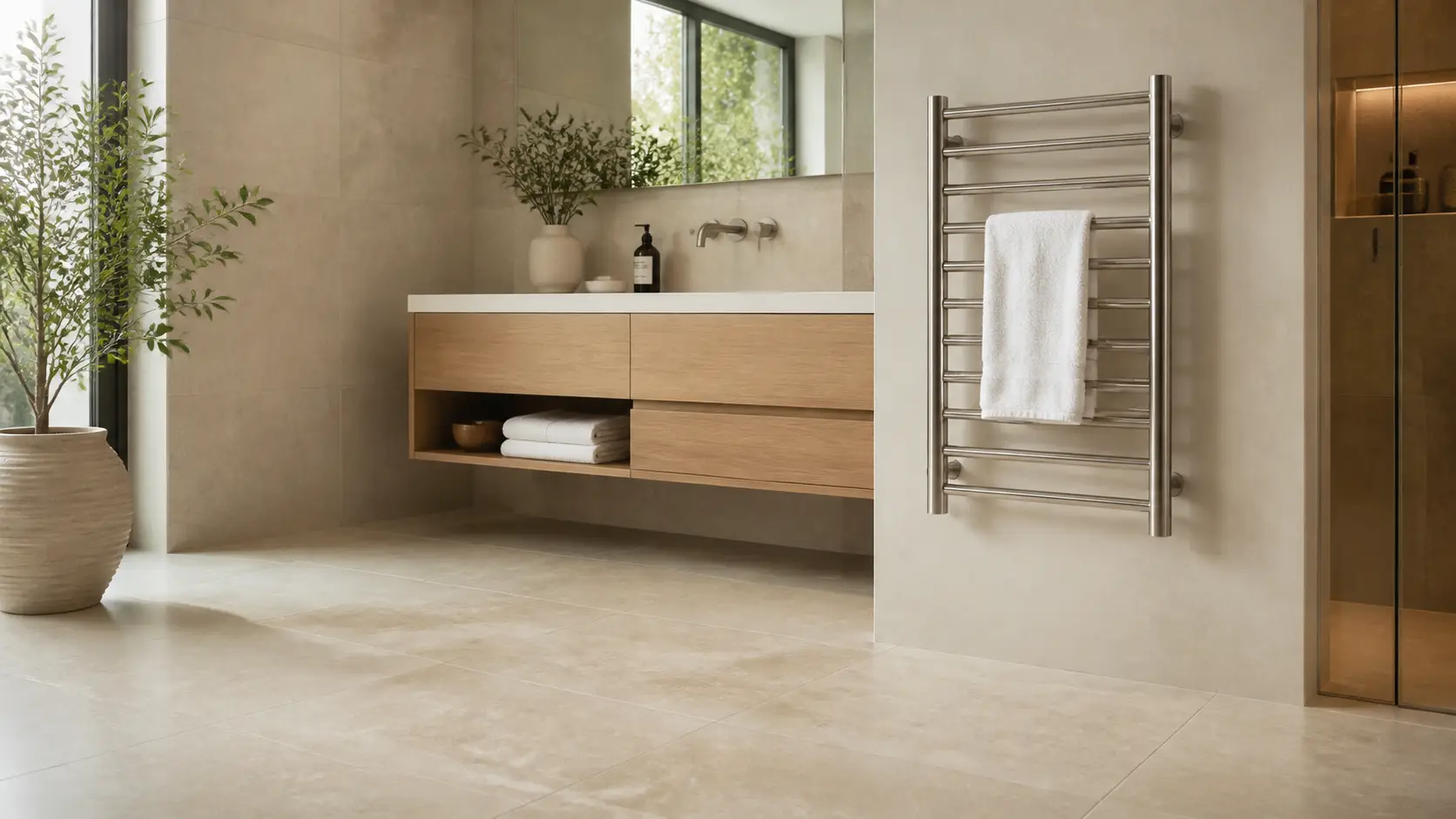
The basic principle is straightforward. A heated towel rail raises the surface temperature of the towels hanging on it above ambient bathroom temperature. This has two immediate effects on the bathroom’s humidity dynamics.
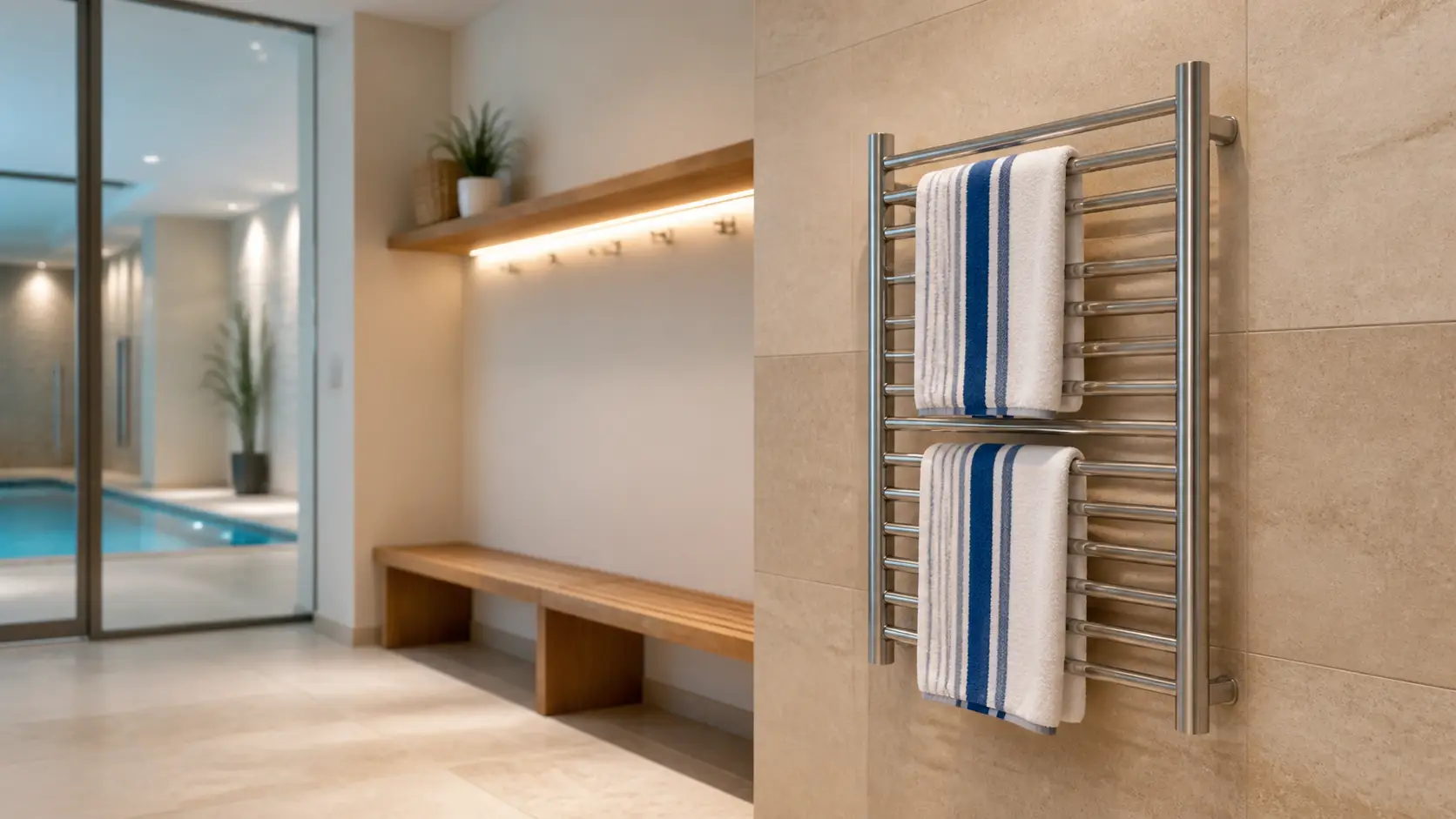
First, the warm towel surface evaporates moisture from the towel itself. A damp towel left at room temperature in a humid bathroom stays damp — it doesn’t dry, it just sits there contributing moisture to the room air. A heated towel rail keeps the towel surface warm enough that evaporation continues actively. The towel dries between uses instead of accumulating moisture between guest sessions.
Second, the warmth raises the local evaporation rate. In a bathroom where the ambient air is already carrying significant moisture, a warm surface accelerates the phase-change from liquid to vapor at that surface. This is basic thermodynamics — warmer air can hold more water vapor, and surfaces above ambient temperature drive faster evaporation. The heated towel rail, by keeping towels warm, is continuously acting as a small localized dehumidification mechanism.
In practical terms, a heated towel rail in a commercial bathroom with normal ventilation reduces the cumulative moisture load that the ventilation system has to handle. It’s not replacing ventilation, but it’s reducing the volume of water the ventilation system needs to move.
The Quantitative Picture
For those who like numbers, here’s a rough framework for thinking about the magnitude.
A standard hotel bath towel holds roughly 50 to 80 grams of water after typical use. In a bathroom without a heated towel rail at 70% relative humidity, that towel dries primarily by evaporation into the room air — contributing that moisture load to the bathroom environment. A heated towel rail at operating temperature (typically 50 to 60 degrees Celsius surface temperature) can evaporate that towel’s moisture content in roughly 2 to 3 hours of runtime, rather than having it sit damp for 8 to 12 hours.
For a 100-room hotel at 70% occupancy with an average of 2.5 towel usages per occupied room per day, that’s roughly 175 to 200 occupied rooms generating 2.5 towel usages each per day — which translates to a daily moisture load from towels alone of approximately 22 to 40 kilograms of water that would otherwise be entering the bathroom air.
With heated towel rails operating on a timer cycle — say, 6 hours per day — that moisture load is being actively evaporated and removed by the ventilation system during those hours rather than accumulating overnight. The ventilation system handles the same total moisture load, but the load is distributed differently and the towels are genuinely dry by the time the next guest enters the bathroom.
How This Connects to Mold and Mildew Prevention
The mold and mildew problem in commercial bathrooms isn’t primarily about surface moisture on tiles — it’s about persistent high humidity in enclosed spaces creating conditions where fungal spores can establish and grow.
Mold and mildew require three things: organic material (present in bathroom grout, silicone, soap residue), warmth (bathrooms are typically 20 to 25 degrees Celsius), and sustained high relative humidity (typically above 70% for extended periods). In a bathroom that stays above 70% relative humidity for more than a few hours at a time, mold will find a foothold.
Heated towel rails help break this cycle by keeping towels — one of the significant moisture sources in any bathroom — actively dry. They’re not addressing the humidity from shower steam directly, but they’re removing one of the continuous moisture generators from the environment. In bathrooms with intermittent ventilation, this matters more because there’s less active dehumidification happening outside of peak-use hours.
What Heated Towel Rails Don’t Do
This is important so buyers don’t overspecify or overexpect.
A heated towel rail is not a dehumidifier. It doesn’t pull moisture from the air. It only affects the moisture balance through the towels hanging on it. If the primary humidity source in a bathroom is steam from showers — which it usually is in high-use commercial bathrooms — the heated towel rail doesn’t directly address that load. A shower generating 500 to 1,000 grams of water vapor per use will overwhelm the evaporation effect of a single heated towel rail.
Ventilation is still the primary tool for humidity control. The exhaust fan, the HVAC system, the presence or absence of operable windows — these are what actually determine whether a bathroom’s ambient humidity stays below the level that promotes mold growth. A heated towel rail is a meaningful supplement to ventilation in humidity management, not a replacement for it.
The benefit is proportional to usage patterns. A heated towel rail in a bathroom that is used infrequently contributes less to overall humidity management because the towel moisture load is lower. In high-traffic hotel bathrooms, apartment building bathrooms, and spa change rooms, the cumulative effect is more significant.
The Specification Question: What Performance Should You Be Looking For
For commercial buyers evaluating heated towel rails for humidity management purposes, there are a few specification points worth paying attention to.
Heat output and surface temperature: Higher surface temperature means faster evaporation. Units with surface temperatures in the 55 to 65 degree Celsius range are more effective at moisture removal than lower-temperature units. This is relevant when specifying for facilities like pool change rooms or high-humidity spa environments where the ambient moisture load is elevated.
Timer controls and runtime programming: A heated towel rail that’s only running when someone manually turns it on delivers inconsistent humidity benefits. Units with programmable 24-hour timer controls allow the operator to keep the rail running continuously during occupied periods. When specifying for commercial projects, prioritize units with programmable timers over simple on/off switches.
Cross-ventilation compatibility: Some heated towel rail designs include integrated ventilation slots or are designed to work in conjunction with exhaust systems. If humidity control is a specific project requirement, look for product specifications that address airflow and moisture removal in the context of the installation environment.
The Practical Installation Note
The placement of the heated towel rail matters for its humidity performance. A unit installed in a corner or behind a door where airflow is restricted will not perform as effectively as one installed in a location with good air circulation. Warm air rises and circulates; a unit in a stagnant location doesn’t get the same convective benefit.
For commercial installations, the manufacturer’s recommended clearance requirements around the unit should be observed — not just for safety reasons, but because airflow around the unit affects how effectively it dries the towels and contributes to the bathroom’s humidity balance.
Wrapping Up
Heated towel rails are effective contributors to humidity management in high-humidity commercial bathrooms, but they’re not a standalone solution. They work by keeping towels actively dry — removing a continuous moisture source from the bathroom environment — and they accelerate evaporation through surface warmth. The benefit is real and measurable in high-traffic commercial bathrooms like hotel rooms, apartment units, and spa change rooms.
The primary tool for humidity control in any bathroom is still ventilation. A heated towel rail supplements that system meaningfully, particularly in bathrooms with intermittent ventilation use. For facilities where mold and mildew have been a recurring problem, adding or upgrading heated towel rails — with programmable timers running during occupied periods — is often a cost-effective supplement to the ventilation upgrade that will ultimately be needed.
If you’re dealing with a specific humidity problem in a commercial bathroom and considering heated towel rails as part of the solution, feel free to reach out. I can help assess whether the product and specification approach matches the conditions of the space.
Dealing with persistent humidity or mold issues in a commercial bathroom? Contact us to discuss your situation.