UL vs CE vs ETL: What Certifications Your Heated Towel Rack Needs for Global Markets
The bottom line
The certifications you need for heated towel racks depend entirely on where you are selling. Simple concept, but the details trip people up constantly. US needs UL 60335-2-43 or ETL. Europe requires CE (LVD plus EMC plus RoHS). UK now wants its own UKCA certification after Brexit. Australia demands SAA. Miss any of these and your container sits at the port. I have watched buyers lose entire shipments because the cert was wrong. It is not a small mistake. Budget $8,000 to $15,000 per certification and plan 4 to 8 weeks per market. Calithrex holds UL, ETL, CE, UKCA, and SAA certifications on file, and this guide breaks down exactly what each one means, how much it costs, and how long it takes.
Why certifications matter for heated towel racks
A heated towel rack is an electrical appliance installed in a wet environment. Every developed market has strict safety standards for exactly this scenario. They are not optional. Full stop.
Three practical reasons you actually care about certs, beyond just staying legal:
- Customs clearance — Without the right cert, your shipment gets stopped at the border. You then pay storage fees while waiting for the certification lab to process your application. Or worse, the goods get destroyed.
- Retailer requirements — Amazon, Home Depot, Wayfair, and most major retailers require UL or ETL certification before they let you list a product. No cert, no listing.
- Liability protection — If something goes wrong — and in electrical appliances, something eventually will — your certification is your best defense in court.
Certification requirements by market
| Market | Required Certification | Applicable Standard | Typical Cost | Timeline |
|---|---|---|---|---|
| United States | UL or ETL | UL 60335-2-43 | $8,000–$15,000 | 4–8 weeks |
| Canada | CSA or ULC | CSA C22.2 No. 60335-2-43 | $3,000–$5,000 (piggyback on UL) | 4–6 weeks |
| European Union | CE (LVD + EMC + RoHS) | EN 60335-2-43 | $3,000–$6,000 | 2–4 weeks |
| United Kingdom | UKCA | BS EN 60335-2-43 | $2,000–$4,000 | 2–4 weeks |
| Australia / NZ | SAA / RCM | AS/NZS 60335.2.43 | $2,500–$5,000 | 3–5 weeks |
| Middle East | SASO / ESMA | IEC 60335-2-43 + local deviations | $1,500–$3,000 | 2–3 weeks |
Deep dive: United States certifications
UL certification
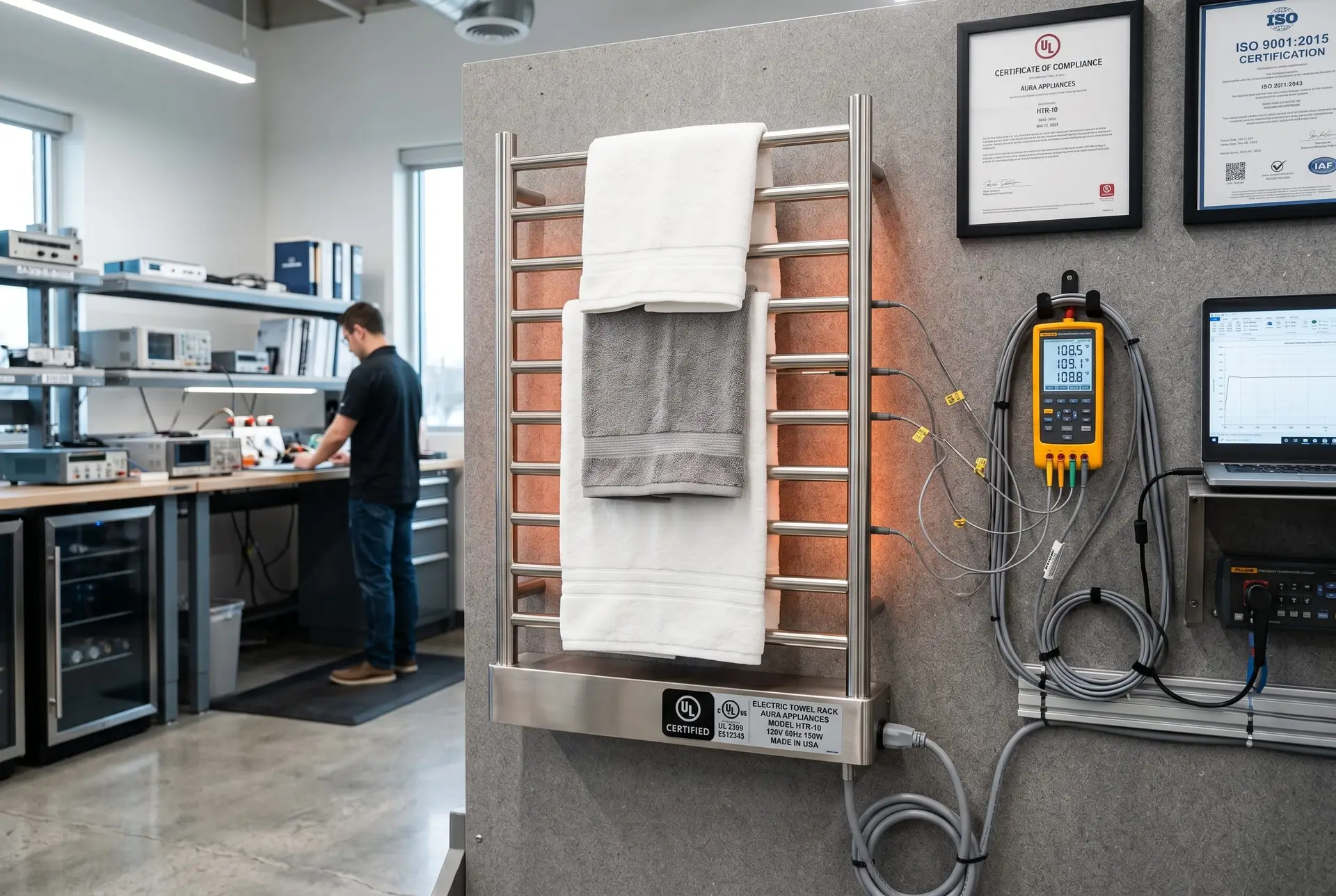
UL (Underwriters Laboratories) is the most recognized safety certification in the United States. For heated towel racks, the applicable standard is UL 60335-2-43 — Standard for Household Electric Heating Appliances.
Key tests in UL certification for towel warmers:
- Dielectric voltage-withstand test — The unit must withstand 1,000V plus twice the rated voltage applied between live parts and accessible metal surfaces for 1 minute without breakdown.
- Ground continuity test — Ground path resistance must not exceed 0.1 ohm.
- Temperature test — Surface temperature measured under worst-case conditions. Maximum allowable surface temperature for accessible metal parts is 80°C (176°F) for handheld contact, 95°C (203°F) for surfaces not intended to be grasped.
- Humidity test — Unit operates at 93% relative humidity and 40°C for 48 hours, then must pass dielectric test immediately after.
- Water ingress test — Verifies IP rating claim. For IP44, the unit must resist splashing water from all directions for 5 minutes.
- Abnormal operation test — Unit is operated with blocked airflow, covered with towels, and with heating element shorted. Must not catch fire or create a shock hazard.
ETL certification
ETL (Intertek) is accepted as equivalent to UL under OSHA’s NRTL (Nationally Recognized Testing Laboratory) program. ETL tests to the same UL 60335-2-43 standard.
UL vs ETL: what is the difference?
| Factor | UL | ETL |
|---|---|---|
| Recognition | NRTL — fully accepted | NRTL — fully accepted |
| Testing standard | UL 60335-2-43 | UL 60335-2-43 (same standard) |
| Cost | Higher ($10,000–$15,000) | Lower ($8,000–$12,000) |
| Timeline | 6–8 weeks | 4–6 weeks |
| Market perception | Highest brand recognition | Well accepted but less brand weight |
| Follow-up visits | 4x per year (unannounced) | 2x per year (scheduled) |
For a new brand, go ETL. Same standard, lower cost, faster timeline. Upgrade to UL once your volume justifies the premium.
FCC compliance
If your heated towel rack has a digital display, WiFi module, or any electronic control board that operates above 9 kHz, it also needs FCC Part 15 compliance for electromagnetic emissions. This is a separate testing process:
- FCC SDOC (Supplier’s Declaration of Conformity) — Self-declared, no lab testing required if using a certified module. Cost: minimal.
- FCC certification — Required for intentional radiators (WiFi, Bluetooth). Lab testing required. Cost: $5,000–$10,000.
Most electric towel racks with basic digital thermostats fall under FCC Part 15B (unintentional radiators) and only need SDOC.
Deep dive: European Union certifications
CE marking
CE marking is mandatory for all electrical products sold in the European Union. It is not a single certification but a family of directives:
- LVD (Low Voltage Directive 2014/35/EU) — Covers electrical safety. Tested to EN 60335-2-43.
- EMC (Electromagnetic Compatibility Directive 2014/30/EU) — Covers electromagnetic emissions and immunity. Tested to EN 55014-1 and EN 55014-2.
- RoHS (Restriction of Hazardous Substances Directive 2011/65/EU) — Covers restricted materials (lead, mercury, cadmium, etc.). Verified through material declaration and lab analysis.
The testing is generally faster than UL because the EU system uses a manufacturer’s declaration model for most requirements. A notified body (such as TUV Rheinland or SGS) reviews the technical file and issues the test report.
CE technical file requirements:
- Product description and intended use
- List of applicable standards
- Design and manufacturing drawings
- Test reports (safety, EMC, RoHS)
- Risk assessment
- Declaration of Conformity (DoC)
- User manual and safety instructions
Deep dive: UK certification post-Brexit
Since January 1, 2025, the UK has fully implemented the UKCA (UK Conformity Assessed) marking. CE marking is no longer accepted in Great Britain.
UKCA requirements are nearly identical to CE, with two differences:
- Standard designation – BS EN 60335-2-43 instead of EN 60335-2-43. The content is the same, but the standard is published by BSI (British Standards Institution) rather than CENELEC.
- Approved body – The testing lab must be a UK Approved Body, not an EU notified body.
If you already have CE certification, the conversion to UKCA is relatively straightforward. Many testing labs offer a “supplementary UKCA” service that reuses your CE test data with minimal additional testing.
Cost: $2,000–$4,000 if done alongside CE. Timeline: 2–4 weeks.
Deep dive: Australia and New Zealand
Australia requires RCM (Regulatory Compliance Mark) or SAA certification. The applicable standard is AS/NZS 60335.2.43.
Key points:
- Australia uses a “certification body” model — testing must be done by a JAS-ANZ accredited lab.
- The climate factor matters: Australia’s tropical humidity means the humidity test (Section 15 of the standard) is strictly enforced.
- Plug type is a separate requirement. Australian towel racks must ship with an AS/NZS 3112 plug (the angled flat-pin design) or be hardwired.
Common certification pitfalls
Pitfall 1: Assuming one cert covers all markets
This one hurts the most. UL does not equal CE. CE does not equal UKCA. Each market wants its own. Plan for the full set if you are targeting multiple regions.
Pitfall 2: Using a ghost cert
Some factories provide a “certificate” that is actually a test report from a non-accredited lab. Customs in the US and EU only accept certifications from recognized bodies. Verify the issuing body against the official lists:
- US: OSHA NRTL list
- EU: NANDO database
- UK: UKAS database
Pitfall 3: Starting production before certification
This happens more than it should. Factory finishes production. Container ships. Buyer realizes cert has not even started. Container sits at port for weeks. Storage fees rack up. I have seen it more than once. The buyer either pays a rush fee to the lab or ships the goods back.
The correct sequence: Sample approval → Submit to certification lab → Receive certification → Authorize production → Schedule shipping.
Pitfall 4: Design changes after certification
Once a model is certified, any change to the heating element, control board, or enclosure can invalidate the certification. If you modify a certified model, you need a “certification variation” or new testing. Always freeze the design before submitting for certification.
Certification flow chart
+-----------------------+
| Target market decided |
+-----------+-----------+
|
+---------------+---------------+
| | |
+-------v------+ +-----v-------+ +-----v-------+
| US / CA | | EU / UK | | AU / NZ |
+-------+------+ +-----+-------+ +-----+-------+
| | |
+-------v------+ +-----v-------+ +-----v-------+
| UL or ETL | | CE + UKCA | | SAA / RCM |
| UL 60335 | | EN 60335 | | AS/NZS 60335|
| + FCC if WiFi| | + EMC + RoHS| | + plug type |
+-------+------+ +-----+-------+ +-----+-------+
| | |
+-------v--------------v---------------v------+
| Submit to accredited lab |
| 4-8 weeks for full certification |
+--------------------+-----------------------+
|
+------------v------------+
| Certification received |
+------------+------------+
|
+------------v------------+
| Authorize production |
+-------------------------+Using a certified OEM partner
The smartest move is working with a factory that already has certs on file for their base models. Then your OEM version becomes a family filing, which costs less and moves faster. When you OEM a unit built on a certified platform, the new certification is often a “family filing” that costs less and takes less time.
Questions to ask your factory about certification:
- Do you currently hold UL certification for any electric towel rack model?
- Can our OEM unit be added as a variant to an existing UL file?
- Which certification bodies have you worked with (UL, Intertek, TUV)?
- Do you have an in-house compliance engineer?
- What is the cost sharing model — buyer pays 100% or factory shares?
Calithrex certification portfolio
Calithrex holds the following certifications on file for our electric heated towel rack product lines:
| Certification | Status | Coverage |
|---|---|---|
| UL 60335-2-43 | Active | USA — all electric models up to 400W |
| ETL (Intertek) | Active | USA — supplemental |
| CE (LVD + EMC + RoHS) | Active | EU — all electric models |
| UKCA | Active | United Kingdom |
| SAA / RCM | Active | Australia & New Zealand |
| FCC Part 15 | Active | USA — digital control models |
New OEM partners can leverage existing certifications as a base, significantly reducing both cost and timeline for market entry. We usually knock out variant filings in 2 to 3 weeks.
Request certification documentation