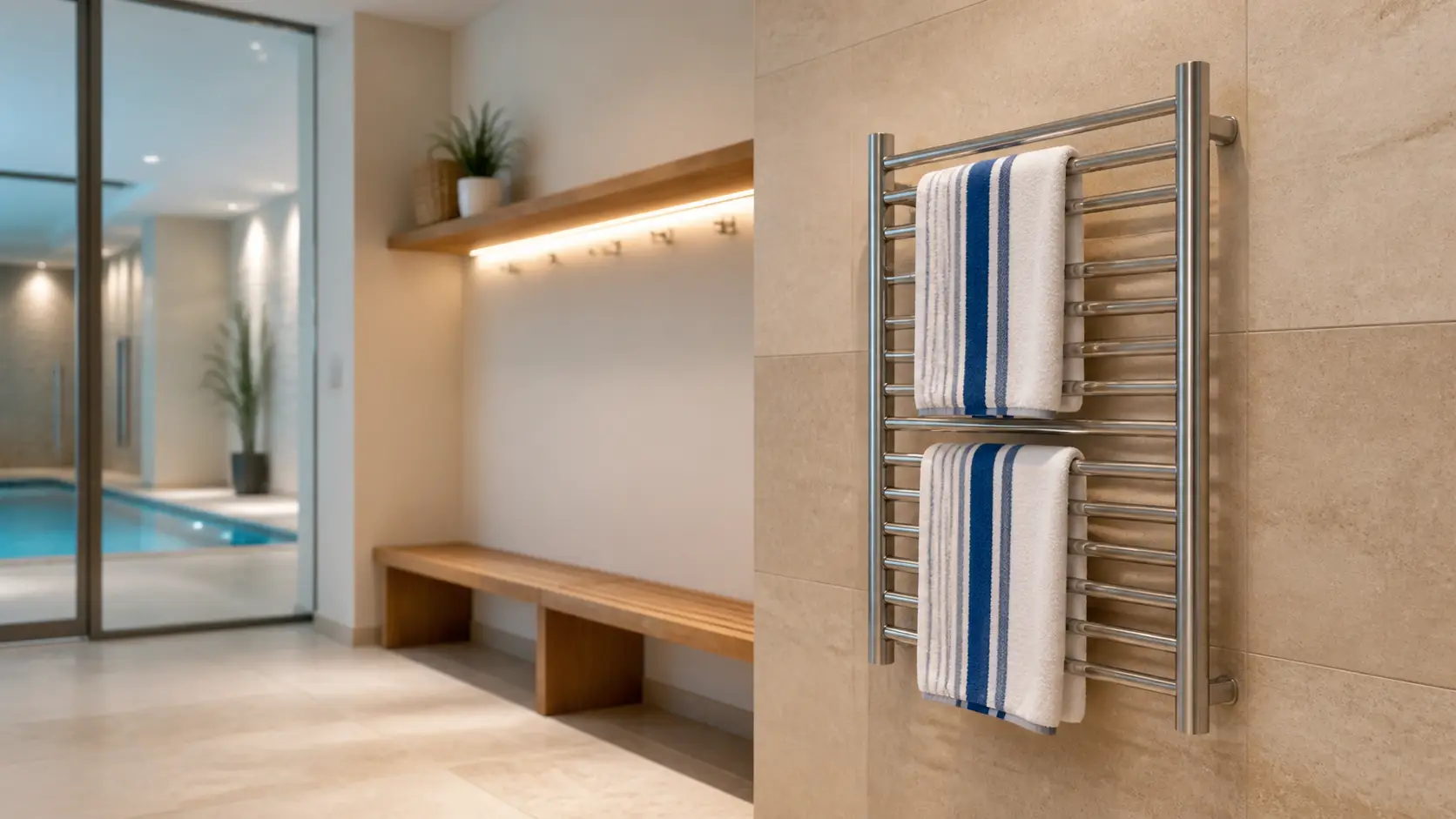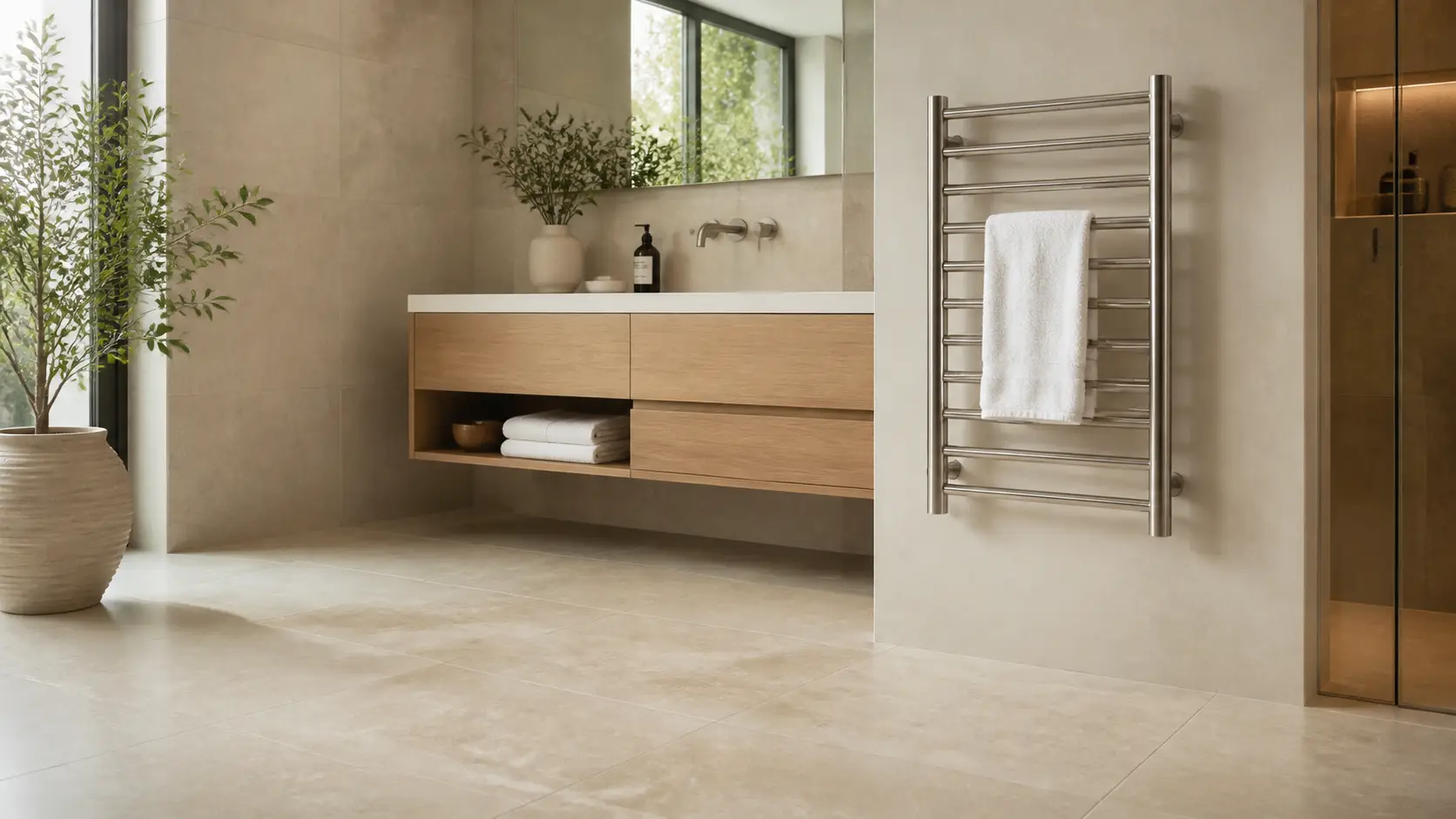
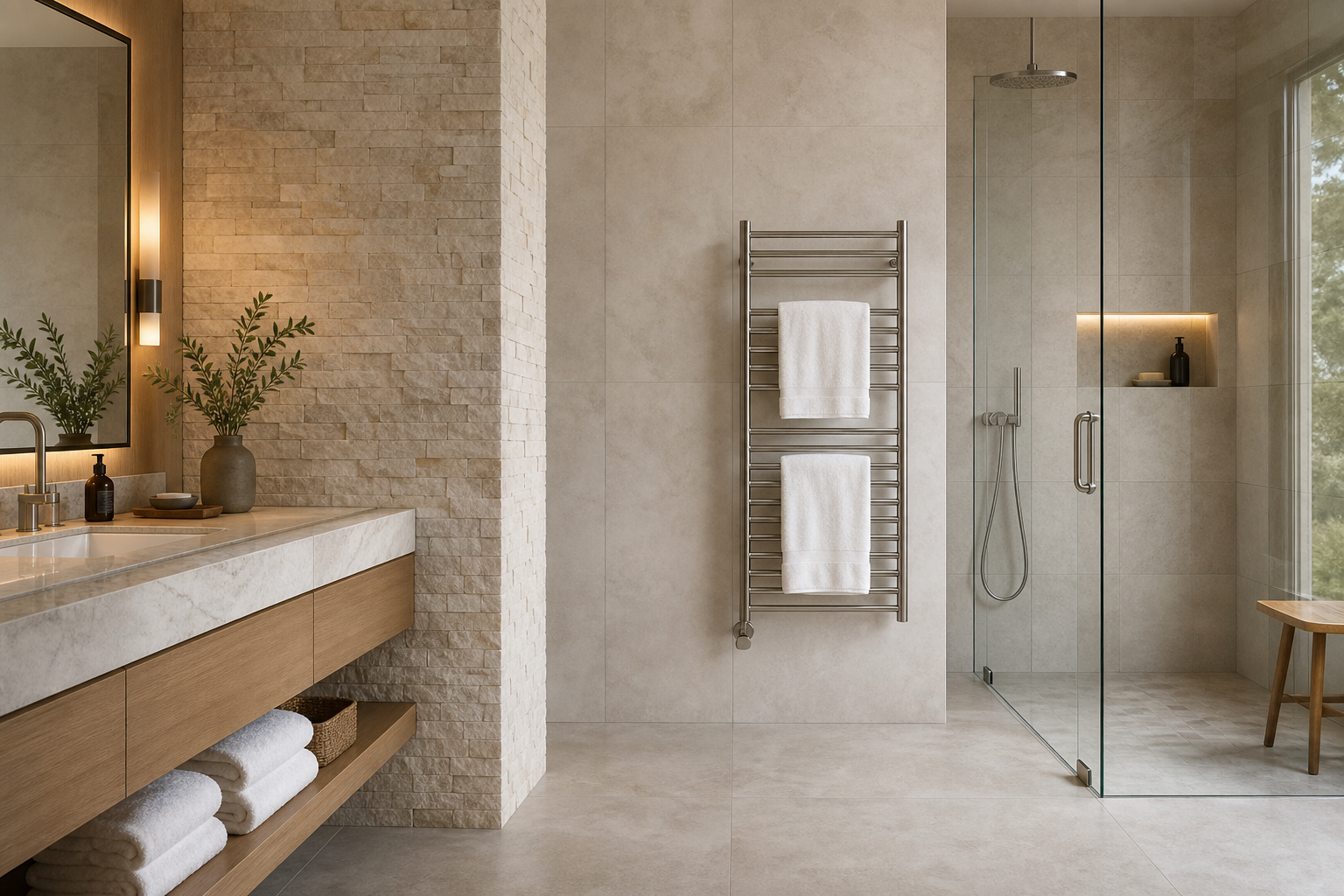
The best bathroom materials for 2026 are not chosen by appearance alone. For most residential, hotel, spa, and multifamily bathrooms, the stronger plan is to combine moisture-resistant surfaces, slip-aware flooring, easier-to-clean grout details, warm natural textures, and metal finishes that coordinate with fixtures such as heated towel racks. Porcelain tile is usually the safest default for wet zones, ceramic can work well on walls and lower-risk areas, natural stone adds luxury when the maintenance plan is clear, and wood or wood-look finishes should be used where warmth matters but standing moisture is controlled.
Current bathroom trend data supports this more practical approach. NKBA's 2026 bath trend coverage highlights durability, easier upkeep, smaller or no grout lines, large-format flooring, natural materials, and warmer finishes. Houzz's 2025 U.S. Bathroom Trends Study shows porcelain and ceramic leading bathroom flooring choices, while nonslip and mildew-resistant features remain meaningful buyer concerns. For Calithrex, this matters because a heated towel rack should look intentional within the room's material palette, not like a late add-on after tile, stone, cabinetry, lighting, and ventilation have already been chosen.
Quick Material Choice Table
| Material | Best bathroom use | Main advantage | Watch out for | Heated towel rack connection |
|---|---|---|---|---|
| Porcelain tile | Shower floors, shower walls, main floors, hotel bathrooms | Dense, moisture-resistant, durable, many looks | Surface texture and DCOF still matter | Works with stainless steel, matte black, chrome, and brushed finishes |
| Ceramic tile | Walls, backsplashes, powder rooms, lower-traffic floors | Budget-friendly and easier to cut | Usually less dense than porcelain | Good for clean wall backdrops behind towel areas |
| Natural stone | Feature walls, vanity tops, spa-style bathrooms | Premium texture and visual depth | Sealing, staining, etching, slip risk, maintenance | Pairs well with brushed or satin towel rack finishes |
| Wood-look porcelain | Floors or walls where warmth is wanted | Wood appearance with better wet-area performance | Pattern quality and grout color affect realism | Helps warm metal fixtures visually |
| Real wood veneer or cabinetry | Vanities, shelves, dry storage zones | Natural warmth and biophilic style | Needs moisture control and finish protection | Coordinates with warm towel comfort and spa positioning |
| Large-format tile or slabs | Floors, shower walls, hotel projects | Fewer grout lines and cleaner appearance | Requires flatter substrates and skilled installation | Creates a quieter backdrop for visible towel racks |
| Textured or matte tile | Wet floors, universal design bathrooms | Better underfoot confidence than polished surfaces | Can be harder to clean if texture is too aggressive | Supports safer shower-to-towel movement |
Why Bathroom Materials Are a 2026 Comfort Decision
Bathroom materials used to be treated as a style choice: white tile, chrome fixtures, a vanity top, and a towel bar. In 2026 planning, materials carry more responsibility. They affect cleaning effort, moisture control, safety underfoot, acoustic softness, visual warmth, and how premium the room feels during everyday use.
That is why the best material plan starts with use, not mood boards. A primary bathroom needs surfaces that support daily showers and wet towels. A hotel bathroom needs repeatable materials that housekeeping can clean quickly. A spa bathroom needs warmth, texture, and calm without creating hidden maintenance problems. A multifamily bathroom needs durable surfaces, standard details, and fewer callbacks.
A heated towel rack fits into the same decision. Its finish, wall location, wiring method, and surrounding materials should be coordinated before the tile and wall surfaces are finalized.
Porcelain Is the Default for Many Wet Zones
Porcelain is often the most practical first choice for bathroom floors and shower surfaces because it is dense, hard, and highly water-resistant. It can also imitate marble, limestone, travertine, concrete, terrazzo, or wood, which gives designers more freedom without automatically accepting natural material maintenance.
Use porcelain when the bathroom needs:
- A durable floor for daily foot traffic.
- A shower wall or floor that handles regular water exposure.
- A hotel or apartment finish that can be repeated across many rooms.
- A stone or wood look with simpler care.
- A quieter large-format surface with fewer grout lines.
Porcelain is not automatically slip-safe. A polished porcelain floor can still be a poor choice for wet walking zones. For shower floors, bathroom entries, wet rooms, and universal design bathrooms, ask for the manufacturer's wet-area rating, texture, grout plan, and maintenance instructions.
Ceramic Still Has a Place
Ceramic tile is not obsolete. It can be a smart material for bathroom walls, vanity backsplashes, decorative zones, and budget-sensitive renovations. It is usually easier to cut and install than porcelain, which can matter in small bathrooms with many edges, niches, and penetrations.
Ceramic is less ideal where the surface will face constant standing water, heavy traffic, or frequent impact. For a shower floor or a busy hotel bathroom, porcelain usually makes more sense. For a powder room wall, a vanity backsplash, or a decorative tile band, ceramic can be both attractive and cost-effective.
| Use case | Porcelain usually wins | Ceramic can work well |
|---|---|---|
| Shower floor | Yes, if slip-aware and wet-rated | Sometimes, but check rating carefully |
| Shower wall | Yes | Yes, especially for walls |
| Main bathroom floor | Yes | Yes in lighter-use bathrooms |
| Vanity backsplash | Yes | Yes |
| Hotel guest room | Usually yes | Selectively, mostly walls |
| Decorative accent | Yes | Yes |
Natural Stone Looks Premium but Needs a Maintenance Plan
Natural stone is still one of the strongest ways to make a bathroom feel calm, substantial, and high-end. Marble, limestone, travertine, slate, and quartzite can bring depth that printed surfaces may not fully match.
The tradeoff is maintenance. Many natural stones are porous, some can etch or stain, and some polished surfaces are not suitable for wet walking areas. Stone can be a good choice when the owner, hotel operator, or project buyer understands sealing, cleaning products, replacement tolerance, and slip requirements.
For B2B projects, do not specify stone only because it looks premium in a rendering. Confirm:
- Whether the stone is suitable for the intended wet or dry zone.
- Sealing requirements and cleaning restrictions.
- Slip resistance for floors.
- Stain and etch expectations.
- Replacement availability across project phases.
- Whether housekeeping can maintain it consistently.
A heated towel rack can look excellent against stone, especially in brushed stainless steel, satin, matte black, or soft metallic finishes. The key is restraint. If the stone has strong veining, choose a towel rack finish that supports the room instead of competing with it.
Wood and Wood-Look Surfaces Add Warmth
Natural warmth is one of the clearest bathroom material directions. Wood-faced vanities, warm neutrals, textured surfaces, and organic design cues help bathrooms feel less clinical. This is especially relevant for spa bathrooms, hotel-inspired primary suites, and wellness-focused renovation projects.
Real wood belongs mainly in protected zones: vanities, shelves, linen storage, wall details outside direct splash, and furniture-style pieces. It should not be treated casually in constantly wet areas. Good ventilation, proper finish protection, and cleaning habits matter.
Wood-look porcelain is often the more practical solution for floors or wet-adjacent walls. It gives the room warmth while keeping the performance advantages of tile. In a Calithrex context, warm wood tones can soften the look of a metal heated towel rack and make the towel area feel like part of the comfort sequence rather than a purely functional wall fixture.
Grout Lines Are a Maintenance Decision
Grout is not just a visual detail. It affects cleaning, moisture perception, staining, and the amount of texture in the room. NKBA's 2026 material findings point toward smaller or fewer grout lines and large-format flooring because buyers want cleaner, lower-maintenance surfaces.
That does not mean every bathroom should use the largest tile possible. Small shower floor tiles can provide more grout joints and contour more easily toward a drain. Large-format tile can make walls and main floors feel cleaner, but it requires good substrate preparation and skilled installation.
| Grout strategy | Best use | Tradeoff |
|---|---|---|
| Smaller grout lines | Main floors, shower walls, large-format tile | Needs precise installation |
| Contrasting grout | Design accent or patterned tile | Can make cleaning issues more visible |
| Matching grout | Quiet, seamless look | Poor color match can still show |
| More grout joints | Small shower floors and slopes | More cleaning surface |
| Epoxy or high-performance grout | Wet zones and commercial projects | Higher material and installation cost |
Slip Resistance Matters More Than the Product Photo
Bathroom floors are walked on when bare feet, water, soap residue, towels, and cleaning products may all be involved. A beautiful floor that feels slick after a shower is a poor material choice.
The Tile Council of North America explains that wet DCOF values can help compare tile surfaces, but they do not predict every slip condition. The surface, drainage, maintenance, contaminants, footwear or bare feet, slope, and project use all matter. For level interior areas expected to be walked on when wet, the commonly cited wet DCOF threshold is 0.42, but specifiers still need to judge the real project conditions.
For residential bathrooms, that means asking for wet-area suitability instead of choosing by sample-board appearance. For hotels, spas, senior living, and multifamily projects, it means documenting flooring choices, maintenance methods, and replacement standards.
Moisture Control Is Bigger Than the Surface
Good bathroom materials help, but they do not remove moisture by themselves. EPA guidance is clear that mold control depends on moisture control, and bathrooms are one of the places where ventilation and cleaning frequency matter most.
A material plan should answer:
- Where does shower water go?
- How quickly can wet surfaces dry?
- Is the bathroom fan or ventilation strategy adequate?
- Are towels spaced so they can dry?
- Are porous materials kept away from repeat wetting?
- Can cleaning teams reach corners, grout, towel racks, and shelving?
A heated towel rack can help towels feel warmer and dry more consistently, but it should not be treated as a substitute for ventilation. The best bathroom plan uses moisture-resistant materials, airflow, sensible towel placement, and heated towel rack scheduling together.
Match Heated Towel Rack Finishes to the Material Palette
The towel rack finish should be chosen with the bathroom materials, not after them. A finish that looks perfect against white porcelain may feel too sharp against travertine, too flat against dark stone, or too busy beside bold tile.
| Bathroom material palette | Towel rack finish direction | Why it works |
|---|---|---|
| White porcelain and light neutrals | Brushed stainless steel, chrome, matte black | Clean and easy to coordinate |
| Warm stone, travertine, beige, tan | Brushed, satin, champagne, soft metallic tones | Keeps the room warm and calm |
| Dark stone or dramatic tile | Matte black or brushed stainless steel | Gives contrast without visual clutter |
| Wood vanity and organic textures | Brushed stainless steel, satin, warm metal | Balances natural warmth with clean function |
| Hotel-style neutral bathroom | Brushed stainless steel or chrome | Repeatable, serviceable, familiar |
| Spa or wellness suite | Satin, brushed, or soft matte finishes | Supports a quiet comfort-focused look |
For Calithrex buyers, the practical specification should include finish, mounting wall material, wall backing, electrical route, towel capacity, cleaning access, and whether the same finish will repeat across multiple rooms or product lines.
Residential Bathroom Material Checklist
Homeowners should start with daily routine:
- Choose porcelain or another wet-rated material for shower floors and wet zones.
- Use slip-aware textures where people step out of the shower.
- Keep porous materials away from constant splash unless maintenance is acceptable.
- Use warmer materials, wood-look surfaces, or textured tile to avoid a cold bathroom.
- Plan the towel rack location before tile work and electrical work are finished.
- Coordinate towel rack finish with faucets, shower fixtures, lighting, and cabinet hardware.
- Keep ventilation and towel drying in the same planning conversation.
Hotel, Spa, and Multifamily Specification Notes
Project buyers need a more repeatable material strategy. The bathroom should look premium, but it also has to survive cleaning cycles, guest variation, maintenance teams, and future replacements.
Confirm these details before procurement:
- Approved floor material and wet-area slip documentation.
- Shower wall and floor tile sizes.
- Grout type, color, and maintenance standard.
- Vanity countertop material and repair expectations.
- Towel rack finish, size, and mounting requirements.
- Wall backing for towel racks and accessories.
- Electrical coordination for hardwired towel warmers.
- Cleaning access behind and around heated towel racks.
- Replacement availability for tile, stone, vanities, and metal finishes.
This is where a bathroom materials guide becomes a procurement tool. It prevents the common problem of choosing beautiful materials first and discovering later that the towel rack, wiring, cleaning, or maintenance plan does not fit.
Common Mistakes to Avoid
| Mistake | Why it causes problems | Better decision |
|---|---|---|
| Choosing polished tile for wet walking areas | It may look premium but feel slippery | Ask for wet-area suitability and texture |
| Treating natural stone as maintenance-free | Stone can stain, etch, or need sealing | Confirm cleaning and sealing before purchase |
| Using too many competing materials | The bathroom feels busy and dated quickly | Limit the main palette and vary texture carefully |
| Planning towel racks after tile installation | Placement, wiring, and backing may be wrong | Coordinate towel rack early with wall and electrical plans |
| Ignoring grout color and type | Cleaning and staining become visible later | Specify grout as part of the material package |
| Assuming a towel rack solves dampness | Moisture still needs ventilation and airflow | Pair heated towel racks with proper ventilation |
FAQ
What is the best bathroom material for 2026?
For most wet zones, porcelain tile is the best default bathroom material because it is durable, moisture-resistant, and available in many stone, concrete, and wood-look styles. The final choice should still consider slip resistance, grout, installation quality, and maintenance.
Is porcelain better than ceramic for bathrooms?
Porcelain is usually better for shower floors, main bathroom floors, and heavy-use bathrooms because it is denser and more water-resistant. Ceramic can still work well on walls, backsplashes, decorative areas, and lower-risk bathroom zones.
Is natural stone good for bathrooms?
Natural stone can be excellent in bathrooms when it is selected for the correct zone and maintained properly. It needs more care than porcelain, especially around sealing, staining, etching, and wet-floor slip risk.
What bathroom flooring is safest when wet?
No bathroom floor is automatically slip-proof. For wet areas, choose materials with suitable wet-area ratings, appropriate texture, drainage, and maintenance instructions. In project specifications, review DCOF data and the manufacturer's guidance.
Are large-format tiles better for bathrooms?
Large-format tiles can reduce grout lines and create a cleaner, more modern bathroom. They work especially well on shower walls and main floors, but they require good substrate preparation, careful layout, and skilled installation.
How should a heated towel rack match bathroom materials?
Match the towel rack finish to the material palette. Brushed stainless steel and chrome work well with clean porcelain bathrooms, matte black can add contrast, and satin or soft metallic finishes often suit warm stone, wood, and spa-style bathrooms.
Planning Takeaway
The strongest bathroom materials plan for 2026 combines performance and comfort. Use porcelain or other wet-rated surfaces where water is constant, treat stone and wood as premium materials that need placement and maintenance planning, reduce grout where it improves cleaning, and check slip resistance before choosing a floor. Then coordinate the heated towel rack finish, wall location, and electrical plan with those materials early.
For residential, hotel, spa, and multifamily bathrooms, Calithrex heated towel racks can be specified as part of a complete comfort package: warm towels, clean wall placement, coordinated finishes, and practical drying support within a moisture-aware bathroom design.
Sources
- NKBA 2026 Bath Trends Report coverage
- Houzz 2025 U.S. Bathroom Trends Study
- Tile Council of North America coefficient of friction guidance
- EPA guide to mold and moisture in your home
- Bedrosians bathroom porcelain, ceramic, and stone comparison
- WarmlyYours bathroom design trends and natural materials angle