The bottom line: a standard heated towel rack uses 60–150 watts and costs roughly $0.10–$0.30 per day to run, depending on your electricity rate and how long you leave it on. That is $40–$120 per year. A timer cuts that by 60–75%. The real surprise is not how much it costs—it is how little it costs compared to the comfort it delivers.
I have had this conversation with dozens of buyers. They want the warm towels, but they picture their electricity meter spinning like a slot machine. The reality is more like a nightlight. Most heated towel rails draw less power than a single incandescent bulb. The difference between a $40 year and a $120 year is not the rail itself. It is how you control it.
This guide breaks down the actual numbers: wattage, daily consumption, cost by region, and how timers and thermostats change the math.
Wattage and power draw: what the numbers mean
Heated towel racks typically range from 40 watts for a small single-bar unit to 300 watts for a large floor-standing model with multiple bars. The majority of wall-mounted rails fall in the 60–150 watt range.
| Rail Size | Typical Wattage | Approx. Heated Area | Best For |
|---|---|---|---|
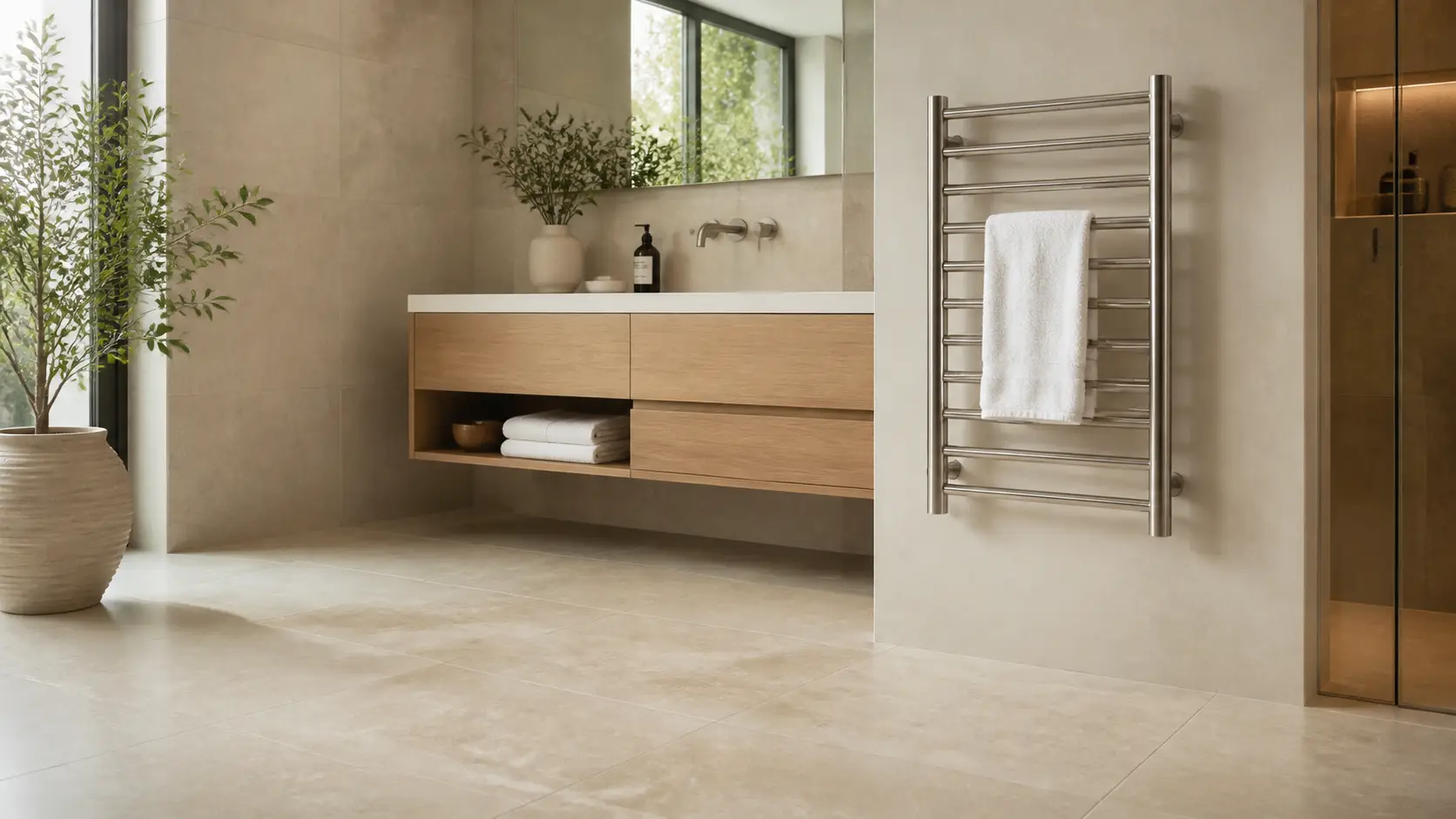
| Small (2–3 bars) | 40–80W | 1–2 m² | Compact bathrooms, guest ensuites |
| Medium (4–6 bars) | 100–150W | 2–4 m² | Standard family bathrooms |
| Large (7+ bars or ladder) | 150–250W | 4–6 m² | Large bathrooms, high humidity |
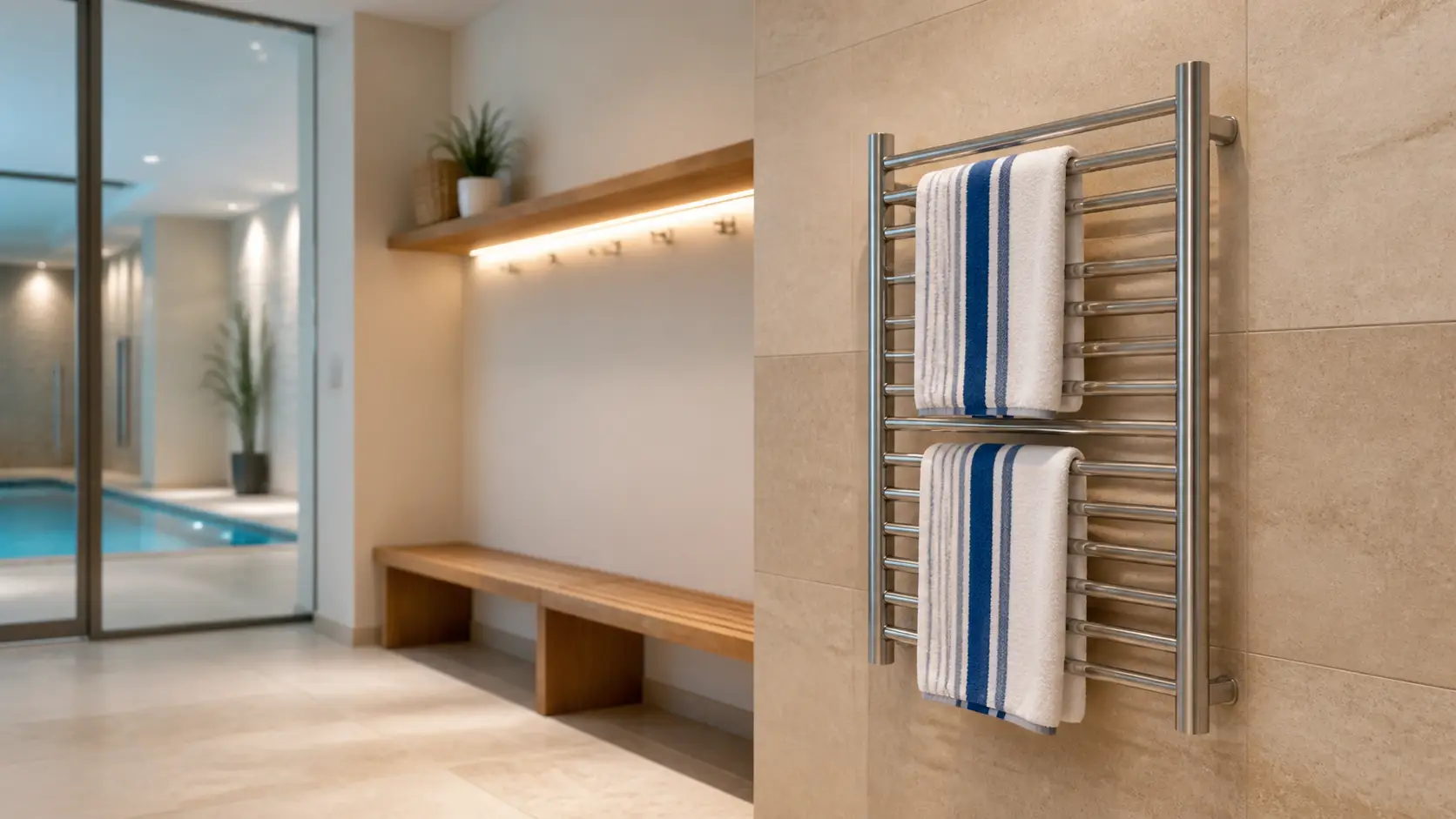
| Floor-standing | 200–300W | 5–8 m² | Hotels, spas, pool houses |
Important distinction: The wattage rating is the maximum draw when the element is actively heating. Once the rail reaches operating temperature, the thermostat or thermal cutout cycles the element on and off. The actual average consumption is typically 60–70% of the rated wattage over a 24-hour period if left on continuously.
Daily and annual running costs by region
Electricity rates vary significantly by country and even by provider. Here are realistic calculations based on average residential rates in 2026.
Assumptions
- Medium rail: 120W rated, 80W average continuous draw
- Timer-controlled: 6 hours per day, full power for first 30 minutes then cycling
- Continuous: 24 hours per day at average 80W
| Region | Avg. Rate (per kWh) | Timer (6 hrs/day) | Continuous (24 hrs) | Annual Timer | Annual Continuous |
|---|---|---|---|---|---|
| United States | $0.16 | $0.10/day | $0.31/day | $36 | $113 |
| United Kingdom | £0.30 | £0.18/day | £0.58/day | £66 | £212 |
| Germany | €0.40 | €0.24/day | €0.77/day | €88 | €281 |
| Australia | A$0.30 | A$0.18/day | A$0.58/day | A$66 | A$212 |
| Canada | C$0.13 | C$0.08/day | C$0.25/day | C$29 | C$91 |
The timer difference: Running 6 hours instead of 24 cuts your cost by about 68%. But you still get warm towels for morning showers and evening baths because the rail heats up in 10–15 minutes.
How timers and thermostats change the math
A basic heated towel rail with no controls draws full power whenever it is plugged in or hardwired. Adding controls is the single biggest factor in reducing running costs.
Timer types and their impact
| Control Type | How It Works | Typical Savings | Cost to Add |
|---|---|---|---|
| Basic plug-in timer | On/off at set times | 60–70% | $10–$20 |
| Digital programmable | Multiple on/off periods per day | 65–75% | $20–$40 |
| Built-in thermostat | Cycles element to maintain set temperature | 50–60% | Included on some models |
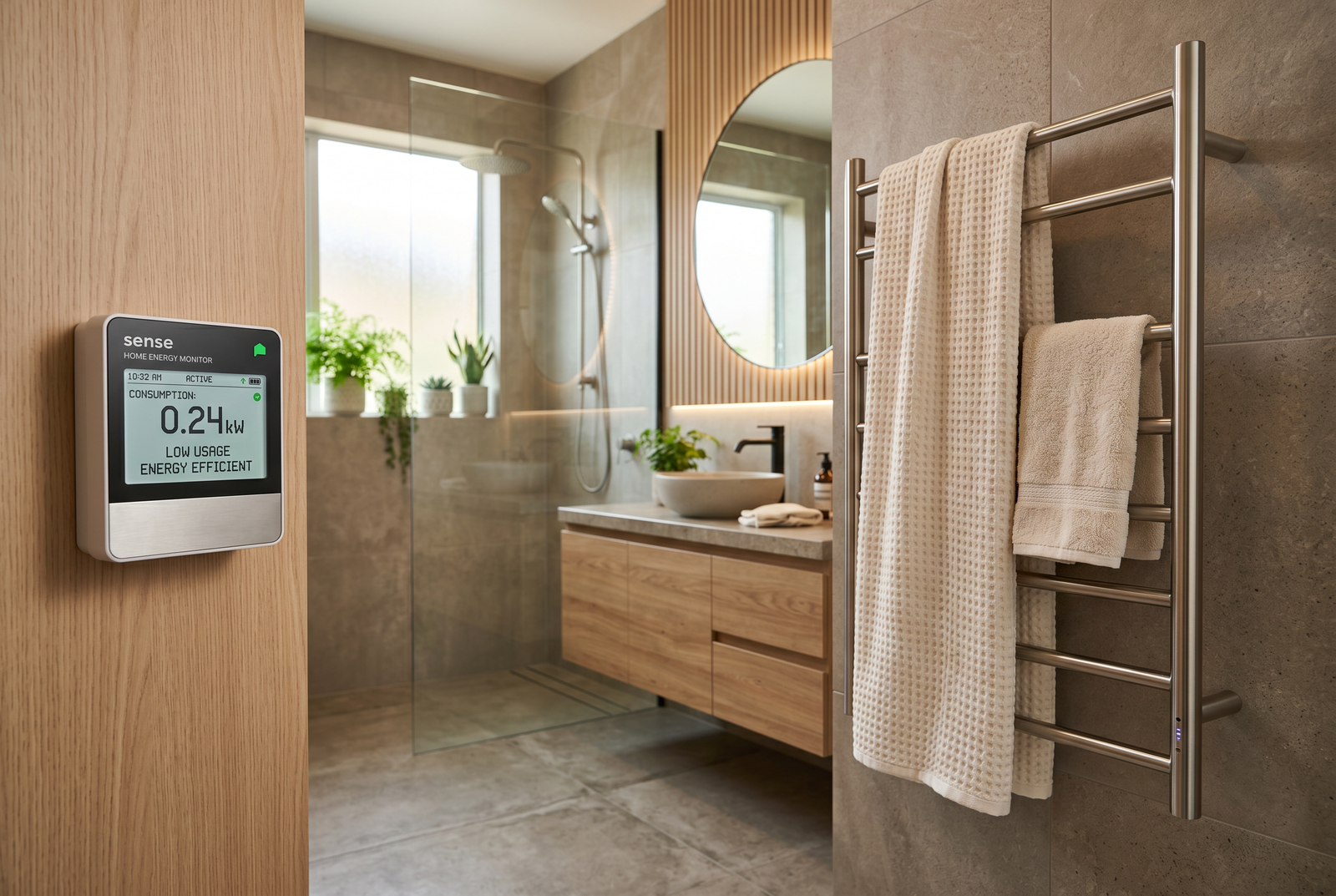
| Smart WiFi timer | App-controlled, geofencing, usage tracking | 70–80% | $30–$60 |
| Dual-fuel (wet + electric) | Uses central heating when available, electric backup | 40–60% | Rail-specific |
Real-world example: A 150W rail left on 24/7 in the UK costs about £212 per year. The same rail on a programmable timer (6:00–9:00 AM and 5:00–10:00 PM) costs about £66 per year. A £25 timer pays for itself in under two months.
Energy efficiency features to look for
Not all heated towel racks consume power the same way. If running cost matters to you—and it should—look for these features when buying.
1. PTC (Positive Temperature Coefficient) heating elements
PTC elements increase resistance as they heat up, naturally self-regulating their power draw. They consume less energy once the rail reaches temperature compared to traditional wire elements. Most quality manufacturers have switched to PTC for this reason.
2. Low-wattage designs
Some modern rails achieve the same surface temperature with lower wattage through better thermal design: closer bar spacing, improved convection fins, or denser element placement. A 100W rail that performs like a 150W traditional rail saves 33% on running costs.
3. Eco or frost-protection modes
Many digital controllers offer an eco mode that maintains the rail at a lower background temperature (say 30°C instead of 50°C) rather than full heat. This keeps towels fresh and slightly warm without the full power draw. Frost-protection mode uses even less power, just enough to prevent freezing in cold bathrooms.
4. Dual-fuel capability
Wet-system rails connected to central heating use essentially free heat when the boiler is running for the house. The electric element only kicks in during summer months when the boiler is off. If you have a wet central heating system, this is the most efficient option by far.
Comparing heated towel racks to alternatives
Buyers sometimes ask whether a heated towel rack is worth it compared to just using a radiator or a tumble dryer. Here is the honest comparison.
| Method | Running Cost (per year) | Towel Warmth | Bathroom Heat | Convenience |
|---|---|---|---|---|
| Heated towel rack (timer) | $40–$90 | Excellent | Moderate | Always ready |
| Heated towel rack (continuous) | $120–$280 | Excellent | Good | Always ready |
| Standard radiator | $0 (if boiler already running) | None | Good | N/A |
| Electric radiator | $150–$400 | None | Good | Manual control |
| Tumble dryer | $80–$150 | Hot initially | None | Batch process |
| Towel warmer cabinet | $60–$120 | Hot | None | Batch process |
The honest take: If your boiler is running anyway for central heating, a wet-system towel rail costs almost nothing extra. If you are heating a bathroom with no central heating, a towel rail is cheaper than an electric radiator and far more convenient than a tumble dryer. The comfort of a warm towel is a side benefit; the real value is dry towels that do not smell.
How to calculate your exact running cost
If you want precise numbers for your specific situation, use this formula.
Step 1: Find your rail’s wattage
Check the label or manual. If it gives a range, use the rated (maximum) wattage for worst-case calculations.
Step 2: Estimate daily hours of use
Be realistic. Most people do not need warm towels at 3 AM. A typical pattern is 2–3 hours in the morning and 3–4 hours in the evening = 5–7 hours total.
Step 3: Apply the cycling factor
The element does not draw full power continuously. It cycles on and off to maintain temperature. Multiply your hours by 0.7 to account for this.
Step 4: Calculate
Daily cost = (Wattage × Hours × 0.7) / 1000 × Cost per kWh
Annual cost = Daily cost × 365
Example: 120W rail, 6 hours per day, $0.16/kWh, cycling factor 0.7
– Daily: (120 × 6 × 0.7) / 1000 × 0.16 = $0.081
– Annual: $0.081 × 365 = $29.46
That is under $30 per year for warm towels every morning and evening.
Final thoughts
The fear of high running costs stops more people from buying heated towel racks than any other factor. But the numbers do not support that fear. A properly controlled heated towel rail costs less per year than a few takeaway coffees. The comfort, hygiene, and convenience it adds to a bathroom are out of proportion to the cost.
If you are buying for a hotel, spa, or residential development, the running cost matters at scale. A 100-room hotel with timer-controlled rails saves thousands per year compared to continuous operation. For a single home, the savings are modest but still worth the price of a programmable timer.
If you are sourcing heated towel rails for retail, hospitality, or commercial projects and need energy-efficient models with programmable controls, contact us for a product catalog and specification sheets. We supply PTC-heated, low-wattage, and smart-controlled towel rails with CE, cULus, and Watermark certification for global markets.