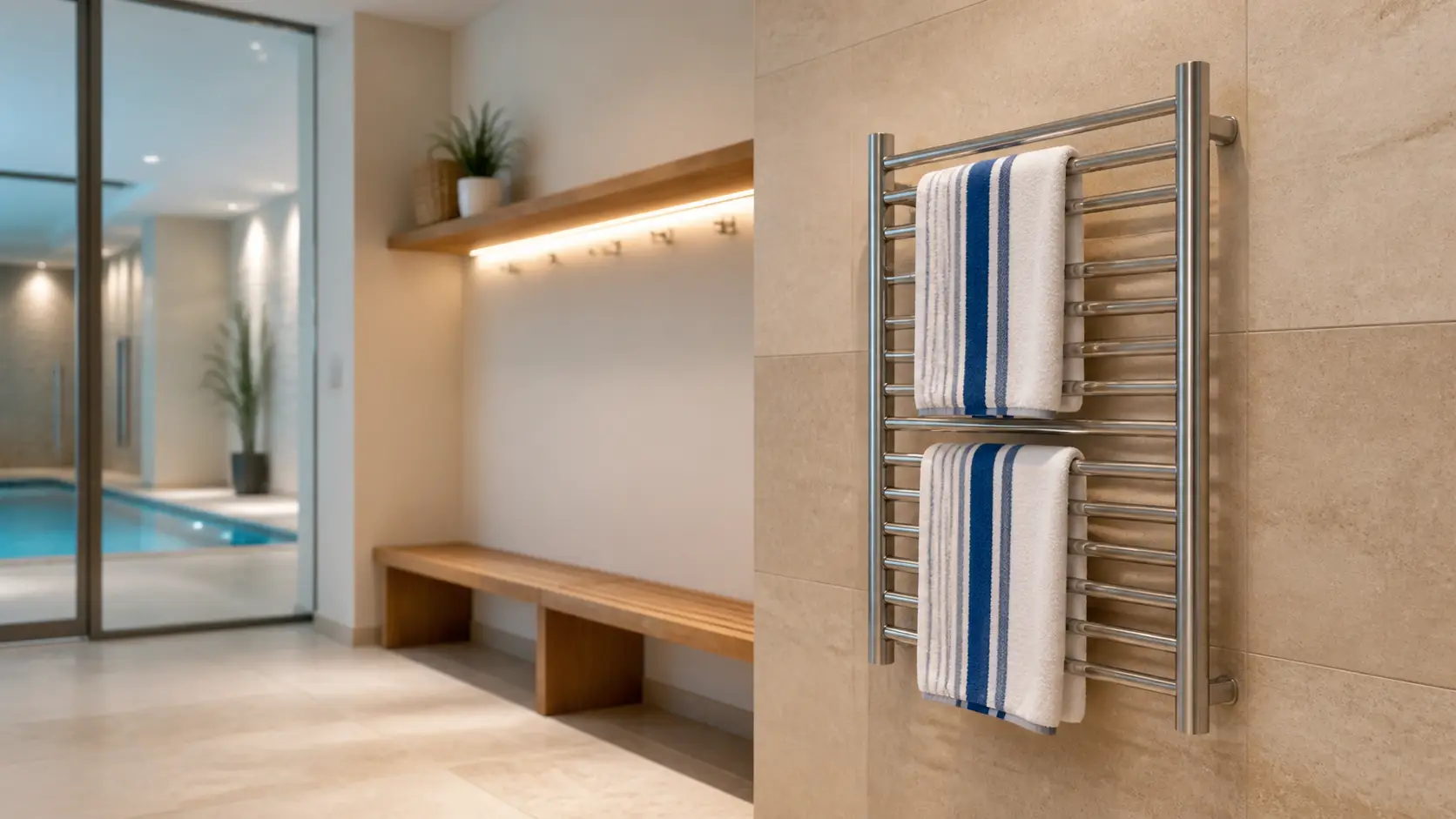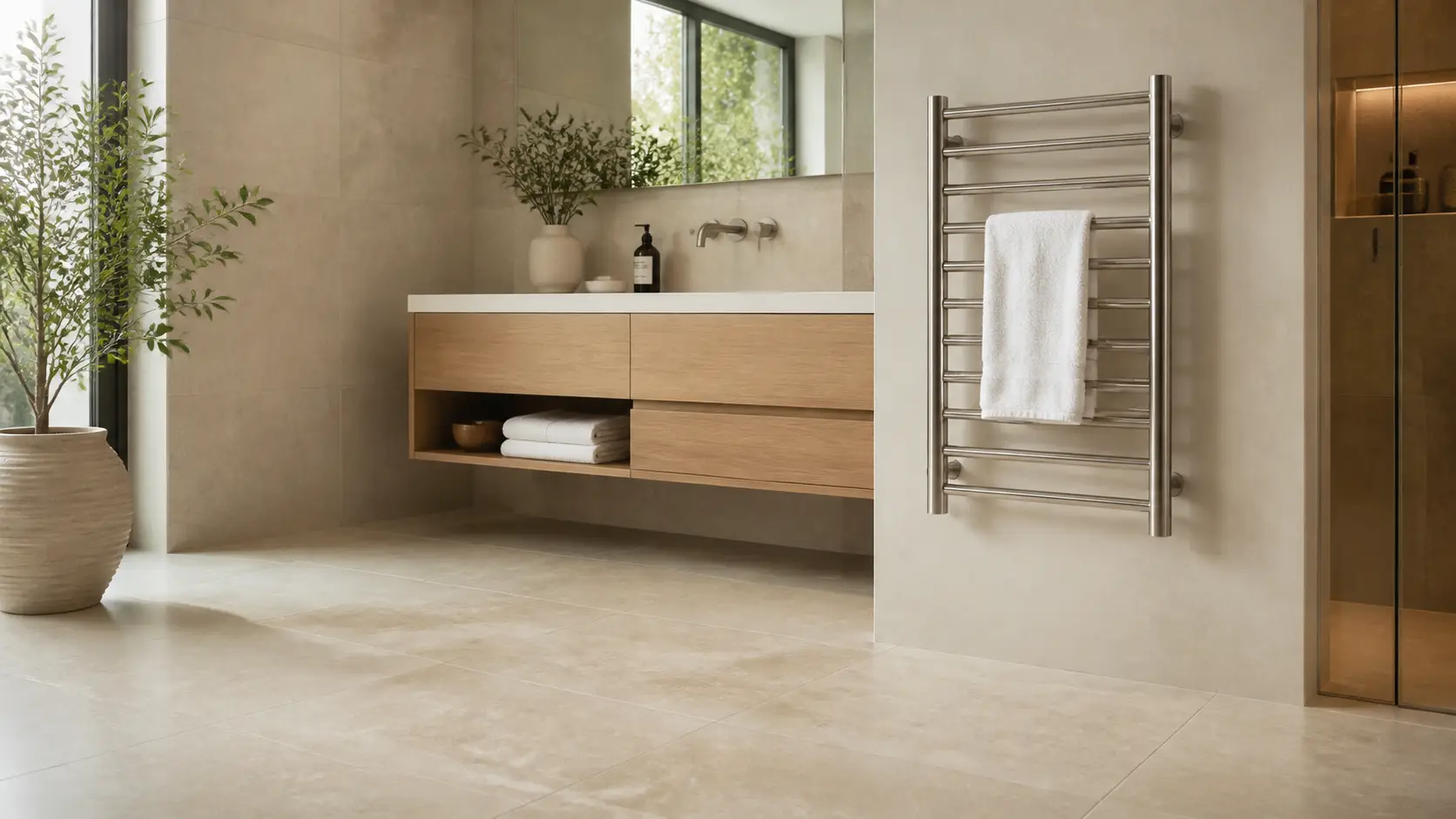
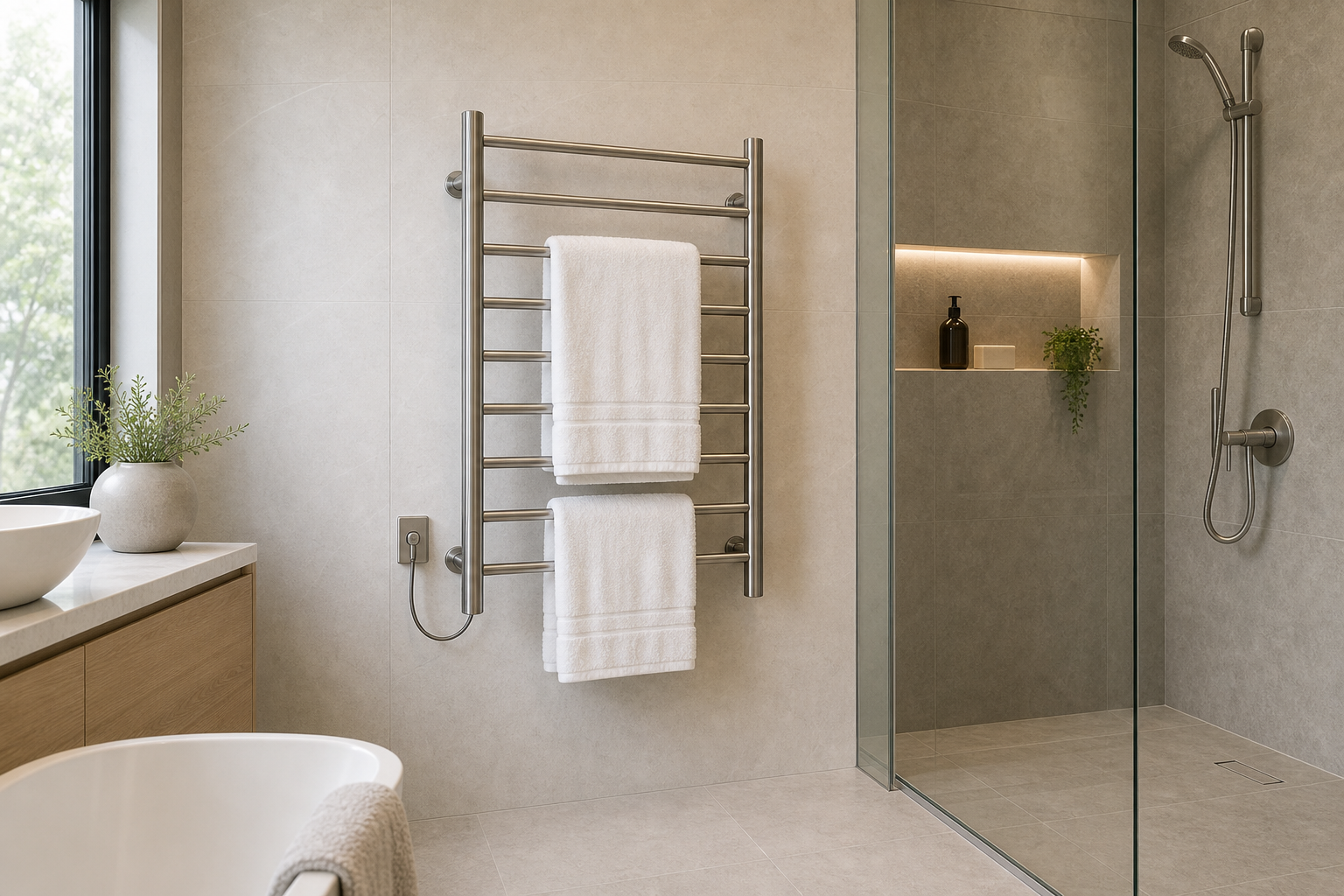
A heated towel rack used in a bathroom should have an IP rating that matches its installation position, exposure to splashes, and local electrical code. For many bathroom towel rails installed outside the shower or tub area, IP44 or IPX4 is commonly used because it indicates protection against splashing water. If the rack may be exposed to stronger spray, heavy humidity, or commercial use, a higher rating such as IP55 can be a more conservative choice. The product manual, bathroom zone, wiring method, and local code should always override a generic rule.
Do not treat "waterproof heated towel rack" as a precise specification. A safer buying question is: what IP rating does the product carry, where will it be installed, and who is confirming the electrical layout?
Quick IP rating guide for heated towel racks
| Bathroom location | Typical concern | Practical buying direction |
|---|---|---|
| Outside direct splash areas | Humidity and occasional splashes | Look for bathroom-rated products, commonly IP44 or higher |
| Near a shower opening | Splash risk and user reach | Confirm the bathroom zone, product manual, and electrician approval |
| Inside a wet enclosure | Direct water exposure | Do not assume a towel rack is suitable; use only products rated and approved for that exact location |
| Hotel or apartment project | Repeatable compliance across rooms | Specify the rating, installation zone, wiring method, and certification package |
| Plug-in upgrade | Outlet and cord location | Confirm GFCI/RCD protection and avoid unsafe cord routes |
The IP rating is only one part of the decision. A safe bathroom installation also needs suitable certification, correct wiring, proper grounding, splash-aware placement, and a qualified installer when hardwiring is involved.
What does an IP rating mean?
IP stands for ingress protection. It describes how well an enclosure resists solid objects and water. The first digit relates to solids such as dust or touch access. The second digit relates to water.
For heated towel racks, buyers usually care most about the second digit because bathrooms combine humidity, wet hands, shower spray, and metal fixtures.
| Rating | What it generally means | How it applies to towel racks |
|---|---|---|
| IP20 | Limited protection, not a bathroom splash rating | Not the normal choice for wet bathroom areas |
| IP44 | Protection against small solids and splashing water | Commonly seen on bathroom-rated towel rails |
| IPX4 | Water-splash protection; solids digit not declared | Useful when water protection is the key point |
| IP55 | Dust-protected and protected against water jets | More conservative for demanding or commercial settings |
| IP67 | Temporary immersion protection | Not usually necessary for a wall-mounted towel rack outside water |
Higher is not automatically better if the product is poorly installed. A correctly rated IP44 product in the right zone can be safer than a higher-rated product installed with a poor cord route, weak wall fixings, or incorrect wiring.
Is IP44 enough for a heated towel rail?
IP44 can be enough for many heated towel rails when the product is designed for bathroom use and installed in a suitable location away from direct water jets. It is often used for splash-resistant bathroom electrical products, but it should not be read as permission to install the rack anywhere in the room.
Before relying on IP44, check:
- The exact installation location.
- The product manual's bathroom restrictions.
- Whether the rack is plug-in or hardwired.
- Whether the outlet, junction box, switch, or controller is also suitable.
- Whether local code requires additional protection such as GFCI or RCD.
- Whether the installer agrees that the bathroom zone is appropriate.
For homeowners, this means the question is not simply "Is IP44 good?" The better question is "Is this IP44 towel rack approved for this wall, this distance from water, and this wiring method?"
Bathroom zones matter more than the label alone
Many bathroom electrical guides divide bathrooms into zones based on distance from the bath, shower, and direct water exposure. The details vary by country and code system, but the planning principle is consistent: electrical products closer to water need stricter protection and more careful installation.
Use this practical approach:
| Planning question | Why it matters |
|---|---|
| Is the rack inside or outside the shower enclosure? | Direct spray changes the risk level |
| Could someone touch the rack while standing in water? | User contact matters in wet spaces |
| Where is the power connection? | A rated rail does not make an unsafe outlet safe |
| Is the controller in a reachable wet area? | Controls need suitable placement and protection |
| Does local code define a restricted zone? | Code and product instructions override blog advice |
For a standard home bathroom, a heated towel rack is usually easiest to specify on a dry wall near the shower or tub, not inside the wet enclosure. For hotels, spas, and apartment projects, the same logic should be documented in the room specification so every unit is installed consistently.
IP rating vs certification: do not confuse them
An IP rating describes protection against ingress. Certification or listing addresses broader product safety requirements. A towel rack can advertise an IP rating while still needing the right safety certification for the target market.
For example:
- The IP rating helps answer "How does the enclosure resist splashes?"
- Electrical certification helps answer "Has the product been evaluated for electrical safety?"
- Installation instructions help answer "Where and how may this product be installed?"
- Local code helps answer "What is allowed in this building?"
B2B buyers should ask suppliers for the complete document set, not just a product image and a one-line IP claim. For hotels, apartments, and commercial projects, ask for the IP rating, electrical certificates, voltage and wattage, wiring diagram, installation manual, warranty terms, and packaging or labeling details.
Plug-in vs hardwired IP rating checks
Plug-in and hardwired heated towel racks create different safety questions.
| Installation type | What to check |
|---|---|
| Plug-in towel rack | Outlet location, GFCI/RCD protection, cord route, plug suitability, distance from splash zones |
| Hardwired towel rack | Junction box location, grounding, circuit protection, switch or timer placement, licensed electrician installation |
| Timer-controlled rack | Whether the timer or controller has a suitable rating and location |
| Smart-control rack | Whether the control module is suitable for humid bathroom conditions |
A plug-in towel warmer may be convenient, but the visible cord and outlet matter. A hardwired model may look cleaner, but it should be planned before tile and wall finishes are complete. CALITHREX's guide to plug-in vs hardwired heated towel rails is a useful next step when the IP rating question becomes an installation decision.
What about GFCI or RCD protection?
In wet areas, shock protection is a major part of electrical safety. In the United States, bathroom receptacles commonly require GFCI protection. In many other markets, RCD protection is part of bathroom electrical safety planning. The names and code details vary, so use the local rule for the project location.
For a heated towel rack, ask:
- Is the bathroom circuit protected as required?
- Has the outlet or breaker been tested?
- Is the product manual asking for specific protection?
- Is the installation hardwired or plug-in?
- Does a licensed electrician need to approve the final layout?
An IP rating does not replace GFCI or RCD protection. It also does not make a poor bathroom layout acceptable.
B2B specification checklist
For hotels, apartments, spas, and commercial bathroom projects, IP rating should be written into the specification instead of handled casually on site.
| Specification item | What to request |
|---|---|
| Product rating | IP rating shown in documentation and labeling |
| Safety certification | Target-market certificates such as UL, ETL, CE, UKCA, SAA, or other required approvals |
| Installation zone | Approved bathroom wall location and restricted areas |
| Electrical method | Plug-in, hardwired, voltage, wattage, circuit requirements |
| Control layout | Switch, timer, thermostat, or smart controller position |
| Maintenance plan | Replacement access, cleaning guidance, and warranty support |
| Room consistency | Repeatable placement across room types |
This matters because a project can fail on details even when the towel rack looks premium. A buyer may choose a beautiful finish, but if the rating, wiring, and room layout are not clear, contractors may install units inconsistently across rooms.
Common mistakes to avoid
- Buying a product described as "waterproof" without checking the actual IP rating.
- Assuming IP44 means the rack can go inside a shower.
- Checking the towel rail rating but ignoring the outlet, controller, or cord.
- Placing a plug-in rack where the cord crosses a wet walking path.
- Treating a product photo as installation guidance.
- Using the same bathroom layout in every hotel room without checking fixture variations.
- Forgetting that local electrical code and product manuals override general advice.
For placement planning, CALITHREX's article on heated towel rack installation height can help combine rating, towel drop, reach, and wall clearance into one installation decision.
FAQ
What IP rating should a heated towel rack have in a bathroom?
Many bathroom heated towel racks use IP44 or IPX4 when installed outside direct water exposure, but the correct rating depends on the location, bathroom zone, product manual, and local code.
Is IP44 waterproof?
No. IP44 generally means splash protection, not full waterproofing or immersion protection. Avoid using "waterproof" as the main buying standard.
Can a heated towel rack go next to a shower?
It may be possible if the product rating, bathroom zone, wiring method, and local code allow it. The safest default is to place the rack near the shower for convenience but outside direct spray.
Is IP55 better than IP44 for a towel rack?
IP55 provides stronger water-jet protection than IP44, so it can be a more conservative choice for demanding environments. It still must be installed correctly and matched to the product manual.
Do plug-in heated towel racks need GFCI protection?
In many bathroom settings, GFCI or similar shock protection is required or strongly expected. Check local electrical code and have the outlet tested if you are unsure.
What should hotel buyers ask suppliers?
Ask for the IP rating, safety certificates, installation manual, wiring diagram, voltage and wattage, approved bathroom placement, warranty details, and whether the same model can be specified consistently across room types.
Choosing the right CALITHREX direction
For most bathrooms, start with placement. Keep the heated towel rack outside direct spray where possible, choose a bathroom-rated product with a clearly stated IP rating, confirm the wiring method, and involve a qualified electrician for hardwired work.
For commercial projects, make the IP rating part of the specification package, not a late-stage question. CALITHREX heated towel rack selection should balance finish, towel capacity, installation height, electrical protection, and documentation so the final bathroom feels premium and works safely in daily use.
Sources
- NICEIC: Bathrooms and electrics
- Electrical Safety First: Bathroom safety
- U.S. Consumer Product Safety Commission: GFCI fact sheet
- CALITHREX: Plug-in vs hardwired heated towel rails
- CALITHREX: Heated towel rack installation height