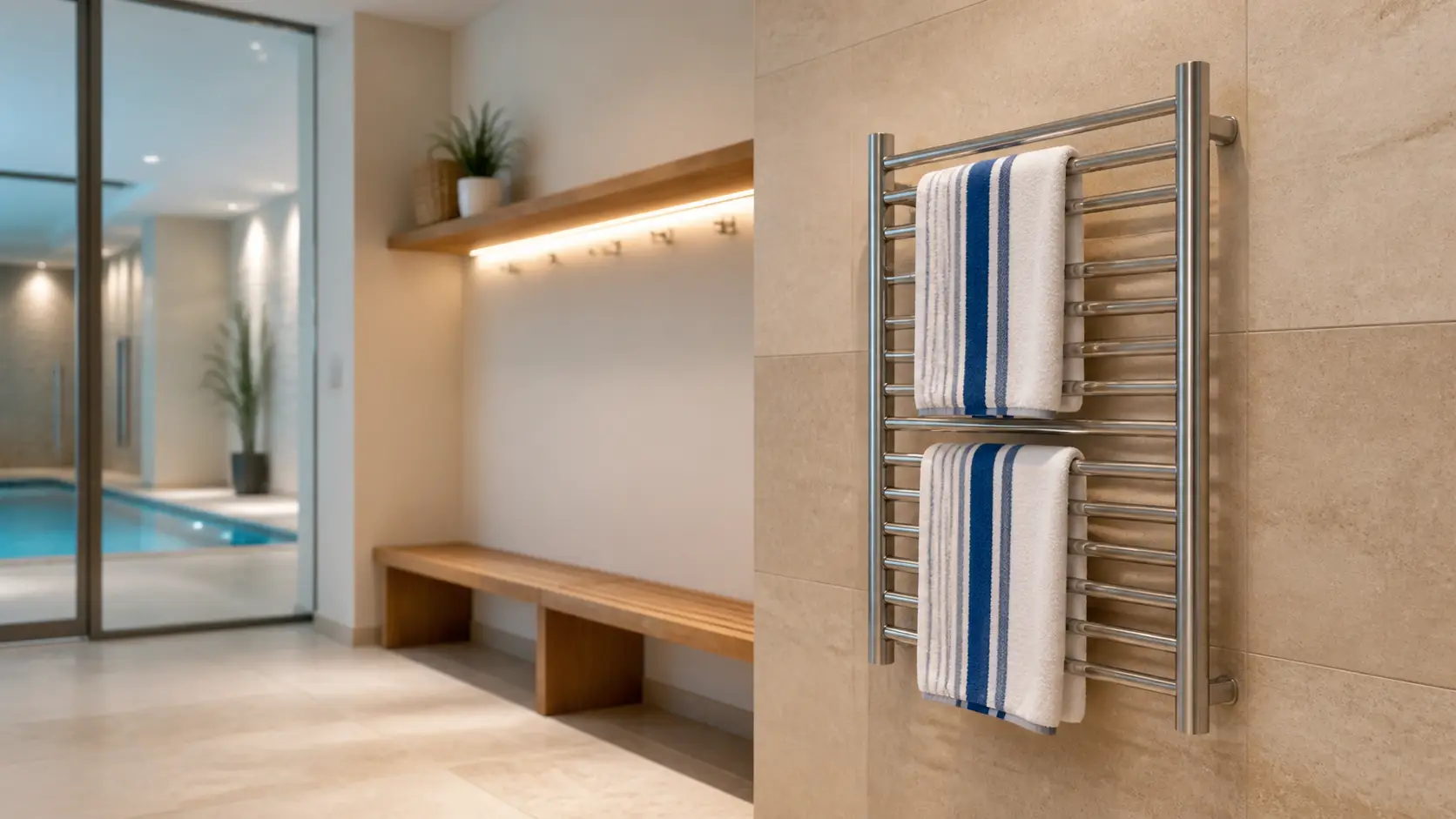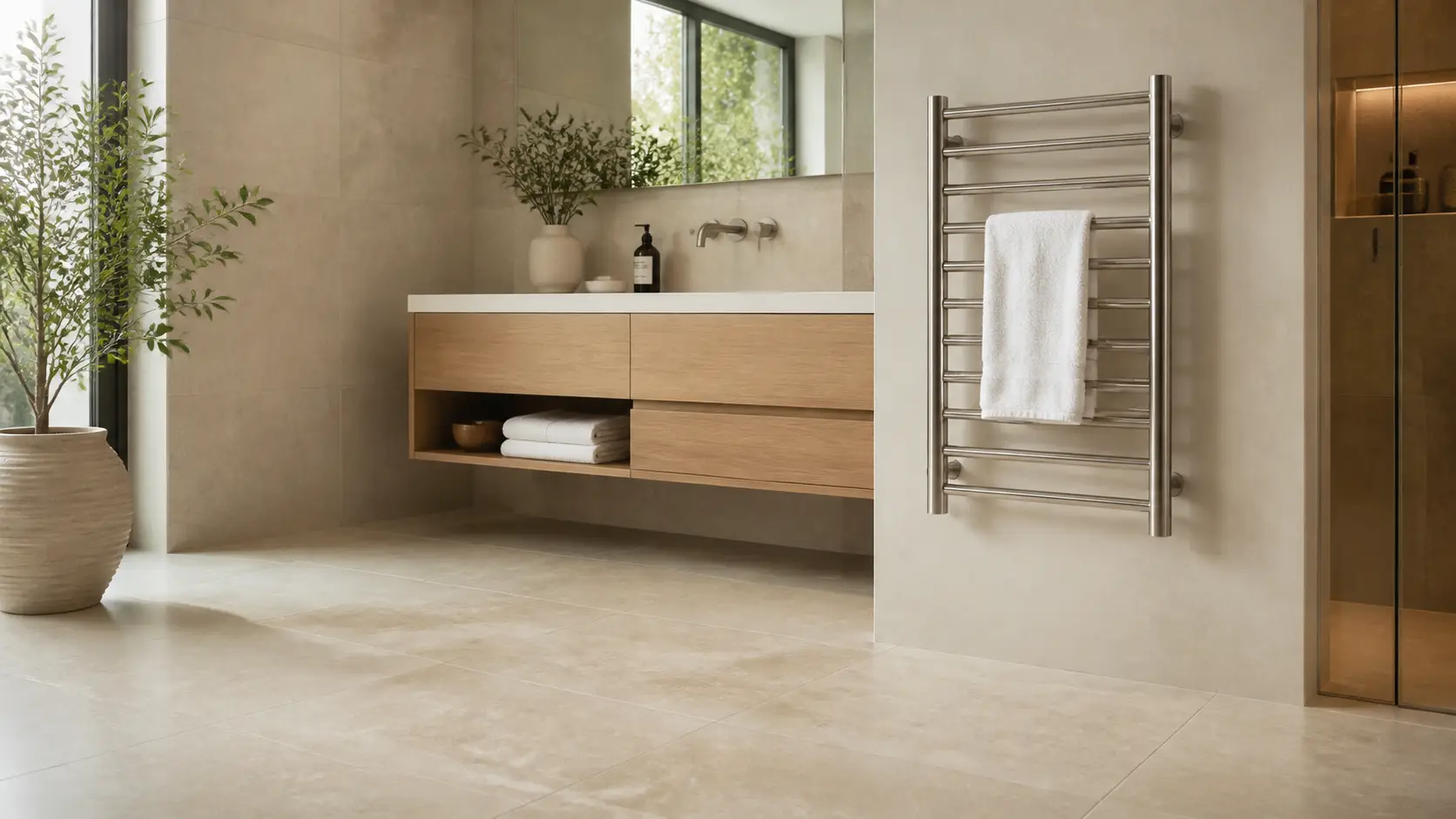
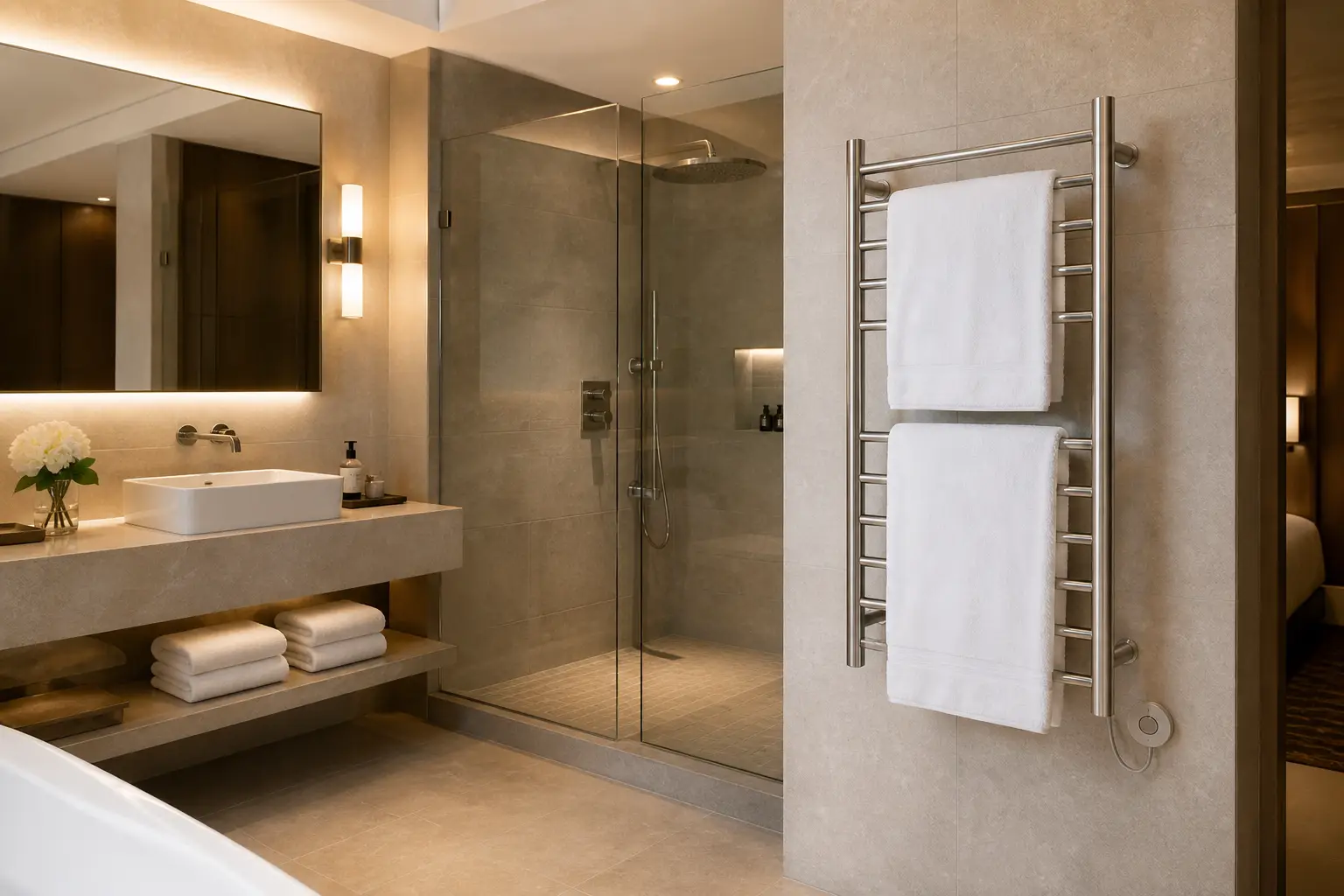
For hotels, heated towel racks are not just a decorative bathroom upgrade. They are a small fixture that affects guest comfort, towel drying, room perception, electrical planning, housekeeping routines, and long-term maintenance. The right unit should look like part of the room design, dry towels predictably between uses, and be simple enough for guests and housekeeping teams to understand.
The decision is different from buying one towel warmer for a home bathroom. A hotel buyer has to think in batches: room types, wall space, wiring method, safety rating, finish durability, spare parts, lead time, warranty terms, and whether the same model can be repeated across dozens or hundreds of rooms. That is why a hotel heated towel rack should be specified like a commercial bathroom fixture, not like a one-off accessory.
Why hotels are adding heated towel racks
Hospitality bathrooms are moving closer to the spa and wellness experience guests expect from premium homes and resorts. NKBA's 2026 bath trends coverage says 77% of respondents expect hotel or resort experiences to influence bath design, while Houzz's 2025 U.S. Bathroom Trends Study reports that 36% of renovated bathrooms include wellness-oriented features.
Market data also supports the commercial case. Grand View Research reports that electric heated towel rails held 70.7% of the market in 2024, and that commercial applications represented the largest revenue share. For hotel buyers, that combination matters: electric models are easier to plan room by room, while commercial demand shows the category is no longer a niche luxury add-on.
The practical value is straightforward:
- Guests notice warm, dry towels after a shower.
- Towels dry faster when they are hung with airflow around them.
- A heated rack can reduce musty towel complaints in humid bathrooms.
- The fixture helps a standard guest bathroom feel more premium.
- A consistent model across rooms simplifies purchasing and maintenance.
Start with the room type, not the product catalog
Before comparing suppliers, divide the project by room type. A boutique hotel with 30 rooms may need one premium model across the entire property. A large hotel may need different specifications for standard rooms, suites, spa rooms, accessible rooms, and staff or pool facilities.
Use this basic planning table before choosing a model:
| Room type | Recommended rack style | Buyer priority |
|---|---|---|
| Standard guest room | Compact wall-mounted electric rack | Space efficiency and simple controls |
| Premium room or suite | Larger wall-mounted or ladder-style rack | Design impact and towel capacity |
| Spa or wellness room | Wider rack with timer or thermostat | Comfort, drying performance, and guest experience |
| Pool or gym area | Commercial stainless steel rack | Durability and towel turnover |
| Accessible room | Carefully placed wall-mounted rack | Reach, clearance, and safety |
The common mistake is choosing the largest or most luxurious-looking rack first. Hotels should first confirm how many towels the guest actually uses, where wet towels are placed after showering, and whether the wall can support a safe and comfortable installation height.
What specifications should hotel buyers request?
A commercial heated towel rack quote should include more than size and price. At minimum, ask suppliers for the following specification set:
| Specification | Why it matters |
|---|---|
| Dimensions | Confirms fit beside vanity, shower, bathtub, or entry wall |
| Wattage | Helps estimate energy load across many rooms |
| Voltage | Must match market and project electrical design |
| Wiring type | Hardwired is cleaner for hotels; plug-in may suit retrofits |
| Surface temperature range | Affects comfort, towel drying, and guest safety |
| IP rating | Important for bathroom wet zones and placement planning |
| Material | Stainless steel is usually preferred for humid commercial use |
| Finish | Must resist fingerprints, cleaning chemicals, and visible wear |
| Timer or thermostat options | Helps control energy use and guest operation |
| Warranty and spare parts | Critical for multi-room projects |
| Certifications | Required for import, code compliance, and procurement approval |
For U.S. hotel projects, buyers should discuss UL or ETL listing, GFCI protection, installation zones, and local electrical code with the project electrician. For EU, UK, Australia, or mixed-market projects, ask about CE, UKCA, SAA, RoHS, and region-specific documentation as applicable.
Hardwired or plug-in for hotels?
For new hotel construction and major renovations, hardwired heated towel racks usually make more sense. They create a cleaner look, avoid visible cords, reduce guest tampering, and fit better into professional electrical plans.
Plug-in racks can still be useful in limited cases:
- Small boutique retrofits where walls are already finished.
- Short-term pilot rooms before a wider rollout.
- Non-guest spaces where aesthetics matter less.
- Temporary spa, pool, or wellness areas.
For guest rooms, the safer default is to plan hardwired installation early with the electrical contractor. Waiting until after tile and wall finishes are complete often limits placement options or raises labor cost.
Wattage and energy planning across many rooms
One towel rack may draw modest power. A hotel with 80 or 200 rooms is different. Buyers should ask for the rated wattage of each model and estimate usage by room type.
Use this simple formula:
Daily kWh = wattage / 1000 x hours used per day. Monthly cost = daily kWh x 30 x electricity rate x number of rooms.
Example: if a 120W rack runs 4 hours per day in 100 rooms, that is:
0.12 kW x 4 hours x 30 days x 100 rooms = 1,440 kWh per month.
The final cost depends on local electricity rates, occupancy, timer settings, and whether housekeeping turns units off between stays. That is why timers, thermostats, or simple operating instructions can matter as much as the rack's rated wattage.
Finish and material choices for hospitality bathrooms
Hotels need finishes that look good after repeated cleaning. Chrome and polished stainless steel are familiar and easy to match with many bathroom fixtures. Brushed stainless steel hides fingerprints better and fits modern hotel interiors. Matte black and brushed gold can look premium, but they need stronger finish quality control because scratches and chemical marks can be more visible.
For humid hotel bathrooms, stainless steel is usually the safest material direction. It offers good corrosion resistance, a clean commercial look, and stronger long-term durability than low-grade plated materials. Buyers should still ask what grade of stainless steel is used, how the finish is applied, and what cleaning chemicals should be avoided.
Guest safety and placement
Placement is one of the most important hotel buyer decisions. A rack that looks good in a rendering may be awkward or unsafe in a real guest room.
Check these points before approving drawings:
- Keep the rack away from direct water spray unless the model and installation zone allow it.
- Avoid locations where guests may bump into the rails when entering the shower or toilet area.
- Confirm towel clearance so wet towels do not touch the floor.
- Place controls where guests can understand them without instructions.
- Use GFCI protection where required.
- Avoid mounting the rack behind a door if airflow is poor.
- For accessible rooms, confirm reach range and clear floor space with the project team.
A heated towel rack should make the bathroom feel easier to use, not more complicated.
Supplier questions before placing a hotel order
Hotel buyers should treat the supplier conversation as a project risk check. Ask direct questions before ordering samples:
- Can you provide the same model and finish across the full room count?
- What is the lead time for sample, pilot order, and bulk production?
- What certifications and test reports are available for our market?
- Can you provide installation drawings and wiring diagrams?
- What is the warranty period for commercial use?
- Are spare parts, controllers, and mounting kits available after delivery?
- Can packaging be labeled by room type, floor, or project phase?
- What is the process if a finish batch does not match?
If a supplier cannot answer these questions clearly, the low unit price may not be worth the project risk.
FAQ
Are heated towel racks worth installing in hotel guest rooms?
They can be worth it for hotels that compete on bathroom comfort, wellness, or premium room experience. The strongest fit is boutique hotels, resorts, spa properties, luxury apartments, and upgraded suite categories.
What heated towel rack size is best for luxury hotel bathrooms?
There is no single best size. For standard rooms, choose a compact wall-mounted model that fits one or two bath towels. For suites and spa rooms, a taller or wider rack gives better visual impact and towel capacity.
Should hotels choose hardwired heated towel racks?
In most new-build and renovation projects, yes. Hardwired installation looks cleaner, avoids exposed cords, and allows the rack to be coordinated with wall switches, timers, or bathroom electrical plans.
Do hotel towel warmers need timers?
Timers are strongly recommended. They help control energy use, reduce unnecessary runtime, and make operation easier for housekeeping or guests.
What certifications should commercial heated towel racks have?
That depends on the target market. U.S. projects commonly ask about UL or ETL listing; European projects may require CE; other markets may require UKCA, SAA, RoHS, or local documentation. Always confirm with the importer, electrician, or project compliance team.
Final advice for hotel buyers
The best heated towel rack for a hotel is not always the biggest or most decorative one. It is the model that fits the room, meets electrical and safety requirements, matches the finish schedule, dries towels predictably, and can be supplied consistently across the full project.
For hotel, spa, apartment, and commercial bathroom projects, Calithrex can help compare size, finish, wiring, and project packaging options before bulk ordering. Start with the room type, towel count, target market, and installation method; then choose the rack that fits the project rather than forcing the project to fit the rack.