Heated Towel Rack IP Rating Guide: What Those Numbers Actually Mean
Every heated towel rail sold in Europe carries an IP rating. Most product pages list it without explanation. Buyers see “IP24” or “IP44” and have no idea whether that rail can go near a shower, above a bath, or only in a dry corner of the bathroom.
We have had distributors return entire shipments because the IP rating did not match local electrical codes. We have had installers refuse to fit a rail because they were unsure if the rating allowed placement where the customer wanted it. The IP rating is not a detail. It determines where the product can legally and safely be installed.
This guide breaks down what IP ratings mean for heated towel rails, which rating suits which bathroom zone, and how to specify the right one for your market.
What Is an IP Rating?
IP stands for Ingress Protection. The rating consists of two digits:
- First digit: Protection against solid objects (dust, tools, fingers)
- Second digit: Protection against liquids (water, moisture)
Higher numbers mean better protection. A rating of IP00 offers no protection. IP68 is fully dust-tight and can withstand submersion.
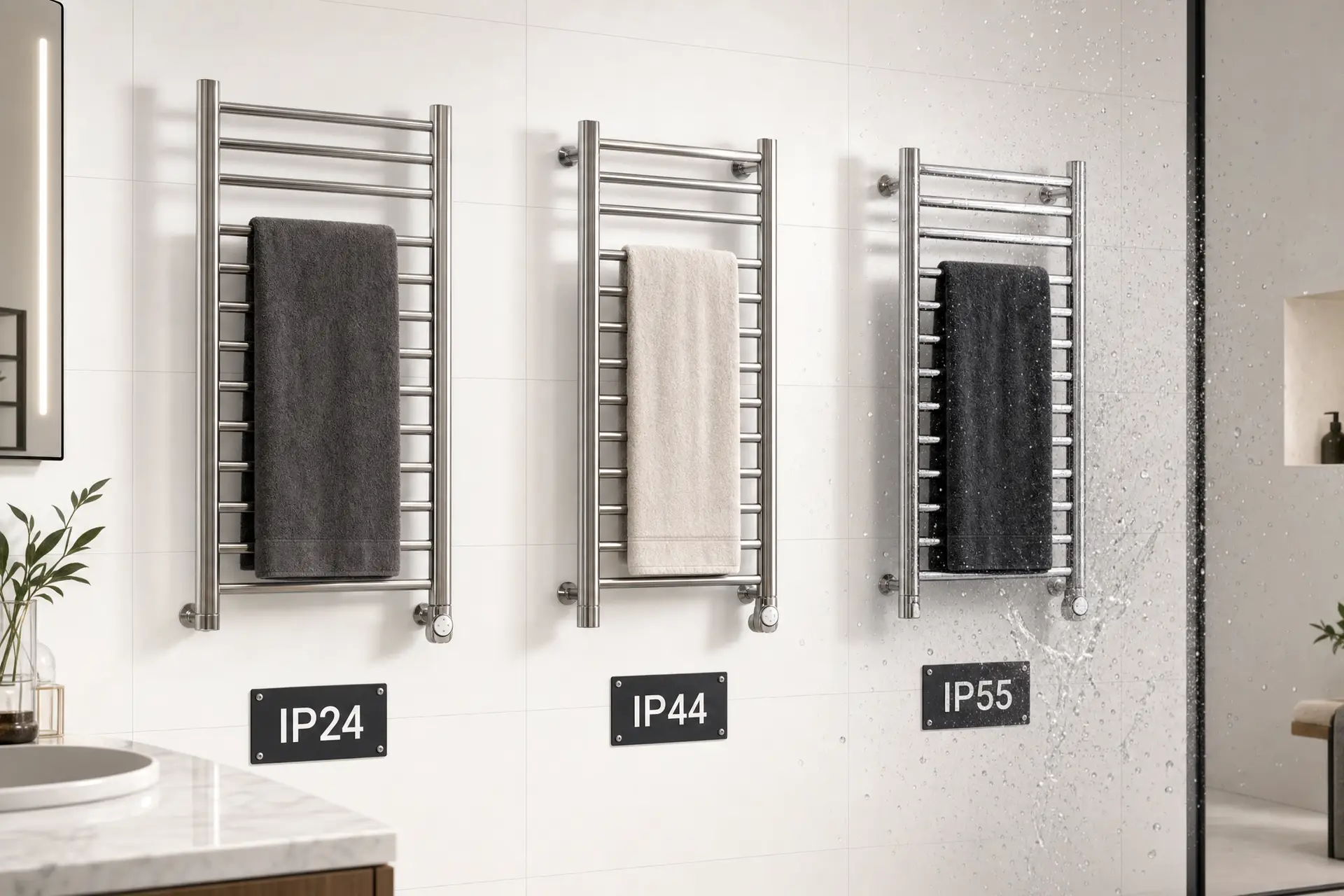
For heated towel rails, the relevant ratings are IP24, IP44, and IP55. Each suits different bathroom locations and regulatory environments.
IP24: The Minimum for Bathroom Use
An IP24 rating means:
- 2: Protection against solid objects larger than 12.5mm (fingers or similar)
- 4: Protection against water splashing from any direction
This is the baseline rating for electrical equipment in bathrooms under European standards. A heated towel rail with IP24 can handle splashing water but cannot withstand direct water jets or immersion.
Where it can be installed:
- Bathroom Zone 3 (general bathroom areas, away from direct water sources)
- Outside the perimeter of the bath or shower
- Above washbasins where splashing is possible but not direct spray
Where it cannot be installed:
- Inside the shower enclosure
- Directly above the bath where shower spray reaches it
- Any location where water jets or sustained spray occur
IP24 is common on budget heated towel rails and on models designed for guest bathrooms or cloakrooms where exposure to water is minimal. It is not suitable for wet room installations or for placement inside shower enclosures.
IP44: The Standard for Most Bathrooms
An IP44 rating means:
- 4: Protection against solid objects larger than 1mm (tools, wires, most particles)
- 4: Protection against water splashing from any direction
This is the most common rating for heated towel rails sold in the UK and EU. The improvement from IP24 to IP44 is in the first digit. IP44 offers better protection against small solid objects entering the casing, which matters in dusty construction environments and over long-term use.
Where it can be installed:
- Bathroom Zone 2 (the horizontal space immediately outside the bath or shower, up to 0.6m horizontally and 2.25m vertically from the bath rim or shower floor)
- Above washbasins
- General bathroom walls where occasional splashing occurs
Where it cannot be installed:
- Inside the shower enclosure (Zone 0 or Zone 1)
- Directly under showerheads where water streams hit the rail continuously
- Locations with water jets or sustained spray
IP44 covers the vast majority of residential bathroom installations. A towel rail with this rating can go on the wall next to the bath or shower, provided it sits outside the direct spray zone. It cannot go inside the enclosure itself.
IP55: Protection Against Water Jets
An IP55 rating means:
- 5: Protection against dust (limited ingress permitted, but dust cannot enter in harmful quantities)
- 5: Protection against water jets from any direction
This is a significant step up from IP44. IP55 can withstand directed water jets, which means it survives cleaning with a handheld showerhead or bathroom spray cleaner without moisture entering the electrical components.
Where it can be installed:
- Bathroom Zone 2 (same as IP44)
- Locations where the rail may be sprayed during bathroom cleaning
- Commercial bathrooms with high-pressure cleaning protocols
- Areas with higher humidity and condensation than standard residential bathrooms
Where it cannot be installed:
- Inside the shower enclosure (still not rated for submersion or sustained direct spray)
- Fully wet room environments without additional protection
IP55 is overkill for most homes but makes sense for hotels, gyms, spas, and any commercial setting where cleaning staff use spray equipment. It also provides a longer service life in coastal or humid climates where salt air or persistent moisture accelerates wear on lower-rated units.
Bathroom Zones: Where Each Rating Belongs
European electrical safety standards divide bathrooms into zones based on proximity to water sources. The zone determines what IP rating equipment must have.
| Zone | Definition | Permitted Equipment | Typical IP Rating Required |
|---|---|---|---|
| Zone 0 | Inside the bath or shower basin | None (no electrical equipment) | N/A |
| Zone 1 | Above the bath or shower, up to 2.25m | SELV (max 12V AC or 30V DC) | IPX7 |
| Zone 2 | 0.6m horizontal from zone 1, up to 2.25m | Towel rails, fans, lights | IPX4 (IP44) |
| Zone 3 | Remaining volume outside zones 0-2 | General electrical equipment | IPX0 (no special rating) |
Heated towel rails are not permitted in Zone 0 or Zone 1. They belong in Zone 2 or Zone 3. This means IP24, IP44, and IP55 are all legally acceptable for towel rail installation, provided the rail sits in the correct zone.
The practical difference is durability and peace of mind. An IP24 rail in Zone 2 is legal but risky if the bathroom has poor ventilation or aggressive cleaning habits. An IP44 rail in Zone 2 is the standard recommendation. An IP55 rail in Zone 2 adds a safety margin for commercial use.
How IP Rating Affects Product Design
The IP rating is not just a label. It changes how the manufacturer builds the rail.
Sealing: Higher IP ratings require better gaskets around the heating element housing, the wiring entry points, and any control interfaces. An IP24 rail may have basic rubber seals. An IP55 rail needs precision-molded gaskets and possibly potting compound around electrical connections.
Ventilation vs. sealing trade-off: Heated towel rails need some airflow to dissipate heat. A completely sealed unit traps heat and reduces efficiency. Manufacturers balance sealing with ventilation by using labyrinth seals or breather membranes that allow air passage while blocking water ingress.
Control placement: Rails with built-in timers or thermostats need additional sealing around the control module. A rail rated IP24 may have the control module in a less exposed position. A rail rated IP55 can have controls on the front face because the sealing is robust enough to handle direct spray.
Cost impact: Moving from IP24 to IP44 adds roughly 5-8% to manufacturing cost. Moving from IP44 to IP55 adds another 10-15% due to precision sealing, testing, and certification. For high-volume residential sales, IP44 is the sweet spot. For commercial or premium residential, IP55 justifies the higher price.
IP Rating and Market Regulations
Different markets treat IP ratings differently.
UK and EU: IP rating is mandatory for electrical bathroom equipment. Products must be tested and certified by an accredited lab. The rating must be printed on the product label and in the installation manual. Trading standards can remove non-compliant products from sale.
North America: The US does not use IP ratings. Instead, UL and ETL listings focus on overall safety testing. A product with IP44 certification from Europe will not automatically carry UL approval. If you are exporting to the US, you need separate certification. However, the IP rating still matters for buyer confidence and for Canadian markets where CSA standards reference IP ratings.
Australia and New Zealand: AS/NZS standards reference IP ratings for bathroom electrical equipment. IP44 is the minimum for Zone 2. Watermark certification requires IP testing as part of the approval process.
Middle East and Asia: Many Gulf states adopt European standards and require IP ratings. Asian markets vary. Japan uses JIS protection ratings, which map closely to IP codes. China has its own GB standards but often accepts IP ratings for imported products.
For B2B buyers, understanding the target market’s regulatory requirements is essential. A container of IP24 rails may sell in budget EU markets but cannot be distributed in the UK or Australia if the importer needs Zone 2 installation flexibility.
Specifying the Right IP Rating for Your Project
Residential developments (apartments, houses): IP44 is the safe default. It covers legal requirements for Zone 2 installation and handles normal bathroom humidity and splashing. Specify IP55 only if the project targets the premium segment or if the bathrooms have open showers with minimal enclosure.
Hotels and hospitality: IP44 for standard rooms. IP55 for spa bathrooms, poolside changing rooms, and any bathroom where cleaning staff use spray equipment. The extra cost of IP55 pays back in reduced maintenance and longer replacement cycles.
Healthcare (hospitals, care homes): IP55 minimum. Healthcare cleaning protocols use aggressive disinfectants and high-pressure spray. Electrical equipment in patient bathrooms must withstand frequent wet cleaning without degradation.
Marine and coastal: IP55 or higher. Salt air corrodes seals and penetrates poorly protected housings. Marine-grade heated towel rails need IP55 plus corrosion-resistant finishes like 316 stainless steel or powder-coated aluminum.
Retail ranges: Stock IP44 as your volume seller. Offer IP24 as a budget option for cloakrooms and small bathrooms. Offer IP55 as a premium upgrade for buyers who want maximum durability or plan to install near open showers.
Testing and Certification: What the Numbers Mean in Practice
IP ratings are not theoretical. They are tested in certified labs using standardized equipment.
Solid object testing (first digit): A test probe of specified size attempts to enter the enclosure. For digit 2, a finger-sized probe. For digit 4, a 1mm wire. For digit 5, a dust chamber with vacuum applied to the enclosure to check for ingress.
Water testing (second digit): Digit 4 uses an oscillating tube that sprays water from multiple angles for 10 minutes. Digit 5 uses a nozzle with a 6.3mm jet, spraying 12.5 liters per minute from 3 meters distance for at least 3 minutes.
A manufacturer cannot self-declare an IP rating for electrical products sold in the EU. The rating must come from a notified body or accredited test lab. Ask your supplier for the test report number and the certifying body. Common bodies include Intertek, SGS, TÜV, and BSI.
Common Mistakes When Buying by IP Rating
Assuming higher is always better: IP55 costs more and may be unnecessary. A standard family bathroom does not need jet-proof sealing. Overspecifying wastes margin and can confuse buyers who wonder why your rail costs more than competitors.
Ignoring zone placement: A buyer installs an IP24 rail inside a shower enclosure because they assumed any bathroom-rated product could go anywhere. The rail fails. The distributor blames the manufacturer. The manufacturer points to the installation manual. Everyone loses.
Mixing IP ratings in the same range: If you stock three models with different IP ratings, clearly label which is which on packaging and datasheets. Installers and end users need to know at a glance what they are buying.
Not checking certification validity: Fake IP ratings exist. A supplier may print IP44 on a product that was never tested. Verify the certificate with the issuing body. Most accredited labs have online certificate databases.
Final Thoughts
IP rating is not a marketing feature. It is a safety and compliance specification that determines where a heated towel rail can be installed and how long it will last in that environment.
IP24 suits dry bathrooms and budget installations. IP44 covers standard residential and light commercial use. IP55 handles aggressive cleaning, high humidity, and commercial settings where durability matters more than upfront cost.
For B2B buyers, the right approach is simple: match the IP rating to the installation zone and the cleaning regime. Specify IP44 for volume residential. Specify IP55 for commercial, healthcare, and coastal projects. Keep IP24 in the range only for cloakrooms and dry bathroom applications where cost sensitivity is high.
The buyers who understand IP ratings make better specifications, face fewer returns, and build stronger reputations with their own customers. The ones who ignore it end up with failed installations, regulatory problems, and damaged relationships.
Need heated towel rails with certified IP ratings for your market? We manufacture IP24, IP44, and IP55 models in stainless steel, aluminum, and brass, with full test reports from accredited labs. Custom finishes, OEM branding, and bulk pricing available. Contact us for datasheets and certification documents.