Do Heated Towel Racks Use a Lot of Electricity? The Real Numbers
This is the question every buyer asks before plugging one in. The short answer is no. A heated towel rack does not use a lot of electricity compared to most household appliances. But the full answer depends on wattage, usage hours, and what you are comparing it against.
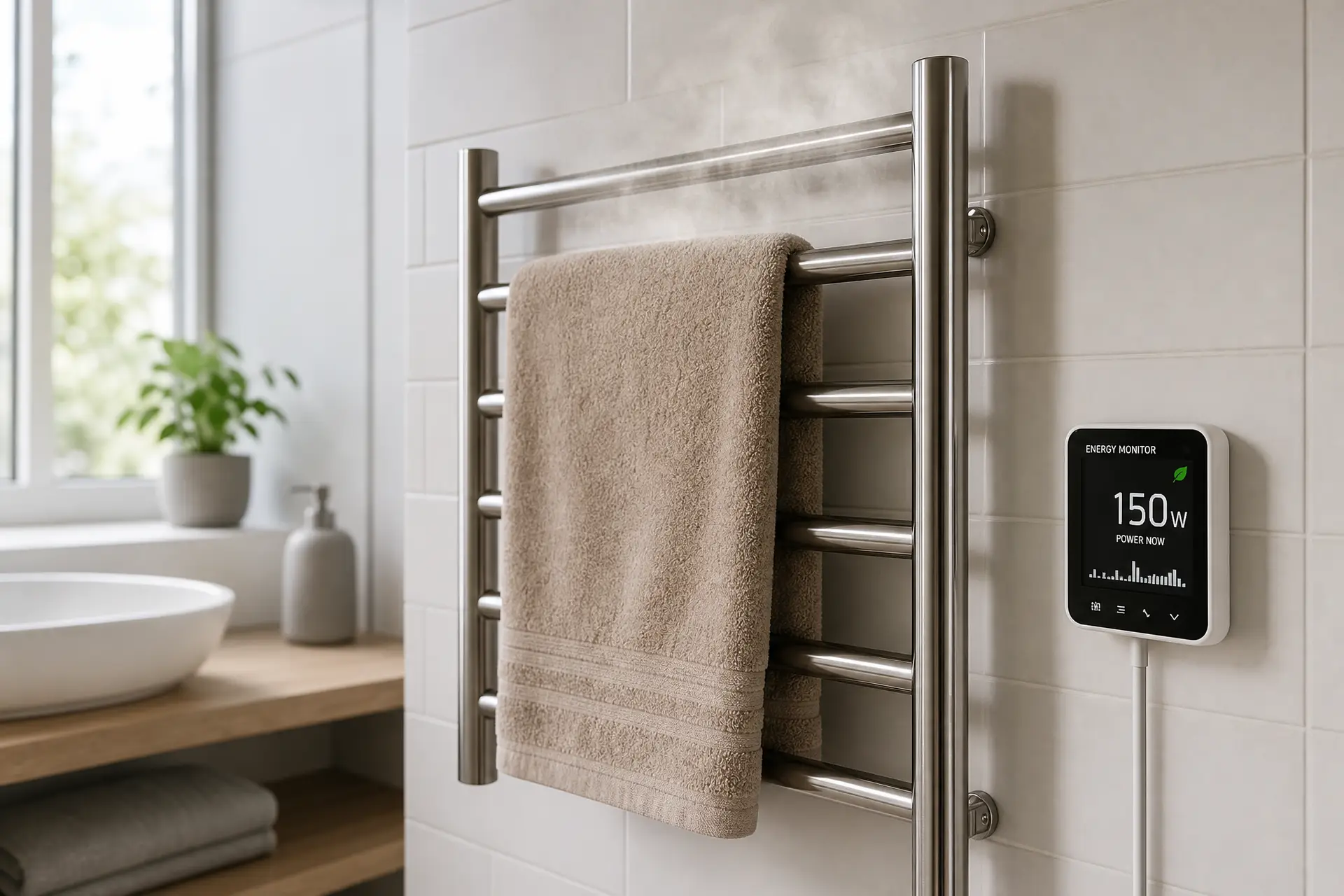
A standard heated towel rail draws between 100W and 200W. That is roughly the same as a bright incandescent bulb or a laptop charger. It is nowhere near the 2,000W+ draw of an electric heater, a tumble dryer, or a hairdryer. If you run a 150W rail for four hours a day, it consumes 0.6 kWh daily. At the US average electricity rate of 16 cents per kWh, that costs about 10 cents a day, or three dollars a month.
The confusion comes from expectations. People see a metal rail that gets hot and assume it must guzzle power like a space heater. It does not. The heating element inside a towel rail is small, focused, and thermostatically controlled. It is designed to warm towels, not heat the room.
How Much Power Do They Actually Draw?
Most heated towel rails on the market fall into three wattage brackets:
| Size | Wattage | Typical Use Case |
|---|---|---|
| Compact | 80-120W | Small bathrooms, guest ensuites, single towel |
| Standard | 150-200W | Family bathrooms, two towels, moderate humidity |
| Large / High-output | 250-400W | Large bathrooms, multiple towels, room heating assist |
The compact 100W unit is the most efficient for drying towels. It produces enough heat to evaporate moisture from a damp towel in three to four hours without wasting energy. The 150W standard unit is the sweet spot for most households. It dries towels faster and provides a slight warmth boost to the bathroom. The 250W+ models are overkill for towel drying alone. Buyers choose them when they want the rail to double as a bathroom heater.
Daily and Monthly Cost Breakdown
Here is what running a heated towel rail actually costs at different usage levels. We will use the US average rate of 16 cents per kWh. Adjust for your local rate.
| Wattage | Daily Use | Daily kWh | Daily Cost | Monthly Cost |
|---|---|---|---|---|
| 100W | 4 hours | 0.4 kWh | $0.06 | $1.80 |
| 150W | 4 hours | 0.6 kWh | $0.10 | $3.00 |
| 200W | 4 hours | 0.8 kWh | $0.13 | $3.90 |
| 150W | 8 hours | 1.2 kWh | $0.19 | $5.70 |
| 150W | 24 hours | 3.6 kWh | $0.58 | $17.40 |
Four hours per day is the realistic usage pattern for most households. You turn the rail on after the morning shower, let it dry the towels, and switch it off before leaving. A timer or smart plug makes this automatic. At four hours daily, even a 200W unit costs less than a cup of coffee per month.
Running a 150W rail continuously, 24 hours a day, pushes the monthly cost to around $17. Some people do this in winter for the constant warmth. It is still cheaper than running a 2,000W electric heater for the same period, which would cost over $230 per month.
Comparison: Towel Rail vs. Other Drying Methods
The real question is not whether a heated towel rack uses a lot of electricity. It is whether it uses less than the alternatives.
Tumble dryer: A standard vented or condenser dryer draws 2,000-3,000W per cycle. A 45-minute load consumes 1.5-2.25 kWh, costing 24-36 cents. If you wash and dry towels twice a week, that is 52 cents weekly, or $2.08 monthly. The heated towel rack at four hours daily costs $3.00 monthly. The dryer is slightly cheaper per month but wears out towels faster and cannot dry them between washes.
Radiator drying: If you hang towels on a central heating radiator, the cost is buried in your gas or heating bill. A typical radiator outputs 1,500-2,000W. Towels block heat output, forcing the boiler to work harder. The indirect cost is hard to measure but real. Towels also trap moisture against the radiator cover, creating condensation and potential mold.
Air drying on a rack: Free, but slow. A thick bath towel can take 12-24 hours to dry in a humid bathroom. During that time, the towel breeds bacteria and smells musty. You either reuse a damp towel or wash it more frequently, increasing laundry costs.
The heated towel rail sits in the middle. It costs a few dollars a month, dries towels in a few hours, and keeps them fresh between washes. For households that value convenience and hygiene, it is the most balanced option.
What Affects Electricity Consumption?
Three factors determine how much power your towel rail actually uses:
Wattage rating: This is the maximum draw when the element is fully on. A 150W rail cannot use more than 150W per hour. But it can use less. Thermostatic rails cycle on and off once they reach target temperature. In practice, a 150W rail may only draw power for 60-70% of the time it is switched on.
Usage duration: This is the biggest variable. A rail on a timer for four hours daily uses one-sixth the electricity of a rail left on 24 hours. Smart controls and programmable timers pay for themselves quickly.
Bathroom environment: A cold, damp bathroom forces the rail to work harder to reach target temperature. Good ventilation reduces humidity and lets the rail dry towels faster, cutting running time. A rail in a warm, dry cloakroom uses less energy than the same rail in a steamy bathroom with no window.
Thermostats and Timers: How They Cut Costs
A basic heated towel rail with no controls runs at full power whenever it is switched on. Adding a thermostat or timer reduces consumption without reducing convenience.
Thermostatic control: The rail heats to a set temperature, then cycles off. It turns back on when the temperature drops. This reduces actual power draw by 30-40% compared to continuous operation. A 150W thermostatic rail uses roughly the same electricity as a 100W non-thermostatic rail.
Timer: A simple mechanical or digital timer switches the rail on for set hours. Four hours in the morning and four in the evening covers most household shower patterns. The rail is off overnight and during the workday. This cuts daily consumption by 50-66% compared to continuous use.
Smart control: Wi-Fi enabled rails let you set schedules from your phone. Some models detect humidity and switch on automatically when towels are damp. Others learn your routine and pre-heat before your usual shower time. These features optimize energy use without requiring you to remember to press a button.
The Environmental Angle
For buyers concerned about carbon footprint, the heated towel rail is a low-impact appliance. At 150W and four hours daily, annual consumption is 219 kWh. That produces roughly 85 kg of CO2 with the current US grid mix. By comparison, a tumble dryer used twice weekly consumes 234 kWh annually, producing 91 kg of CO2, while wearing out towels faster.
The rail also reduces laundry frequency. Dry, warm towels stay fresh longer. Many households find they wash towels weekly instead of every two or three days. Less laundry means less water, detergent, and dryer use. The savings are small per household but add up across millions of installations.
What to Tell Your Customers
If you are a retailer, installer, or distributor, here is how to answer the electricity question:
For budget-conscious buyers: Emphasize the low running cost. A 150W rail on a timer costs under $4 monthly. That is less than a streaming subscription.
For eco-conscious buyers: Highlight the reduced laundry angle. Warm towels stay fresh longer, cutting wash cycles and detergent use.
For buyers comparing to dryers: Point out the convenience gap. A dryer cannot dry a towel at 6 AM before work. A heated rail can.
For commercial buyers: Calculate the per-room cost for hotels or care homes. A 150W rail in 100 rooms, each running 8 hours daily, costs roughly $570 monthly total. That is a reasonable operational cost for the guest satisfaction and hygiene benefits.
Final Thoughts
A heated towel rack does not use a lot of electricity. It draws a fraction of the power of a dryer or heater and costs a few dollars a month to run. The key to keeping costs low is matching wattage to bathroom size, using timers or thermostats, and running the rail only when needed.
For most households, the monthly running cost is between $2 and $6. That buys dry, warm towels every morning, reduced laundry, and a fresher bathroom. The value is clear. The electricity use is not.
Looking for energy-efficient heated towel rails? We manufacture thermostatic and timer-controlled models from 80W to 300W, with smart Wi-Fi options for precise scheduling. Custom finishes, OEM branding, and bulk pricing for distributors and developers. Contact us for technical datasheets and wholesale rates.