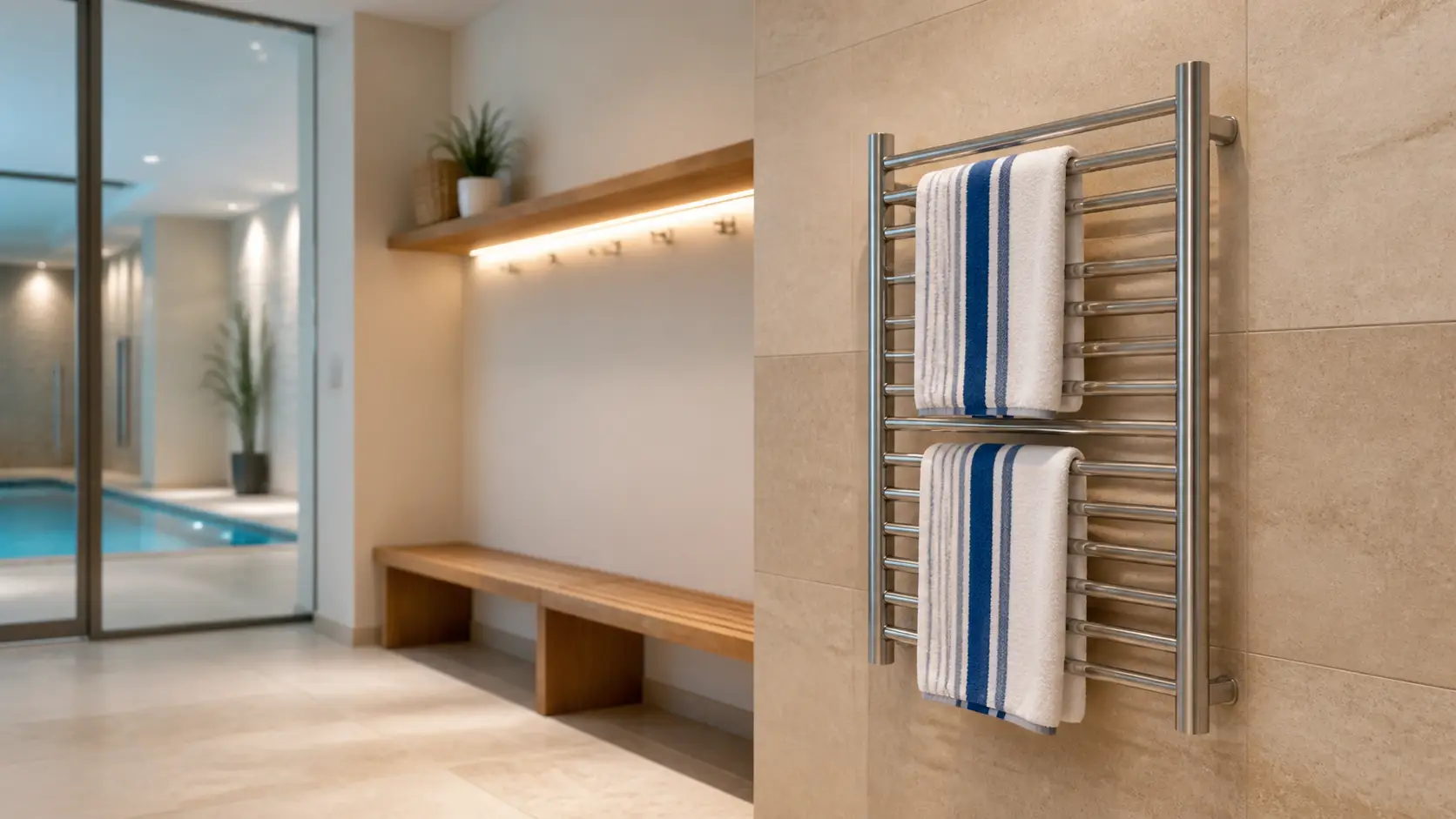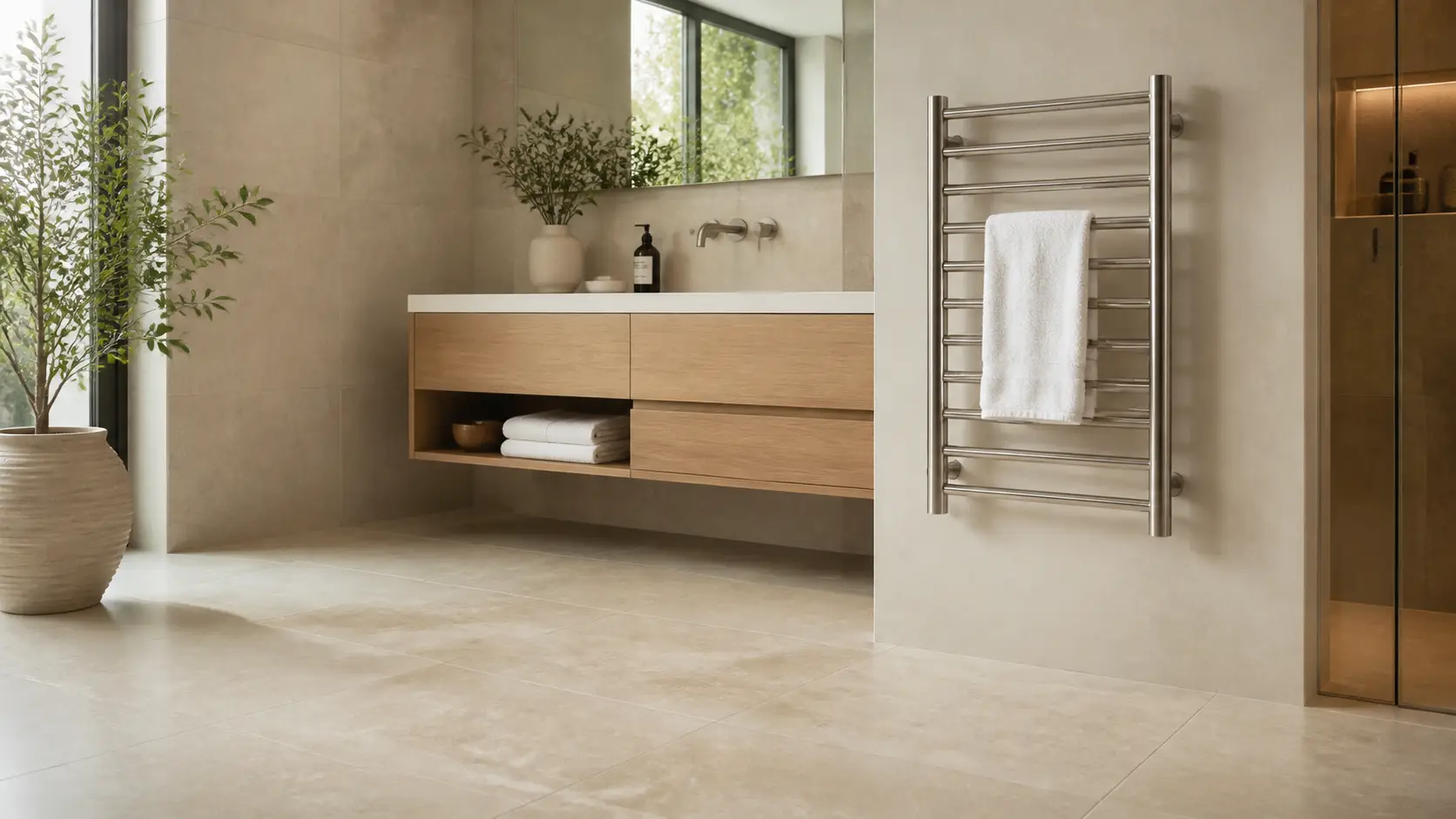
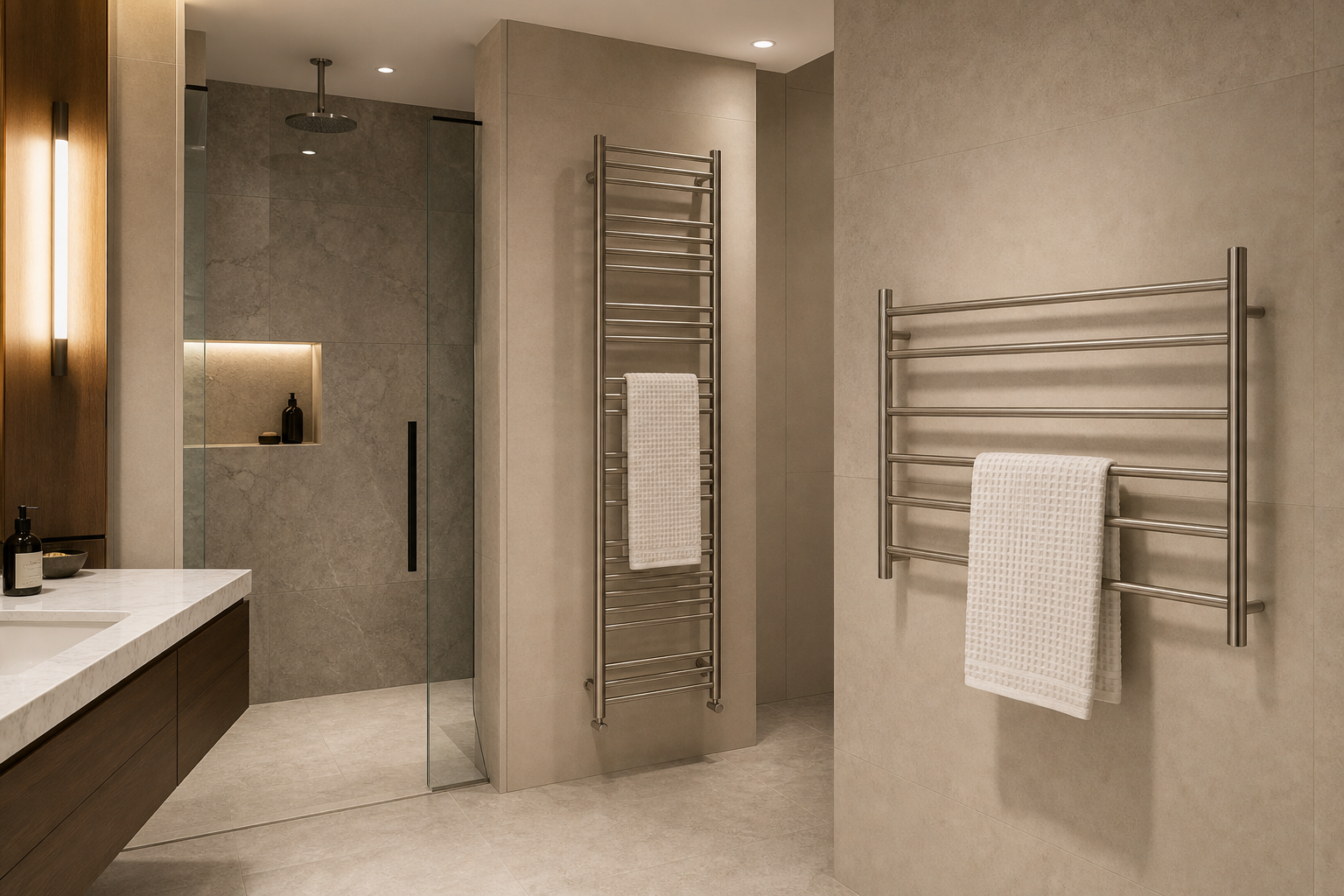
Vertical heated towel rails are usually better when wall width is limited, towels are hung individually, or a clean spa-style look matters. Horizontal heated towel rails are usually better when you need more bar space, want a familiar ladder layout, or need one rail to serve several towels in a family bathroom or guest room.
The best choice is not only about style. It depends on towel contact, wall space, bathroom traffic, installation position, and how users actually hang towels after a shower.
Quick comparison
| Choice factor | Vertical heated towel rail | Horizontal heated towel rail |
|---|---|---|
| Best bathroom type | Narrow walls, ensuite bathrooms, powder rooms, compact remodels | Medium to large bathrooms, shared family bathrooms, hotels, suites |
| Towel contact | Often strong contact along one towel when draped over a pole | More bars, but towels can overlap if the rail is crowded |
| Capacity | Usually one towel per heated pole or a small set of towels | Better for multiple towels when properly sized |
| Visual effect | Minimal, architectural, spa-like | Familiar ladder style, easier to match with classic bathroom layouts |
| User behavior | Easy for casual hanging | Better when users fold or spread towels neatly |
| Project risk | Needs enough vertical clearance and correct placement | Needs enough wall width and spacing from fixtures |
When a vertical heated towel rail makes more sense
A vertical heated towel rail is useful when the bathroom has height but not much uninterrupted wall width. This is common beside showers, near vanities, in compact ensuites, and in renovation projects where doors, glass panels, mirrors, and storage take up most horizontal wall space.
Vertical rails also work well when the user wants a simpler towel routine. Instead of folding a towel across several bars, the towel can be draped over one heated pole. In homeowner discussions, vertical rails often come up when people are trying to solve limited wall space or avoid messy folded towels.
Choose vertical rails when:
- The bathroom has narrow wall space beside a shower or bath.
- One or two towels need dedicated contact rather than shared bar space.
- The design goal is a clean, hotel-style bathroom.
- Users are unlikely to fold towels neatly after each use.
- The project can install multiple vertical poles for more towel capacity.
The tradeoff is capacity. A single vertical rail may not be enough for a family bathroom unless the layout includes multiple heated poles or another towel storage solution.
When a horizontal heated towel rail is the better choice
A horizontal heated towel rail is the safer default when the bathroom needs flexible towel capacity. The ladder layout gives users several bars, and it is familiar to homeowners, hotel guests, contractors, and maintenance teams.
Horizontal rails are especially practical when a bathroom serves more than one person. A wider rail can hold two or more towels if the towels are spread out and not heavily overlapped. That makes the format useful for primary bathrooms, shared family bathrooms, guest suites, and hospitality projects.
Choose horizontal rails when:
- You need one fixture to hold multiple towels.
- The wall has enough width for a balanced layout.
- The bathroom design already uses a classic towel-bar rhythm.
- Guests or tenants need an obvious, easy-to-understand fixture.
- A project buyer wants a familiar specification for multiple rooms.
The main drawback is crowding. If too many towels are layered over one ladder-style rail, airflow drops and drying can slow down. For drying performance, spacing and user habits matter as much as the rail shape.
Which dries towels better?
Neither layout is automatically better in every bathroom. Drying depends on four practical factors:
| Drying factor | Why it matters | What to check |
|---|---|---|
| Towel contact | Heat transfers where the towel touches the warm rail | Avoid thick folds that block contact |
| Airflow | Moisture needs air movement to leave the towel | Do not crowd towels tightly together |
| Bathroom humidity | Damp air slows evaporation | Use ventilation after showers |
| Runtime | Towels need enough warm time after use | Use a timer or schedule instead of guessing |
Vertical rails can perform well when each towel gets direct contact and room to breathe. Horizontal rails can perform well when the rack is sized correctly and towels are spread over separate bars. Problems usually happen when a rail is undersized, placed in a poor location, or overloaded with damp towels.
For more detail on drying behavior, see CALITHREX's guide to why heated towel racks dry towels slowly.
Small bathroom decision guide
For a small bathroom, start with available wall geometry instead of product photos.
| Bathroom condition | Better first choice | Reason |
|---|---|---|
| Narrow wall beside shower | Vertical rail | Uses height instead of width |
| Wide wall above low storage | Horizontal rail | Makes better use of bar length |
| Door swing limits wall access | Vertical rail | Easier to fit into a slim zone |
| Two users share the bathroom | Larger horizontal rail or multiple vertical rails | More towel capacity |
| Minimal spa-style design | Vertical rail | Cleaner visual line |
| Rental or hotel guest room | Horizontal rail | Familiar and easy to use |
If the bathroom is very compact, also check projection from the wall. A rail that fits on paper can still feel wrong if it catches towels, blocks a shower door, or sits too close to a vanity.
For broader sizing logic, see CALITHREX's room-by-room heated towel rack size guide.
Installation and placement checks
Before choosing vertical or horizontal, confirm the rail can be installed in a safe and useful position.
| Checkpoint | Why it matters |
|---|---|
| Reach from shower or bath | Warm towels should be easy to reach without crossing the room |
| Clearance from doors and drawers | The towel should not block normal bathroom movement |
| Electrical route | Hardwired models need planning before tile and wall finish |
| Wet-zone suitability | Product rating and placement must match local electrical rules |
| Towel drop length | Large bath sheets need enough vertical space below the rail |
| Ventilation | Heated rails support drying, but moisture still needs exhaust or airflow |
If the bathroom is being renovated, decide the towel rail type before final tile work and electrical rough-in. Late decisions often force awkward placement.
For safety-related checks, review CALITHREX's heated towel rack IP rating guide.
B2B note for hotels, apartments, and renovation projects
For commercial and multifamily projects, the best rail layout is the one that stays easy to use across many rooms.
Horizontal rails are often easier to standardize because guests and tenants understand them immediately. Vertical rails can be valuable in premium suites, narrow bathrooms, spa rooms, and compact apartment layouts where wall width is scarce.
Project buyers should compare:
- Wall space across the full room schedule, not just the model bathroom.
- Towel count per room type.
- Electrical rough-in consistency.
- Replacement access and cleaning.
- Guest behavior and housekeeping routines.
- Finish durability across repeated use.
For procurement planning, use the CALITHREX commercial heated towel rack buying guide.
Practical recommendation
Choose a vertical heated towel rail if the bathroom is narrow, the design is modern, and each towel can get dedicated heated contact. Choose a horizontal heated towel rail if you need more towel capacity, a familiar ladder layout, or a flexible fixture for shared bathrooms and hospitality rooms.
If both will fit, do not decide by appearance alone. Mock up towel size, user reach, door swing, and the number of damp towels expected after peak use. The layout that keeps towels separated and easy to hang will usually perform better in daily life.
FAQ
Are vertical heated towel rails better than horizontal ones?
Vertical rails are better for narrow spaces and simple towel contact. Horizontal rails are better for capacity and familiar use. The better choice depends on wall space, towel count, and how users hang towels.
Do vertical heated towel rails dry towels faster?
They can, especially when one towel has good contact with one heated pole and enough airflow around it. A crowded vertical or horizontal rail will dry more slowly.
Are horizontal heated towel rails better for families?
Often yes. A properly sized horizontal rail gives more bar space for multiple towels. For a family bathroom, capacity and spacing usually matter more than a minimal visual style.
Which heated towel rail is best for a small bathroom?
A vertical rail is often easier to fit in a small bathroom because it uses wall height. A compact horizontal rail can also work if there is enough width and it does not crowd doors, drawers, or the shower entry.
Can a heated towel rail replace bathroom heating?
Usually no. A heated towel rail can improve towel comfort and support drying, but it should not be treated as the main heat source for a cold bathroom unless the product is specifically sized for room heating.
Should I choose plug-in or hardwired for vertical and horizontal rails?
For a permanent renovation, hardwired installation usually looks cleaner. Plug-in models can be easier for retrofit projects. Always follow the product instructions and local electrical requirements.