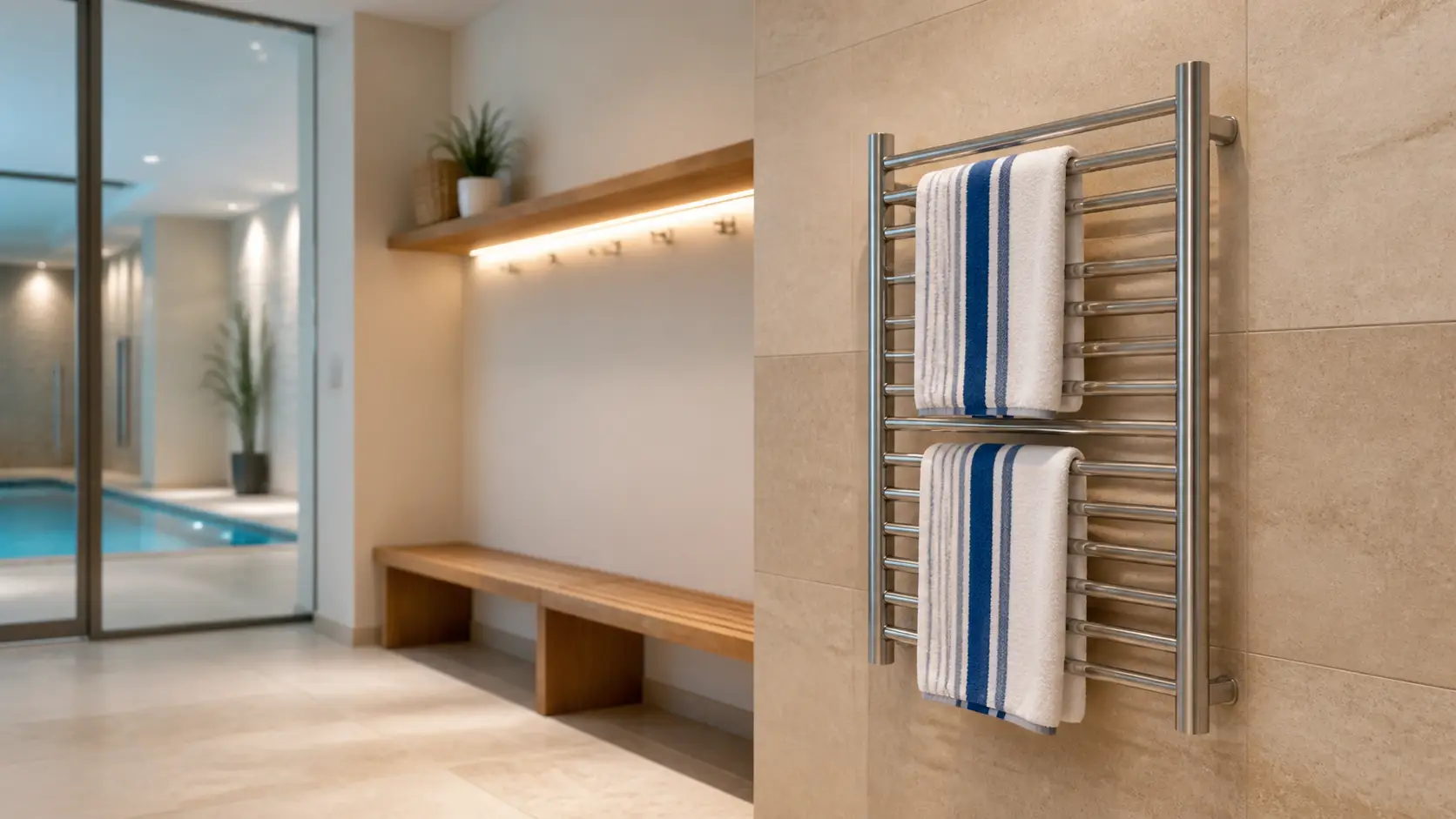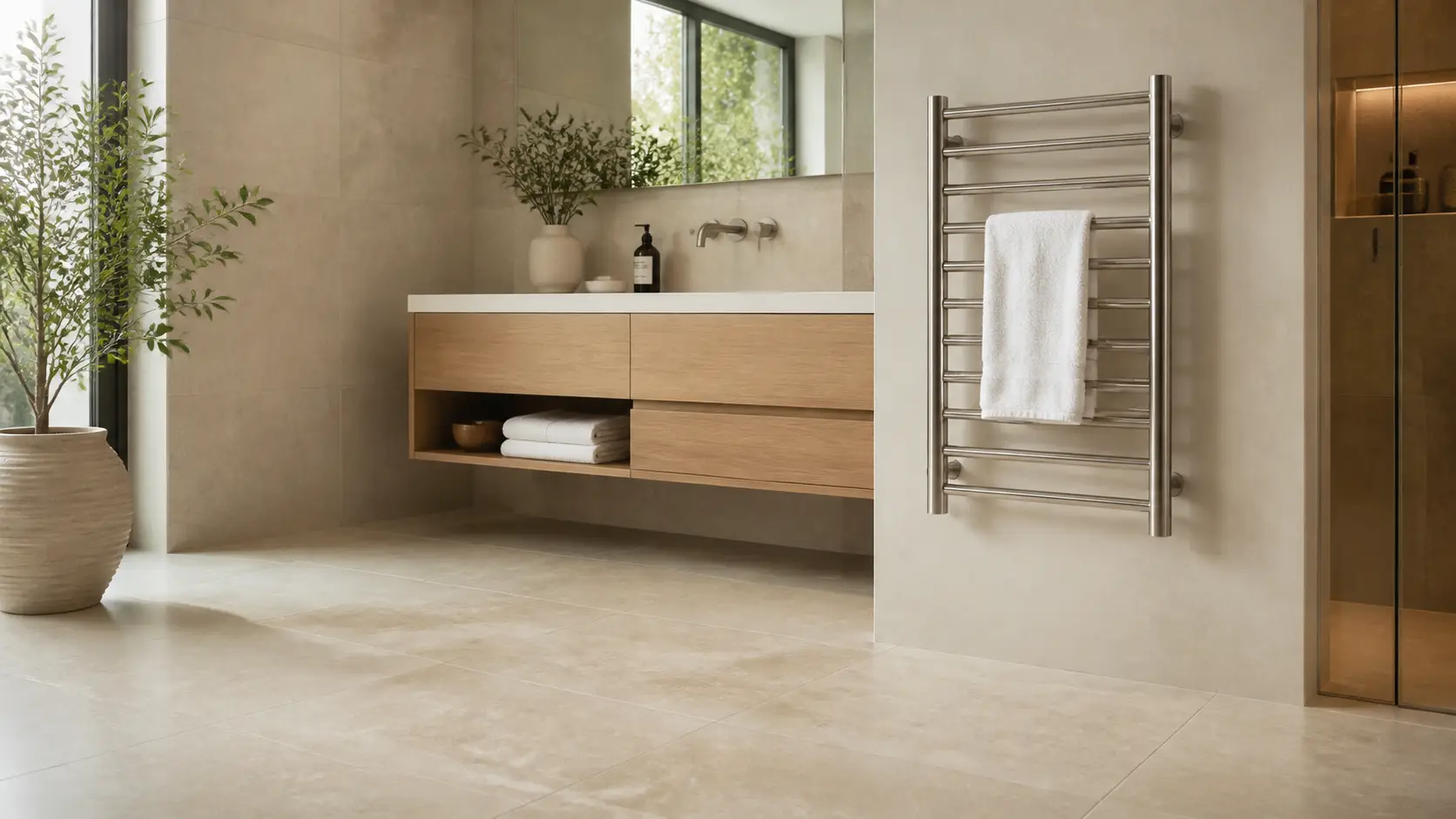
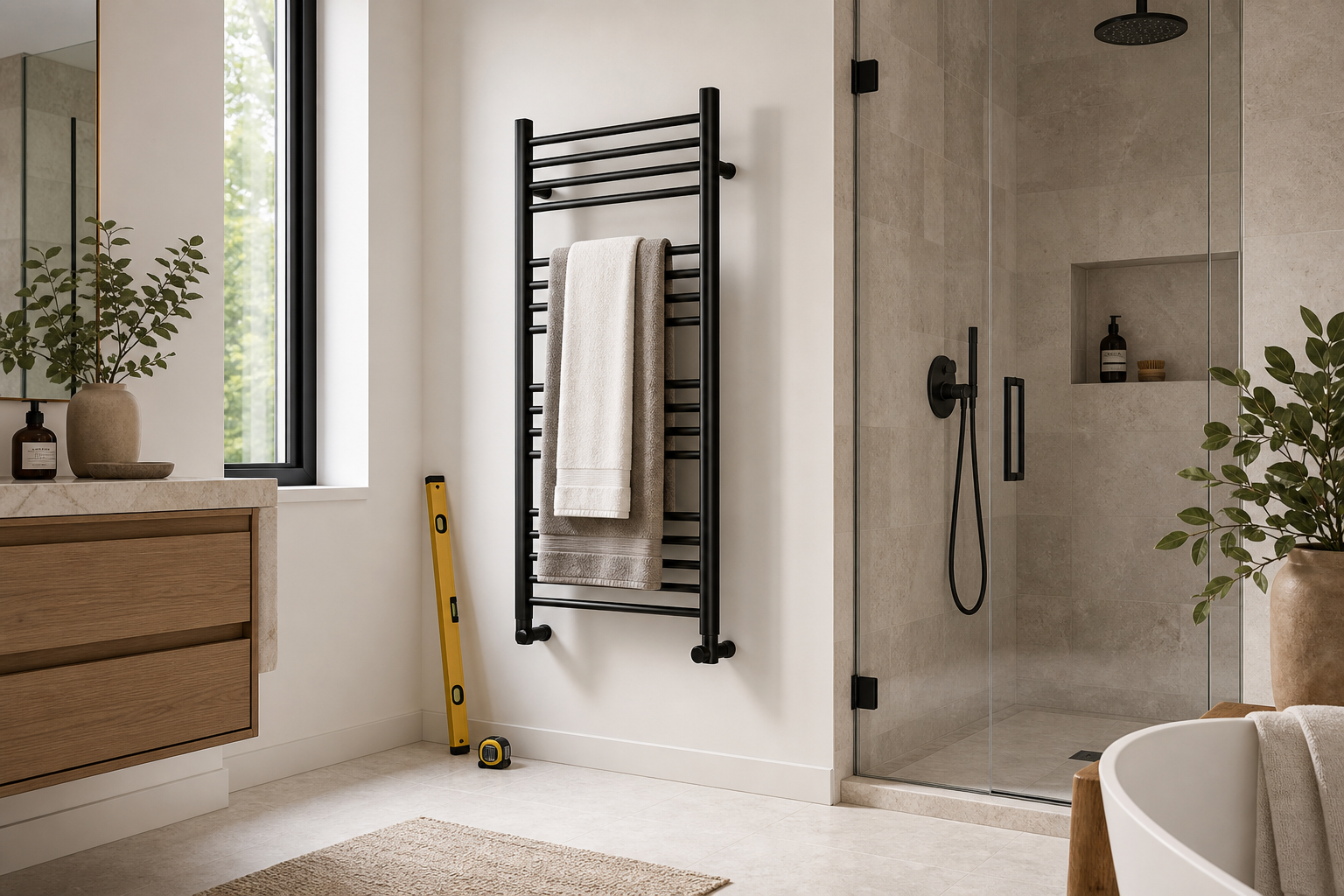
A heated towel rack should be mounted at a height that lets towels hang freely, keeps controls easy to reach, avoids splash-prone zones, and follows the product manual and local electrical code. For many wall-mounted towel warmers, a practical starting point is to place the bottom heated bar roughly 24 to 36 inches above the finished floor, then adjust for towel length, user height, outlet or junction-box location, and bathroom layout.
Do not treat installation height as one fixed number. A compact powder room, family bathroom, hotel guest room, and accessible bathroom can each need a different mounting plan.
Quick mounting-height guide
| Bathroom situation | Practical height direction | What to confirm before drilling |
|---|---|---|
| Standard home bathroom | Bottom bar around 24-36 inches from the floor | Full towel drop, easy reach, stud or anchor position |
| Small bathroom | Mount where the towel clears doors, drawers, and fixtures | Wall width, towel swing, shower-door clearance |
| Tall bath sheets | Raise the rack enough for fabric to hang freely | Towel length, lowest bar height, floor clearance |
| Hotel or apartment project | Use a repeatable room-type specification | Electrical rough-in, housekeeping routine, replacement consistency |
| Accessible bathroom | Keep controls and usable parts within reachable range | ADA reach range, obstruction depth, local code review |
Why heated towel rack height matters
Mounting height affects more than appearance. It changes how comfortably people can load towels, whether fabric touches the floor, how well air moves around damp towels, and whether the switch or timer can be used safely.
A towel warmer installed too low can leave bath towels bunched near the floor. A rack installed too high may look clean in drawings but become awkward for daily use. In commercial projects, inconsistent height can also create maintenance and replacement problems across rooms.
Before setting the final height, check four things:
- The towel size that will be used most often.
- The distance from the lowest heated bar to the floor.
- The user's comfortable reach to the top bar and controls.
- The manufacturer's wet-location, electrical, and mounting instructions.
A practical way to choose installation height
Start with the towel, not the wall. Hold the towel on the rack, or use the product dimensions to model the drop before marking holes.
| Step | Check | Why it matters |
|---|---|---|
| 1 | Measure the rack height and bar layout | The lowest usable bar controls towel drop |
| 2 | Measure the towel length when folded for use | Bath sheets need more clearance than hand towels |
| 3 | Decide who will use the rack daily | Homeowners, children, guests, and housekeeping teams reach differently |
| 4 | Check nearby fixtures | Doors, vanities, toilets, shower glass, and drawers can block access |
| 5 | Confirm electrical location | Hardwired units need planned rough-in; plug-in units need cord-safe placement |
| 6 | Review the manual and code | Product ratings and local electrical rules override generic advice |
For many bathrooms, the final height is a balance: low enough for comfortable reach, high enough for towels to hang cleanly, and far enough from wet areas for the product rating and local code.
Where should a heated towel rack go?
The best placement is usually near the shower or tub, but not in a splash-heavy location unless the model is specifically rated and installed for that environment. The rack should be easy to reach after bathing without blocking the room's traffic path.
Good placement options often include:
- A side wall outside the shower opening.
- A clear wall near the vanity, if towel drop will not interfere with drawers.
- A wall opposite the shower, if the room is narrow but access remains easy.
- A dry zone near the bath, if electrical routing is practical.
Avoid mounting a towel warmer where it will be hit by doors, squeezed behind a toilet, hidden behind a shower panel, or exposed to drafts that reduce warming and drying performance.
For layout comparisons, see CALITHREX's vertical vs horizontal heated towel rail guide.
How far should it be from a shower or tub?
The safe distance depends on the product rating, installation type, and local electrical code. WarmlyYours, for example, states that its electric towel warmers should be installed at least 24 inches away from wet locations such as a shower or tub, and not inside a shower enclosure.
That does not mean every towel warmer has the same rule. Some product lines may offer wet-rated kits or specific installation options for moisture-prone spaces. The safe approach is to match the product to the actual location rather than forcing a standard indoor model into a wet zone.
For homeowners, this is a reason to read the manual before choosing the wall. For designers and contractors, it is a reason to specify the towel warmer early, while electrical rough-in and bathroom zoning are still flexible.
Accessible and commercial bathroom considerations
If the bathroom must meet accessibility requirements, treat reach range as a design constraint. The U.S. Access Board guide to operable parts explains that unobstructed high reach is generally capped at 48 inches above the finished floor, and the maximum can be lower when reaching over an obstruction.
For a heated towel rack, that can affect:
- Switch or timer location.
- Top usable bar height.
- Side reach beside a vanity or partition.
- Clearance for wheelchair approach.
- Whether the rack creates a protruding or burn-contact concern.
Do not use this article as a compliance drawing. For accessible commercial rooms, the product specification, local authority, electrical code, and ADA design review should be checked together.
Common mounting mistakes
| Mistake | Result | Better approach |
|---|---|---|
| Mounting from visual center only | Towels may touch the floor | Mock up towel drop before drilling |
| Ignoring outlet or junction-box location | Visible cords or awkward controls | Plan electrical location before tile is finished |
| Placing the rack behind a door | Poor access and possible impact damage | Keep it in a low-traffic reachable zone |
| Installing too close to a wet area | Safety and warranty risk | Follow the product rating and local code |
| Choosing height before choosing towel size | Bath sheets may bunch or overlap | Size the rack around real towel use |
| Using one height for every project room | Bad fit in compact or accessible rooms | Create room-type specifications |
B2B specification checklist
For hotels, apartments, spas, and renovation projects, installation height should be part of the specification package rather than left entirely to field judgment.
Ask suppliers and installers to confirm:
- Product dimensions and mounting footprint.
- Recommended mounting range.
- Hardwired, plug-in, or dual connection requirements.
- Clearance from wet areas and fixtures.
- Surface temperature guidance and controls.
- Finish durability for humid bathrooms.
- Replacement availability by model and size.
- Packaging and installation hardware consistency.
For procurement context, read CALITHREX's commercial heated towel rack buying guide.
Practical recommendation
For most home bathrooms, start by testing a bottom-bar height around 24 to 36 inches from the finished floor, then adjust so the main towel hangs freely and the upper bars remain easy to reach. Keep the rack outside splash-prone areas unless the product is rated for that use, and plan electrical work before tile, cabinetry, or final wall finishes are complete.
For commercial or accessible bathrooms, do not rely on a generic height. Use a room-by-room specification that includes towel size, user reach, control placement, electrical rough-in, wet-zone clearance, and code review.
FAQ
How high should a heated towel rack be mounted?
Many wall-mounted towel warmers work well when the bottom heated bar starts around 24 to 36 inches above the finished floor, but the final height should be adjusted for towel length, user reach, product dimensions, and code requirements.
Should the heated towel rack be centered on the wall?
Only if that also works for towel drop, reach, and clearance. Visual centering can look good in photos but fail in daily use if towels hit the floor or the rack is hard to reach.
Can a heated towel rack be installed next to a shower?
Often yes, but the exact distance depends on the product rating and local electrical code. Use the manufacturer's instructions first, especially near showers, tubs, wet rooms, or steam areas.
Is a plug-in towel warmer easier to place?
It can be easier to install, but the cord, outlet location, wet-area clearance, and daily traffic path still matter. A plug-in model should not create a cord hazard or force the rack into a poor position.
What height is best for hotel bathrooms?
Hotels should specify height by room type, towel size, guest reach, housekeeping routine, and electrical rough-in. A consistent standard helps operations, but it should still fit the actual bathroom layout.
Does installation height affect towel drying?
Yes. Height affects towel drop, overlap, airflow, and how easily users place towels on the bars. A well-positioned rack with good towel spacing usually performs better than one mounted only for symmetry.