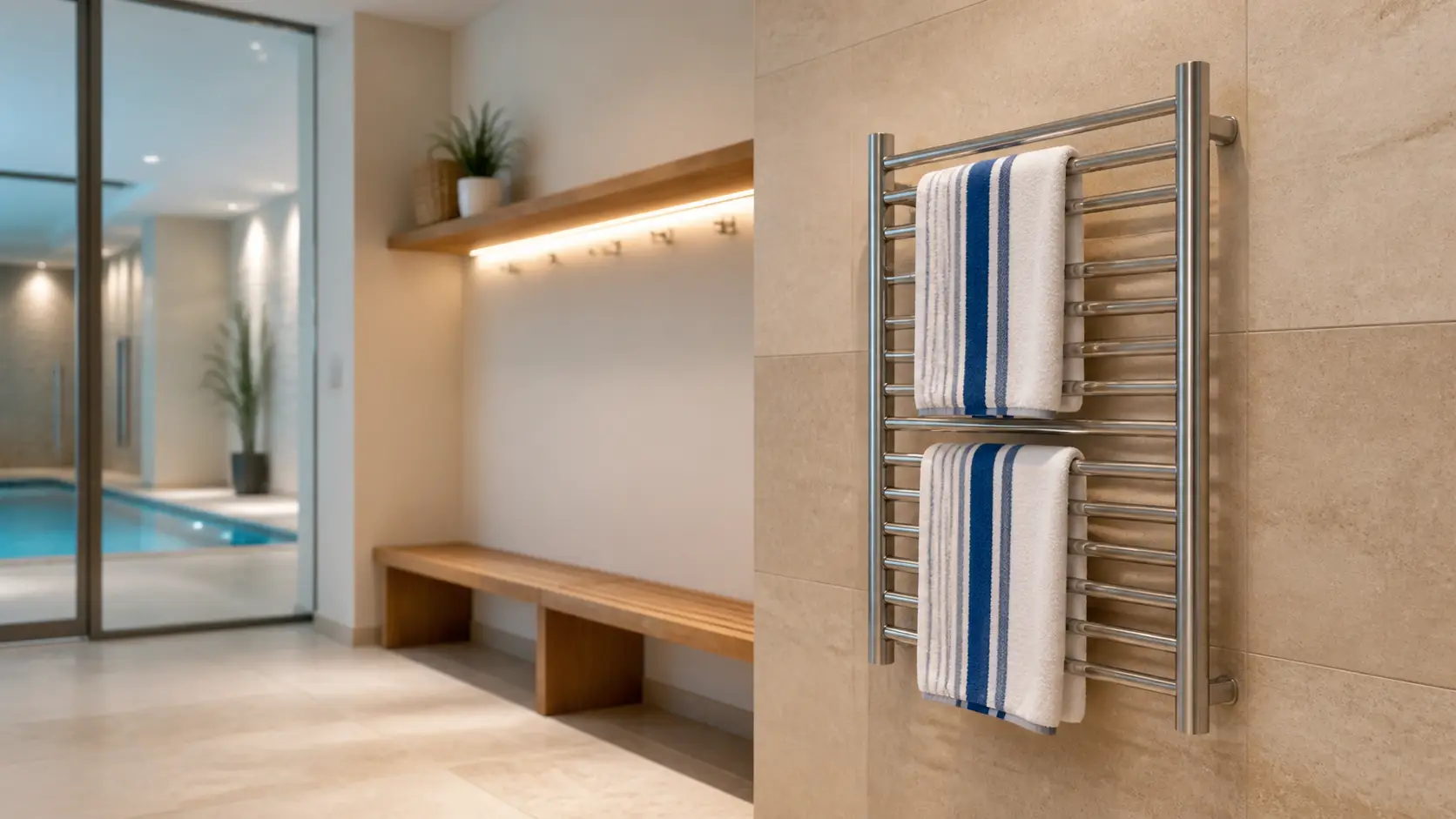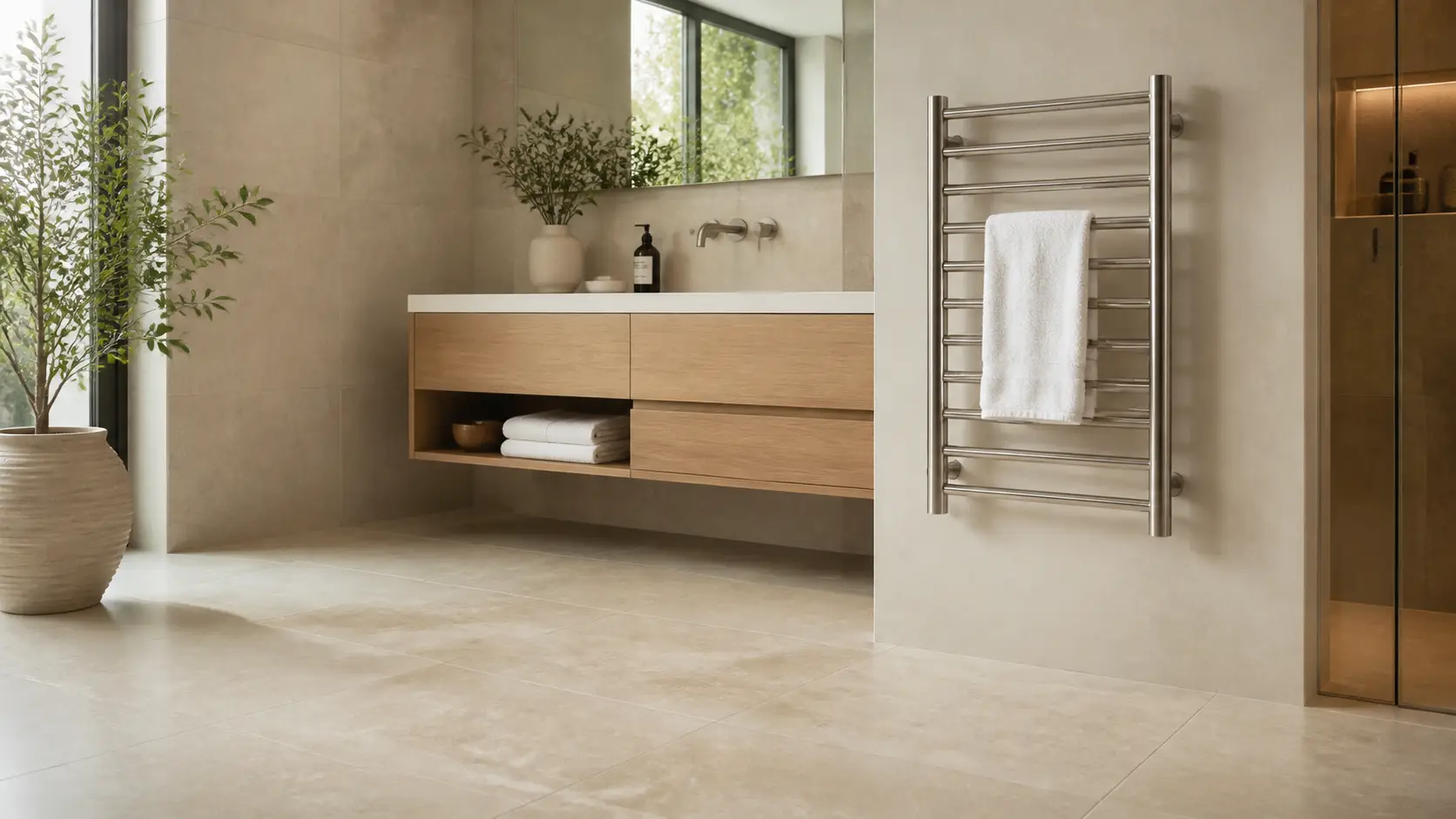
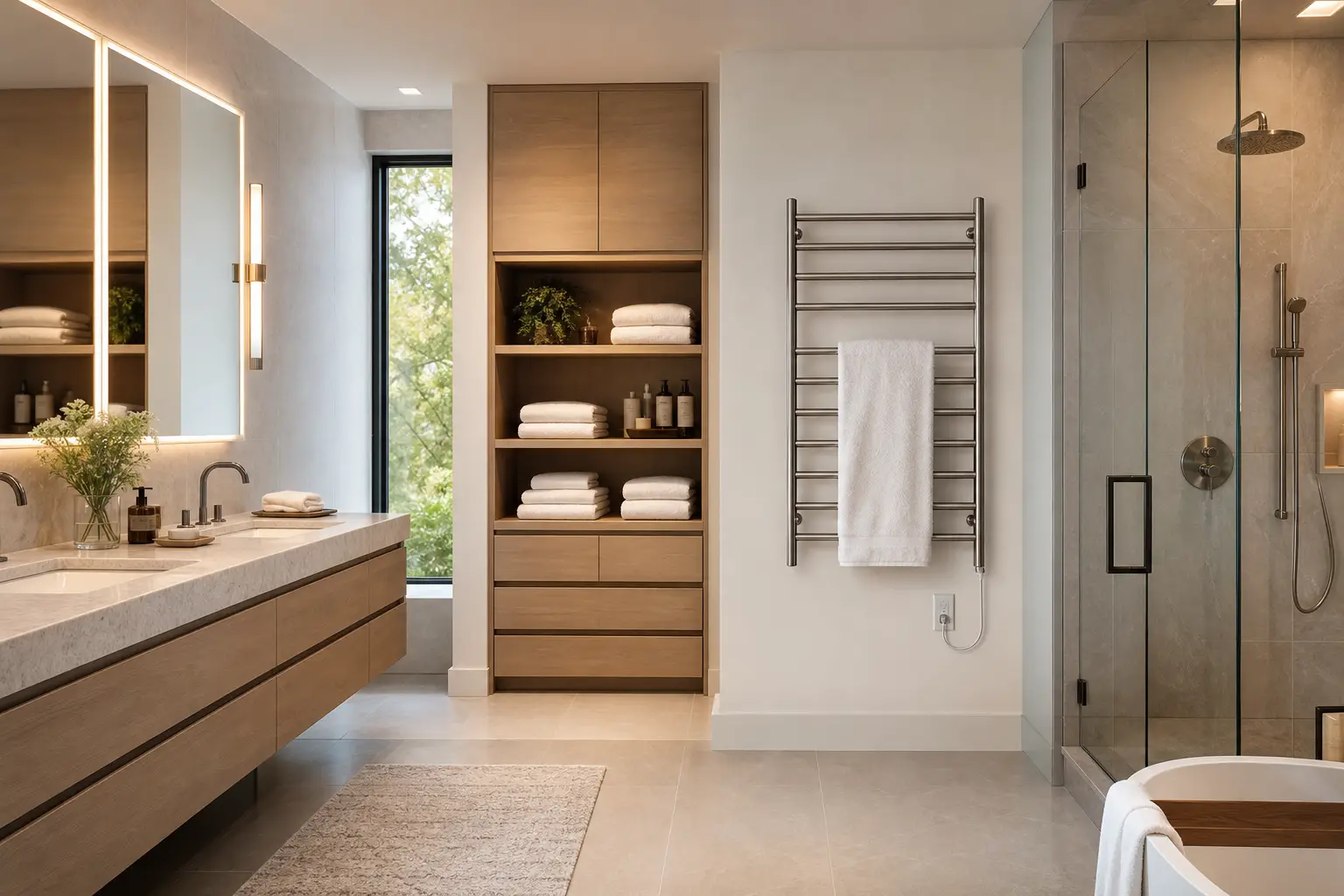
The best bathroom storage ideas for 2026 start by separating three jobs: closed storage for clutter, open storage for clean towels and daily-use items, and a dedicated drying zone for damp towels. A heated towel rack fits best when it is planned as part of that towel zone, close to the shower or vanity but outside the heaviest splash area.
For homeowners, this creates a cleaner bathroom routine with fewer damp towels on doors, tubs, or vanity tops. For hotels, spas, and multifamily projects, it turns storage into a specification decision: towel quantity, shelf depth, wall backing, electrical planning, finish coordination, and cleaning access should be decided before tile, cabinetry, and wiring are finalized.
Quick Answer: What Bathroom Storage Works Best in 2026?
| Storage need | Best planning choice | Why it works | Heated towel rack connection |
|---|---|---|---|
| Daily toiletries | Drawers with dividers or medicine cabinets | Keeps visual clutter off the vanity | Leaves wall space for towel warming or hooks |
| Clean towels | Open shelves, linen towers, or recessed niches | Makes guest and family towels easy to see | Pair with a nearby dry-side towel warming zone |
| Damp towels | Wall hooks, towel bars, or heated towel racks | Gives wet towels an assigned drying location | A rack improves comfort and drying between uses |
| Small bathrooms | Vertical storage and slim wall-mounted fixtures | Uses height instead of floor area | Vertical or narrow towel warmers can protect circulation space |
| Hotel bathrooms | Repeatable shelf, hook, and rack locations | Improves housekeeping and guest consistency | Standardized placement simplifies specification and maintenance |
| Spa bathrooms | Display towels plus hidden backstock | Supports a calm, premium experience | Warm towels become part of the wellness ritual |
Plan Storage by Towel Movement, Not Only Cabinet Size
Bathroom storage often fails because it is planned as cabinetry first and towel behavior second. A bathroom can have a large vanity and still feel messy if wet towels have no place to hang, clean towels are stored too far away, or the rack is installed after the layout is already fixed.
A better 2026 bathroom storage plan follows the towel path:
- Where are clean towels stored before use?
- Where does the user reach for a towel after showering?
- Where does the damp towel hang after use?
- How close is that drying point to ventilation?
- Will the towel zone block drawers, doors, or shower glass?
- Can the same layout be repeated across hotel or apartment bathrooms?
This approach matters because towel storage is both a design issue and a moisture-control issue. Folded towels need clean, dry storage. Used towels need airflow. A heated towel rack should support that routine, not compete with cabinetry, towel shelves, or bathroom circulation.
Closed Storage vs Open Storage vs Heated Towel Racks
| Option | Best for | Watch-outs | Where Calithrex planning fits |
|---|---|---|---|
| Vanity drawers | Cosmetics, grooming tools, spare products | Deep drawers can become cluttered without dividers | Keep electrical and wall space free for the towel zone |
| Medicine cabinet | Small daily-use items and mirrors | Not enough for towels or larger supplies | Pair with a separate towel rack or shelf |
| Linen tower | Clean towels, robes, and bathroom backstock | Needs floor or wall width | Place the heated towel rack close enough for daily use |
| Open shelves | Guest towels and visual display | Exposed towels need good ventilation and cleaning | Works well beside a dry-side heated rack |
| Recessed niche | Shower products or compact towel display | Requires early wall planning | Do not confuse shower niche storage with towel drying |
| Heated towel rack | Damp towels, warm towels, comfort routines | Needs wall support, power, clearance, and safe placement | Specify before tile and electrical rough-in |
Small Bathroom Storage: Use Height Before Floor Space
Small bathrooms need storage that does not make the room harder to move through. Wall-mounted vanities, recessed medicine cabinets, tall narrow shelves, and vertical towel zones usually work better than bulky freestanding cabinets.
For a small residential bathroom, the most practical combination is often:
- A floating vanity with drawers.
- A mirror cabinet for small items.
- One vertical linen or open shelf zone.
- A wall-mounted heated towel rack on a dry-side wall.
- Hooks for quick-use towels or robes.
This setup keeps the floor clearer and gives damp towels a defined place. If the heated towel rack is added too late, it may end up behind a door, too close to the shower spray, or too far from where towels are actually used. That is why small-bathroom storage and towel warmer placement should be reviewed together.
Hotel Bathroom Storage Needs Repeatable Rules
Hotel bathroom storage is less about one beautiful room and more about repeatable performance across many rooms. Guests need intuitive towel access, housekeeping needs fast reset, and owners need fixtures that can be specified, replaced, and maintained without room-by-room improvisation.
For hotel projects, storage planning should answer:
- How many bath towels, hand towels, and robes are displayed?
- Where are spare towels stored?
- Where should damp towels hang between uses?
- Can housekeeping reach shelves, hooks, and racks easily?
- Are electrical routes and wall backing consistent across room types?
- Does the finish match faucets, lighting, shower trim, and door hardware?
A heated towel rack can support a premium hotel bathroom, but only if its placement is operationally sensible. It should not block housekeeping, compete with the linen shelf, or sit in a location where guests cannot understand how to use it.
Spa and Wellness Bathrooms Need Display Plus Drying
Spa-style bathrooms often use visible towels as part of the atmosphere. Open shelves, rolled towels, warm materials, and calm lighting can make the room feel more prepared and intentional. But display storage is not the same as drying storage.
Clean towels can be shown on shelves or in niches. Damp towels need a separate place with airflow. In a home spa bathroom, that might mean a heated towel rack beside a dry wall near the shower. In a boutique hotel or treatment room, it may mean a planned warm towel zone that staff can reset easily.
The key is to separate the visual display from the post-use drying routine. When those functions overlap badly, shelves become damp, towels stay bunched, and the bathroom feels less organized even when the materials look premium.
Where Should a Heated Towel Rack Go in a Storage Plan?
The best location is usually on a reachable dry-side wall near the shower, tub, or vanity. It should be close enough that the towel routine feels natural, but not so close to direct splash that the rack, towel, or electrical route is exposed unnecessarily.
Before choosing the location, confirm:
- Wall structure and backing.
- Outlet or hardwired route.
- Door swing and drawer clearance.
- Shower glass and splash direction.
- Towel drop length.
- User reach height.
- Nearby clean towel storage.
- Finish coordination with hardware and lighting.
For new construction, hotel rooms, multifamily projects, and major remodels, this review should happen before tile is ordered. A late towel rack decision can create awkward wiring, poor alignment, or a finished bathroom that has storage but no good towel-drying behavior.
Bathroom Storage Ideas by Project Type
| Project type | Storage priority | Best towel strategy | Calithrex specification note |
|---|---|---|---|
| Primary home bathroom | Reduce countertop clutter and organize daily routines | Heated towel rack near shower plus drawer storage | Choose finish and controls with the vanity and lighting plan |
| Small apartment bathroom | Save floor space and avoid damp towel piles | Vertical wall storage and compact towel warmer | Check clearance and outlet location early |
| Guest bathroom | Make towels visible and easy to use | Open shelf with one clear drying point | Keep the layout simple and intuitive |
| Hotel guest room | Standardize storage and guest towel access | Repeated rack location across room types | Confirm wall backing, cleaning access, and replacement strategy |
| Spa suite | Present clean towels beautifully and keep used towels separate | Display shelves plus warm towel zone | Plan staff workflow, towel volume, and controls |
| Multifamily project | Balance cost, maintenance, and resident comfort | Durable wall-mounted rack with consistent wiring | Specify model, finish, and installation method before procurement |
Common Bathroom Storage Mistakes
Do not store every towel in a closed cabinet. Clean towels can go in closed storage, but damp towels need airflow and an assigned drying point.
Do not rely on hooks alone in a humid bathroom. Hooks are useful for quick hanging, but thick towels may dry slowly if they stay bunched.
Do not install a towel warmer after the vanity, tile, and shower glass are already fixed. Late placement often causes poor clearance, visible wiring, or awkward reach.
Do not place open towel shelves inside the wettest shower-adjacent zone. Towels should feel accessible, not constantly exposed to splash or steam.
Do not treat hotel bathroom storage as decoration only. Shelf depth, towel count, housekeeping access, and replacement consistency affect operating value.
Calithrex Planning Notes
For Calithrex projects, the towel rack should be included in the bathroom storage brief, not added after cabinetry. The strongest brief includes towel count, room type, rack location, finish, control method, wall structure, electrical route, and the relationship between clean towel storage and damp towel drying.
Useful internal planning links include a heated towel rack size guide, a bathroom materials guide, wet room bathroom design guidance, and bathroom remodeling trend planning. These links are most useful when they support the same storage and towel-zone decision rather than being added as unrelated product references.
The practical rule is simple: closed storage hides clutter, open storage presents clean towels, and a heated towel rack gives damp towels a better place to recover between uses.
FAQ
What is the best bathroom storage idea for 2026?
The best bathroom storage idea is a layered plan: closed vanity storage for clutter, open shelves or linen towers for clean towels, and a separate towel drying zone. A heated towel rack works best when it is part of that towel zone rather than a late decorative add-on.
Are open bathroom shelves still a good idea?
Open shelves are useful for clean towels, guest towels, and spa-style display, but they need good placement and ventilation. They should not be the main place for damp towels unless the room has enough airflow and a separate drying strategy.
Where should towels be stored in a small bathroom?
In a small bathroom, store clean towels vertically on shelves, in a slim linen tower, or in a nearby cabinet. Damp towels should hang on hooks, bars, or a compact heated towel rack where they do not block drawers, doors, or the shower opening.
Is a heated towel rack storage?
A heated towel rack is not storage in the same way as a cabinet or shelf. It is a towel holding, warming, and drying accessory. It should be planned beside storage so clean towels and damp towels have different, logical places.
What should hotels consider before adding heated towel racks?
Hotels should confirm towel count, guest reach, housekeeping access, wall backing, electrical routing, finish consistency, control method, and replacement strategy. The rack should improve the bathroom routine without complicating maintenance.
What tags fit this article?
The best tags are Bathroom Industry, Bathroom Design, Bathroom Trends, Residential Bathrooms, Hotel Bathrooms, and Heated Towel Racks because the article connects storage planning, towel organization, hotel and residential bathrooms, and towel warmer placement.
CTA
Planning bathroom storage for a home, hotel, spa, or multifamily project? Include the Calithrex heated towel rack in the early layout review: towel capacity, wall placement, finish, control method, and installation route should be decided before cabinetry, tile, and electrical work are locked.