A water-efficient bathroom in 2026 should reduce waste without making the room feel cheap, underpowered, or inconvenient. The best plan combines WaterSense-labeled faucets, showerheads, and toilets, good ventilation, moisture-resistant surfaces, smart controls, and a towel drying strategy. A heated towel rack fits into this plan when it is specified as a controlled comfort and drying accessory, not as a substitute for ventilation or basic moisture management.
For homeowners, that means lower water use, better daily comfort, and fewer damp towels left in a closed bathroom. For hotel, spa, multifamily, and renovation projects, it means a more disciplined specification: fixtures, airflow, electrical planning, towel placement, finishes, and maintenance expectations should be decided together before walls and tile are finalized.
Quick Planning Table
| Decision area | What to specify | Why it matters | Heated towel rack connection |
|---|---|---|---|
| Showerhead | WaterSense-labeled model with comfortable spray performance | Reduces shower water use without relying on guest behavior alone | Shorter towel soak-through and better ventilation still matter |
| Faucet | WaterSense-labeled lavatory faucet or aerator | Cuts daily sink water use in homes, hotels, and public bathrooms | Supports an overall resource-efficient bathroom story |
| Toilet | WaterSense-labeled high-efficiency toilet | Major water-use decision in residential and hospitality bathrooms | Complements, but does not replace, comfort accessories |
| Ventilation | ENERGY STAR certified bath fan sized and installed correctly | Removes moist air and helps protect materials | A towel rack helps towels dry; the fan manages room humidity |
| Materials | Porcelain, ceramic, sealed stone, or other moisture-aware surfaces | Reduces maintenance problems and premature damage | Wall strength and finish coordination affect rack placement |
| Controls | Timer, switch, occupancy logic, or scheduled use | Prevents unnecessary runtime | Makes towel warming more efficient and predictable |
| Towel location | Dry-side placement near shower or vanity | Improves use without placing towels in the wettest zone | Keeps warm towels reachable and reduces damp towel piles |
Start With WaterSense Fixtures
Water efficiency begins with the fixtures that use water every day. EPA's WaterSense program covers products such as bathroom sink faucets, showerheads, toilets, and flushing urinals that meet water-efficiency and performance criteria. In a new bathroom or remodel, these are the first specification points to check because they directly affect water use every time the bathroom is used.
This does not mean every bathroom should feel like a low-pressure utility room. The goal is to choose fixtures that have been designed for efficient performance, then support them with the right layout, ventilation, storage, and comfort details.
For a residential bathroom, the priority is usually daily comfort and lower utility waste. For a hotel or spa bathroom, the priority is repeated performance across many users: guests should not need instructions to use less water, and maintenance teams should not inherit damp surfaces, poor airflow, and towels that stay wet for too long.
Do Not Treat Towel Warmers as Moisture Control
A heated towel rack can help a towel feel warmer and dry more comfortably after use, but it is not a bathroom ventilation system. Moisture control still depends on removing humid air, choosing durable surfaces, and keeping wet towels from being piled in corners or closed cabinets.
The more practical hierarchy is:
- Use efficient fixtures to reduce unnecessary water flow.
- Use proper ventilation to move humid air out of the room.
- Use moisture-resistant surfaces where water exposure is expected.
- Use a heated towel rack to improve towel comfort and drying between uses.
- Use controls so heating runs when it is useful, not all day by default.
This distinction is important for Calithrex buyers because it avoids overpromising. A towel warmer is valuable, but it works best as part of a complete bathroom comfort system.
Ventilation Is Still a Core Sustainability Detail
Water-efficient bathrooms still create steam, damp towels, and wet surfaces. A lower-flow shower may reduce total water use, but it does not remove the need for ventilation. ENERGY STAR guidance for residential ventilating fans focuses on efficiency, airflow, sound, and verified performance, which is why fan selection and installation should be part of the early bathroom plan.
In practice, good ventilation helps protect grout, cabinetry, paint, mirrors, and towels. It also makes a heated towel rack more useful because the room is not fighting against trapped humidity. For hotels and multifamily projects, this is a specification issue, not a decoration issue: fan performance, ducting, controls, and maintenance access affect guest comfort and operating costs.
Place the Heated Towel Rack on the Dry Side
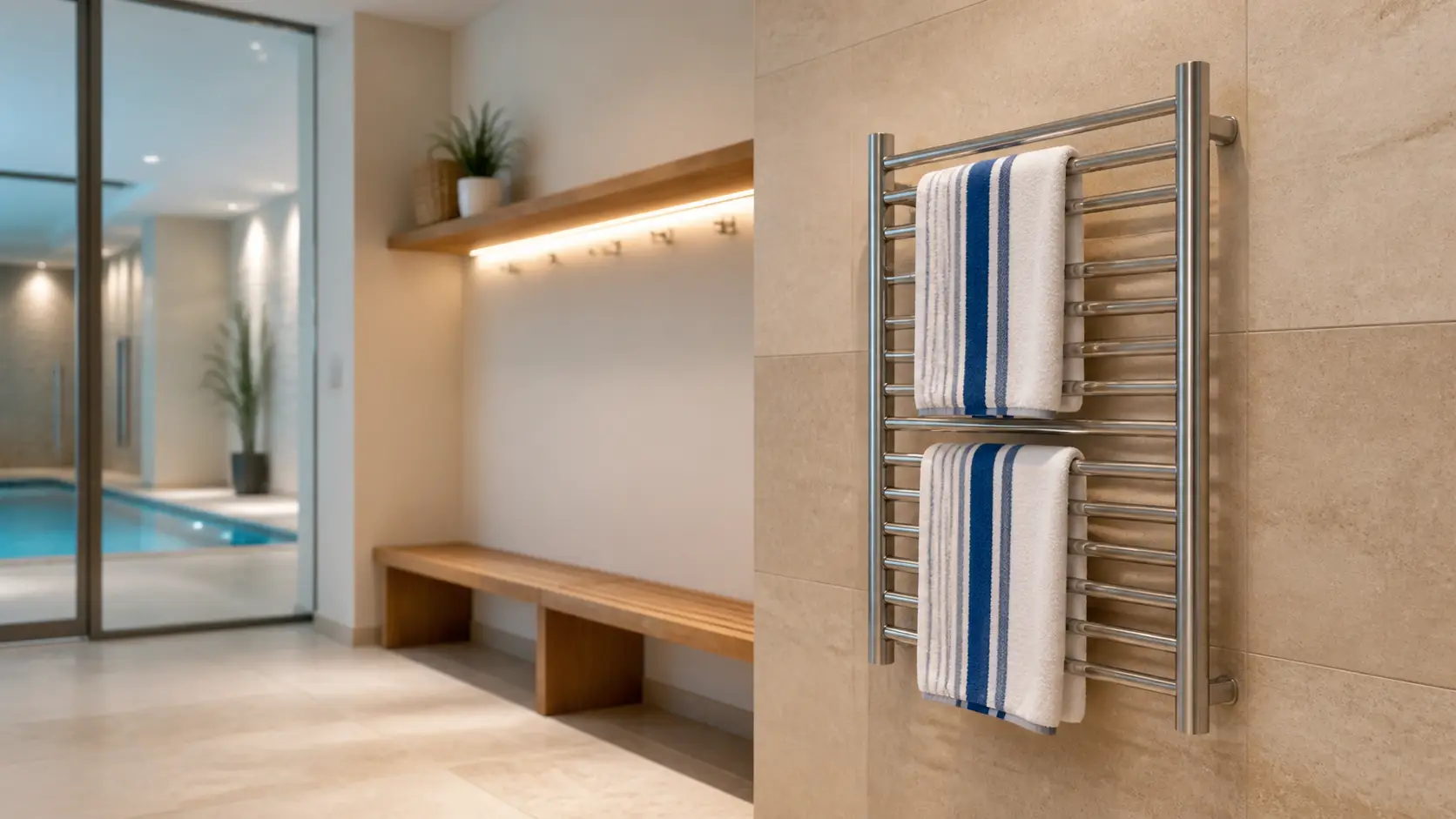
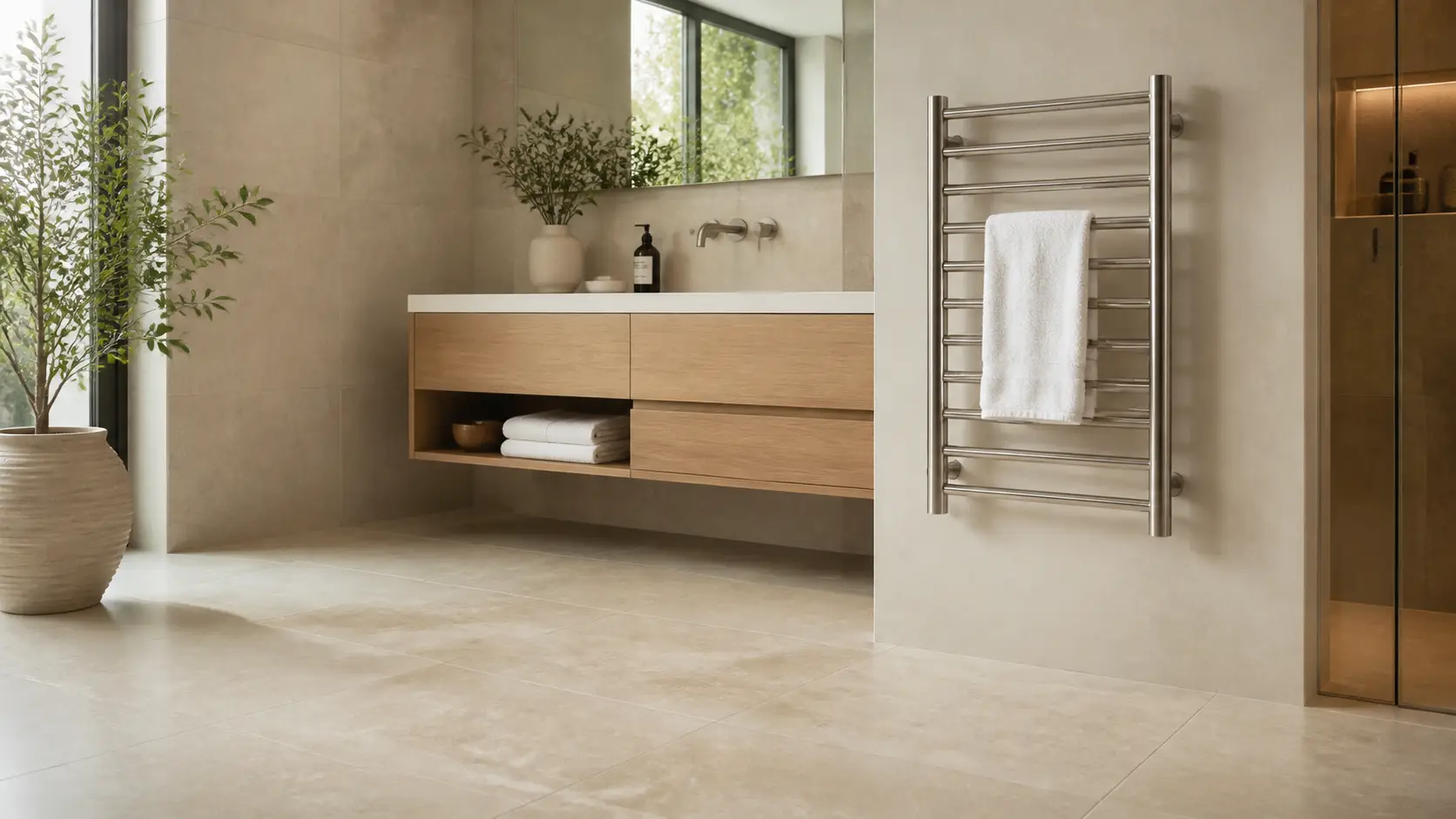
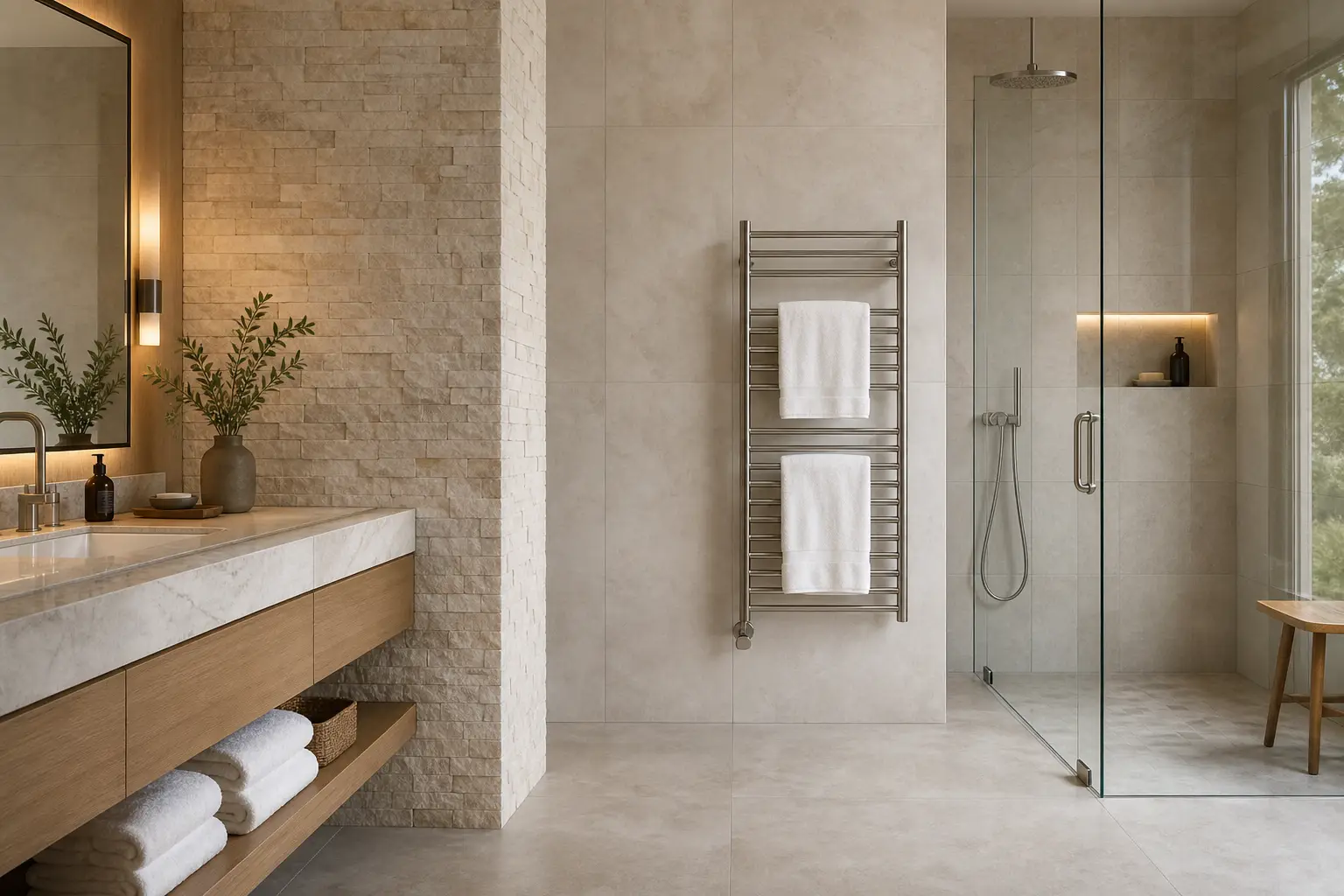
The best towel rack location is usually close enough to the shower or tub for convenience, but not in the wettest splash zone. In water-efficient bathroom design, this matters for three reasons.
First, dry-side placement keeps towels easier to reach without exposing the rack to unnecessary splash. Second, it gives wet towels a consistent place to hang instead of being left over shower doors, tubs, or vanity counters. Third, it helps the rack read as part of the design plan, especially when its finish coordinates with faucets, shower trim, lighting, and cabinet hardware.
For project buyers, the placement review should happen before tile and electrical rough-in. Confirm wall structure, electrical path, outlet or hardwired requirements, towel reach, door swing, and nearby storage before the bathroom is finished.
Match Controls to Real Use
Energy-aware operation is less about the rack's existence and more about how it is controlled. A towel rack that runs only when towels are likely to be used can be more practical than one left on continuously by habit.
Good control options include:
- A manual switch for simple residential bathrooms.
- A timer for morning and evening routines.
- A programmable control for guest suites or spa treatment rooms.
- A central control strategy for hotels or multifamily projects.
- Clear owner guidance so users understand when to run the rack.
This is also where article topics such as smart bathroom comfort and towel rack wattage connect naturally. The best system is not always the largest or warmest product; it is the product that fits the towel load, wall space, room type, and operating pattern.
Materials and Finishes Should Support Low Maintenance
Water-efficient bathroom design is not only about gallons. It is also about reducing premature wear, mold risk, cleaning burden, and replacement cycles. Porcelain tile, ceramic wall tile, well-detailed grout, sealed stone where appropriate, and moisture-aware cabinetry all help the room perform over time.
The heated towel rack finish should be chosen with the same discipline. Stainless steel works well for many modern, hotel, and spa bathrooms because it is durable and easy to coordinate. Matte black can create strong contrast but needs careful cleaning expectations. Chrome can work in brighter, more classic bathrooms. Brushed and satin finishes often hide fingerprints better and pair well with warmer material palettes.
For B2B buyers, the finish decision should include replacement consistency, cleaning chemicals, corrosion expectations, warranty terms, and whether the same finish family can be repeated across several room types.
Residential vs Hotel Planning
| Bathroom type | Main water-efficiency goal | Comfort detail to protect | Heated towel rack planning note |
|---|---|---|---|
| Primary home bathroom | Reduce daily water waste while improving routine comfort | Warm towels, quieter ventilation, easier cleaning | Timer control and finish coordination usually matter most |
| Small apartment bathroom | Save water and prevent damp towel clutter | Dry storage and efficient use of wall space | Choose compact wall-mounted layouts and dry-side placement |
| Hotel guest bathroom | Reduce repeated water and laundry pressure at scale | Guest comfort without complicated instructions | Standardize finish, wattage, placement, and controls |
| Spa or wellness suite | Balance efficient operation with premium experience | Warm towels, calm materials, reliable ventilation | Plan visible towel presentation and staff workflow |
| Multifamily project | Control specification cost and maintenance risk | Durable surfaces and consistent parts | Confirm wiring, wall backing, and replacement strategy early |
Common Mistakes to Avoid
Do not choose low-flow fixtures without checking user comfort. A bathroom that saves water but feels frustrating will not support the brand or the homeowner's daily routine.
Do not install a heated towel rack as a late decorative add-on. Late placement can create awkward wiring, weak wall support, poor towel reach, or finish mismatch.
Do not rely on a towel warmer to fix a damp bathroom. If the room has poor ventilation or wet towels are stored badly, the rack will not solve the underlying moisture problem.
Do not over-specify controls that users will ignore. A clear timer or simple schedule is often better than a complex control system nobody maintains.
Do not treat sustainability as one product claim. A credible water-efficient bathroom is a system of fixtures, airflow, surfaces, controls, and daily behavior.
Calithrex Specification Notes
For Calithrex projects, a water-efficient bathroom brief should include the towel rack early in the design package. Confirm whether the rack is wall-mounted or freestanding, how many towels it needs to hold, whether the bathroom is residential or commercial, what finish family is being used, and how the rack will be controlled.
The strongest specification usually answers five questions before ordering:
- What water-saving fixtures are being used?
- How is humid air removed after showers?
- Where will wet towels hang between uses?
- Which finish coordinates with faucets, lighting, and hardware?
- What control method prevents unnecessary heating time?
When those answers are clear, the heated towel rack becomes part of the bathroom's comfort and efficiency plan instead of an isolated accessory.
FAQ
What is a water-efficient bathroom?
A water-efficient bathroom uses fixtures and planning choices that reduce unnecessary water use while keeping the room comfortable and practical. Typical elements include efficient toilets, faucets, showerheads, proper ventilation, durable wet-area materials, and smarter towel drying or storage.
Are low-flow showerheads worth it?
They can be worth it when the product is selected for both efficiency and spray comfort. For residential, hotel, and multifamily bathrooms, WaterSense-labeled showerheads are a practical starting point because they are designed to reduce water use while meeting performance criteria.
Does a heated towel rack make a bathroom more sustainable?
It can support a more efficient comfort routine when it is sized correctly, controlled sensibly, and used to help towels dry between uses. It should not be presented as the main sustainability feature. Water-saving fixtures, ventilation, materials, and maintenance planning matter first.
Should a heated towel rack stay on all day?
Usually, a timer or scheduled use is more practical than leaving it on all day by default. The right runtime depends on towel thickness, room humidity, rack wattage, and how often the bathroom is used.
Where should a towel warmer go in a water-efficient bathroom?
Place it on a reachable dry-side wall near the shower, tub, or vanity, but outside the heaviest splash area. Confirm wall backing, electrical routing, door swing, and towel clearance before installation.
What tags fit this article?
The best primary direction tags are Bathroom Industry, Bathroom Design, Bathroom Trends, Energy Efficiency, Bathroom Safety, and Heated Towel Racks because the article connects water efficiency, ventilation, safe dry-side planning, and towel warmer specification.
CTA
Planning a water-efficient bathroom for a home, hotel, spa, or multifamily project? Use Calithrex heated towel racks as part of the early comfort plan: specify towel capacity, wall placement, finish, control method, and installation route before the bathroom materials and electrical layout are locked.