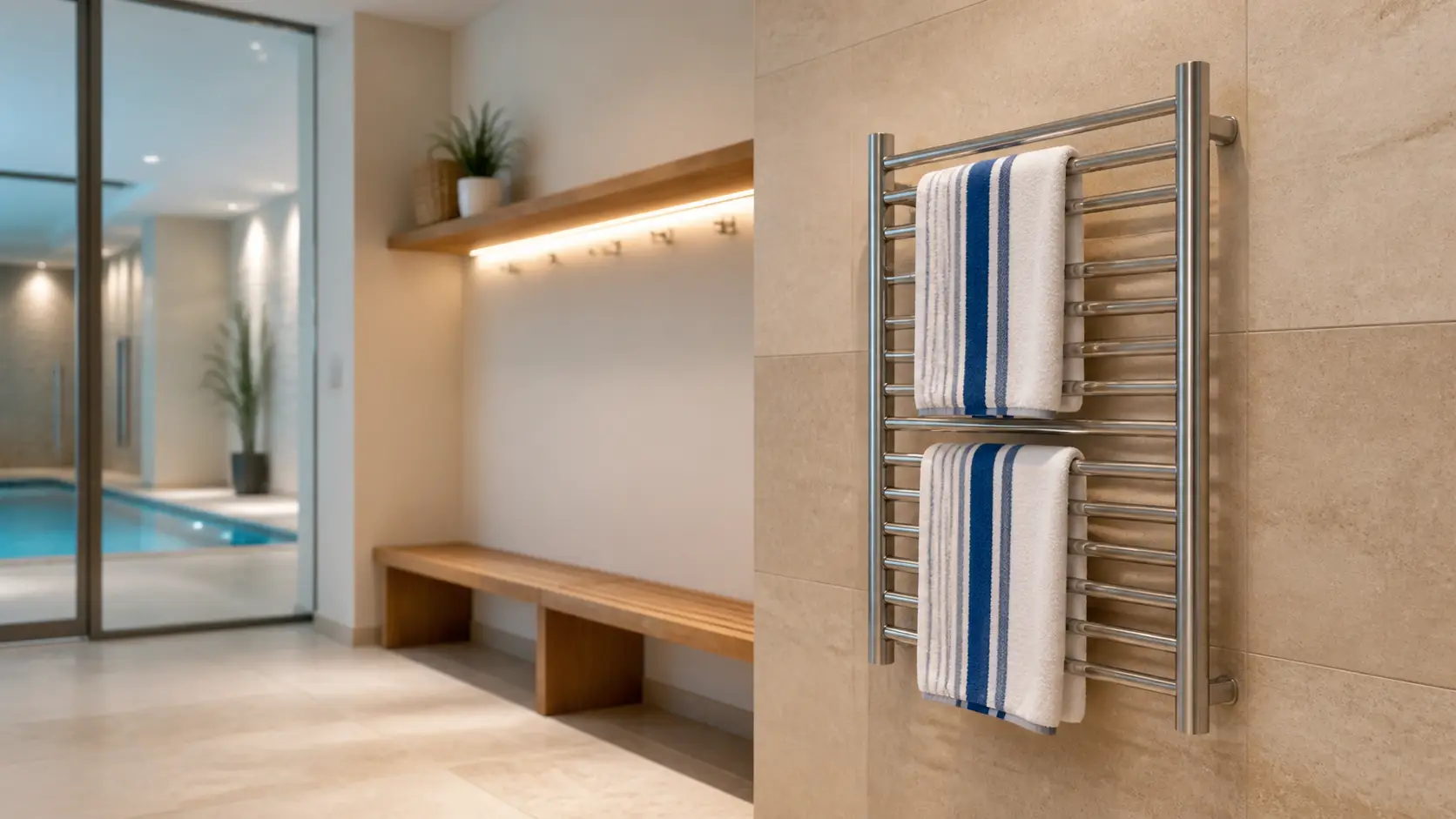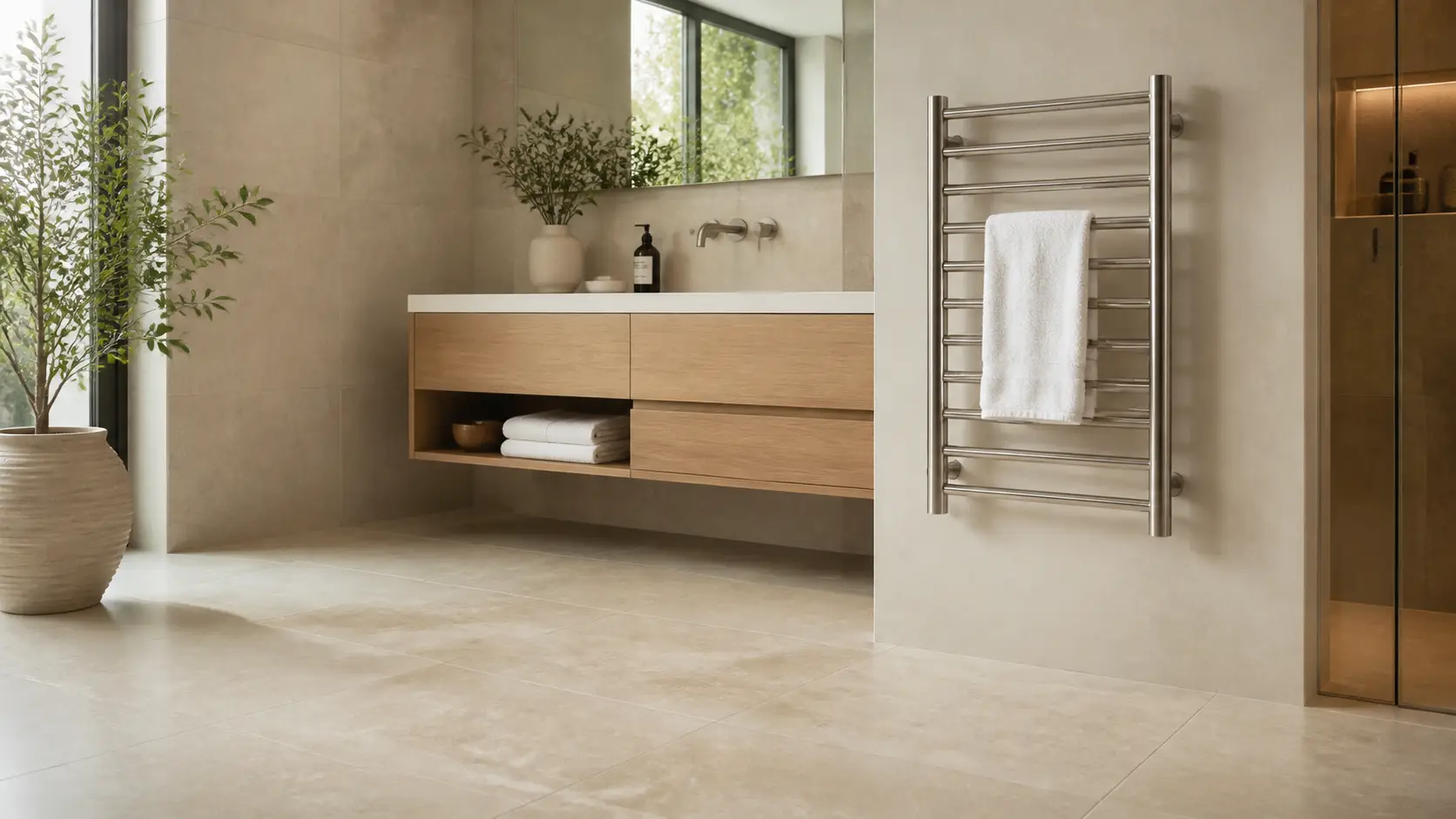
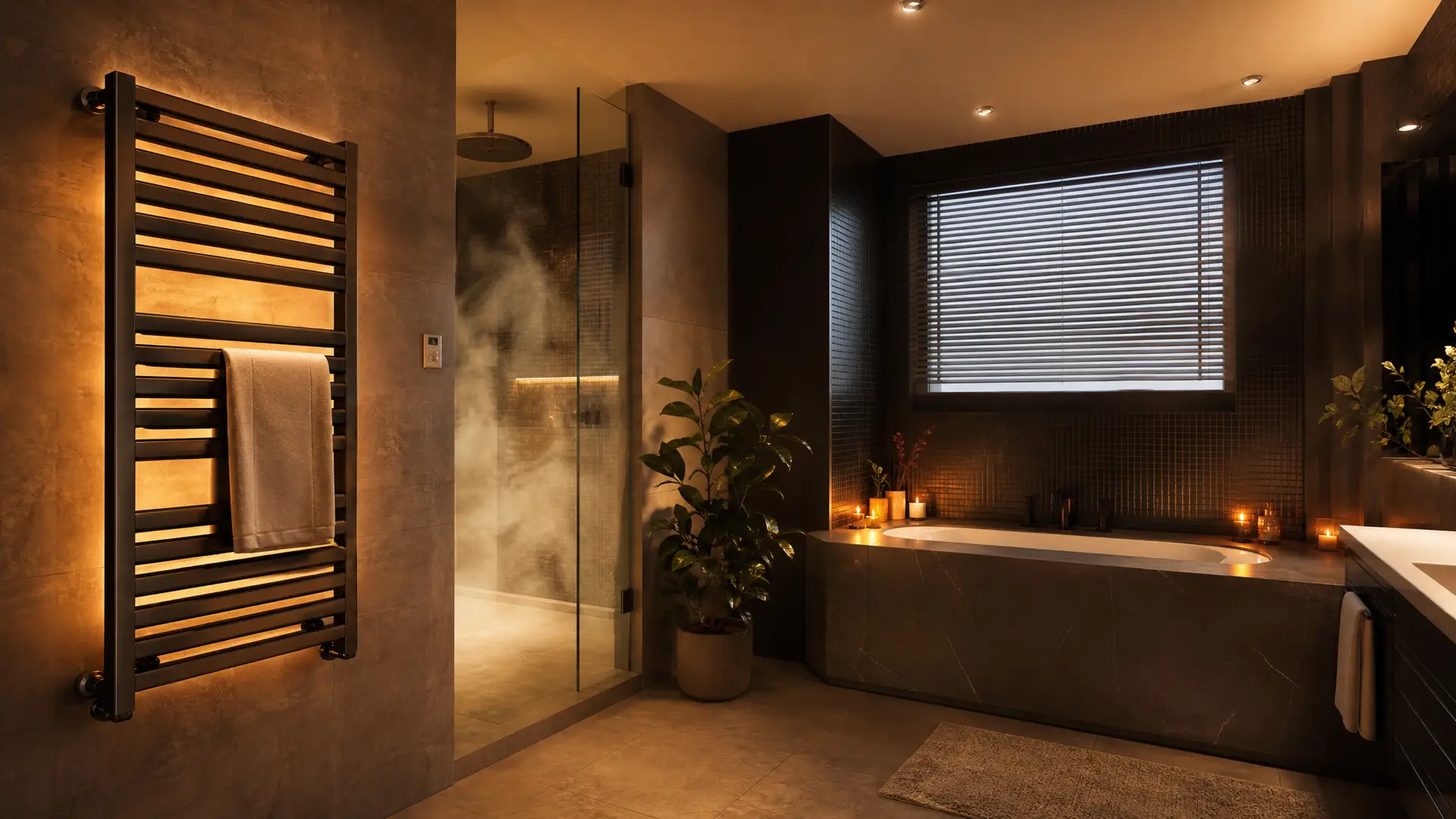
Bottom line: A standard 150W heated towel rack produces roughly 500–600 BTU per hour. In a small 4–6 m² bathroom with decent insulation, that raises the air temperature by 2–4°C. It takes the chill off. It does not replace your radiator.
Every few weeks a buyer asks if they can skip installing a bathroom radiator and just use a heated towel rail. The honest answer: only if the bathroom is tiny, well-insulated, and you live in a mild climate. This article breaks down the heat output numbers so you can set realistic expectations for yourself or your customers.
BTU Output by Rail Size
| Wattage | Approximate BTU/hr | Room Size It Can Warm | Temp Rise (1 Hour) |
|---|---|---|---|
| 100W | 340 | Under 3 m² | +1–2°C |
| 150W | 510 | 3–5 m² | +2–3°C |
| 200W | 680 | 4–6 m² | +3–4°C |
| 250W | 850 | 5–8 m² | +4–5°C |
| 300W | 1,020 | 6–10 m² | +5–6°C |
Conversion: 1 watt ≈ 3.41 BTU per hour. A 150W rail outputs about 510 BTU/hr.
For comparison, a standard bathroom radiator outputs 1,500–3,000 BTU/hr. A heated towel rail is roughly one-third to one-fifth the output of a dedicated radiator.
Real-World Heating Performance
Scenario 1: Small En-suite (4 m²)
- Rail: 150W stainless steel
- Starting temp: 16°C
- After 1 hour: 19–20°C
- After 2 hours: 20–21°C (plateaus here)
- Verdict: Comfortable for showering. Not warm enough for prolonged use without additional heat.
Scenario 2: Family Bathroom (6 m²)
- Rail: 200W
- Starting temp: 15°C
- After 1 hour: 18–19°C
- After 2 hours: 19–20°C
- Verdict: Takes the edge off. Still chilly on cold mornings.
Scenario 3: Large Bathroom (10 m²)
- Rail: 300W
- Starting temp: 14°C
- After 1 hour: 16–17°C
- After 2 hours: 17–18°C
- Verdict: Noticeable but inadequate as sole heat source.
What Limits a Towel Rack as a Heater?
Surface Area
A heated rail has 0.3–0.8 m² of radiating surface. A standard radiator has 1.5–3 m². Less surface area means less heat transfer to the air, regardless of wattage.
Design Purpose
Towel rails are designed to dry towels first. The bars are spaced to hold fabric, not to maximize air convection. A radiator’s fins are engineered specifically to circulate warm air. Different jobs.
Towel Load
When loaded with towels, up to 40% of the rail’s surface is covered. The towels insulate the bars, reducing radiant heat to the room. A loaded rail heats the room slower than an empty one.
When a Towel Rack CAN Be Your Only Heat Source
| Condition | Can It Work Alone? |
|---|---|
| Bathroom under 4 m² | ✅ Often sufficient |
| Well-insulated walls and window | ✅ Yes |
| Mild climate (winter lows above 5°C) | ✅ Yes |
| Underfloor heating present | ✅ Rail + UFH is ideal |
| Bathroom over 6 m² | ❌ No |
| Poor insulation or single glazing | ❌ No |
| Cold climate (winter lows below 0°C) | ❌ No |
The Best Pairing: Towel Rack + Supplementary Heat
The ideal bathroom heating setup combines three layers:
- Primary heat: Underfloor heating or a radiator (for ambient warmth)
- Towel drying: Heated rail (for dry towels and bonus heat)
- Quick boost: Towel rail timer set pre-shower (for immediate comfort)
This layered approach gives you warm floors, warm towels, and a comfortable room—without expecting one device to do everything.
The Bottom Line
A heated towel rack is a towel dryer that happens to warm the room slightly. In a small, insulated bathroom, it may be enough. In most bathrooms, it is a valuable secondary heat source that makes the primary heating more pleasant and efficient.
For buyers asking “Will this heat my bathroom?” the accurate answer is: “It will help, but don’t throw out your radiator.”
Need high-output rails for colder climates? We manufacture 250W–400W models with extended bar counts for maximum heat output. Request specs →