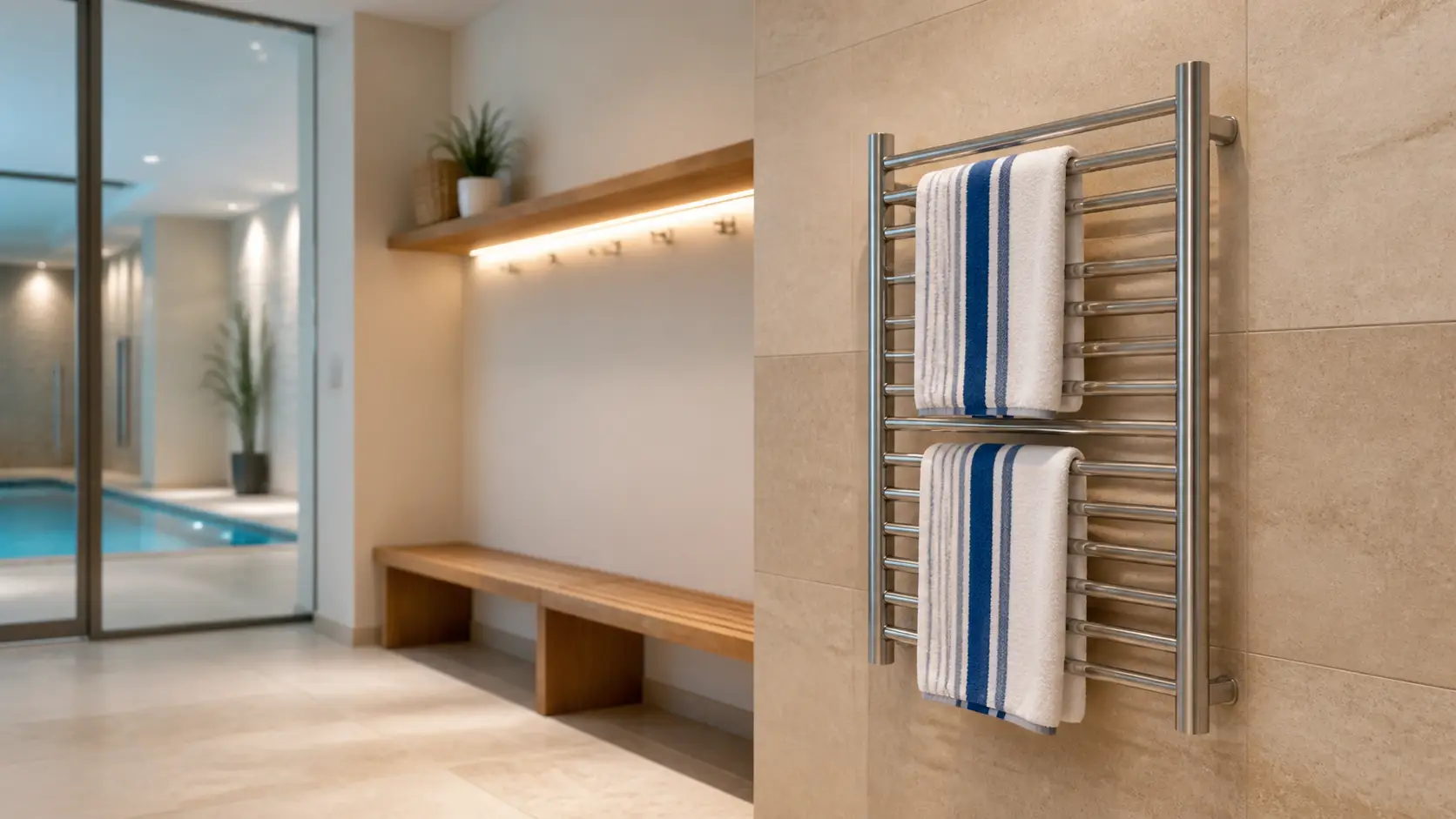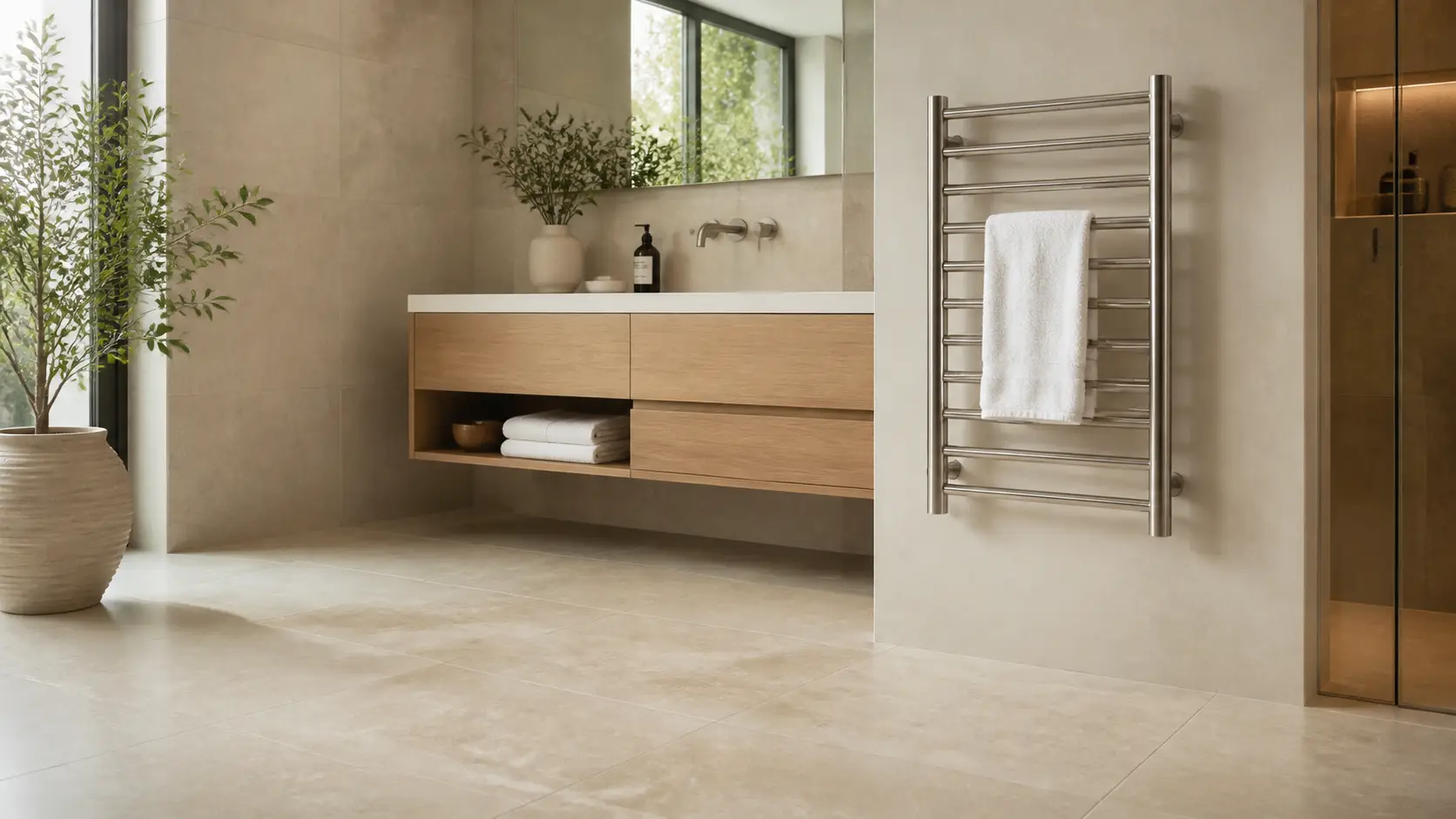

Here is the short version: electric towel warmers work for almost every project. They go anywhere, heat up in minutes, and run all year. Hydronic models tie you to a central heating system and leave you with cold towels in summer. That is the trade-off.
If you are specifying towel warmers for a hotel, residential development, or retail range, the electric-versus-hydronic question always comes up. Builders tend to like hydronic because it feels like “real” heating. Electricians prefer electric because it is predictable. Guests and homeowners do not care about the technology. They just want warm, dry towels.
This article compares both types on the factors that actually matter for procurement and installation decisions.
Side-by-Side Comparison
| Factor | Electric Towel Warmer | Hydronic Towel Warmer |
|---|---|---|
| Installation | Simple: wall mount + electrical connection | Complex: plumbing + heating system integration |
| Installation cost | $50-200 (electrician, 1-2 hours) | $300-800 (plumber, 3-6 hours + possible floor work) |
| Running cost | $0.10-0.40/day (timer-controlled) | Near zero (piggybacks on boiler) |
| Heat-up time | 5-15 minutes | 20-45 minutes (depends on boiler distance) |
| Summer operation | Works year-round | Cold towels unless dual-fuel |
| Heat output | 500-1,500 BTU/hr | 1,000-3,000 BTU/hr (can warm small bathrooms) |
| Control | Thermostat, timer, WiFi options | Limited (valve on/off, thermostatic radiator valve) |
| Maintenance | Minimal (occasional element replacement) | Tied to central heating system maintenance |
| Failure risk | Element burnout (replaceable) | Leaks, airlocks, system pressure issues |
| Retrofit suitability | Excellent | Poor (requires pipe access) |
| New-build suitability | Excellent | Good (if heating system designed for it) |
What the numbers mean in practice
The installation cost difference is usually what decides it. A hotel with 100 bathrooms saves $20,000-60,000 in installation labor by choosing electric over hydronic. That gap alone tends to settle the specification.
Running cost is where people get confused. Hydronic looks “free” because it uses boiler heat, but the boiler burns fuel to produce that heat. In a well-insulated building with an efficient boiler, the marginal cost is low. In an older building with an inefficient system, the electric option may actually cost less to run.
Heat-up time matters for user experience. A guest who turns on an electric towel rail before showering has warm towels in 10 minutes. A hydronic rail depends on whether the heating system is already running. In hotels with 24-hour heating, this is fine. In homes with timed heating schedules, it is frustrating.
Running Costs: The Math Over Five Years
Electric model (150W, timer-controlled)
| Cost item | Annual | 5-year total |
|---|---|---|
| Electricity (4 hrs/day, $0.15/kWh) | $32.85 | $164.25 |
| Maintenance (element replacement year 4) | $0 | $45 |
| Total | $32.85 | $209.25 |
Hydronic model (connected to gas boiler)
| Cost item | Annual | 5-year total |
|---|---|---|
| Additional gas (marginal load) | $15-25 | $75-125 |
| Maintenance (valve service, bleeding) | $20 | $100 |
| Total | $35-45 | $175-225 |
The running costs are roughly comparable over five years. The difference is in upfront installation, not ongoing operation.
Project-Specific Recommendations
Hotels and hospitality
Recommendation: Electric, hardwired, with timer control.
Reasons:
- Lower installation cost per room
- Consistent performance regardless of building heating schedule
- Year-round operation
- Individual room control (housekeeping can adjust timers)
- Easier maintenance (replace element, not plumbing)
Exception: Luxury spa hotels with 24-hour heating and premium positioning may specify hydronic for the higher heat output and “authentic radiator” aesthetic.
Residential developments (apartments, houses)
Recommendation: Electric for most units; hydronic only where central heating is already specified.
Reasons:
- Electric avoids plumbing coordination delays
- Buyers expect towel warmers to work in summer
- Installation cost savings improve project margin
- Fewer warranty claims (no leaks, no system balancing issues)
Exception: High-end developments with underfloor heating and hydronic towel rails as part of a luxury package.
Retrofit and renovation
Recommendation: Electric, almost always.
Retrofitting hydronic requires access to pipework that may be buried in floors or walls. The disruption and cost rarely justify the marginal benefit.
Exception: Bathrooms where the old radiator is being replaced. If the pipework is already exposed, a hydronic towel rail can reuse the existing connection.
Retail and e-commerce
Recommendation: Stock electric models; offer hydronic as a special order.
Electric models suit 90% of buyers. Hydronic buyers are typically either new-build homeowners with planned heating systems or replacement buyers upgrading an existing radiator.
Specifying for Your Project
Checklist for electric specification
- [ ] Voltage: 110V (US/Canada/Japan) or 220-240V (EU/UK/AU)
- [ ] Wattage: Match to room size (100W small, 150-200W standard, 250W+ large)
- [ ] Control type: Basic on/off, programmable timer, or WiFi/smart
- [ ] IP rating: IP24 minimum for bathroom use
- [ ] Installation type: Plug-in or hardwired
- [ ] Finish: Match bathroom fixtures (chrome, brushed nickel, matte black, white)
- [ ] Certification: UL (US), CE (EU), WRAS (UK), Watermark (AU)
Checklist for hydronic specification
- [ ] Connection size: Standard 1/2″ or 3/4″ BSP (check local standards)
- [ ] Heat output: BTU rating to match room requirements
- [ ] Valve type: Manual, thermostatic, or lockshield
- [ ] Dual-fuel option: Yes/no for summer operation
- [ ] System compatibility: Check boiler capacity and water chemistry
- [ ] Pressure rating: Match central heating system pressure
- [ ] Finish: Same considerations as electric
Source Both Types from One Supplier
We manufacture electric and hydronic towel warmers for export to Europe, North America, and Australia.
Electric range:
- 60W to 300W, 110V and 220-240V
- Carbon fiber and PTC heating elements
- Programmable timer and WiFi control options
- IP24 and IP44 ratings
- Custom finishes and OEM branding
Hydronic range:
- Standard 1/2″ BSP connections
- 1,000 to 3,000 BTU/hr output
- Compatible with standard central heating systems
- Dual-fuel models available
- Same custom finish options as electric
To discuss specifications for your project:
Submit your inquiry here. We will recommend the right type, size, and control options for your market and building type.
Minimum order: 100 pieces electric, 200 pieces hydronic (due to lower demand volume). Sample orders include both types for side-by-side comparison.
Related articles: