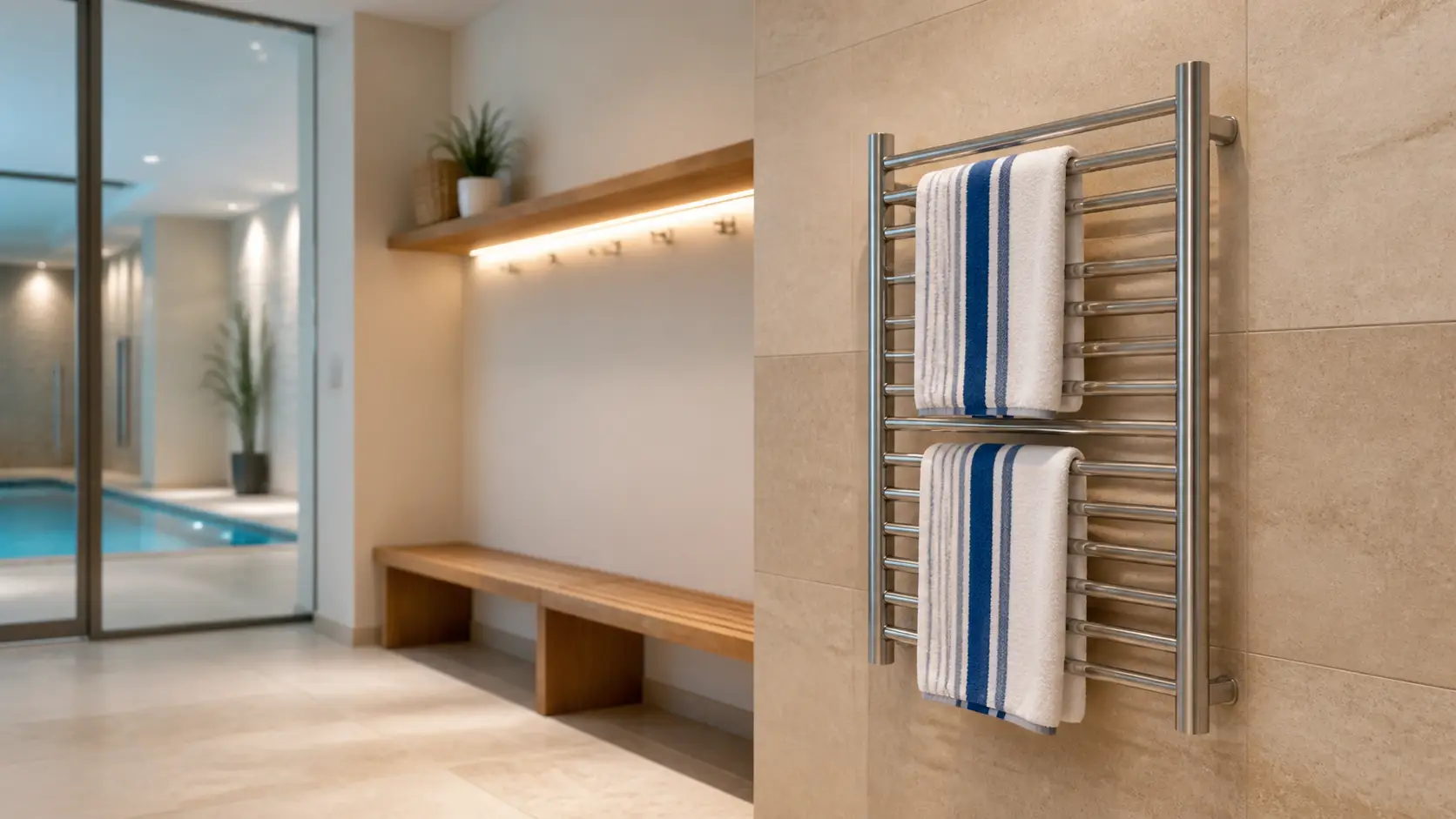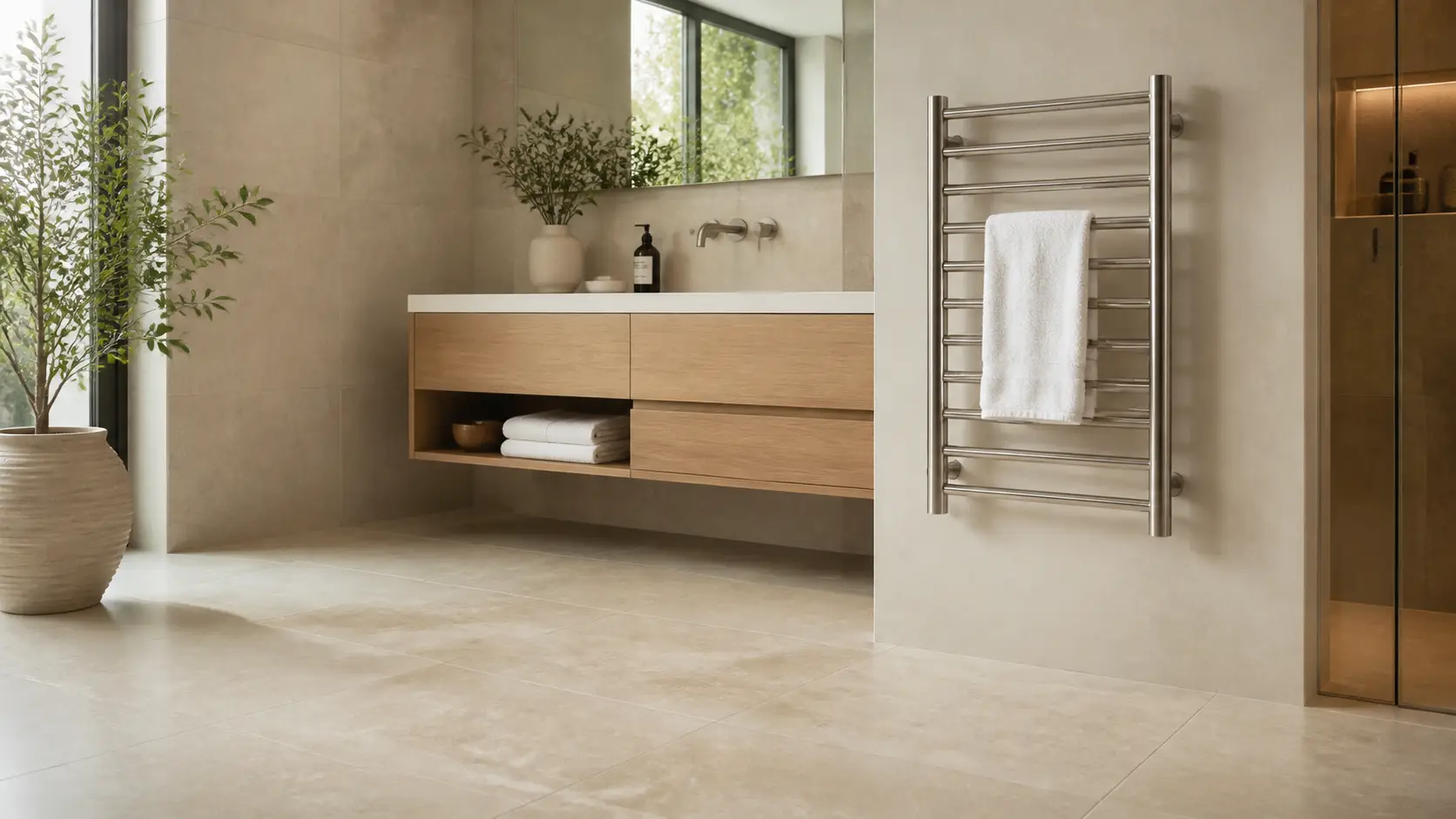
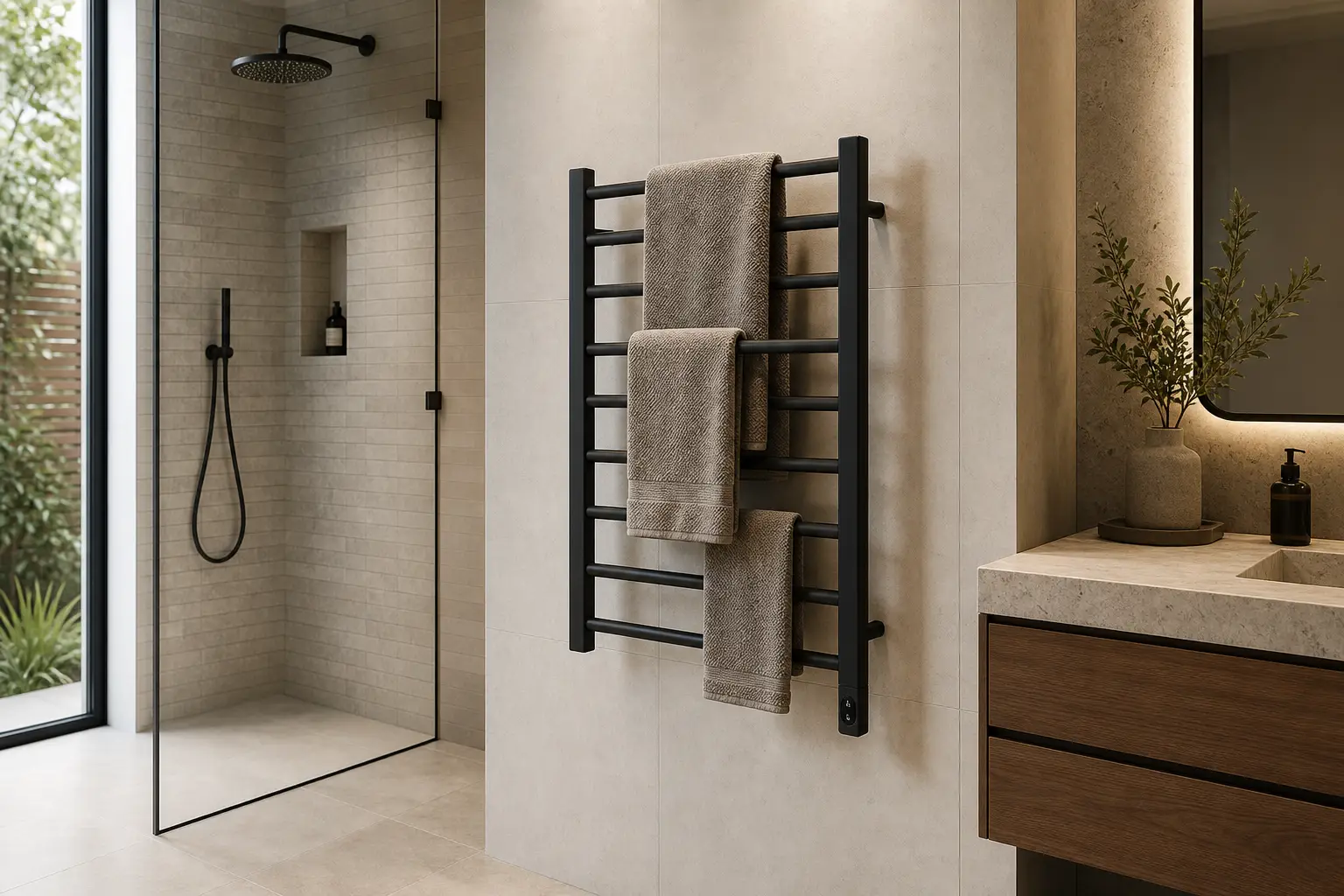
A heated towel rack should be sized by towel count, available wall space, mounting height, and how close it can sit to the shower or vanity without crowding the room. For most homes, a compact rack works for one towel or a guest bath, a standard 7-10 bar rack works for a primary bathroom, and a taller or wider rack is better for family bathrooms, hotel rooms, spas, or any space where multiple towels need regular drying.
The right size is not just the biggest model that fits on the wall. A good heated towel rack leaves room for safe mounting, easy towel loading, door and drawer clearance, electrical access, and enough open bar contact for towels to warm and dry properly.
Quick Size Recommendations
| Bathroom or project type | Practical rack size | Best use case | Watch point |
|---|---|---|---|
| Powder room or guest bath | Compact rack, often under 30 inches tall | One hand towel or one bath towel used occasionally | Do not crowd the vanity, toilet, or door swing |
| Small full bathroom | Narrow wall-mounted rack or vertical layout | One to two towels where wall width is limited | Check towel drop so fabric does not touch the floor |
| Primary bathroom | Standard 7-10 bar rack | Two bath towels in regular household use | Leave enough width for towels to hang flat, not bunched |
| Family bathroom | Large rack, tall ladder, or wider multi-bar model | Several towels used daily | More bars help only if towels have real contact and airflow |
| Hotel, spa, or multifamily room | Standardized wall-mounted model by room type | Repeatable guest comfort and easier procurement | Match model size to room drawings, electrical plan, and towel program |
Measure the Wall Before Choosing the Rack
Start with the wall, not the catalog. Measure the clear wall area where the rack could actually be mounted, then subtract space for nearby trim, outlets, switches, shower screens, vanity drawers, robe hooks, and door swings.
For a wall-mounted heated towel rack, the most useful measurements are:
- Clear wall width between fixtures.
- Clear wall height from finished floor to any shelf, window, mirror, or cabinet above.
- Distance from shower, bathtub, vanity, toilet, and door swing.
- The intended bottom-bar height, especially if long bath towels will hang from the lower bars.
- Power location for plug-in, hardwired, or dual-connect installation.
Manufacturer guidance commonly treats placement and installation details as part of the purchase decision, not an afterthought. WarmlyYours, for example, groups towel warmers by compact, standard, and large sizes, and its 2026 buying guide notes that bar count and width should match bathroom type and towel volume. Installation guidance also emphasizes reachable placement near the shower or tub while keeping required electrical clearance.
Match Rack Size to Towel Count
Bar count is a useful shortcut, but towel contact matters more than the number printed on the product page. A rack with many bars can still perform poorly if towels are folded too thickly, stacked over each other, or squeezed into a tight corner with poor airflow.
Use this simple sizing logic:
| Towel need | Better rack choice | Why it works |
|---|---|---|
| One bath towel | Compact or standard rack | Enough bar contact without using excess wall space |
| Two bath towels | Standard 7-10 bar rack | Gives each towel more surface contact and separation |
| Two towels plus hand towels | Taller ladder or wider rack | Reduces bunching and improves daily usability |
| Family towel rotation | Large rack or two planned drying points | Avoids asking one small rack to handle too much damp fabric |
| Hotel guest room | Consistent standard rack by room category | Easier for procurement, installation, maintenance, and replacement |
If the rack is mainly for warming towels before a shower, a smaller unit may be acceptable. If the goal is drying damp towels between uses, choose more usable bar area and better spacing.
Choose Width and Height by Bathroom Layout
Width decides how naturally towels can hang. Height decides how many bars can fit and whether towels clear the floor. In a narrow bathroom, a taller vertical or ladder-style layout often works better than a wide horizontal rack. In a larger bathroom, a wider rack can look balanced and give bath towels more contact area.
For tight layouts, check these details before ordering:
- Can the towel hang without covering a switch, outlet, or control?
- Will the rack block a drawer, cabinet door, shower screen, or toilet access?
- Is there enough space for a person to stand in front of it and load towels comfortably?
- Does the lower towel edge stay above the floor and away from the toilet?
- Can the control be reached without stretching across wet flooring?
For premium homes and hospitality rooms, the rack should also look proportional to the wall. A rack that is technically functional but visually undersized can make a finished bathroom feel less intentional.
Compact, Standard, or Large: Which One Fits?
| Size category | When to choose it | When to avoid it |
|---|---|---|
| Compact | Guest baths, powder rooms, narrow wall spaces, one primary towel | Family bathrooms, shared bathrooms, daily drying for multiple towels |
| Standard | Most primary bathrooms and typical residential use | Very narrow walls or rooms that need three or more towels handled daily |
| Large | Family bathrooms, luxury suites, spas, hotels, and high-use bathrooms | Very small bathrooms where it blocks movement or overfills the wall |
A larger rack is not automatically better. If the wall is too tight, the rack may interfere with fixtures or force towels into awkward folds. In that case, a better layout, a narrower model, or a different mounting wall may outperform a larger model squeezed into the wrong place.
B2B Sizing Notes for Hotels, Apartments, and Projects
For projects, sizing should be decided from the room type and drawing package, not only from a product photo. A hotel, apartment, or spa buyer should standardize rack dimensions where possible, but still confirm that each room type has enough wall area and electrical access.
Project teams should check:
- Standard bathroom type and any accessible-room exceptions.
- Finished wall material and blocking requirements.
- Hardwired junction location or plug-in outlet location.
- Rack projection from the wall and clearance from doors or glass.
- Towel program, including bath towels, hand towels, robes, or spa towels.
- Replacement consistency across phases or future maintenance cycles.
This is where a size guide becomes a specification tool. A clear size decision reduces installation questions, mismatched room finishes, and purchasing substitutions during the project.
How Size Affects Drying and Comfort
A heated towel rack works best when towels have contact with warm bars and enough exposure to air. If a rack is too small, towels may overlap heavily, stay damp longer, or feel warm only in patches. If the rack is too large for the room, it may look awkward, crowd the wall, or create avoidable installation complexity.
Bathroom moisture still needs ventilation. EPA moisture guidance emphasizes controlling moisture as the core mold-prevention strategy, while ENERGY STAR bathroom ventilation criteria focus on efficient fan performance. A heated towel rack can support towel drying and comfort, but it should work alongside good ventilation, not replace it.
Common Sizing Mistakes
| Mistake | Why it causes problems | Better choice |
|---|---|---|
| Choosing only by wattage | Wattage does not prove the rack fits the wall or towel load | Check dimensions, bar count, towel contact, and placement together |
| Ignoring towel length | Long towels can hang too low or bunch at the bottom | Confirm bottom-bar height and towel drop |
| Buying too small for shared bathrooms | Multiple towels overlap and dry slowly | Use a larger rack or plan two towel locations |
| Mounting too far from the shower | Users drip water while reaching for towels | Choose a reachable wall with proper electrical clearance |
| Treating product photos as scale drawings | Photos can hide real width, height, and projection | Use the specification sheet and room measurements |
Practical Buying Checklist
Before ordering a heated towel rack, confirm these points:
- The rack width fits the clear wall space.
- The rack height leaves room for towel drop and comfortable access.
- The bar count matches the number of towels used daily.
- The rack style suits the bathroom layout: vertical, horizontal, ladder, freestanding, plug-in, or hardwired.
- The electrical plan is suitable for the installation type.
- The finish and size look proportional to the bathroom design.
- The product specification sheet includes dimensions, voltage, wattage, and installation requirements.
- The final position supports daily use, not just visual symmetry.
If you are comparing options for a project or premium bathroom, start with CALITHREX wall-mounted and freestanding towel rack styles, then match the finish, size, and installation type to the room plan.
FAQ
What size heated towel rack is best for a small bathroom?
A compact or narrow wall-mounted heated towel rack is usually best for a small bathroom, especially if it can hold one to two towels without blocking the vanity, shower screen, or door swing. A taller narrow layout often uses limited wall space better than a wide rack.
How many bars should a heated towel rack have?
For occasional use, 4-6 bars may be enough. For a primary bathroom, 7-10 bars is often more practical. For family bathrooms, spas, or hotel rooms, a larger bar count can help, but only if towels have enough contact area and airflow.
Is a bigger heated towel rack always better?
No. A bigger rack helps only when the bathroom has enough wall space, clearance, and towel demand. In a tight room, an oversized rack can block movement or make towels awkward to load.
Should I choose a vertical or horizontal heated towel rack?
Choose vertical or narrow ladder-style layouts when wall width is limited. Choose wider horizontal layouts when you have a broad wall and want towels to hang flatter. The best choice depends on wall space, towel count, and nearby fixtures.
Can one heated towel rack dry towels for a whole family?
It can help, but one small rack is usually not enough for a busy family bathroom. Choose a larger rack with more usable bar area or plan a second towel location if multiple damp towels are used every day.
What dimensions should I send to a supplier?
Send the clear wall width, clear wall height, preferred mounting location, shower or tub distance, power location, towel count, finish preference, and project room type. For B2B projects, also send drawings if available.