Complete Guide to OEM Heated Towel Rack Manufacturing: From Design to Delivery
The bottom line
If you are sourcing heated towel racks under your own brand, the process breaks down into five stages: design spec, sampling and approval, certification, production, and logistics. The total timeline from initial inquiry to landed goods typically runs 60 to 90 days, with MOQs ranging from 200 to 1,000 units depending on finish complexity and custom branding. The single most important decision you will make is stainless steel vs. zinc alloy for the base material. Pick that wrong and nothing downstream — coating, shipping weight, warranty cost — works out right. We have been on the factory side of that table for over 50,000 units at Calithrex, working with brands in North America, Europe, and Australia. This guide is the walkthrough I wish every first-time buyer had before they called us.
What OEM means in the heated towel rack industry
OEM — Original Equipment Manufacturing — means a factory builds units to your spec, and you sell them under your own brand. The factory handles engineering, tooling, assembly, and testing. You own the design, finish, branding, packaging, and distribution.
Do not confuse this with ODM — Original Design Manufacturing — where the factory already has a design and you just add your logo. Most suppliers, ourselves included, do both. But this guide is about full OEM, where you bring your own design or significantly modify an existing platform.
There are three common scenarios that lead buyers to OEM:
| Scenario | Typical Buyer | Why OEM |
|---|---|---|
| Brand launch | Startup home goods brand, DTC company | Exclusive product nobody else carries |
| Specification-driven | Hotel procurement, property developer | Must meet specific dimensions, finishes, power requirements |
| Existing product refinement | Distributor switching suppliers | Wants better materials, different features, or cost optimization |
Stage 1: Design & specification
Here is something I have learned the hard way: do not call a factory until you have a written spec. They quote on specs, not on vague ideas. Here is what the minimum viable spec looks like:
Core parameters
- Dimensions — Overall width, height, and rail spacing. Be specific about whether dimensions are for the unit body only or include mounting brackets.
- Tube diameter and wall thickness — Common diameters are 20 mm, 25 mm, and 32 mm. Wall thickness should be a minimum of 1.2 mm for 304 stainless steel; anything thinner risks denting during shipping.
- Number of rails — 4 to 7 rails is standard for residential. Commercial projects often specify 8 to 12 rails.
- Power rating — 150 W to 400 W for electric models. Specify whether you want a fixed power output or adjustable via a thermostat.
- Electrical configuration — Hardwired only, plug-in with cord, or both. Plug-in requires specifying cord length, plug type (US NEMA 5-15, EU Schuko, UK BS 1363, AU AS/NZS 3112), and whether a GFCI is required.
- IP rating — IP44 is minimum for bathroom use. IP55 is preferred for Zone 2 installations and commercial bathrooms.
Finish specification
If I had a dollar for every time a buyer said brushed gold and the factory delivered polished champagne, I would have a lot of dollars. Be painfully explicit here:
- Finish type — Brushed, polished, satin, matte, textured
- Color — Use a physical color standard (RAL code, Pantone, or a physical sample). “Brushed gold” means different things to different factories.
- Coating method — PVD (physical vapor deposition) is the gold standard. Electroplating is cheaper but less durable. Powder coating is used only for matte black and white finishes.
- Coating thickness — For PVD finishes, specify minimum coating thickness in microns (0.3 to 0.5 micron is typical for quality PVD).
Branding requirements
- Logo placement — Engraved on the side rail, embossed on the control panel, printed on the nameplate, or all three
- Packaging — Branded box dimensions, print colors, material (corrugated vs. rigid), insert foam type
- Manual — Language requirements, whether a printed manual is included or QR-code-to-digital
Stage 2: Sampling & approval
Once your spec is locked, the factory cuts samples. Figure 15 to 25 days for this stage.
What happens during sampling
- Engineering review — The factory checks your spec against their tooling capabilities and flags any issues. For example, a curved rail with a tight radius may require a new bending die.
- Material procurement — Stainless steel tubes are cut to length. If you specified a non-standard diameter, the factory may need to order specialty tubing.
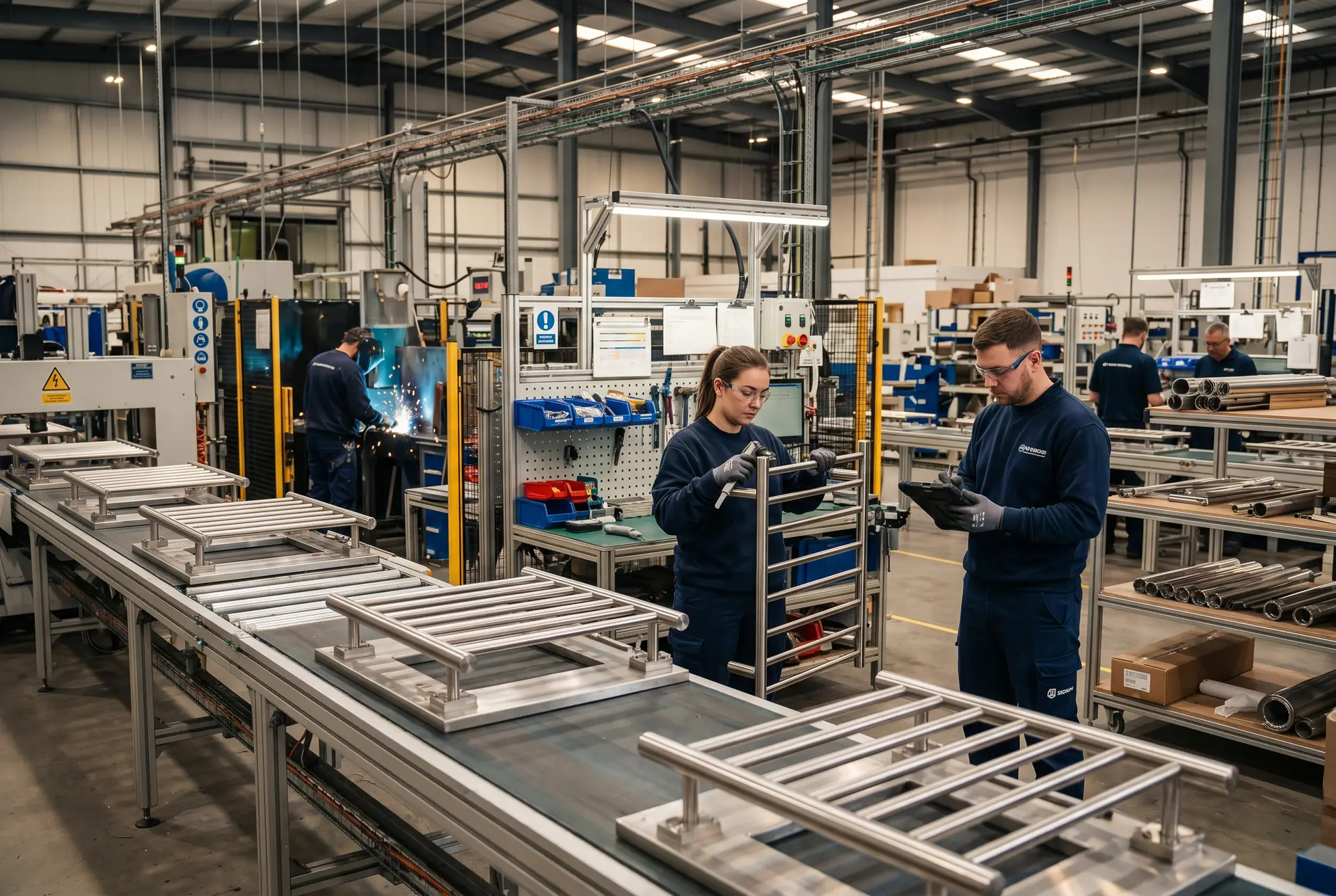
- Welding and assembly — The frame is welded (TIG welding for stainless steel, MIG for brass or zinc alloy), ground smooth, and polished.
- Coating application — The sample goes through the full coating process to verify color and finish consistency.
- Electrical assembly — The heating element, thermostat, and wiring are installed.
- Function testing — The sample is powered on to verify heat output, evenness, and timer/digital functions.
What to evaluate when you receive the sample
- Finish uniformity — Hold the sample at an angle under direct light. Look for thin spots, color variations, or visible weld lines under the coating.
- Weld quality — Check all joints. TIG welds on stainless steel should be smooth and consistent. Grinding marks that are visible under the coating indicate poor workmanship.
- Heat distribution — If the sample has a digital display or thermostat, power it on and measure surface temperature top to bottom with an infrared thermometer. Variation should be no more than 5 degree F across all rails.
- Fit and finish — Mount the sample on the wall if possible. Check that brackets align and the unit sits level. Test that any knobs, buttons, or switches feel solid.
- Packaging fit — Place the sample in the proposed packaging. Ensure foam inserts hold it securely with no movement.
Sample approval letter
Once you approve, provide a written sign-off. This protects both parties. A simple email stating “We approve the sample dated [date] and authorize mass production based on this specification” is sufficient for most factories.
Stage 3: Certifications
Certification. This is where rookies lose the most time. You cannot ship without the right certs, and the timelines vary wildly by market.
Major certifications by market
| Market | Required Certification | Typical Timeline | Cost Range |
|---|---|---|---|
| United States | UL 60335-2-43 or ETL | 4 to 8 weeks | ,000 to ,000 |
| Canada | CSA/ULC | 4 to 6 weeks (piggyback on UL) | ,000 to ,000 |
| European Union | CE (LVD + EMC + RoHS) | 2 to 4 weeks | ,000 to ,000 |
| United Kingdom | UKCA (post-Brexit) | 2 to 4 weeks | ,000 to ,000 |
| Australia/New Zealand | SAA / RCM | 3 to 5 weeks | ,500 to ,000 |
| Middle East | SASO / ESMA | 2 to 3 weeks | ,500 to ,000 |
Questions to ask your factory about certification
- Do you already have a certification for this base model? If your OEM unit is built on a certified platform, the new certification may be a “harmonized” filing that costs less and takes less time.
- Who pays for certification? Typically the buyer pays, but some factories share the cost if they retain the certification on file for future orders.
- Can the certification cover multiple models? Some certification bodies allow a “family” filing that covers variations in size and power rating under one certificate.
- What is the certification validity period? UL certifications typically require annual follow-up inspections.
Critical note
Do not — seriously, do not — start production without certification in hand. I know buyers who lost entire containers at customs because the cert was still in the lab. The right sequence: approve sample → submit to lab → receive certification → authorize production → schedule shipping.
Stage 4: Mass production
Production runs 25 to 45 days, give or take. Depends on quantity and how busy the factory is.
Typical production timeline
| Week | Activity |
|---|---|
| Week 1 | Raw material procurement — stainless steel tubes, heating elements, electrical components, packaging materials |
| Week 2 | Tube cutting, bending, and welding — frame assembly |
| Week 3 | Grinding, polishing, and surface preparation — first coating layers |
| Week 4 | Final coating (PVD or electroplating), electrical assembly, digital control programming |
| Week 5 | Quality control testing, packaging, palletizing, loading |
QC checkpoints during production
A good factory runs QC at four points during production. Here is what we check at each stage:
- Pre-coating QC — Check weld quality, surface finish, dimensional accuracy. Defects found here are corrected before coating.
- Post-coating QC — Visual inspection of finish under standardized lighting. Color comparison against the approved sample using a spectrophotometer.
- Electrical QC — 100% of units are power-tested. Measured parameters: power draw, surface temperature, timer accuracy, GFCI trip test (if applicable).
- Pre-shipment QC — Final inspection on a statistical sample (AQL 2.5 is standard for consumer goods, AQL 1.0 for commercial/hotel orders). Includes packaging integrity, branding accuracy, manual completeness.
Third-party inspection
For first orders, we recommend hiring a third-party inspection company (SGS, Bureau Veritas, Intertek) to conduct a pre-shipment inspection at the factory. Cost is typically to per man-day. The inspector will:
- Verify quantity against packing list
- Conduct random visual and dimensional checks
- Witness power testing on a random sample
- Confirm packaging and labeling accuracy
- Take photos for your records
Stage 5: Logistics & delivery
Shipping methods
| Method | Transit Time | Cost per CBM (est.) | Best For |
|---|---|---|---|
| Sea freight (LCL) | 25 to 35 days | to | Orders under 5 CBM |
| Sea freight (FCL) | 20 to 30 days | ,500 to ,000 (20 ft) | Orders over 5 CBM |
| Air freight | 5 to 10 days | to per kg | Rush orders, samples |
| Express (DHL/FedEx) | 3 to 7 days | to per kg | Samples, small orders |
Incoterms: what you need to know
| Term | What the buyer pays for | Risk transfer point |
|---|---|---|
| EXW (Ex Works) | Everything from factory gate onward | Factory |
| FOB (Free on Board) | Ocean freight, insurance, destination charges | Port of loading |
| CIF (Cost, Insurance, Freight) | Destination port charges and inland delivery | Port of destination |
| DDP (Delivered Duty Paid) | Nothing — factory handles everything | Buyer door |
For first-time OEM buyers, FOB is the most balanced option. The factory handles domestic logistics and port loading, while you have control over international shipping and customs clearance.
Documentation required for customs clearance
- Commercial invoice
- Packing list
- Bill of lading (sea) or air waybill (air)
- Certificate of origin (for preferential tariff rates)
- Certification certificates (UL, CE, etc.)
- Import license (varies by country)
How to choose the right OEM partner
Factory evaluation checklist
| Check Item | What to Look For |
|---|---|
| Years in business | 5+ years minimum in heated towel rack production |
| Production capacity | Monthly output of at least 3,000 units (electric) |
| Export experience | Proven track record to your target market |
| Certifications on file | UL/CE/ETL for current models |
| Material sourcing | 304 stainless steel as standard, not zinc alloy |
| QC process | ISO 9001 certification or documented QC procedures |
| Minimum order quantity | Willing to start with 200 to 500 units for new partnerships |
| Communication | English-speaking sales team or dedicated account manager |
| Sample policy | Custom samples available within 15 to 20 days |
| Warranty support | Willing to back a 2 to 5 year warranty structure |
Red flags
- Factory refuses to show you a physical sample before production
- MOQ under 100 units (usually means they are trading, not manufacturing)
- Cannot provide certification documentation for current products
- Unwilling to accommodate third-party inspection
- Shipping address differs from factory address (trading company posing as manufacturer)
Cost breakdown: what you are paying for
For a typical electric heated towel rack, the factory price breaks down roughly as:
| Component | Percentage of Factory Price |
|---|---|
| Stainless steel tubes and raw materials | 25 to 30% |
| Heating element and electrical components | 15 to 20% |
| Coating and surface treatment (PVD) | 10 to 15% |
| Labor (welding, assembly, QC) | 15 to 20% |
| Packaging and manual | 8 to 12% |
| Certification amortization | 3 to 5% |
| Factory margin | 10 to 15% |
Know this breakdown and you will negotiate better. If a quote comes in way below everyone else, something is getting cut. Nine times out of ten it is the steel or the coating.
Frequently asked questions
What is the MOQ for custom electric towel rails?
For a full OEM order with custom finishing and branding, MOQ typically ranges from 200 to 500 units per SKU. Some factories, including Calithrex, offer a lower MOQ of 100 units for first-time partnerships. ODM orders (rebranding an existing design) can start as low as 50 units.
How long does OEM towel warmer production take?
A typical OEM order takes 60 to 90 days from spec sign-off to departure from the factory. This breaks down as: sampling 15 to 25 days, certification 20 to 40 days (can run in parallel with other stages), mass production 25 to 45 days. Air freight can reduce transit time but not production time.
How to find a reliable towel warmer factory in China?
Start with trade platforms (Alibaba, Global Sources) but always verify claims. Request video calls showing the production floor, not just the showroom. Ask for current certification documents. Order samples. Use a third-party inspection company for your first order. Visit the factory in person if your order volume justifies the trip.
What certifications do I need to import towel warmers to USA?
UL 60335-2-43 (Standard for Household Electric Heating Appliances) is the primary certification required for the US market. ETL is accepted as equivalent. You will also need compliance with FCC Part 15 if the unit has digital controls or WiFi connectivity.
How to get a sample from a towel rack factory?
Most OEM factories charge for custom samples, typically to per unit plus shipping. The sample cost is usually deducted from your first production order. Standard ODM samples (existing designs) are often available for the cost of shipping only.
Can I use my own logo on an OEM towel rack?
Yes. That is the core value of OEM. Your logo can be engraved on the metal rail, printed on a nameplate, or displayed on the digital control panel. The factory will also print your logo on the packaging, manual, and any included documentation.
Calithrex OEM capabilities
Calithrex operates a dedicated OEM production line at our Guangdong facility with:
| Capability | Detail |
|---|---|
| Monthly capacity | 8,000 units (electric heated towel racks) |
| Material base | 304 stainless steel (standard), brass options available |
| Finish options | Brushed/satin/matte/polished in gold, black, white, bronze, chrome — all PVD coated |
| Digital features | Digital thermostat, WiFi module, 7-day programmable timer (can be white-labeled with your app) |
| Certifications on file | UL, ETL, CE, UKCA, SAA, RoHS |
| MOQ for OEM | 200 units (100 units for returning partners) |
| Sample timeline | 15 to 18 days for custom OEM sample |
| Production lead time | 28 to 35 days after sample approval |
| Warranty support | Up to 5-year structural warranty pass-through |
We work with hotel procurement teams, bathroom brand startups, and distributors across 12 countries. Got a design in mind? Send it over and we will quote within 48 hours.