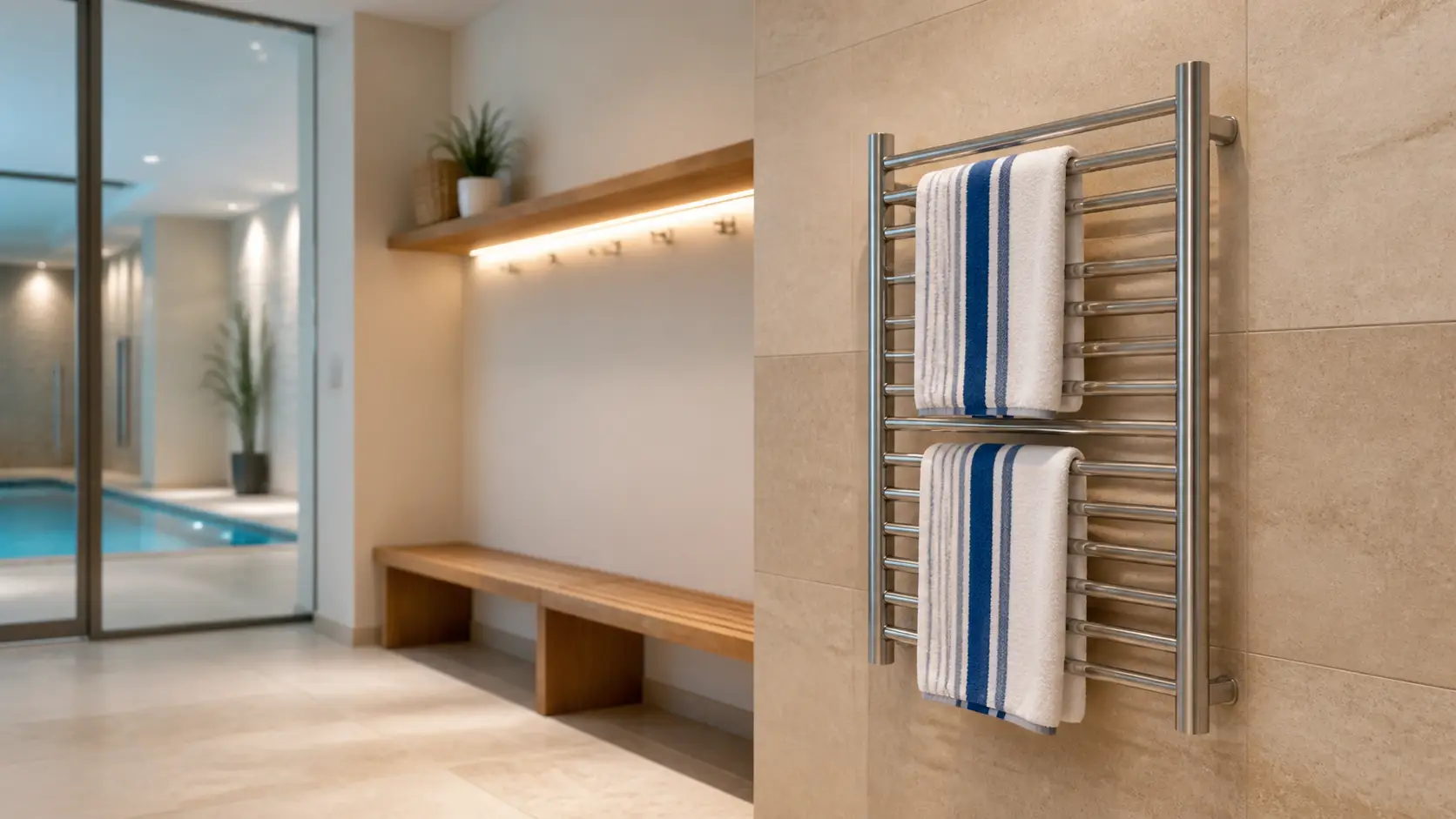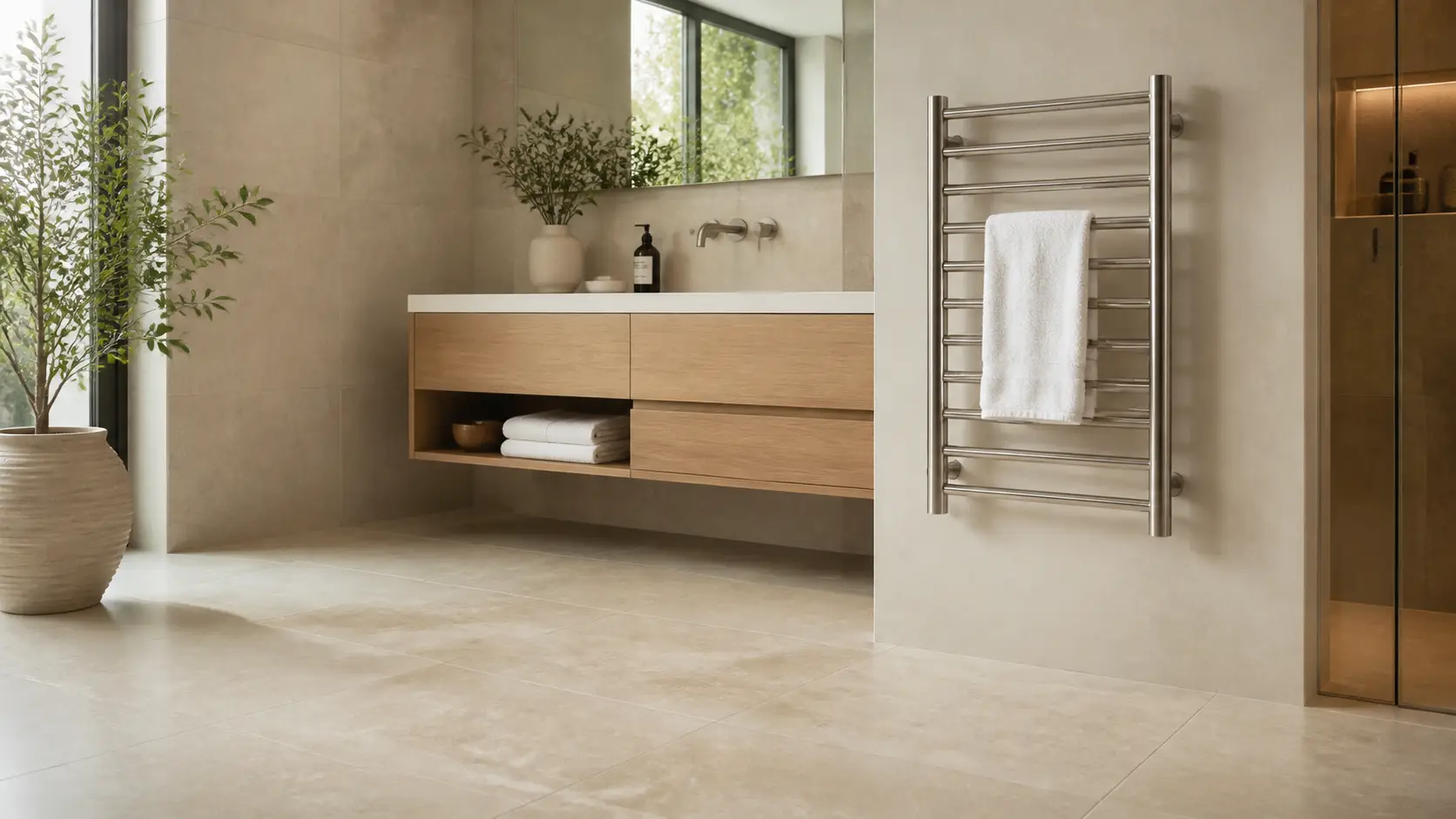
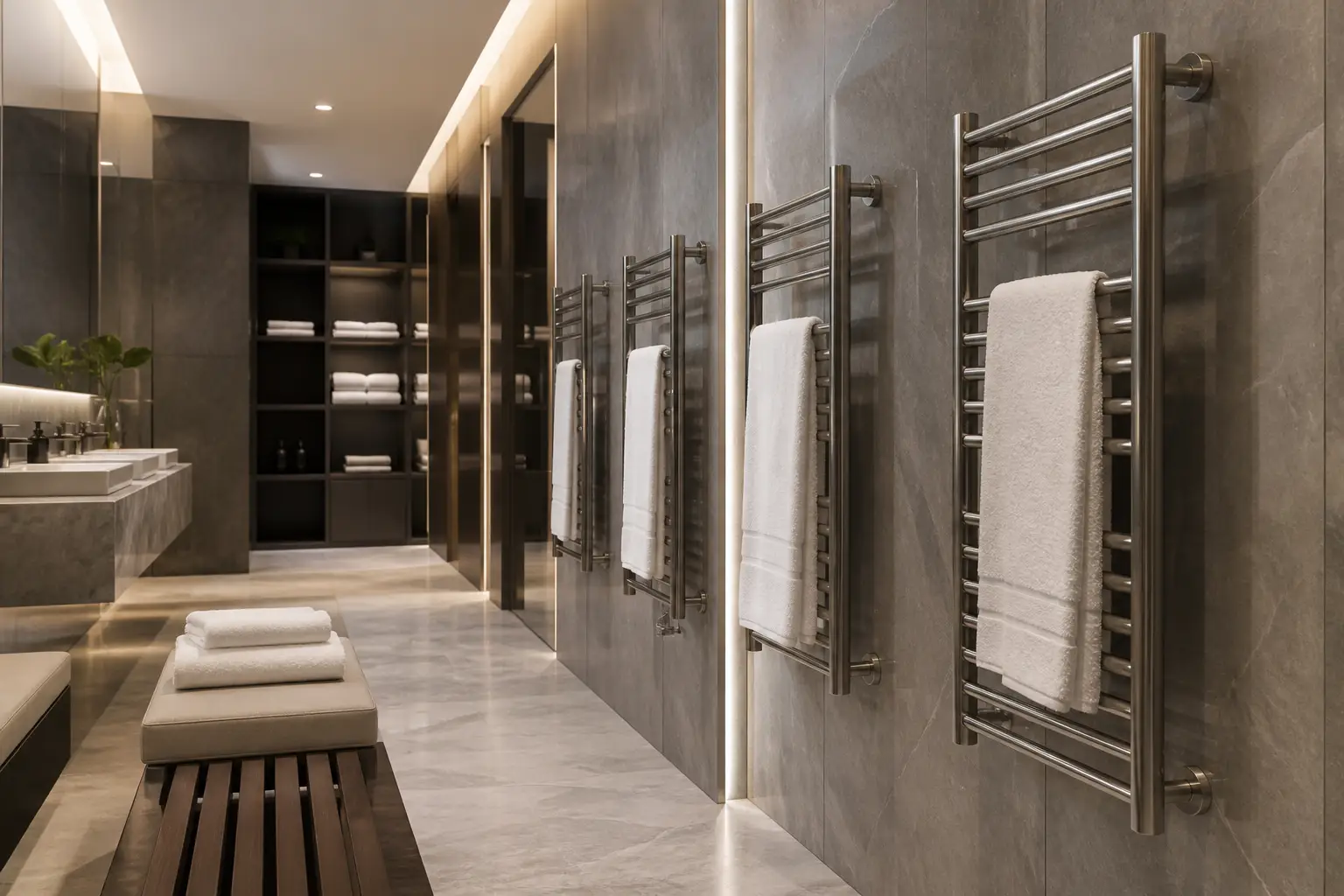
A commercial heated towel rack should be bought like a project fixture, not like a single home accessory. Commercial buyers need to check dimensions, wattage, wiring, safety ratings, finish durability, controls, packaging, warranty, spare parts, and whether the supplier can deliver the same model consistently across the full order.
This matters for hotels, spas, gyms, apartment projects, wellness facilities, and commercial bathrooms where the towel rack affects guest comfort, cleaning routines, electrical planning, and long-term maintenance.
What makes a heated towel rack commercial?
A commercial heated towel rack is not always a separate product category. In many cases, it is a model specified, documented, installed, and supported for repeated use across a project.
The commercial difference is the buying process:
- More units are ordered at once.
- Installation must be repeatable.
- Documentation must satisfy project teams.
- Finish consistency matters across batches.
- Maintenance and spare parts matter after handover.
- Safety and certification questions are more formal.
Grand View Research reports that commercial applications accounted for the largest revenue share in the heated towel rail market in 2024. That supports what many project buyers already see: heated towel racks are increasingly used in hospitality, wellness, and residential development projects, not only private homes.
Where commercial heated towel racks are used
Commercial heated towel racks can fit many property types:
| Property type | Main reason to specify |
|---|---|
| Hotels | Guest comfort and premium bathroom perception |
| Spas | Warm towels and wellness experience |
| Gyms and clubs | Towel turnover and premium changing rooms |
| Apartments | Bathroom amenity upgrade |
| Serviced residences | Home-like comfort with hotel-style presentation |
| Pool areas | Better towel drying support |
| Senior living | Comfort and controlled towel placement |
The right model depends on the setting. A hotel suite may prioritize appearance. A gym changing room may prioritize durability. An apartment project may prioritize repeatable installation and simple controls.
Core specifications to request
Before comparing prices, ask every supplier for the same specification set. This makes quotations easier to compare.
| Specification | Why it matters |
|---|---|
| Product dimensions | Confirms wall fit and towel capacity |
| Wattage | Supports energy planning |
| Voltage | Must match the market and project design |
| Wiring method | Hardwired or plug-in affects installation |
| IP rating | Helps determine bathroom placement |
| Surface temperature range | Affects comfort and safety |
| Material | Influences corrosion resistance and durability |
| Finish | Must match design and survive cleaning |
| Controls | Timer, thermostat, or simple on/off |
| Certifications | Supports compliance and import approval |
| Warranty | Important for commercial use |
| Spare parts | Reduces long-term replacement issues |
If a supplier cannot provide these details, the quote is incomplete.
Hardwired, plug-in, or mixed specification?
For commercial guest-facing bathrooms, hardwired installation is usually the cleaner specification. It avoids visible cords, reduces tampering, and looks integrated with the room.
Plug-in models can still make sense for:
- Retrofit spaces where walls are finished.
- Pilot projects before a wider rollout.
- Back-of-house or staff areas.
- Temporary wellness or spa rooms.
- Small properties without major renovation work.
Some projects use a mixed approach: hardwired units in premium rooms and plug-in units in selected retrofit spaces. The key is to document the decision so purchasing, installation, and maintenance teams know which model belongs where.
Safety and compliance questions
Commercial buyers should involve the project electrician or compliance team before final approval. Requirements vary by market, but the questions are consistent:
- Is the product certified for the target market?
- Is the voltage correct?
- Is GFCI, RCD, or similar protection required?
- Is the IP rating suitable for the planned bathroom zone?
- Is the surface temperature appropriate for guest use?
- Are installation drawings available?
- Are controls safe and easy to understand?
- Is the product suitable for the expected environment?
Do not use lifestyle photos as proof of bathroom suitability. Use the product rating, installation manual, and local code guidance.
Material and finish durability
Commercial bathrooms are cleaned often. The towel rack finish must survive moisture, towels, fingerprints, and cleaning routines.
Common commercial choices:
- Stainless steel for durability and corrosion resistance.
- Brushed stainless for a modern look that hides marks better.
- Chrome for broad fixture compatibility.
- Matte black for design-led boutique projects.
- Brushed gold for luxury suites or spa environments.
Ask the supplier what cleaning chemicals should be avoided. A finish that looks good in a sample can still fail if it cannot handle the property's cleaning process.
Energy and controls
Energy planning is simple for one unit but more important across many rooms. Ask for the rated wattage and estimate usage by project type.
Daily kWh = wattage / 1000 x hours used per day.
For example, a 150W rack running 4 hours per day uses 0.6 kWh per day. In 80 rooms, that becomes 48 kWh per day before occupancy and control settings are considered.
Commercial projects should consider timers, thermostats, or clear operating procedures. In hotels and spas, simple timer controls can support comfort while limiting unnecessary runtime.
Supplier and project questions
Ask these questions before placing a commercial order:
- Can you supply the same model and finish for the full project quantity?
- What is the lead time for samples, pilot orders, and bulk production?
- Can you provide installation drawings and wiring diagrams?
- What certifications and test reports are available?
- What is the warranty for commercial or project use?
- Are replacement controls, mounting kits, and spare parts available?
- Can packaging be labeled by floor, room type, or project phase?
- How do you manage finish consistency across batches?
- What happens if a product is damaged during transport?
- Can you support future repeat orders?
The best commercial supplier is not simply the lowest-price supplier. It is the supplier that reduces project risk.
Commercial buying checklist
Use this checklist before approving the purchase order:
| Checkpoint | Confirmed? |
|---|---|
| Room or facility type is defined | |
| Wall space and mounting height are confirmed | |
| Wiring method is selected | |
| Wattage and voltage are approved | |
| IP rating is suitable for placement | |
| Finish matches the project schedule | |
| Controls are simple and appropriate | |
| Certifications are available | |
| Installation drawings are approved | |
| Warranty and spare parts are documented | |
| Packaging and labeling needs are confirmed |
This checklist helps prevent the most common commercial purchasing problem: choosing the product before the project conditions are clear.
FAQ
Are commercial heated towel racks different from home models?
Sometimes the physical product may be similar, but the specification requirements are stricter. Commercial projects need better documentation, repeatable installation, finish consistency, warranty clarity, and spare-part support.
What is the best commercial heated towel rack material?
Stainless steel is usually a strong choice for humid commercial bathrooms because it offers durability, corrosion resistance, and a clean professional look.
Should commercial heated towel racks be hardwired?
For guest-facing hotels, spas, and new construction, hardwired installation is usually preferred. Plug-in units may still work for retrofits, pilots, or non-guest areas.
What wattage should commercial buyers choose?
There is no single best wattage. Buyers should match wattage to rack size, towel capacity, expected runtime, room type, and energy plan. Always compare rated wattage across models.
What certifications should buyers request?
That depends on the target market. U.S. buyers often ask about UL or ETL listing, while other markets may require CE, UKCA, SAA, RoHS, or local documentation. Confirm with the importer, electrician, or compliance team.
Final advice for commercial buyers
A commercial heated towel rack order should be based on the project conditions: room type, towel capacity, wiring, safety, finish, controls, maintenance, and supplier reliability. A low unit price does not help if the model is hard to install, hard to replace, or inconsistent across batches.
Calithrex can support commercial heated towel rack projects for hotels, spas, apartments, wellness facilities, and bathroom developments. Start with the specification package, then compare models against the real project requirements.