Bottom line: Smart WiFi towel racks add $15-25 per unit and appeal to tech-savvy consumers, but the B2B case is weaker. Hotels prefer simple timers. Retailers face higher return rates. For most bulk buyers, basic programmable models offer better margin and fewer headaches.
Every year someone asks if we can add WiFi to our towel rails. The answer is yes. The better question is whether you should. After watching smart bathroom products move through the market for three years, I have seen enough data to form an opinion. This guide breaks down what smart towel racks actually do, what they cost, and which buyers should care.
What “Smart” Actually Means in a Heated Towel Rack
The Feature Stack
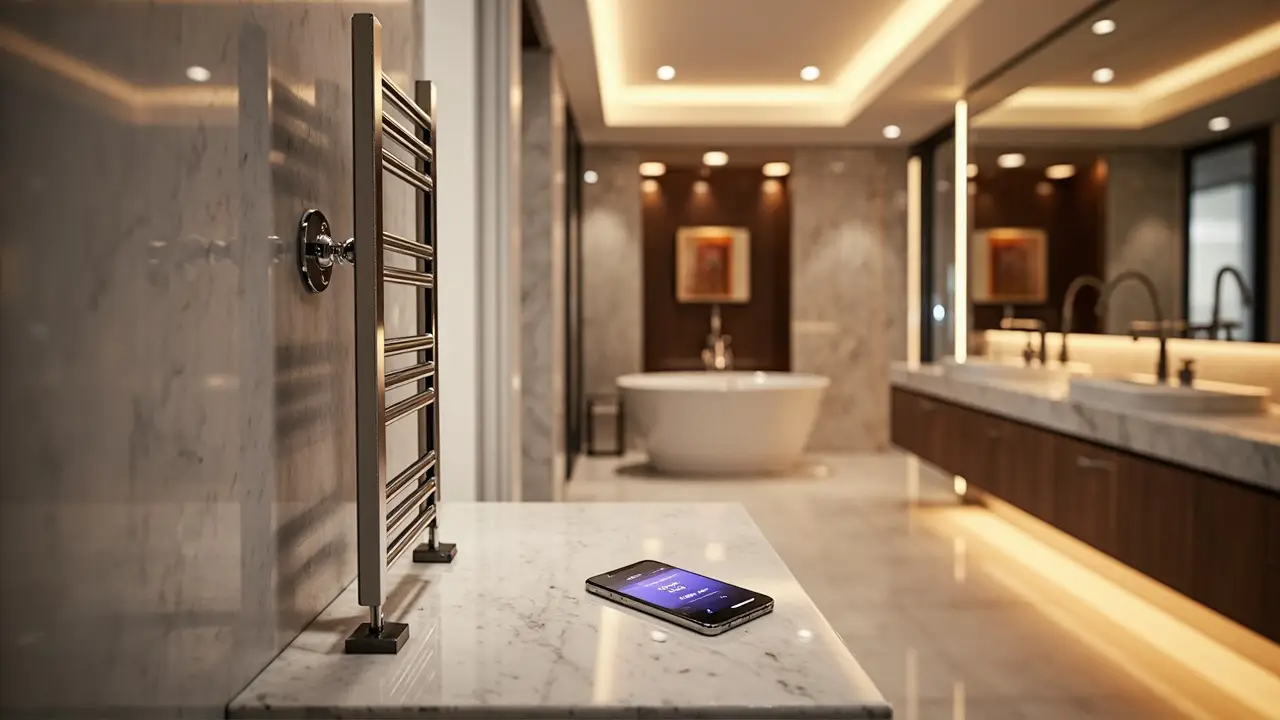
Most smart towel racks on the market use the Tuya Smart platform or a proprietary app. Here is what you actually get:
| Feature | What It Does | User Value |
|---|---|---|
| App on/off | Remote power control via smartphone | Turn on before showering |
| Timer scheduling | Set daily heating windows | Heat towels 6-8 AM, 6-10 PM |
| Temperature control | Adjust heat output (usually 30-60C) | Prevent overheating in summer |
| Energy monitoring | Track kWh usage in app | See running costs |
| Voice control | Alexa/Google integration | “Turn on towel rack” |
| Child lock | Disable physical buttons | Prevent kids changing settings |
The Hardware Inside
A smart towel rack contains three extra components versus a basic model:
- WiFi module (Tuya WB3S or similar): $3-5
- Relay/control board: $4-6
- Temperature sensor upgrade: $2-3
Total hardware adder: $9-14. The rest of the retail price premium is margin and development amortization.
Real-World Performance: What Works and What Does Not
The Good
Scheduling is genuinely useful. Most users who like their smart towel rack use it for one thing: setting a schedule so towels are warm at predictable times. A factory worker in Manchester told me his family uses the 6:30 AM weekday timer exclusively. They never touch the app otherwise.
Remote pre-heating has niche appeal. Vacation rental owners like turning on towel racks before guests arrive. One Airbnb host in Cornwall said it is his most-mentioned amenity in reviews.
Energy tracking satisfies curiosity. Few users change behavior based on the data, but they like knowing. It is a selling point, not a utility feature.
The Bad
Setup friction is real. Tuya app registration, WiFi pairing, and account creation takes 10-15 minutes. For a product category where buyers expect plug-and-play, this is a support burden. We see 3-4x more “how do I connect” emails for smart models versus basic timers.
WiFi reliability in bathrooms is mixed. Concrete walls, metal fixtures, and distance from routers cause dropouts. A towel rack that goes offline becomes a $400 dumb rail that needs manual reset.
App dependency creates long-term risk. Tuya could change API terms. The app could stop working on newer phones. The manufacturer could abandon updates. A basic timer has none of these failure modes.
The Ugly
Voice control is mostly a gimmick. “Alexa, warm my towels” sounds good in marketing. In practice, most users try it twice and forget. The command syntax is finicky, and by the time you remember the exact phrase, you could have pressed the button.
Energy savings are overstated. Smart marketing claims “up to 30% savings.” The reality: scheduling saves money versus leaving it on 24/7, but a basic programmable timer does the same thing for $20 less. The WiFi itself consumes 2-3W continuously, partially offsetting savings.
Cost Analysis: Smart vs Programmable vs Basic
Factory Pricing Comparison
| Model Type | Factory Price (500 pcs) | Retail Price (UK) | Margin % |
|---|---|---|---|
| Basic on/off | $34 | $89 | 62% |
| Programmable timer | $38 | $119 | 68% |
| WiFi smart (Tuya) | $52 | $169 | 69% |
| WiFi smart (proprietary) | $58 | $189 | 69% |
Total Cost of Ownership (3 Years)
| Cost Item | Basic | Timer | WiFi Smart |
|---|---|---|---|
| Purchase price | $89 | $119 | $169 |
| Electricity (3 yrs) | $180 | $135 | $125 |
| Total | $269 | $254 | $294 |
Assumptions: 150W average, $0.30/kWh, basic runs 12 hrs/day, timer 8 hrs/day, smart 7 hrs/day with optimization.
The timer model wins on total cost. The smart model saves $10 in electricity over three years but costs $50 more upfront. Net loss.
Market Segments: Who Actually Buys Smart?
Residential Premium (Weak Demand)
Smart towel racks target the same buyer as Nest thermostats and Philips Hue lights: affluent early adopters. The problem is bathroom fixtures are invisible to guests. Unlike a smart doorbell or lighting, a towel rack offers no status signaling.
Sales data from UK retailers:
– Smart towel rails represent 8-12% of electric towel rack sales
– Return rate: 14% (vs 6% for basic models)
– Main return reason: “More complicated than expected”
Hospitality (Minimal Interest)
Hotel chains have tested smart towel racks and largely passed. Their reasoning:
- Housekeeping complexity: Staff cannot troubleshoot app issues
- Guest variability: Different guests want different settings
- Energy management: Central BMS controls heating more efficiently
- Theft risk: Visible electronics increase theft in budget properties
One boutique hotel group in London trialed 50 units and removed them after 8 months. Guests never used the app. Housekeeping found the manual override button taped down.
Property Development (Niche Spec)
High-end residential developers occasionally spec smart towel racks in “smart home” packages. Volume is small but margin is good. The decision is usually made by the technology integrator, not the bathroom specifier.
Retail Distribution (Mixed Results)
Retailers who stock smart models report:
- Higher basket value: Customers buying smart rails also buy smart mirrors, scales
- Higher support cost: 20-30 minutes per sale explaining setup
- Seasonal spikes: November-January (gift season), flat rest of year
Technical Considerations for B2B Buyers
Certification Complexity
Smart towel racks require additional certifications beyond basic electrical safety:
| Certification | Purpose | Cost Adder |
|---|---|---|
| FCC (USA) | WiFi radio emissions | $2,000-4,000 |
| CE-RED (EU) | Radio equipment directive | $3,000-5,000 |
| SRRC (China) | Radio type approval | $1,500-2,500 |
| IC (Canada) | Radio certification | $1,000-2,000 |
Total certification adder: $7,500-13,500 per product family. Amortized across 1,000 units, that is $8-14 per unit.
Firmware Management
Smart products require ongoing firmware support:
- Bug fixes: Tuya updates occasionally break compatibility
- Security patches: IoT devices are attack vectors
- App store compliance: Apple/Google policy changes require updates
Suppliers without dedicated firmware teams should avoid smart products. The long-term liability exceeds the short-term margin.
Warranty Implications
Smart components fail more often than heating elements:
| Component | Typical Failure Rate (5 yr) |
|---|---|
| Heating element | 2-3% |
| Timer/control | 4-6% |
| WiFi module | 8-12% |
| App/software | 15-20% (obsolescence) |
The WiFi module and app support create warranty exposure that basic models avoid.
The B2B Decision Framework
When Smart Makes Sense
✅ Your market is tech-forward consumers (Scandinavia, urban US coasts, Singapore)
✅ You have technical support infrastructure (dedicated app support team)
✅ You sell through integrators (not DIY retail)
✅ Your brand positioning is premium/smart home
✅ You can absorb higher return rates (15% vs 6%)
When to Skip Smart
❌ Price-sensitive market (budget retail, developing markets)
❌ Hospitality focus (hotels, serviced apartments)
❌ Limited technical support (small distributor, no app team)
❌ Margin-dependent business (the $15-25 adder hurts competitiveness)
❌ Reliability-critical applications (care homes, healthcare)
Alternative: The “Semi-Smart” Compromise
Some manufacturers now offer a middle path: programmable timers with simple Bluetooth setup (no WiFi, no cloud, no account). Users set schedules via a basic app that pairs directly. No internet required. No ongoing service.
Advantages:
– Lower hardware cost (+$5-8 vs +$15-25)
– No certification complexity
– No cloud dependency
– Easier setup
Disadvantages:
– No remote access
– No voice control
– Less “smart” marketing appeal
For most B2B buyers, this is the sweet spot. It offers enough technology to justify a premium without the support burden of full WiFi connectivity.
Supplier Evaluation: Smart Towel Rack Manufacturers
If you decide to source smart models, evaluate suppliers on:
| Criteria | Questions to Ask |
|---|---|
| Platform stability | How long have you used Tuya? Any platform migrations? |
| Firmware support | Who handles app updates? What is the update commitment? |
| Certification portfolio | Which markets are certified? Can you share certificates? |
| Failure data | What is the WiFi module return rate? |
| Cloud costs | Is Tuya platform fee included or per-unit? |
| API access | Can we white-label the app? Is API documentation available? |
Red flags:
– Supplier started offering smart models within the last 12 months
– No dedicated firmware engineer on staff
– Cannot provide failure rate data
– Tuya fees are unclear or escalating
Summary: The Verdict on Smart
Smart WiFi towel racks are a viable product for specific markets, but they are not the default choice most buyers assume.
For B2B buyers, the decision matrix is simple:
| Your Situation | Recommendation |
|---|---|
| General retail distribution | Start with programmable timers |
| Premium consumer market | Add smart as a 15-20% SKU mix |
| Hospitality projects | Avoid. Use central BMS instead |
| Smart home integrators | Full WiFi with white-label app |
| Budget/price-sensitive | Do not offer smart at all |
The technology works. The business case is narrower than marketing suggests. For most bulk buyers in 2025, a well-built programmable timer offers 80% of the user benefit at 60% of the cost and 20% of the support burden.
Need Smart or Programmable Models?
We manufacture both basic and WiFi-enabled heated towel rails, with Tuya integration and custom app development options.
Our smart lineup:
– Tuya WiFi + app control (iOS/Android)
– Alexa/Google voice integration
– Programmable timer models (no WiFi complexity)
– Bluetooth “semi-smart” options
– White-label app development for OEM clients
Certifications available: CE-RED, FCC, SRRC, IC
To discuss smart vs standard for your market:
📧 Submit your inquiry here. We will review your target segment and recommend the right technology level.
Minimum order: 200 pieces for smart models (higher MOQ due to certification costs). Sample orders include both basic and smart versions for comparison.
Related Articles:
– Wholesale Heated Towel Rack Pricing: FOB vs CIF vs DDP Explained
– OEM Customization: From Prototype to Mass Production
– The Complete Guide to Heated Towel Rail Certifications