A universal design bathroom should be easier to enter, safer to move through, comfortable for different ages and mobility levels, and still refined enough for a premium home or hotel room. The best plan combines low-threshold access, slip-resistant surfaces, good lighting, reachable controls, practical storage, and towel placement that does not force users to stretch, bend, or cross a wet floor.
For heated towel racks, the universal design question is not only "does it warm towels?" It is also "can users reach the towel safely, is the control easy to operate, and does the rack sit outside the highest-risk wet path?" That makes placement, mounting height, towel drop, wiring, and surface temperature part of the same design decision.
Why Universal Design Belongs in Modern Bathrooms
Universal design is not only for medical or senior-care spaces. It is a practical way to make bathrooms work better for more people: children, adults, older homeowners, guests, hotel users, people recovering from injury, and anyone carrying towels or toiletries while the floor is damp.
Current bathroom design data supports this direction. NKBA's 2026 bath trends coverage points to larger bathrooms that make room for wellness layouts, storage, and universal design considerations. Houzz's 2025 U.S. bathroom study also shows that bathroom renovations increasingly connect wellness, relaxation, lighting, accessibility, and long-term use.
For homeowners, this means a bathroom can feel calmer today and remain usable later. For hotels, apartments, spas, and senior-living projects, it means fewer awkward guest experiences and a more consistent room specification.
Start With the Wet Path
The wet path is the route from the shower or tub to the towel, vanity, toilet, and door. In many bathrooms, this is where small design problems become real safety issues: a towel hook too far away, a bath mat that slides, a sharp corner near the shower, or a switch that requires reaching across a wet surface.
Use this checklist before choosing accessories:
| Design point | Universal design goal | Heated towel rack implication |
|---|---|---|
| Shower entry | Reduce tripping and awkward stepping | Keep towel access close but outside splash-heavy zones |
| Floor surface | Improve traction when feet are wet | Avoid forcing users to cross the room for a towel |
| Lighting | Make edges, controls, and floor changes visible | Place controls where users can see and reach them |
| Grab support | Provide stable hand placement where needed | Do not use towel bars as grab bars |
| Towel storage | Keep towels reachable without twisting or stretching | Mount the heated rack at a practical reach height |
| Electrical planning | Keep fixtures appropriate for bathroom zones | Use qualified installation for hardwired models |
The goal is simple: a user should be able to shower, step out, dry off, and hang the towel without rushing, reaching, or moving across a slippery route.
Choose a Shower Entry That Reduces Trip Risk
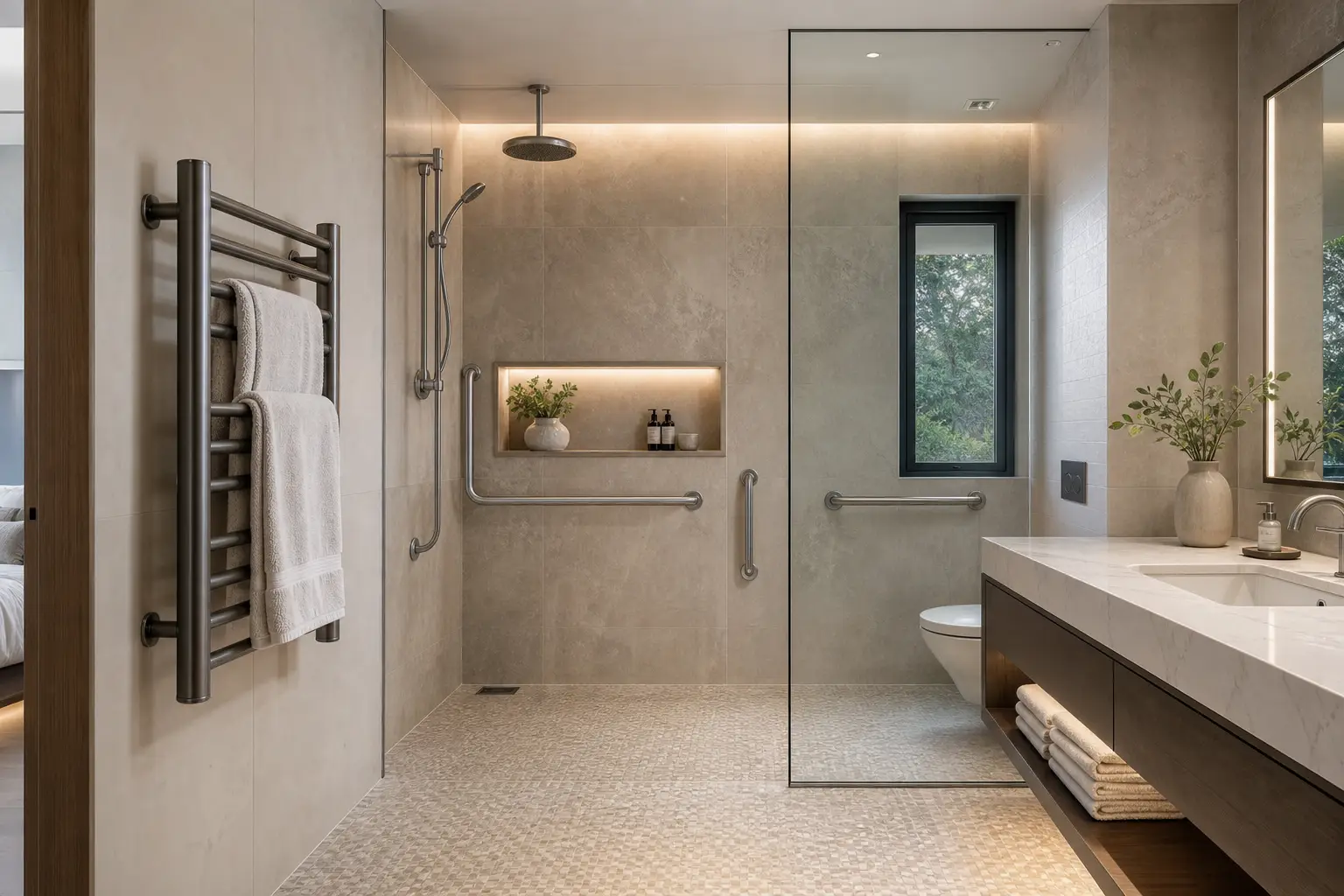
Curbless showers, low-curb showers, and wider shower entries are common universal design choices because they reduce the physical effort of stepping in and out. They also support a cleaner, more open bathroom layout when designed well.
For residential renovations, this can help a bathroom age with the homeowner. For hotels and spas, it can make the room feel more premium while reducing awkward access points. The key is to coordinate slope, drainage, waterproofing, door swing, and towel placement early. A beautiful curbless shower still performs poorly if water travels into the towel area or the user must step across wet tile to reach a towel.
When planning a heated towel rack near a curbless shower, keep it convenient but not intrusive. It should not block transfer space, door swing, shower glass movement, or the user's path out of the shower.
Use Slip-Resistant Surfaces and Fewer Loose Items
The National Institute on Aging recommends bathroom fall-prevention basics such as grab bars and nonskid surfaces. That advice is practical for any universal design bathroom, not only aging-in-place projects.
Start with the floor. Large polished tile can look high-end but may be risky when wet if the surface is too slick. Textured porcelain, matte finishes, smaller tile formats with more grout traction, or tested slip-resistant surfaces can help. The best choice depends on the project, cleaning needs, and local requirements.
Then reduce loose items. A towel lying on the floor, a sliding bath mat, or a freestanding rack in a tight wet path can create a trip hazard. A wall-mounted heated towel rack can help because it gives towels a fixed place to dry, but it must be mounted where it does not become an obstacle.
Plan Lighting for Eyes, Edges, and Night Use
Universal design bathrooms need more than decorative lighting. Users should be able to see floor transitions, shower edges, towel locations, controls, and water on the floor.
Good lighting usually includes:
- Ceiling or recessed ambient light for general visibility.
- Vanity lighting that reduces shadows on the face.
- Shower-rated lighting where allowed and needed.
- Night or low-level lighting for late use.
- Clear contrast between floor, walls, fixtures, and grab supports.
For hotels and multifamily projects, lighting consistency matters across rooms. For homeowners, it can make a bathroom feel more luxurious while also reducing everyday friction. If a heated towel rack has a timer or switch, place it where the user can operate it without bending low, reaching behind towels, or crossing a dark wet floor.
Place Controls and Accessories Within Practical Reach
The 2010 ADA Standards include reach-range principles for operable parts, and the U.S. Access Board explains that operable parts should be placed within the required reach ranges and usable with one hand without tight grasping, pinching, or twisting. Private homes are not always governed by the same rules as public accommodations, but the design logic is still useful.
For a universal design bathroom, think about how users actually move:
- Can the user reach the towel while standing on a dry or mostly dry surface?
- Can the user turn on a switch or timer without twisting behind the rack?
- Can the user hang a towel without lifting it above shoulder height?
- Can a seated user or shorter guest reach at least one towel position?
- Does the rack leave enough clear wall and floor space around the shower or toilet?
This is where a heated towel rack should be specified like a fixture, not treated as afterthought decor. The wall, electrical route, towel size, reach height, and surrounding accessories all affect usability.
Heated Towel Rack Placement for Universal Design
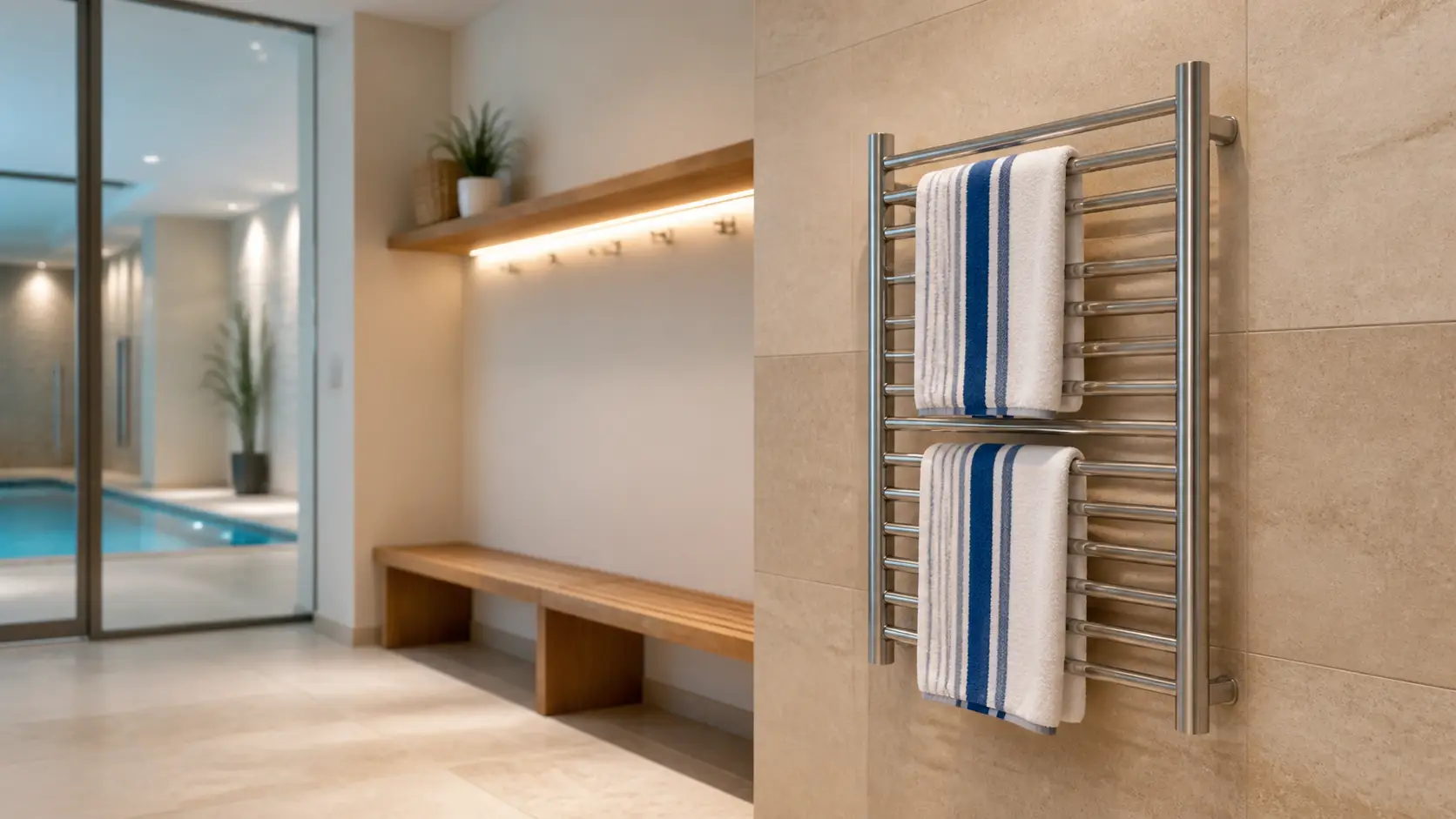
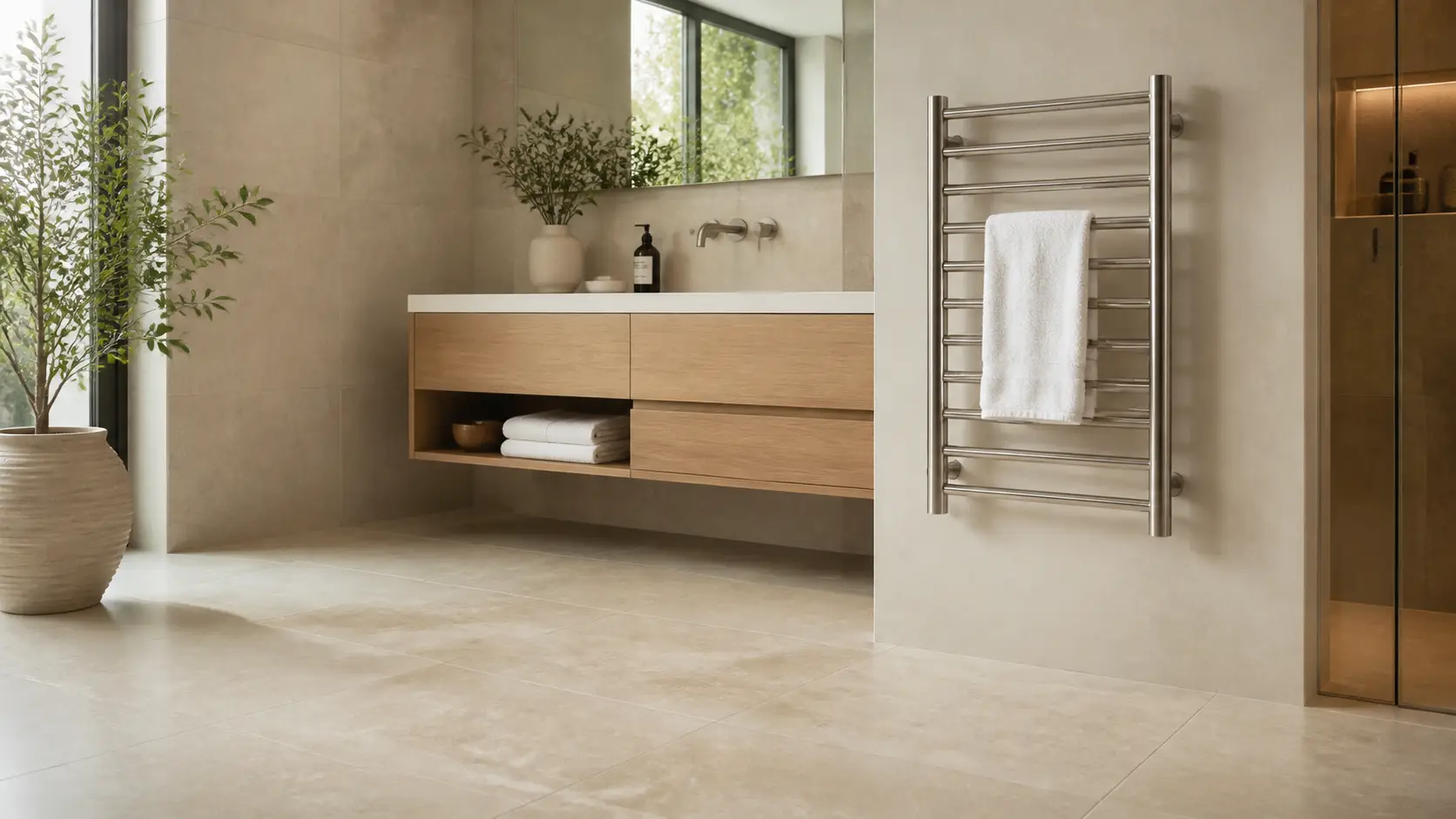
For most universal design bathrooms, the best heated towel rack location is close to the bathing area but outside the direct splash zone and away from the tightest movement path. It should feel natural to reach after bathing, but it should not force a user to stand on a wet threshold or step around a protruding fixture.
Consider these placement rules:
| Placement decision | Better choice | Avoid |
|---|---|---|
| Distance from shower | Close enough for easy towel access | Across the bathroom from the shower |
| User path | Along a dry side wall or clear towel zone | Directly in the narrowest exit route |
| Mounting height | Based on towel length and user reach | So high that towels require stretching |
| Control access | Visible, reachable, and simple | Hidden behind towels or near the floor |
| Fixture type | Wall-mounted for clear floors in tight rooms | Freestanding units in narrow wet paths |
| Project use | Consistent mounting specification | Room-by-room guesswork |
In a home bathroom, the right location may be beside the shower or near the vanity if that is the safest dry zone. In a hotel bathroom, repeatability matters: the rack should be easy for guests to understand, easy for housekeeping to access, and consistent across room types.
Wall-Mounted vs Freestanding in Accessible Layouts
Freestanding towel warmers can be convenient in some homes because they avoid wall work. But in a universal design bathroom, floor clearance often matters more than portability. A freestanding unit can narrow the walking path, shift position, create cord-management issues, or become one more item to move around.
A wall-mounted heated towel rack is usually the cleaner choice for universal design bathrooms, especially when the room is small, the shower is curbless, or the project needs a repeatable hotel-style specification. Hardwired installation can also reduce visible cords and create a more intentional finish, provided electrical work is handled correctly for bathroom conditions.
Plug-in models may still work in some residential bathrooms, but the outlet location, cord route, wet-area separation, and user path need careful review. If the cord crosses a walking route or sits near water exposure, it is the wrong solution.
Do Not Confuse Towel Bars With Grab Bars
A heated towel rack, towel bar, robe hook, or decorative rail should not be treated as a grab bar unless it is specifically designed, rated, and installed for that purpose. This matters because users often reach for whatever is nearby when stepping out of a shower.
If a bathroom needs support, specify real grab bars or integrated support rails installed into suitable backing. Then place the heated towel rack where it supports the towel routine without pretending to be a safety device.
This distinction is important for hotels, spas, apartments, and aging-in-place homes. The bathroom can look elegant, but safety roles should remain clear.
Universal Design Does Not Have to Look Clinical
Modern universal design can look warm, minimal, and premium. The best examples hide the effort inside better planning:
- A curbless shower with clean drainage.
- Grab bars that match the finish palette.
- Wider clearances that feel spacious, not institutional.
- Layered lighting that supports comfort.
- Storage that reduces counter clutter.
- A heated towel rack that aligns with the hardware finish.
For Calithrex buyers, this is where product finish and proportion matter. Stainless steel, matte black, chrome, or brushed finishes should coordinate with shower hardware, faucets, cabinet pulls, and lighting. The rack should look intentional on the wall, not squeezed into leftover space.
B2B Specification Notes for Hotels, Apartments, and Wellness Projects
For B2B buyers, universal design is partly a design value and partly an operating decision. A better bathroom specification can reduce room-to-room inconsistency and make the project easier to install, clean, and maintain.
Before approving a heated towel rack package, confirm:
- Mounting height and wall backing requirements.
- Electrical type, voltage, controls, and timer strategy.
- IP rating and bathroom-zone suitability for the target market.
- Finish durability and cleaning expectations.
- Towel capacity for the room type.
- Clearance from shower doors, toilet areas, vanities, and grab bars.
- Whether the rack placement works for both left- and right-hand layouts.
- Whether the same model can be used across multiple room categories.
If a project includes accessible rooms, universal rooms, premium rooms, and standard rooms, do not assume one placement works everywhere. Use a specification drawing and check the user's path in each layout.
Common Mistakes to Avoid
The most common mistake is treating universal design as a list of accessories instead of a movement plan. A bathroom can include a grab bar, a curbless shower, and a heated towel rack and still feel awkward if the towel is too far away or the floor gets wet in the wrong place.
Other mistakes include:
- Mounting towel storage too high.
- Placing a rack behind a door swing.
- Choosing glossy floor surfaces without checking wet traction.
- Hiding controls behind hanging towels.
- Using freestanding fixtures in narrow paths.
- Forgetting night lighting.
- Letting towel hooks replace real grab support.
- Ignoring housekeeping access in hotel bathrooms.
Universal design works best when the room feels calm and obvious. Users should not have to think hard about where to step, where to reach, or where to hang the towel.
FAQ
What is a universal design bathroom?
A universal design bathroom is planned to be safer, easier to use, and more comfortable for a wider range of users. It often includes better lighting, easier shower access, slip-resistant surfaces, reachable storage, stable support, and clear movement space.
Is universal design only for seniors?
No. Seniors benefit from universal design, but so do children, guests, people recovering from injury, hotel users, and anyone using a bathroom when the floor is wet or visibility is low.
Where should a heated towel rack go in a universal design bathroom?
Place it close to the bathing area but outside the direct splash path and away from the tightest walking route. The towel should be reachable without stretching, twisting, or crossing a wet floor.
Is a wall-mounted heated towel rack better than a freestanding model?
In many universal design bathrooms, yes. Wall-mounted racks keep the floor clearer and can look more integrated. Freestanding units can work in larger residential bathrooms, but they should not narrow the path or create cord hazards.
Can a heated towel rack be used as a grab bar?
No, not unless it is specifically designed and rated as a grab support. Use proper grab bars where body support is needed, and use the heated towel rack for towel warming and drying.
What tags should a project buyer include in a towel rack specification?
Include model, finish, size, mounting height, electrical type, control method, IP rating, towel capacity, wall backing needs, and room-type placement notes. For hotels and apartments, include drawings so installers do not improvise placement room by room.
Plan the Bathroom Around the User's Movement
The strongest universal design bathroom is not the one with the most accessories. It is the one where the user can move naturally, see clearly, reach what they need, and avoid unnecessary wet-floor risk.
For residential bathrooms, that means planning for today's comfort and tomorrow's flexibility. For hotels, spas, apartments, and wellness projects, it means specifying fixtures that support guest comfort and repeatable installation. A well-placed heated towel rack can be part of that plan when it is treated as a practical fixture: reachable, correctly installed, visually integrated, and placed where warm towels improve comfort without adding movement risk.
Explore Calithrex heated towel rack options for bathroom design, hotel bathroom projects, and residential comfort upgrades through the Calithrex product collection.