How Much Does a Heated Towel Rack Cost to Run? A Regional Breakdown
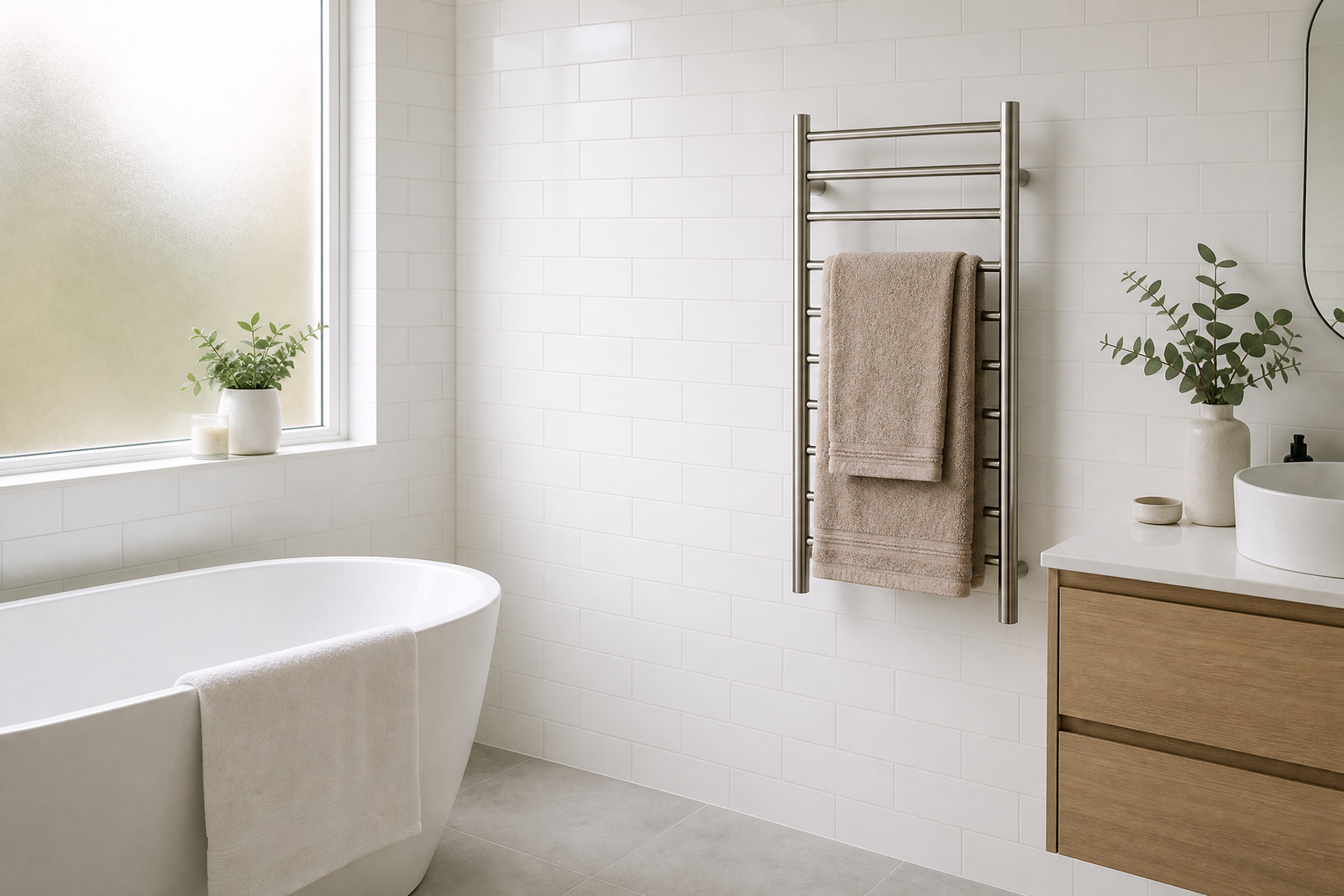
The running cost of a heated towel rack is the second question buyers ask after electricity use. They want a dollar amount, not a wattage number. The answer depends on three things: the rail’s power rating, how many hours you run it, and what you pay per kilowatt-hour.
A standard 150W heated towel rail costs between $2 and $6 per month to run in most developed markets. That assumes four hours of daily use, which is the typical pattern for households that run the rail during morning and evening routines. The range exists because electricity prices vary significantly by country and even by state or region within a country.
This guide gives exact monthly costs for the most common wattages across the US, UK, EU, and Australia. It also explains how to calculate costs for your own tariff and how timers and thermostats cut the bill.
The Simple Formula
Running cost per month equals wattage multiplied by daily hours multiplied by days per month multiplied by your electricity rate.
Formula: (W ÷ 1000) x Hours/day x 30 days x $/kWh = Monthly cost
Where W is the wattage rating. Divide by 1,000 to convert watts to kilowatts.
A 150W rail running four hours daily at 16 cents per kWh costs:
(150 ÷ 1000) x 4 x 30 x 0.16 = $2.88 per month
That is the baseline. Change any variable and the cost changes proportionally. A 200W rail at the same usage costs $3.84. A 150W rail left on 24 hours costs $17.28. A 150W rail on a timer for two hours daily costs $1.44.
Monthly Costs by Wattage and Usage Pattern
These tables show costs at different usage levels using the US average rate of 16 cents per kWh. Use the multiplier at the bottom to adjust for your local rate.
Four Hours Daily (Typical Household Pattern)
| Wattage | Daily kWh | Monthly kWh | Monthly Cost (US avg) |
|---|---|---|---|
| 100W | 0.4 | 12.0 | $1.92 |
| 150W | 0.6 | 18.0 | $2.88 |
| 200W | 0.8 | 24.0 | $3.84 |
| 250W | 1.0 | 30.0 | $4.80 |
| 300W | 1.2 | 36.0 | $5.76 |
Eight Hours Daily (Extended Warmth or Commercial Use)
| Wattage | Daily kWh | Monthly kWh | Monthly Cost (US avg) |
|---|---|---|---|
| 100W | 0.8 | 24.0 | $3.84 |
| 150W | 1.2 | 36.0 | $5.76 |
| 200W | 1.6 | 48.0 | $7.68 |
| 250W | 2.0 | 60.0 | $9.60 |
| 300W | 2.4 | 72.0 | $11.52 |
24 Hours Daily (Continuous Operation)
| Wattage | Daily kWh | Monthly kWh | Monthly Cost (US avg) |
|---|---|---|---|
| 100W | 2.4 | 72.0 | $11.52 |
| 150W | 3.6 | 108.0 | $17.28 |
| 200W | 4.8 | 144.0 | $23.04 |
| 250W | 6.0 | 180.0 | $28.80 |
| 300W | 7.2 | 216.0 | $34.56 |
Rate adjustment multiplier: If your electricity rate is 24 cents per kWh instead of 16 cents, multiply the monthly cost by 1.5. If it is 12 cents, multiply by 0.75.
Costs by Region: US, UK, EU, and Australia
Electricity prices vary significantly. Here are realistic costs for a 150W rail running four hours daily in major markets.
| Region | Average Rate | Monthly Cost (150W, 4h/day) | Annual Cost |
|---|---|---|---|
| US (national average) | $0.16/kWh | $2.88 | $34.56 |
| US (Texas) | $0.14/kWh | $2.52 | $30.24 |
| US (California) | $0.28/kWh | $5.04 | $60.48 |
| US (New York) | $0.24/kWh | $4.32 | $51.84 |
| UK | £0.30/kWh (~$0.38) | £5.40 (~$6.84) | £64.80 (~$82.08) |
| Germany | €0.40/kWh (~$0.44) | €7.20 (~$7.92) | €86.40 (~$95.04) |
| France | €0.25/kWh (~$0.28) | €4.50 (~$5.04) | €54.00 (~$60.48) |
| Australia | A$0.30/kWh (~$0.20) | A$5.40 (~$3.60) | A$64.80 (~$43.20) |
| Canada | C$0.13/kWh (~$0.10) | C$2.34 (~$1.80) | C$28.08 (~$21.60) |
The US national average produces one of the lower running costs among developed markets. UK and German buyers pay roughly double due to higher electricity tariffs. Canadian buyers enjoy the lowest costs thanks to abundant hydroelectric supply.
Thermostats and Timers: Real-World Savings
The tables above assume continuous operation during the stated hours. A rail with a thermostat does not draw full power for the entire period. It heats to target temperature, switches off, then cycles back on when the temperature drops.
Thermostatic savings: In practice, a thermostatic rail runs at full power for roughly 60-70% of the time it is switched on. The rest of the time, it is off or in a low-power maintenance mode. This reduces actual consumption by 30-40% compared to the raw calculation.
A 150W rail on a thermostat, programmed for four hours daily, uses approximately 12-15 kWh monthly rather than the calculated 18 kWh. At 16 cents per kWh, the real cost is $1.92 to $2.40 instead of $2.88.
Timer savings: A timer eliminates human error. Without one, homeowners often leave the rail on overnight or while at work. A timer restricts operation to the hours when towels actually need drying. The savings depend on behavior, but a typical household cuts 20-30% off their towel rail bill by adding a timer.
Smart control savings: Wi-Fi enabled rails with humidity sensors or usage learning algorithms optimize operation further. Some models detect when towels are dry and switch off early, saving 10-20% compared to a fixed timer. Others pre-heat before scheduled shower times, reducing total runtime while maintaining comfort.
How Towel Rails Compare to Bathroom Heating Alternatives
Buyers sometimes ask whether a heated towel rail can replace a bathroom heater. It cannot, but comparing costs clarifies the value proposition.
| Heating Method | Typical Wattage | Monthly Cost (4h/day, US avg) | Primary Purpose |
|---|---|---|---|
| Heated towel rail (150W) | 150W | $2.88 | Dry towels + slight warmth |
| Electric panel heater | 1,000W | $19.20 | Heat bathroom |
| Fan heater | 2,000W | $38.40 | Rapid bathroom heating |
| Underfloor heating (electric) | 150W/m² | $43.20 (for 3m²) | Heat floor + bathroom |
| Central heating radiator | N/A (gas) | $8-15 (indirect) | Whole-house heating |
A heated towel rail is the cheapest powered option for bathroom use. It does not heat the room like a panel heater, but it costs one-seventh the price to run. For buyers who want dry towels and a slightly warmer bathroom without a major energy bill, the rail is the economical choice.
Hidden Costs: Installation and Maintenance
Running cost is only part of the total cost of ownership. Buyers should also consider:
Installation cost: A plug-in rail costs nothing to install beyond the purchase price. A hardwired rail requires an electrician. In the US, electrician rates range from $50 to $150 per hour. A straightforward hardwiring job takes 1-2 hours. In the UK, expect £80-£150 for installation.
Replacement cycles: A quality stainless steel rail with a 5-year element warranty lasts 10-15 years. Budget models with chrome-plated steel may corrode in 5-7 years in humid bathrooms. The cost difference between a $200 premium rail and a $80 budget rail pays back over time through longer service life.
Control upgrades: Adding a programmable timer or smart thermostat costs $20-80 depending on the model. This upgrade pays for itself in 6-12 months through reduced energy use.
What to Tell Your Customers About Cost
For residential buyers: Emphasize the low monthly cost. A 150W rail costs less than a streaming subscription. It is a small luxury that improves daily life without affecting the household budget.
For commercial buyers: Calculate per-unit costs for hotels or care homes. A 100-room hotel with 150W rails running 8 hours daily spends roughly $570 monthly on towel rail electricity. Spread across 100 rooms, that is $5.70 per room monthly. For the guest satisfaction and hygiene benefits, the cost is minimal.
For eco-conscious buyers: Highlight that the rail reduces laundry frequency. Dry towels stay fresh longer, cutting wash cycles. The energy saved on laundry often exceeds the rail’s own consumption.
For buyers in high-tariff regions: Recommend lower-wattage models or thermostatic controls. A 100W thermostatic rail in Germany costs roughly €5 monthly rather than €7.20 for a 150W non-thermostatic unit. Over a year, that is a €26 saving.
Final Thoughts
A heated towel rack costs between $2 and $8 per month to run for most households. The exact figure depends on wattage, usage hours, and local electricity rates. The US, Canada, and Australia enjoy lower costs. The UK, Germany, and other high-tariff EU markets pay more.
The cost is modest in every market. For the convenience of dry, warm towels and a fresher bathroom, few household appliances deliver this much daily value for such a small energy outlay. The key to minimizing cost is simple: match wattage to bathroom size, use a timer or thermostat, and run the rail only when you need it.
Need energy-efficient heated towel rails for your market? We manufacture thermostatic, timer-controlled, and smart Wi-Fi models from 80W to 300W. Full test reports, custom finishes, OEM branding, and bulk pricing for distributors and developers. Contact us for regional pricing and technical datasheets.