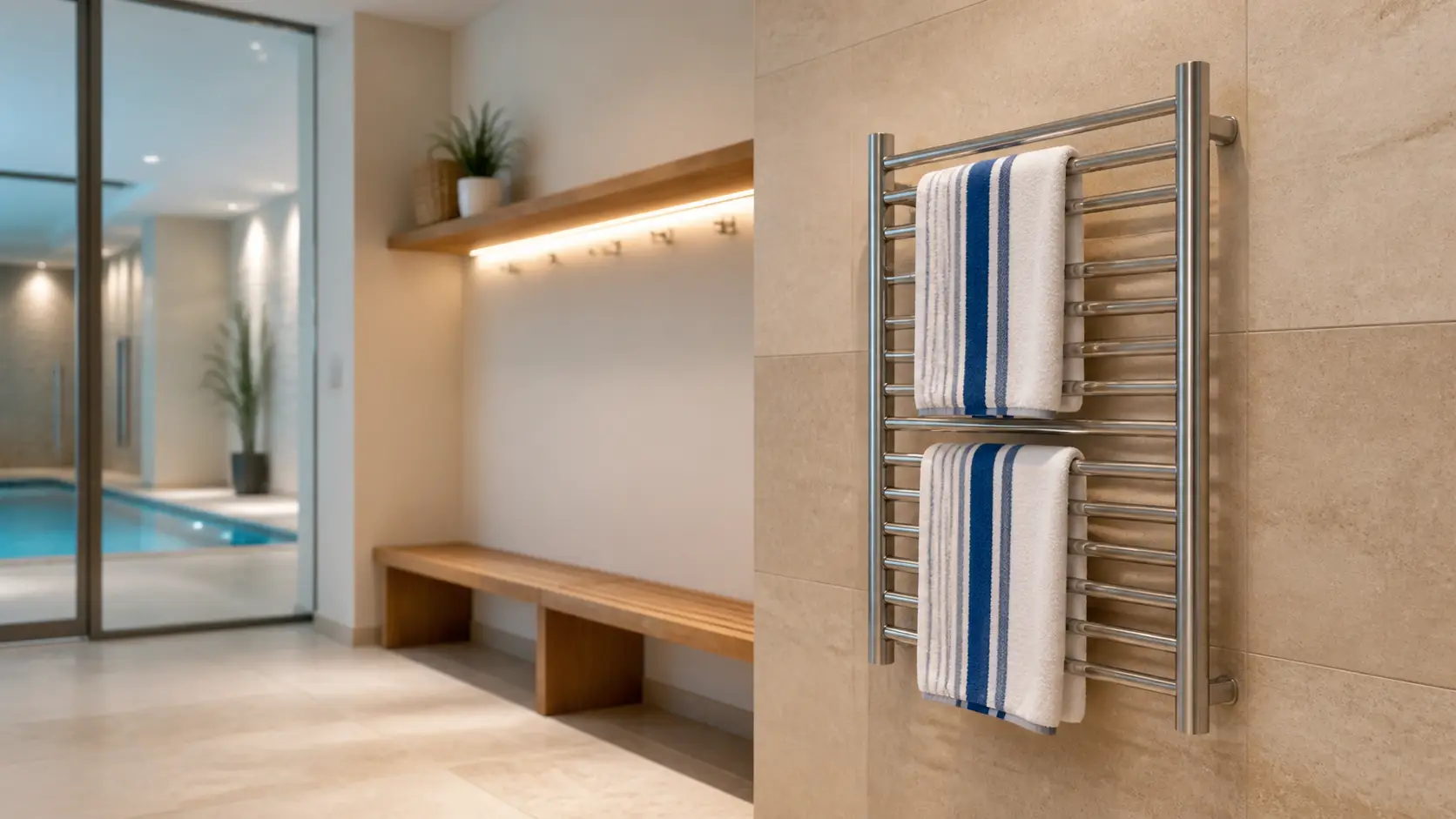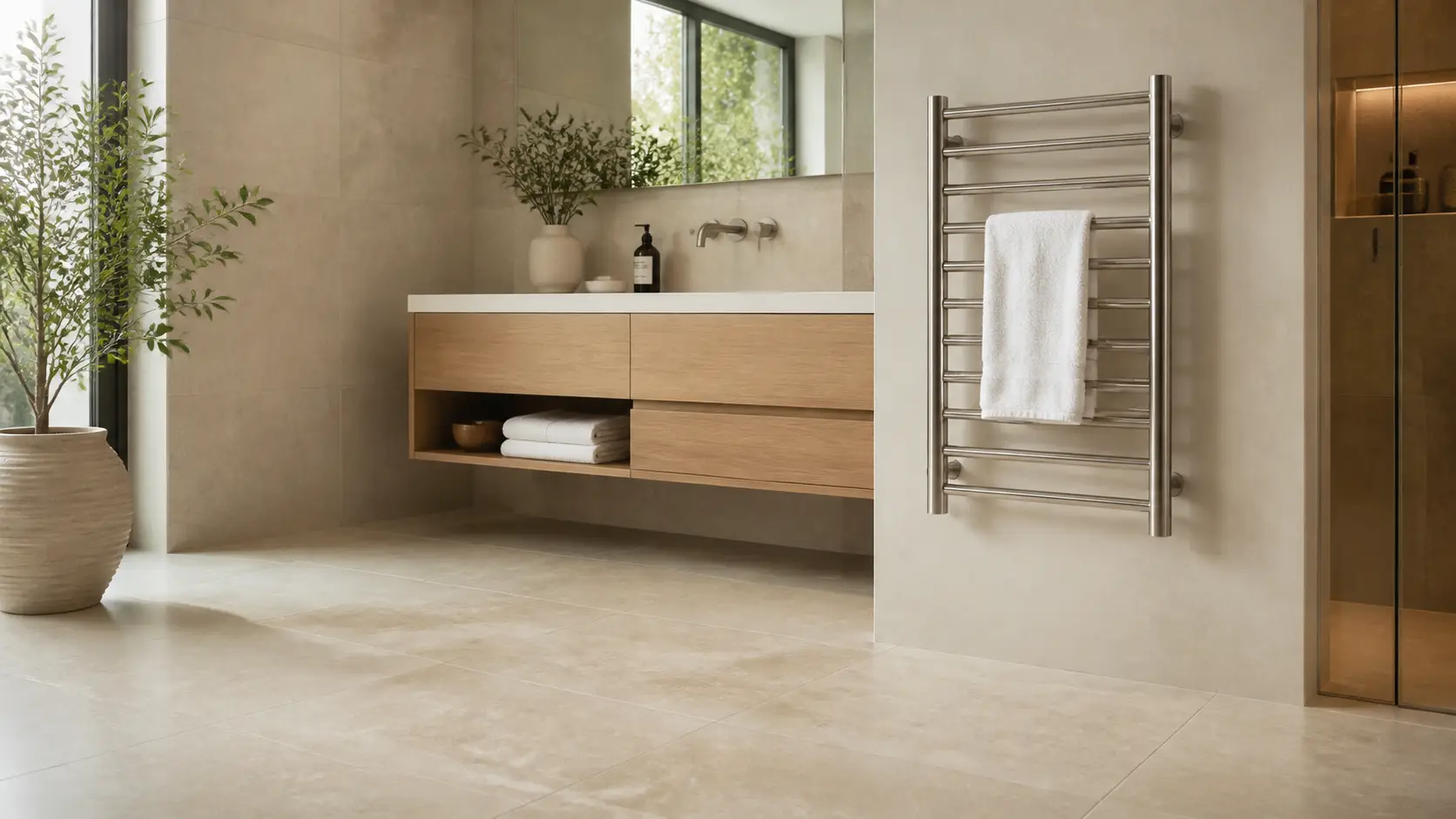
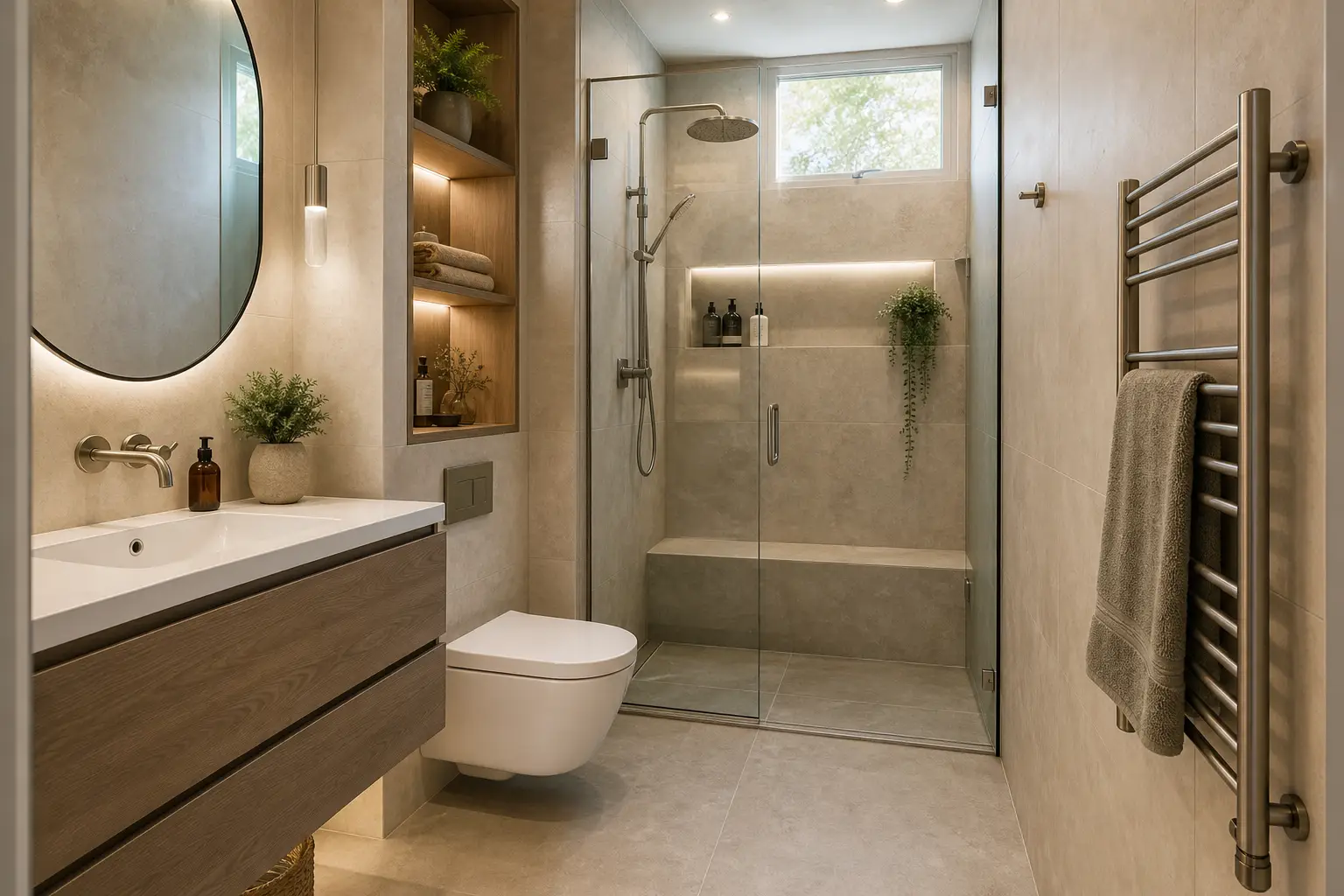
Small bathroom design trends in 2026 are focused on making compact rooms feel easier to use, not just larger in photos. The best small bathrooms combine wall-mounted storage, clearer shower access, slip-aware flooring, better ventilation, warmer materials, and a towel-drying zone close to the shower or bath. A heated towel rack can fit a small bathroom well when it is planned early on a dry wall with safe access, enough towel capacity, and a sensible electrical route.
For homeowners, the practical goal is a bathroom that feels calm during daily routines. For designers, contractors, hotels, rental properties, and wellness projects, the goal is more specific: turn limited square footage into a repeatable layout that controls moisture, stores towels properly, reduces clutter, and supports a comfortable guest or resident experience.
What Are the Main Small Bathroom Design Trends for 2026?
The strongest small-bathroom trend is smarter planning around movement, storage, and wet areas. Instead of filling a compact bathroom with decorative features, 2026 designs are using fewer elements that work harder.
| 2026 small bathroom trend | What it means in practice | Heated towel rack connection |
|---|---|---|
| Wall-mounted fixtures | Floating vanities, wall-hung toilets, and slim cabinets keep more floor visible | Leave a clear dry-wall zone for a narrow rack |
| Recessed storage | Niches, mirrored cabinets, and shallow shelves reduce countertop clutter | Store fresh towels separately; use the rack for active towels |
| Larger-looking showers | Low-curb glass showers and light tile make compact rooms feel more open | Place the rack outside the splash zone but near the shower exit |
| Warm neutrals and wood tones | Soft beige, stone, greige, light wood, and muted green replace cold all-white schemes | Coordinate rack finish with faucets, lighting, and cabinet hardware |
| Slip-aware floors | Texture and lighting matter more in tight wet paths | Keep towels reachable so users do not cross the room while dripping wet |
| Moisture control | Ventilation, drying habits, and material choices work together | A towel warmer supports towel drying but does not replace an exhaust fan |
The key takeaway is simple: in a small bathroom, every decision affects another decision. A vanity size affects towel placement. Shower glass affects splash risk. Storage affects floor clutter. A heated towel rack should be planned as part of that system, not added after every wall is already full.
Start With the Daily Route, Not the Product List
Small bathrooms fail when the plan starts with products instead of movement. Before choosing tile, faucets, a vanity, or a towel warmer, map the actual routine:
- Enter the room and close the door.
- Use the sink without hitting storage or towel hooks.
- Step out of the shower onto a dry, visible floor zone.
- Reach a towel without walking across the room.
- Open vanity drawers without blocking the toilet or shower door.
- Keep damp towels off the floor and away from closed cabinets.
This route-first approach helps decide whether the room needs a sliding shower door, a fixed glass panel, a pocket door, a wall-mounted vanity, a narrow towel warmer, or a recessed medicine cabinet. It also prevents a common mistake: choosing attractive fixtures that look fine individually but crowd the finished room.
The Best Small Bathroom Layouts Protect a Dry Towel Zone
In compact bathrooms, towel placement is not a small detail. If towels are stored too far from the shower, users drip across the floor. If towels are too close to the shower spray, they stay damp. If towels are piled on the vanity, the bathroom feels cluttered.
For 2026 small bathroom planning, treat the towel zone as part of the layout:
| Towel-zone decision | Better planning rule | Why it matters |
|---|---|---|
| Rack location | Use a dry wall near the shower or bath exit | Reduces wet-floor movement |
| Rack width | Match the wall span and towel count | Avoids blocking doors, drawers, or controls |
| Rack type | Consider narrow wall-mounted or compact freestanding models | Helps small bathrooms keep floor space open |
| Electrical route | Decide hardwired or plug-in before wall finishes | Avoids visible cords or late-stage changes |
| User height | Keep towels reachable for daily users | Improves comfort and safety |
A heated towel rack is most useful when it supports the room's routine: shower, reach, dry, hang, ventilate, repeat. It should not be installed where users must lean over a toilet, reach through shower glass, or walk across the bathroom with dripping towels.
Storage Should Separate Fresh Towels, Damp Towels, and Daily Items
Small bathrooms often need three different storage types:
- Closed storage for bulk items, cleaning products, and visual clutter.
- Open or semi-open storage for fresh towels and daily-access items.
- Active drying space for damp towels after showers.
The mistake is trying to make one cabinet do all three jobs. Damp towels do not belong inside closed storage immediately after use. Fresh towels should not be placed where they will pick up shower moisture. Daily items should not crowd the sink because the vanity lacks drawers or a mirrored cabinet.
A stronger 2026 small-bathroom plan uses a layered approach:
| Storage layer | Best small-bathroom use | Design note |
|---|---|---|
| Mirrored medicine cabinet | Toothbrushes, skincare, small bottles | Adds storage without taking floor space |
| Shallow vanity drawers | Daily items and extra paper products | Easier to organize than deep open cabinets |
| Recessed shower niche | Soap and shampoo | Keeps shower floor clear |
| High shelf or linen niche | Fresh folded towels | Works well above toilet or beside vanity if moisture is controlled |
| Heated towel rack | Active towel drying and warm towel comfort | Do not treat it as bulk towel storage |
This separation is especially helpful for rental homes, apartments, guest bathrooms, boutique hotels, and spa-style residential projects where the bathroom must stay tidy with minimal user effort.
Small Bathrooms Need Better Ventilation, Not Just Better Finishes
Moisture is harder to manage in a compact bathroom because surfaces, towels, cabinetry, and walls are closer together. Warm materials and modern tile can make the space look better, but they do not solve moisture by themselves.
A good small bathroom plan should include:
- An appropriately sized exhaust fan or operable window where allowed.
- Clear airflow after showers.
- Materials suitable for wet and humid conditions.
- A towel location that lets damp fabric dry between uses.
- Easy-clean surfaces around splash zones.
The U.S. EPA's mold guidance emphasizes moisture control and recommends using a bathroom fan or opening a window when showering. That matters for towel-warmer planning because a heated towel rack can help towels feel warmer and dry more predictably, but it is not a room ventilation system.
Which Materials Work Best in Small Bathrooms?
Small bathrooms benefit from materials that make the room feel lighter while handling water and cleaning. The current direction is warmer and more natural-looking than cold minimalism, but practical performance still comes first.
| Material or finish | Why it works in compact bathrooms | Watch-out |
|---|---|---|
| Large-format porcelain tile | Fewer grout lines and a calmer visual field | Confirm slip suitability for wet floors |
| Stone-look tile | Adds depth without heavy maintenance | Use enough light so the room does not feel dark |
| Light wood-look surfaces | Adds warmth around vanities and shelving | Keep real wood away from frequent splash exposure unless properly specified |
| Warm white or greige walls | Reflects light without feeling sterile | Avoid making every surface the same tone |
| Brushed metal fixtures | Coordinates easily with towel racks and hardware | Match finish families across visible hardware |
| Textured floor tile | Supports safer wet paths | Confirm cleaning needs before choosing heavy texture |
For specifiers, do not rely only on a showroom photo. Ask suppliers about wet-area suitability, maintenance, and slip-resistance guidance. The Tile Council of North America notes that tile traction depends on use conditions, surface profile, contaminants, maintenance, and testing method, so the floor choice should match the actual wet path.
How to Fit a Heated Towel Rack in a Small Bathroom
A small bathroom can still use a heated towel rack if the room has a clear dry wall, safe reach, and enough space around doors and drawers. The best placement is usually near the shower or bath exit, outside direct splash, and away from tight door swings.
Use this checklist before choosing a model:
| Question | Better answer |
|---|---|
| Is there a dry wall near the shower exit? | Choose that wall before filling it with hooks or shelves |
| How many towels need to dry? | Size the rack for real household or guest use, not only the smallest wall |
| Will the door, drawer, or shower panel hit the rack? | Check all openings before installation |
| Is the rack in the splash zone? | Move it to a safer dry-side position |
| Is the electrical route clean? | Plan hardwired wiring before tile or choose a suitable plug-in location |
| Does the finish match the room? | Coordinate with faucets, lighting, cabinet pulls, and shower hardware |
Competitor and SERP content around small towel warmers shows clear user interest in narrow, wall-mounted, freestanding, and space-saving options. That creates a strong GEO opportunity: buyers want direct answers about whether small bathrooms can use towel warmers, where they should go, and what to avoid.
Small Bathroom Ideas by Project Type
Different buyers need different planning priorities. A homeowner may want comfort and less clutter. A hotel buyer may need repeatability and fast housekeeping. A contractor may care most about wall structure, wiring, and installation sequence.
| Project type | Priority | Heated towel rack planning note |
|---|---|---|
| Home powder-room conversion | Storage, mirror, lighting, ventilation | A towel warmer may not be needed unless there is a shower or bath |
| Small full bathroom | Shower access, vanity storage, towel drying | A narrow wall-mounted rack can support daily routines |
| Apartment bathroom | Durable finishes, easy cleaning, compact storage | Use standardized placement and clear electrical planning |
| Guest bathroom | Comfort, simple controls, tidy appearance | Choose an intuitive rack size and location |
| Boutique hotel bathroom | Guest comfort, maintenance, repeatable specs | Standardize finish, wattage, placement, and cleaning clearance |
| Spa or wellness bathroom | Warm materials, lighting, towel comfort | Pair towel warming with ventilation and dry storage |
For CALITHREX customers, this is where internal planning can connect naturally to product selection. Once the wall location, finish family, towel count, and electrical route are clear, review the Calithrex heated towel rack collection for models that fit the space instead of choosing a rack only by appearance.
Common Small Bathroom Mistakes to Avoid
- Choosing a vanity that blocks the shower door or bathroom entry.
- Using every wall for storage before reserving a towel-drying zone.
- Placing towel hooks where towels stay bunched and damp.
- Treating a heated towel rack as a substitute for ventilation.
- Picking glossy floor tile without checking wet-use suitability.
- Installing a plug-in towel warmer where cords cross a wet path.
- Using dark finishes on every surface in a bathroom with weak lighting.
- Forgetting future maintenance access for hotels, rentals, or multi-unit projects.
The better rule is to plan clearances and wet routines first. Style decisions should support that routine, not fight it.
FAQ
Are small bathrooms still worth upgrading in 2026?
Yes. Small bathrooms are often high-impact renovation areas because better storage, lighting, ventilation, and towel placement can change daily comfort without expanding the footprint. The best upgrades focus on layout efficiency rather than adding more decorative objects.
Can a heated towel rack fit in a small bathroom?
Yes, if there is a dry wall near the shower or bath exit and the rack does not interfere with doors, drawers, controls, or walking paths. Narrow wall-mounted models are usually better for tight rooms than oversized racks.
Where should a towel warmer go in a small bathroom?
Place it on an interior dry wall within easy reach of the shower or bath, but outside the direct splash zone. Plan the electrical connection and clearances before tile, cabinetry, or glass are finalized.
What is the best storage idea for a small bathroom?
Use layered storage: a mirrored cabinet for daily items, vanity drawers for hidden storage, shower niches for products, and a separate towel-drying zone for damp towels. Do not rely on one cabinet for every storage need.
Do warm materials make a small bathroom feel smaller?
Not if they are balanced with good lighting and simple surfaces. Warm neutrals, light wood, stone-look tile, and soft green accents can make a compact bathroom feel more comfortable without making it visually heavy.
Does a heated towel rack reduce bathroom humidity?
It can help towels dry more comfortably, but it does not replace ventilation. Moisture control still depends on an exhaust fan or window, airflow, material selection, and regular drying habits.
Planning Next Step
For a small bathroom, choose the shower route, vanity clearance, dry towel zone, ventilation plan, and wall finish before selecting accessories. If a heated towel rack is part of the comfort plan, decide its wall location, size, finish, and electrical route early so it works with the room instead of competing for leftover space.
For product planning, compare space-saving models in the Calithrex shop or contact CALITHREX with your bathroom size, wall photos, towel count, and preferred finish.