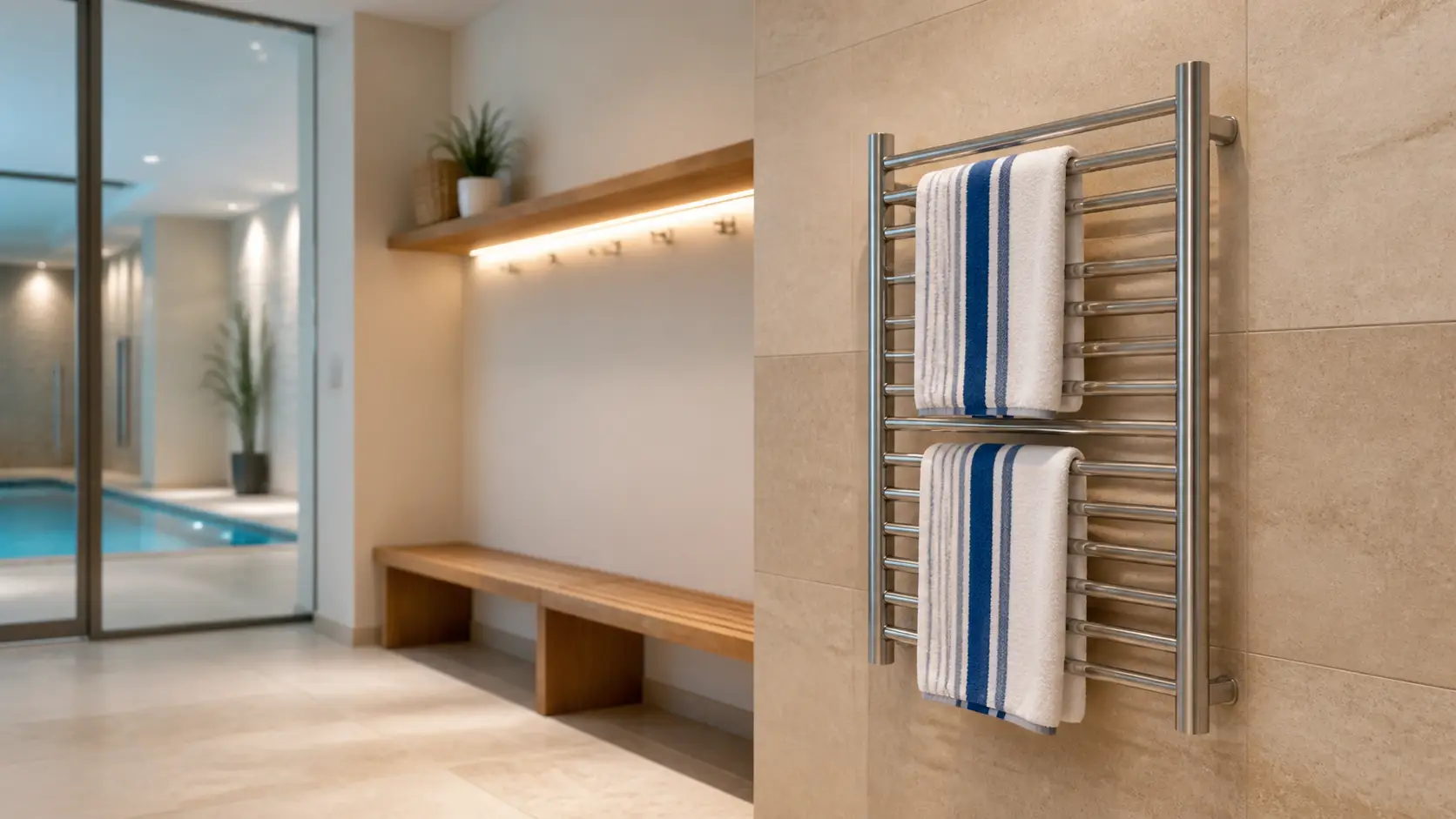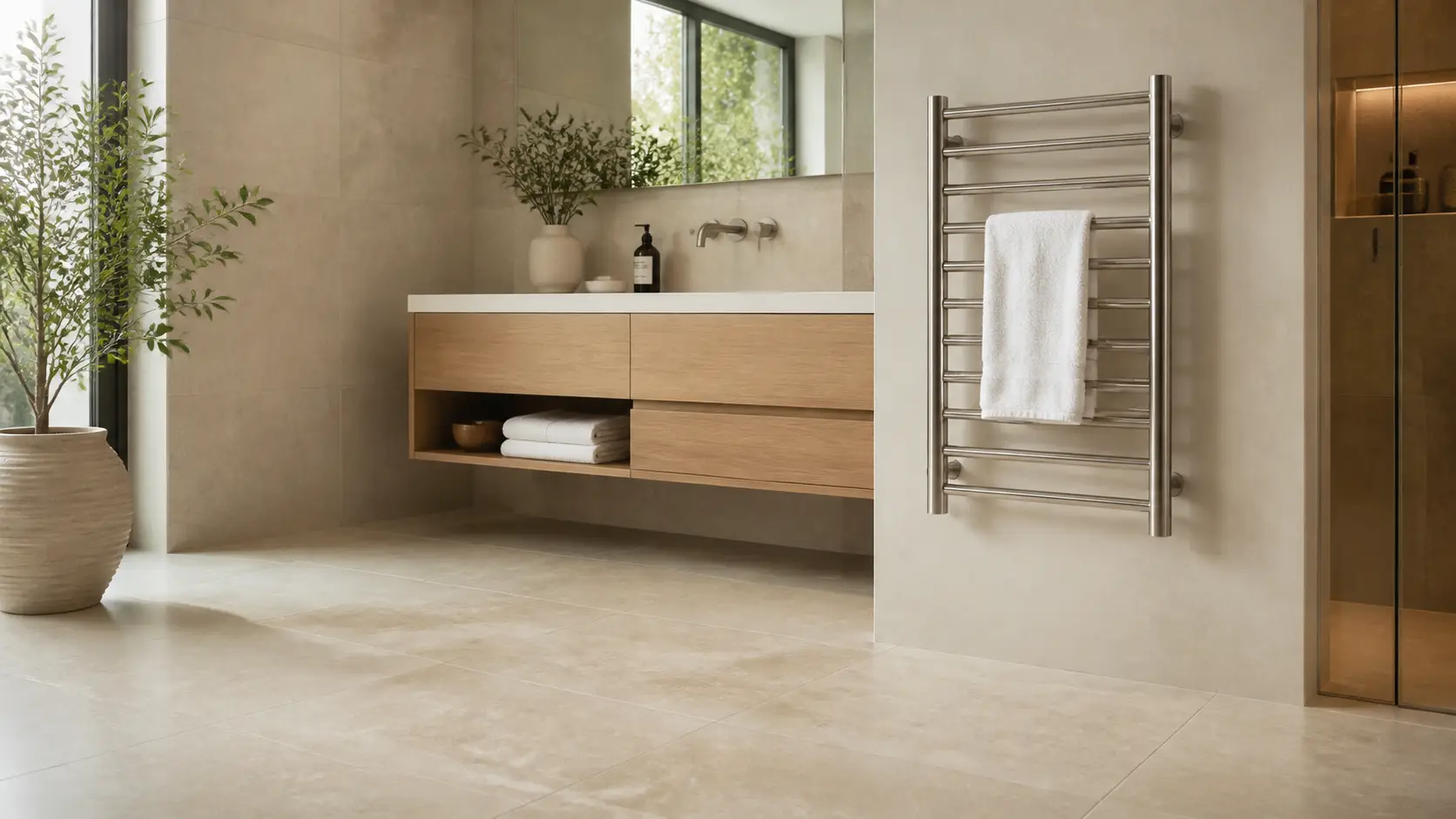
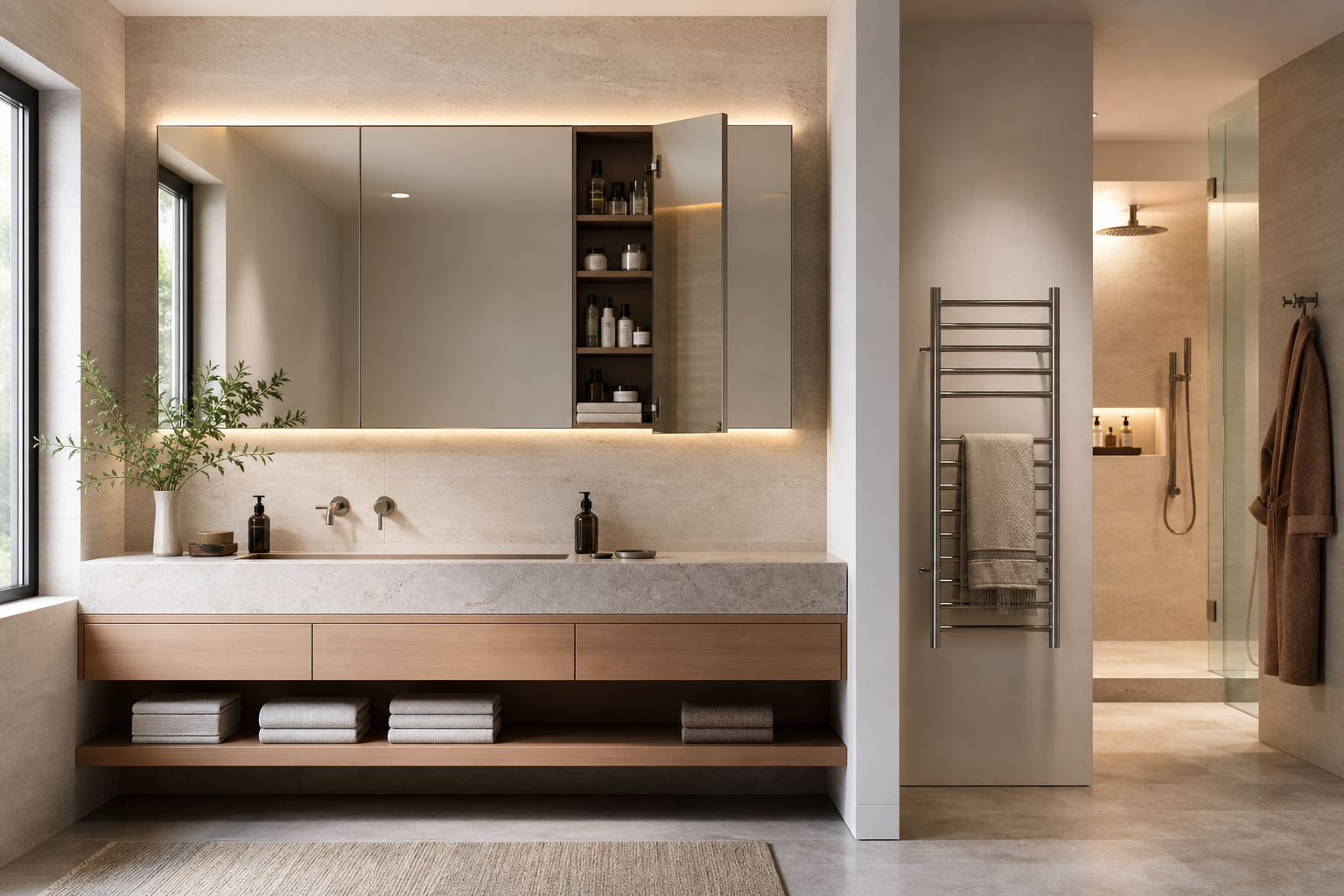
Bathroom mirror trends in 2026 are moving toward mirrors that do more than reflect the room. The strongest direction is a better vanity zone: integrated mirror lighting, recessed or mirrored medicine cabinets, hidden storage, anti-fog features, safer nighttime lighting, and cleaner coordination with towel drying, ventilation, and wall-mounted accessories. A heated towel rack fits naturally into this plan when the mirror, vanity, shower exit, and towel zone are planned together.
For homeowners, this means a bathroom that is easier to use in the morning and calmer at night. For designers, builders, hotel buyers, and wellness projects, it means the vanity wall can support task lighting, storage, grooming, guest comfort, and electrical planning without creating a crowded room.
What Are the Main Bathroom Mirror Trends for 2026?
The main bathroom mirror trend for 2026 is functional integration. Instead of treating the mirror as a separate decorative object, the mirror area is becoming part of a complete comfort system.
| 2026 mirror trend | What it means in practice | Planning connection |
|---|---|---|
| Integrated mirror lighting | LED lighting built into or around the mirror | Supports grooming, makeup, shaving, and nighttime use |
| Mirrored medicine cabinets | Storage hidden behind the mirror surface | Keeps vanity counters clear in small and busy bathrooms |
| Anti-fog features | Heated or treated mirror surfaces that reduce condensation | Works best with proper ventilation, not instead of it |
| Warm, flattering light | Softer color temperature and layered lighting | Makes warm tile, wood, and metal finishes feel more comfortable |
| Larger mirror zones | Wider mirrors over double vanities or hotel-style grooming stations | Needs coordination with sconces, outlets, and towel placement |
| Smart convenience | Dimming, touch controls, clocks, defoggers, or hidden outlets | Requires early electrical planning |
NKBA's 2026 bath trend coverage points to strong demand for task lighting, nighttime-specific lighting, natural light, and integrated lighting in mirrors. Houzz's 2025 bathroom study also shows continued interest in upgraded medicine cabinets, mirror features, recessed lighting, sconces, and wellness-oriented bathroom upgrades. Together, those signals make the mirror wall a serious planning area, not an afterthought.
Start With the Vanity Routine
Before choosing a mirror shape or finish, map what happens at the vanity every day:
- Brushing teeth and washing hands.
- Shaving, skincare, hair styling, and makeup.
- Using the room at night without harsh overhead lighting.
- Storing medicine, toiletries, chargers, and small tools.
- Stepping out of the shower and reaching a towel.
- Clearing steam and moisture after bathing.
This routine shows why mirrors, medicine cabinets, towel racks, and ventilation should be planned together. If the vanity has no storage, the counter becomes cluttered. If the mirror has poor lighting, users add extra lamps or rely on harsh ceiling light. If the towel rack is placed wherever wall space is left, users may cross the room while wet.
Integrated Lighting Is Becoming the Default Upgrade
Integrated mirror lighting is popular because it solves a practical problem: many bathrooms are bright enough for walking around but not accurate enough for grooming. Overhead lighting can cast shadows on the face, especially when the vanity is deep, the ceiling light is behind the user, or the mirror wall lacks side lighting.
A better 2026 lighting plan uses layers:
| Lighting layer | Best use | Mirror planning note |
|---|---|---|
| Integrated mirror light | Face-level grooming light | Choose dimming if the room is used at night |
| Sconces or vertical side lights | Reduces facial shadows | Coordinate width with mirror and medicine cabinet doors |
| Recessed ceiling light | General room brightness | Avoid relying on it as the only vanity light |
| Night lighting | Low-level navigation | Useful for family bathrooms, hotels, and aging-in-place projects |
| Natural light | Daytime comfort | Check glare and privacy before placing mirrors opposite windows |
For commercial and hospitality projects, lighting consistency matters. A guest bathroom with a flattering mirror, clear towel access, and predictable controls feels more premium than a bathroom with expensive surfaces but awkward light.
Medicine Cabinets Are Returning as Better Storage
Mirrored medicine cabinets are not just old-fashioned bathroom storage. In 2026 planning, they are useful because bathrooms need more small-item organization without adding floor cabinets or countertop clutter.
A strong medicine-cabinet plan can support:
- Daily skincare and grooming items.
- Electric toothbrushes and small charging needs.
- Medicine and first-aid storage, where appropriate.
- Guest amenities in hotel or rental bathrooms.
- Better visual calm in compact residential bathrooms.
The key is to choose cabinet depth, door swing, outlet placement, and mirror width early. A medicine cabinet that hits a wall sconce, opens into a shower screen, or sits too high for daily users will create friction every day.
| Medicine cabinet decision | Better planning rule | Why it matters |
|---|---|---|
| Recessed or surface-mounted | Recessed looks cleaner, surface-mounted is simpler in some renovations | Affects wall framing and installation timing |
| Door swing | Confirm the door clears lights, walls, and faucet reach | Prevents awkward daily use |
| Internal outlets | Plan charging needs before wiring | Reduces countertop cords |
| Mirror width | Match vanity and user routine, not only wall size | Keeps the room balanced |
| Lighting | Pair storage with face-level light | Prevents shadows and clutter |
Anti-Fog Mirrors Help, but Ventilation Still Matters
Anti-fog mirrors can make a bathroom feel more polished after showers, especially in compact rooms, hotels, and spa-style bathrooms. But they should not be treated as a substitute for moisture control.
The U.S. EPA's mold and moisture guidance emphasizes moisture control and recommends running a bathroom fan or opening a window when showering. That is important for mirror and towel-warmer planning because steam affects more than the mirror. It affects towels, walls, cabinetry, grout, and stored items.
A practical moisture-control plan includes:
- A correctly specified exhaust fan or operable window where allowed.
- Clear airflow after showers.
- Mirror defogging where user experience matters.
- A towel drying zone outside the direct splash area.
- Materials and finishes that tolerate humid bathroom use.
A heated towel rack can help towels feel warmer and dry more predictably, but it is not a ventilation system. Use it as part of the comfort and towel-care zone, not as the only answer to bathroom humidity.
Coordinate Mirror Lighting With Heated Towel Rack Placement
The mirror wall and towel rack compete for the same limited resources: wall space, power, finish coordination, and safe daily reach. Planning them together avoids common layout problems.
| Planning question | Better answer |
|---|---|
| Where does the user stand after showering? | Place towels within easy reach of the dry side of the shower or bath |
| Where is the vanity power routed? | Decide mirror lighting, cabinet outlets, and towel rack wiring before wall finishes |
| Will the mirror reflect clutter? | Keep towel storage and damp towels visually controlled |
| Does the room need a warm finish family? | Coordinate mirror frame, faucets, lighting, cabinet pulls, and towel rack finish |
| Is the towel rack near a splash zone? | Keep it on a dry wall with suitable clearance and installation guidance |
For CALITHREX buyers, this is where product planning becomes practical. Once the mirror width, vanity lighting, dry towel wall, finish family, and electrical route are clear, compare models in the Calithrex heated towel rack collection by size, finish, and installation type.
Mirror Trends by Bathroom Type
Different bathrooms need different mirror decisions. A family bathroom needs durability and storage. A hotel bathroom needs intuitive lighting. A spa bathroom needs atmosphere. A compact apartment bathroom needs every surface to work harder.
| Bathroom type | Mirror priority | Heated towel rack planning note |
|---|---|---|
| Small residential bathroom | Recessed cabinet, integrated light, clear counter | Use a narrow towel rack on a dry wall near the shower exit |
| Primary bathroom | Wide mirror, layered lighting, personal storage | Coordinate rack finish with faucets and lighting |
| Guest bathroom | Simple controls, flattering light, tidy storage | Keep towels easy to see and reach |
| Hotel bathroom | Consistent grooming light and low learning curve | Standardize rack placement, finish, and housekeeping clearance |
| Spa or wellness bathroom | Warm light, calm materials, anti-fog comfort | Pair towel warming with ventilation and dry storage |
| Aging-in-place bathroom | Task light, nighttime guidance, reachable storage | Keep controls and towels within comfortable reach |
The best mirror trend is the one that improves the room's daily routine. A backlit mirror alone will not fix a cluttered vanity, a poorly placed towel zone, or weak ventilation.
Common Mirror Planning Mistakes to Avoid
- Choosing a decorative mirror before confirming lighting needs.
- Using only overhead lighting for grooming.
- Installing a medicine cabinet without checking door swing.
- Adding anti-fog features but ignoring ventilation.
- Placing outlets where cords crowd the sink.
- Selecting a mirror finish that conflicts with faucets and towel rack finish.
- Forgetting nighttime use in family, guest, hotel, or wellness bathrooms.
- Leaving no dry wall for towel drying near the shower exit.
The better rule is to plan the vanity wall as a working zone: mirror, light, storage, power, ventilation, and towel access all need to cooperate.
FAQ
What bathroom mirrors are trending in 2026?
Integrated-light mirrors, mirrored medicine cabinets, anti-fog mirrors, wider vanity mirrors, warm framed mirrors, and smart convenience features are all gaining attention. The strongest trend is not just appearance; it is a better vanity routine with lighting, storage, and moisture control.
Are LED bathroom mirrors worth it?
They can be worth it when the bathroom needs better face-level lighting, a calmer nighttime setting, or a cleaner vanity wall. They are less useful if the room already has excellent side lighting and the mirror adds no storage or control benefit.
Are medicine cabinets outdated?
No. Medicine cabinets are becoming more useful again because they hide small daily items without taking floor space. Recessed mirrored cabinets work especially well in small bathrooms, guest bathrooms, and hotel-style vanity zones.
Do anti-fog mirrors replace bathroom ventilation?
No. Anti-fog mirrors can improve visibility after showers, but they do not remove room moisture. Bathroom ventilation, airflow, and towel drying are still needed to manage condensation and damp materials.
Where should a heated towel rack go near a vanity?
It should usually go on a dry wall near the shower or bath exit, not directly in the vanity work zone unless the layout clearly supports it. Check door swings, drawer openings, wet paths, controls, and reach before choosing the wall.
Which finishes work best with bathroom mirrors and towel racks?
Brushed nickel, polished chrome, matte black, warm brass, and brushed gold can all work. The key is consistency: coordinate the mirror frame, faucets, sconces, cabinet pulls, shower hardware, and heated towel rack so the room feels intentional.
Planning Next Step
For a 2026 bathroom, choose the vanity routine first: mirror width, face-level lighting, hidden storage, anti-fog needs, ventilation, towel location, and electrical route. If a heated towel rack is part of the plan, reserve the dry towel wall before finalizing mirror lighting and cabinetry.
For product planning, compare finish and size options in the Calithrex shop or contact CALITHREX with your bathroom layout, wall photos, towel count, preferred finish, and installation type.