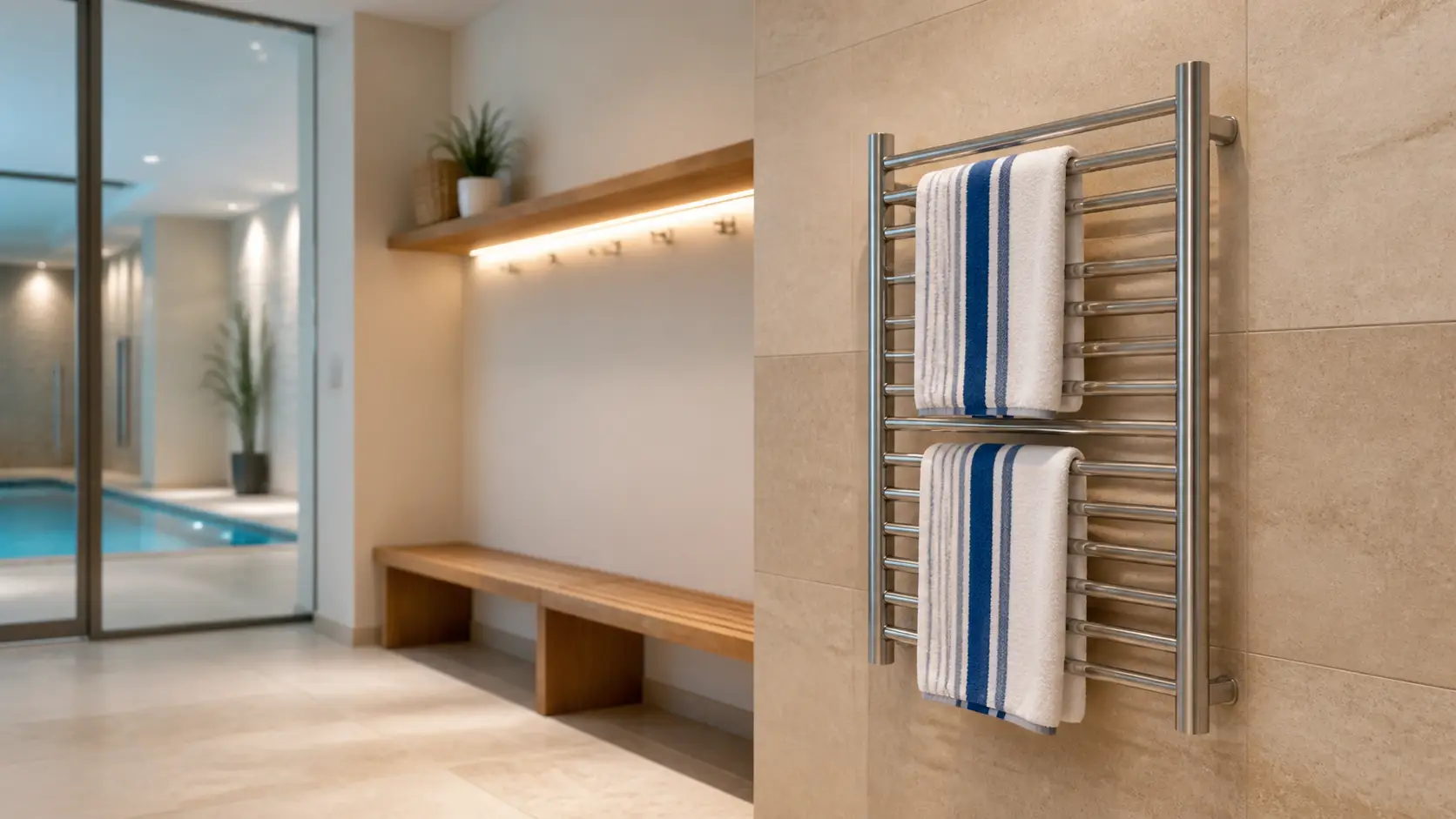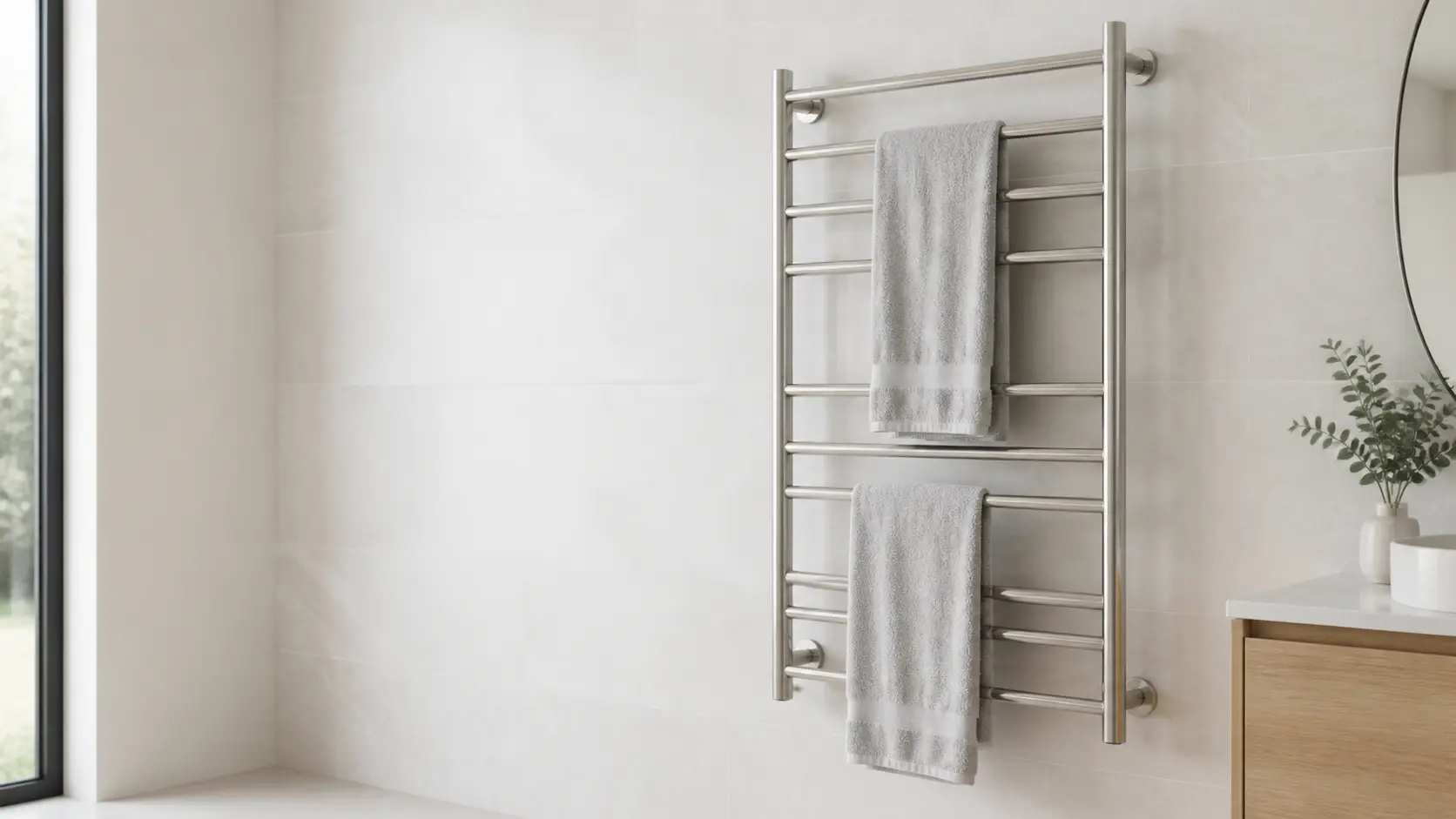
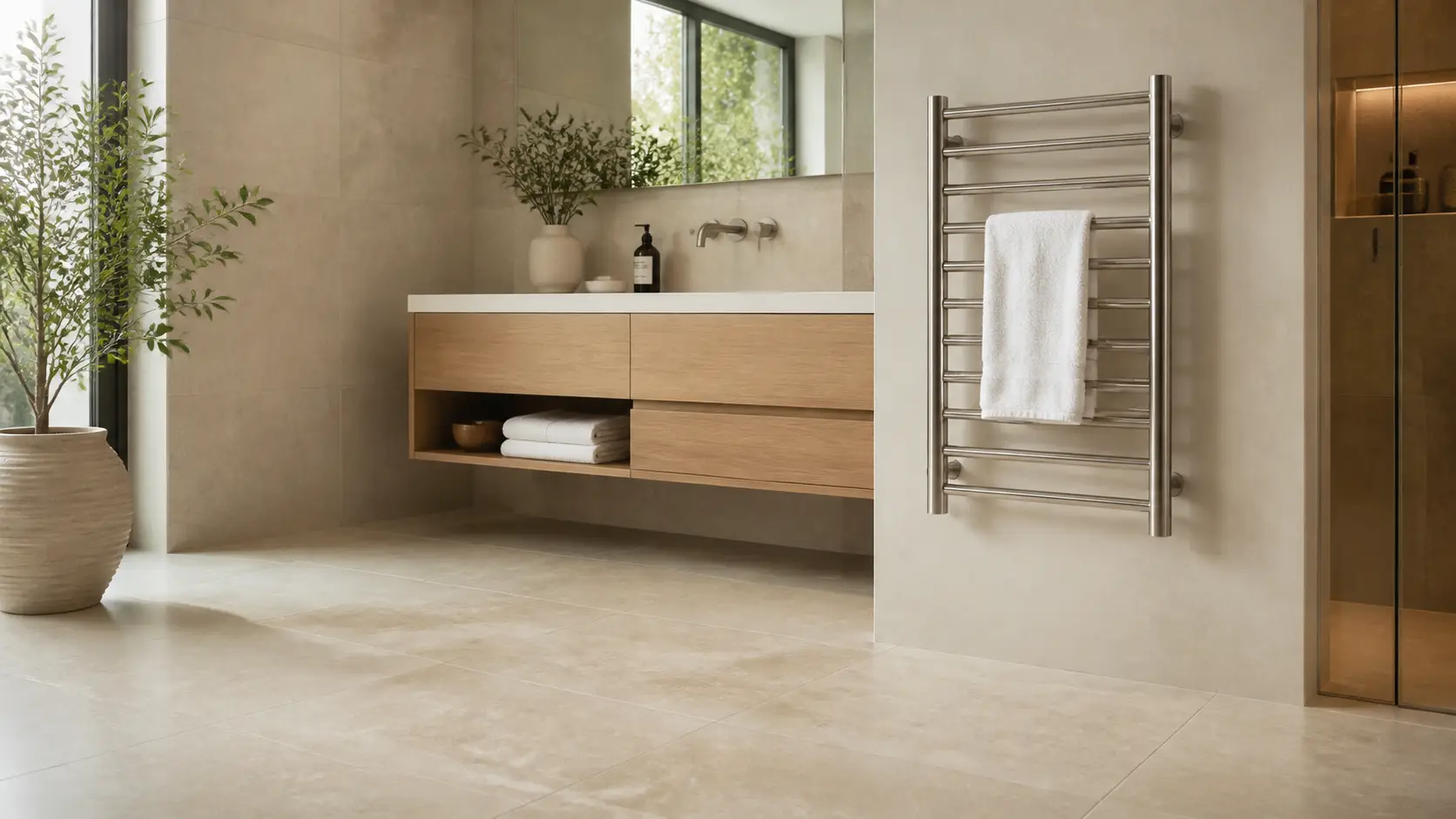
A heated towel rack and a heated floor solve different bathroom problems. Choose a heated towel rack when you want a dedicated place to hang, warm, and help dry towels between uses. Choose a heated floor when cold tile under bare feet is the main discomfort and you are already opening the floor for a remodel. If both issues matter and the budget and electrical plan allow, they can complement each other—but neither replaces ventilation or a properly designed main heating system.
Start with the experience you want to improve
It is easy to group both products under “spa bathroom,” but that can lead to the wrong purchase. Heated flooring warms the surface you stand on. A heated towel rack warms the bars that hold fabric. Their location determines their value.
Recent bathroom-remodel conversations repeatedly mention both features, which makes sense: each improves a different moment after a shower. One makes the floor more comfortable to cross; the other gives the towel a warmer, drier place to wait. The right choice is not the one that sounds more luxurious. It is the one that solves the routine your household actually has.
| If your main question is… | The more direct option | Why |
|---|---|---|
| “How do I avoid stepping onto cold tile?” | Heated floor | The heat is under the walking surface |
| “Where should wet towels dry between showers?” | Heated towel rack | The bars provide an open towel zone |
| “We are replacing tile anyway.” | Consider heated floor during planning | Flooring work is the natural time to assess it |
| “The bathroom is finished and towels stay damp.” | Consider an electric towel rack | It may be a more focused retrofit, subject to safe power planning |
| “The room is humid or has a leak.” | Fix ventilation or moisture sources first | Neither comfort upgrade solves a building-moisture problem |
What a heated towel rack does well
An open electric heated towel rack is a day-to-day towel tool. It gives bath towels, hand towels, robes, and some light garments a place to hang with warmth and airflow around the fabric. That is useful when towels otherwise end up folded over a hook, on a door, or in a damp heap.
The result should be described honestly. A rack helps towels dry between uses and feel more comfortable; it does not rapidly dry a soaked load of laundry or make every towel feel like it came from a commercial towel cabinet. Good towel spacing and appropriate ventilation are still essential.
For a finished bathroom, the rack may be easier to plan than a floor system because the decision centers on wall space, towel capacity, installation type, and appropriate electrical placement. That does not mean “plug in anywhere.” Check the exact model manual and consult a qualified local professional whenever outlet location, hardwiring, wet-area rules, or code is uncertain. The safe electric heated towel rack checklist is a good first screen.
What a heated floor does well
A heated floor is primarily about the sensation of the room underfoot. It can make tile feel more comfortable on cold mornings and distribute warmth across a walking area. It does not create a place to hang towels, keep towels separated, or move moisture out of a bath sheet.
Floor heating is often most sensible when a remodel already includes removing flooring, planning insulation or subfloor work, and coordinating electrical or hydronic systems. Adding it after the bathroom is complete can be much more disruptive. Ask the flooring installer and qualified electrician or heating professional to evaluate the exact floor build-up, control system, waterproofing plan, and local requirements.
Do not use a heated floor as the reason to skip ventilation. A warm tile surface may feel pleasant while shower moisture still needs to leave the room. Run an appropriate exhaust fan, investigate recurring condensation, and repair leaks.
Compare the installation moment, not only the product
The timing of your renovation often decides the answer. If tile is coming out, evaluate heated flooring before the new surface is installed. If the room is finished and the problem is towels on hooks staying clammy, a wall-mounted electric rack may be the more targeted project.
Measure the actual path. For a towel rack, check towel drop, door swing, toilet and vanity clearance, reachable controls, and a compliant power plan. For flooring, check the area that can be heated, fixed cabinetry and fixtures, the thermostat location, and the sequence of waterproofing and tile installation.
Neither choice should be made from a mood board alone. A beautiful feature becomes annoying if it blocks a door, crowds the daily path, leaves no place for towels to hang open, or forces rushed electrical changes late in construction.
Can you install both?
Yes, the two upgrades can work together because their roles are different. A heated floor supports foot comfort. A heated towel rack supports fabric comfort and towel drying. In a remodel, deciding on both early gives the design team a chance to coordinate loads, controls, wall layout, and the bathroom’s ventilation plan.
Still, more comfort equipment does not automatically improve the room. In a compact bath, the best result may be one well-chosen upgrade plus a strong exhaust strategy, practical storage, and enough clear walking space. In a shared family bathroom, a larger rack with enough usable bars may have more daily value than an elaborate feature that does not address the towel bottleneck.
A practical decision checklist
Ask these questions before choosing:
1. Is the main complaint cold feet, damp towels, or both? 2. Are you already replacing the floor, or is the bathroom finished? 3. How many towels need an open drying position each day? 4. Where will power, controls, and access be planned safely? 5. Does the bathroom have effective ventilation, and are there any leaks or moisture issues to fix first? 6. Will the feature interfere with doors, cabinets, cleaning, or accessibility?
If the answer to question one is “damp towels,” start with the towel routine, rack capacity, and ventilation. If it is “cold tile,” discuss floor heating while the floor assembly is still open. If it is both, compare the full project plan rather than assuming one item does both jobs.
Frequently asked questions
Does a heated towel rack warm the bathroom floor?
No. It warms its own bars and the towels placed on them. It should not be chosen as an underfoot-comfort solution.
Does a heated floor dry towels?
Not in the practical way an open towel rack does. Towels need a hanging place with air around the fabric.
Which is easier to add after a bathroom remodel?
It depends on the room and electrical plan, but floor heating is typically best assessed before the final floor is installed. A rack can sometimes be a more focused retrofit, subject to the exact installation requirements.
Can either feature replace a bathroom fan?
No. Ventilation manages humid air; a towel rack and a heated floor have different comfort roles.
Which is better for a small bathroom?
Choose based on the actual bottleneck. A compact room with damp towels may benefit more from a properly sized, safely located rack; a room being fully retiled may be a good time to consider floor comfort.
The practical next step
Name the problem before comparing products. Plan a heated towel rack for open towel drying and a heated floor for underfoot comfort. Then confirm the installation and ventilation details with the people responsible for your bathroom project.