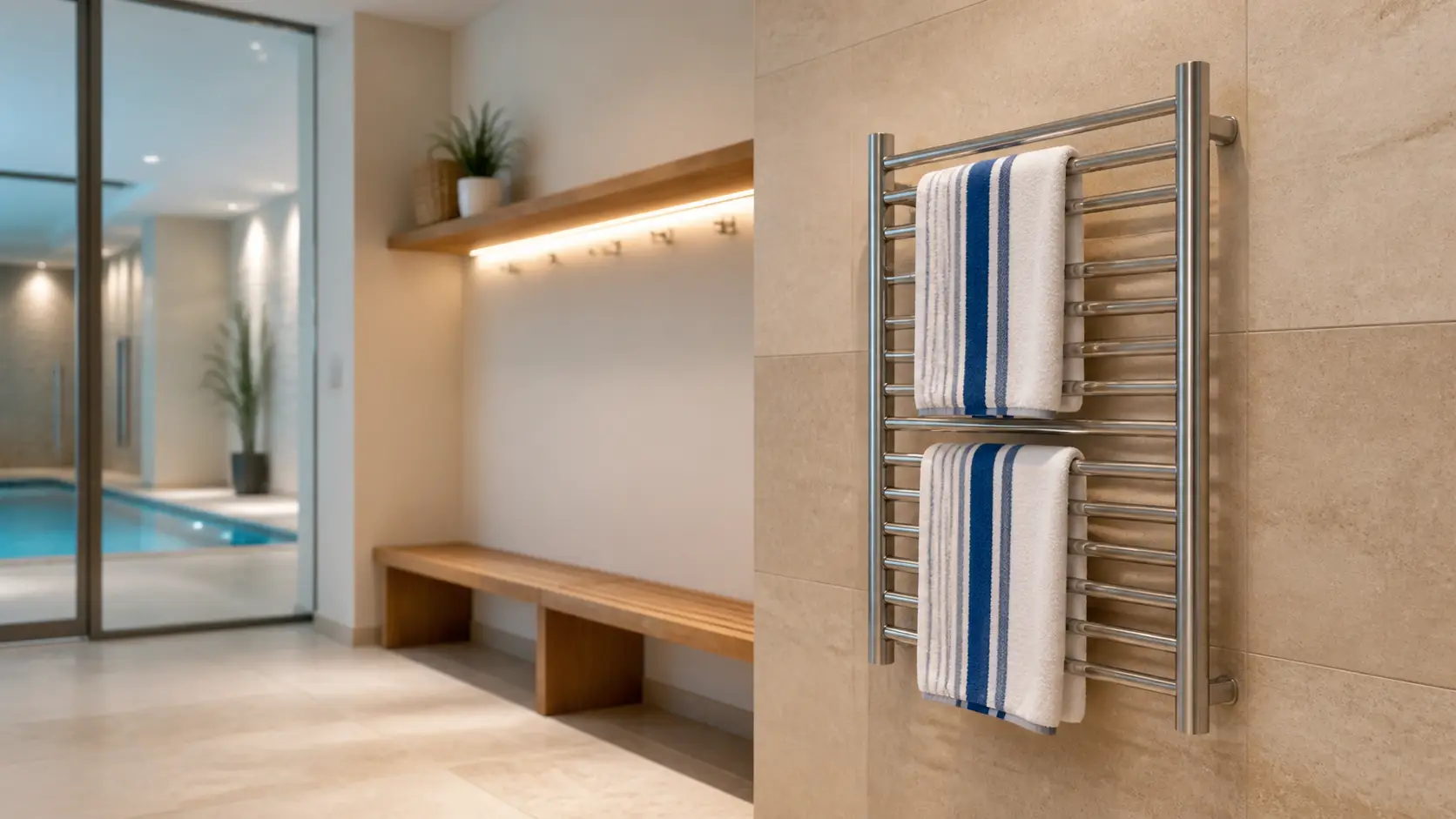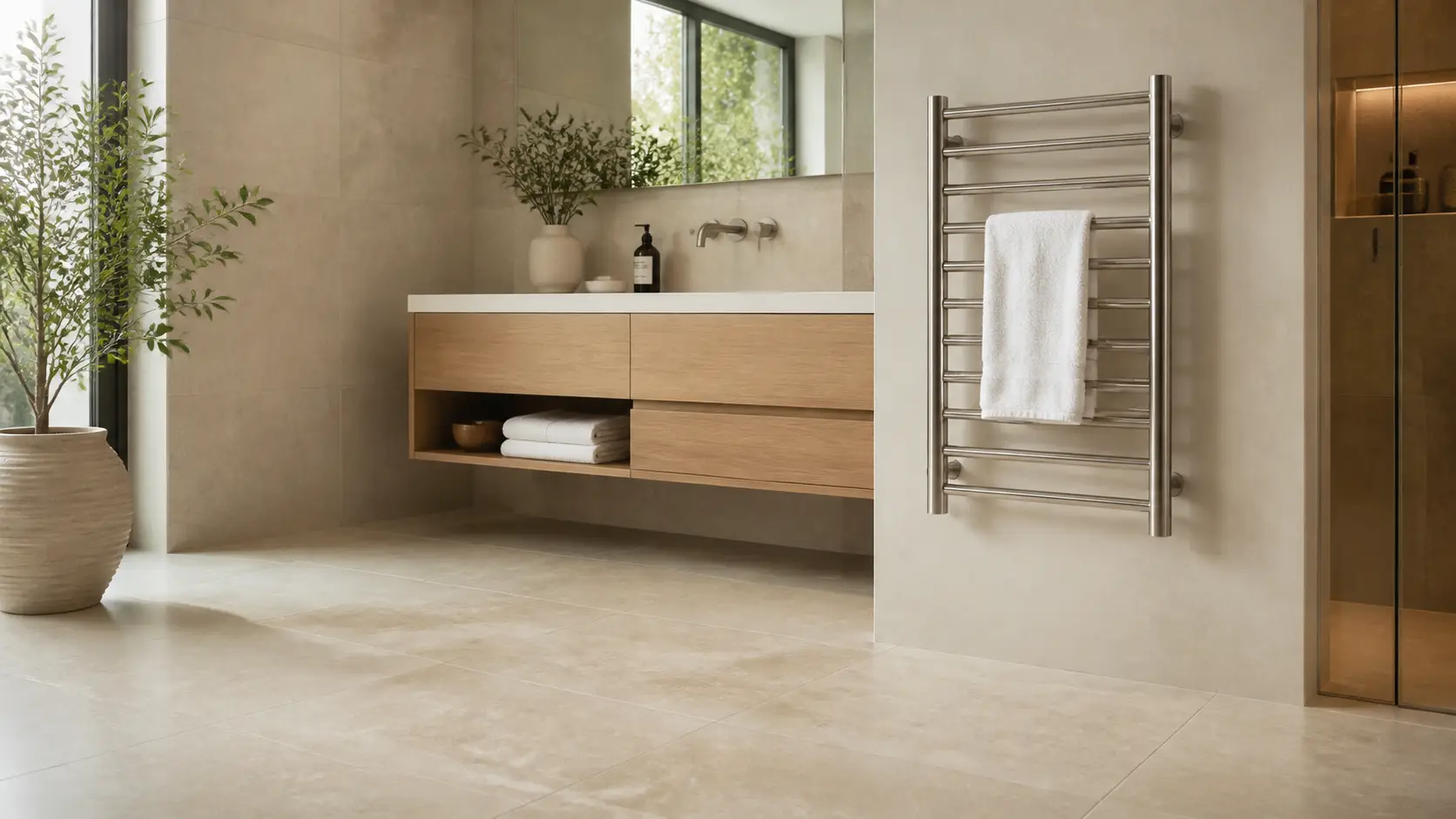
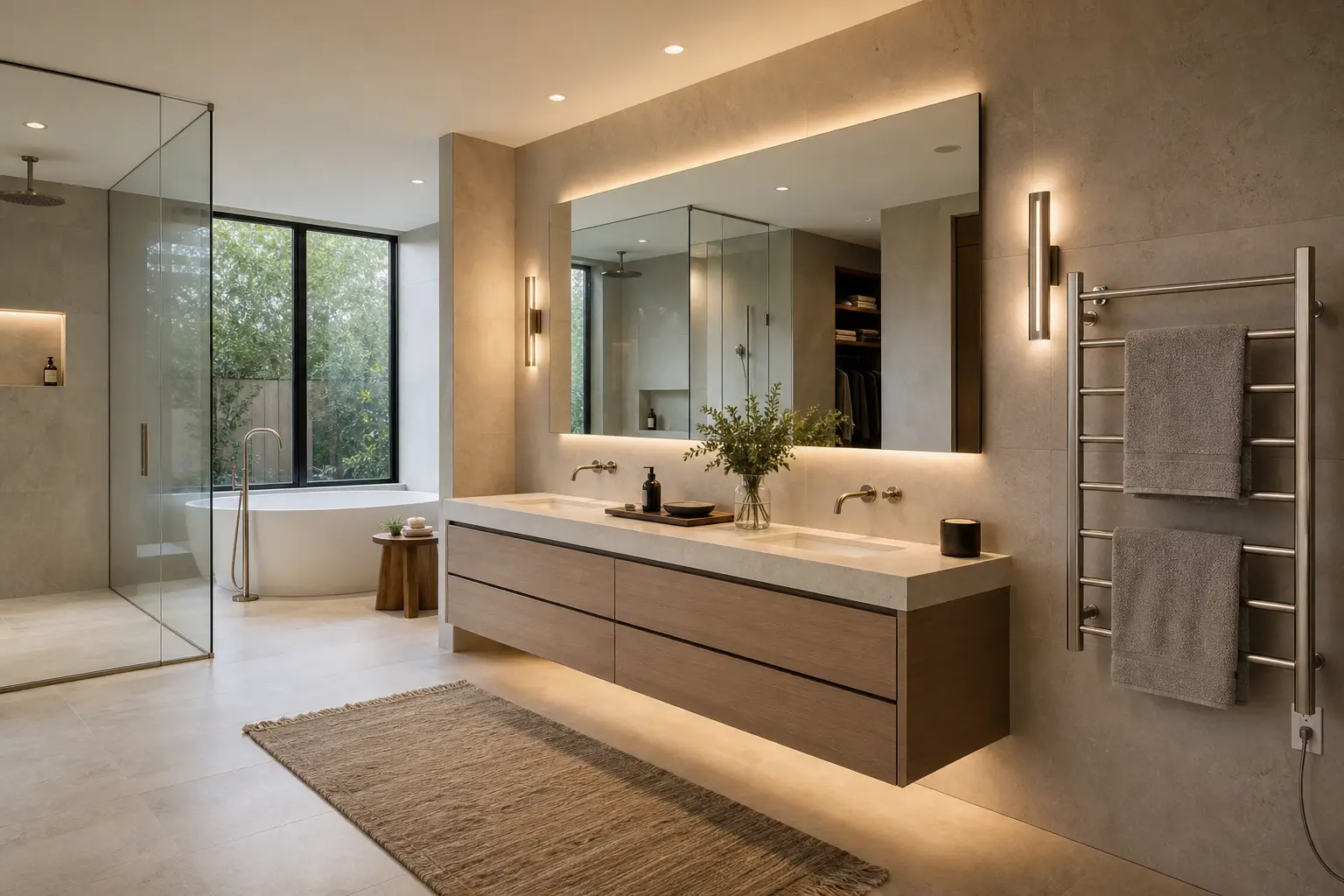
Bathroom vanity trends for 2026 are moving toward cleaner floating cabinets, better drawer storage, integrated mirror lighting, warmer materials, and earlier power planning. The best vanity layouts do more than hold a sink: they organize daily routines, keep counters calmer, support grooming light, protect materials from moisture, and leave a practical dry-wall zone for towels or a heated towel rack.
This matters for homeowners planning a primary bathroom, and it matters for designers, builders, hotels, and multifamily projects that need repeatable layouts. A vanity, mirror, outlet, shower route, and heated towel rack should be planned together before plumbing, tile, and electrical rough-in are locked.
What Are the Main Bathroom Vanity Trends for 2026?
The main bathroom vanity trend for 2026 is a shift from decorative cabinets to routine-centered storage and lighting. Floating vanities, drawer-based storage, large mirrors, medicine cabinets, warm wood tones, integrated lighting, and cleaner counters are all popular because they make the bathroom easier to use every day.
| 2026 vanity trend | What it means in practice | Heated towel rack connection |
|---|---|---|
| Floating vanities | Cleaner floor line and lighter visual weight | Leaves floor open, but wall planning becomes more important |
| Drawer storage | Better organization for grooming tools and towels | Helps separate dry storage from damp towel drying |
| Integrated mirror lighting | More even face lighting and a calmer look | Coordinate towel-zone lighting with the vanity plan |
| Warm wood and stone looks | Softer residential and hotel-style bathrooms | Match towel rack finish to faucet, mirror, and cabinet hardware |
| Hidden power | Outlets inside drawers or medicine cabinets where allowed | Reserve electrical planning for both vanity use and towel warming |
| Wider mirrors | More visual openness and shared grooming space | Check mirror width before placing a towel rack on the same wall |
NKBA's 2026 bath trend coverage points to larger, brighter, better organized bathrooms, with wellness, storage, and lifestyle needs shaping the room. Houzz's 2025 U.S. bathroom study also reports that many renovating homeowners say good organization helps them relax in the bathroom. That makes vanity planning a real comfort decision, not just a cabinet selection.
Start With Daily Routines, Not Cabinet Style
A vanity should be planned around what happens at the sink every morning and evening. Before choosing a finish or handle style, map the routine:
- Who uses the vanity at the same time?
- Which items need to stay on the counter, inside drawers, or inside a medicine cabinet?
- Where will hair tools, toothbrushes, shavers, skincare, and charging devices go?
- Is the mirror light strong enough for grooming but soft enough for evening use?
- Where do hand towels, bath towels, and damp towels go?
- Is there a dry wall nearby for a heated towel rack?
This routine-first approach prevents a common problem: a beautiful vanity with crowded counters, poor lighting, awkward outlet access, and no towel plan.
Floating Vanities Need Strong Wall and Storage Planning
Floating vanities are one of the strongest bathroom vanity trends because they make the room feel lighter and easier to clean. They work especially well in primary bathrooms, small bathrooms, hotels, and contemporary spa-style spaces.
The tradeoff is that floating vanities depend on wall structure, plumbing alignment, drawer depth, and exact installation height. If the wall is not planned early, the vanity may look clean but lose useful storage or force awkward plumbing compromises.
| Planning point | Why it matters | Practical guidance |
|---|---|---|
| Wall support | Floating cabinets need secure mounting | Confirm blocking and wall construction before ordering |
| Drawer depth | Plumbing can reduce usable storage | Check trap location, drawer cutouts, and organizer depth |
| Floor clearance | Too much or too little gap changes the look | Keep the height comfortable for users and easy cleaning |
| Nearby towel wall | Floating design often reduces towel-bar options | Reserve a dry wall for hooks, bars, or a heated towel rack |
| Lighting alignment | Mirror, sconces, and ceiling lights affect the final view | Coordinate fixture heights before tile and mirror installation |
For B2B projects, the strongest floating vanity designs are repeatable. A hotel, apartment, or villa project should standardize vanity height, outlet position, mirror width, towel rack clearance, and cleaning access before procurement.
Drawer Storage Is Replacing Open Counter Clutter
In 2026, vanity storage is less about adding more cabinets and more about making the right storage easy to reach. Deep drawers, shallow top drawers, divided organizers, medicine cabinets, and linen niches all help the bathroom stay calmer.
| Storage need | Better vanity solution | Mistake to avoid |
|---|---|---|
| Daily grooming tools | Shallow drawer with organizer | Leaving everything on the counter |
| Hair dryer or styling tools | Heat-aware drawer or dedicated storage zone | Storing hot tools against towels or cosmetics |
| Skincare and medicine | Medicine cabinet or dry drawer | Putting sensitive items in a damp splash area |
| Clean hand towels | Drawer, shelf, or linen cabinet | Mixing clean towels with damp towel drying |
| Damp bath towels | Hook, bar, or heated towel rack | Folding damp towels inside closed storage |
This distinction is important for heated towel rack planning. A vanity can store clean towels, but damp towels need airflow. A heated towel rack should usually support drying and comfort on a dry wall near the bath or shower route, not replace clean linen storage inside the vanity.
Mirror Lighting Is Becoming Part of Vanity Performance
Vanity lighting affects how a bathroom feels and how well it works. In 2026, more designs use integrated mirror lighting, side sconces, under-vanity glow, softer night lighting, and layered ceiling light instead of one harsh overhead fixture.
Good vanity lighting should support:
- Face-level grooming without strong shadows.
- Evening routines without excessive glare.
- Safer movement between the vanity, shower, and towel zone.
- Accurate finish coordination for faucets, cabinet hardware, and towel racks.
- A calmer hotel or spa-like experience.
When choosing a heated towel rack finish, check it under the same light as the faucet and mirror frame. Stainless steel, brushed nickel, matte black, and warm metal finishes can look different under daylight, warm LEDs, and mirror backlighting.
Power Planning Should Happen Before Tile and Cabinets
Many vanity problems are electrical planning problems. Outlets, switches, mirror lighting, fan controls, under-cabinet lighting, heated floors, smart controls, and heated towel racks all compete for wall space and routing.
For a 2026 vanity plan, discuss these questions early with the electrician or project team:
- Where should GFCI-protected outlets be placed for local requirements?
- Will any outlets be inside a drawer, cabinet, or medicine cabinet where allowed?
- Does the mirror need hardwired lighting or an outlet?
- Will the bathroom use night lighting or under-vanity lighting?
- Is a heated towel rack plug-in or hardwired?
- Can the towel rack be placed on a dry wall without crowding the vanity, mirror, door, or shower glass?
Energy-efficient bathroom planning is not only about lower-watt products. It is also about controls, habits, and placing each feature where it is actually used. Timer use, reachable switches, and clear daily routines help heated towel racks and vanity lighting support comfort without unnecessary runtime.
Where Should a Heated Towel Rack Go Near a Vanity?
A heated towel rack near a vanity should usually sit on a dry wall where towels can be reached after hand washing, bathing, or showering without crossing a wet floor. It should not crowd drawers, block cabinet doors, interfere with mirror lighting, or sit in direct shower spray.
| Placement option | When it works | Watch out for |
|---|---|---|
| Side wall beside vanity | Good for hand towels and compact bathrooms | Keep drawer and cabinet door clearance |
| Wall between vanity and shower exit | Strong for daily towel routines | Confirm the floor path stays dry |
| Wall opposite vanity | Works in wider primary bathrooms | Avoid forcing users across wet tile |
| Near linen storage | Good for spa or hotel-style bathrooms | Keep clean storage separate from damp towel drying |
| Behind a door | Sometimes useful in small bathrooms | Check door swing, heat clearance, and towel access |
If the rack will be hardwired, decide the location before wall finishes are complete. If it will be plug-in, confirm outlet position and cord visibility early so the final room does not look improvised.
For product planning, compare finishes and sizes in the Calithrex heated towel rack collection. For deeper placement checks, pair this article with Calithrex guidance on heated towel rack installation height and heated towel rack IP rating planning.
Vanity Planning by Bathroom Type
Different bathroom types need different vanity decisions. A compact powder room, family bathroom, hotel suite, and wellness bathroom should not use the same storage and towel strategy.
| Bathroom type | Vanity priority | Heated towel rack planning note |
|---|---|---|
| Small residential bathroom | Floating cabinet, mirror storage, clear floor route | Use a compact wall-mounted rack if space is tight |
| Primary bathroom | Double sinks, drawer organizers, layered lighting | Match towel rack finish to faucet and mirror hardware |
| Family bathroom | Durable surfaces, easy cleaning, shared storage | Keep damp towels away from closed vanity drawers |
| Guest bathroom | Simple storage and intuitive lighting | Place towels where guests can find them quickly |
| Hotel bathroom | Repeatable layouts, durable finishes, housekeeping access | Standardize rack location and towel clearance |
| Spa or wellness bathroom | Warm materials, calm lighting, dry towel ritual | Keep towels close to the bath or shower exit |
The strongest vanity design is not always the largest one. It is the one where storage, lighting, power, cleaning, towel drying, and movement all work together.
Common Bathroom Vanity Mistakes to Avoid
- Choosing a vanity before checking plumbing and wall support.
- Installing a large mirror without planning side lighting or outlet locations.
- Using beautiful drawers that lose space to plumbing cutouts.
- Leaving hair tools and chargers with no dedicated storage.
- Folding damp towels into closed vanity drawers.
- Placing a heated towel rack where it blocks cabinet doors or shower glass.
- Matching faucet and cabinet hardware but forgetting towel rack finish.
- Planning hardwired features after tile and wall finishes are complete.
- Treating ventilation as separate from towel drying and material durability.
These mistakes are avoidable when the vanity is planned as part of the whole bathroom, not as a standalone furniture piece.
FAQ
What bathroom vanity trends are popular for 2026?
Floating vanities, drawer-based storage, integrated mirror lighting, warm wood tones, stone-look counters, cleaner counters, hidden power, and coordinated metal finishes are strong bathroom vanity trends for 2026. The practical trend is better routine planning.
Are floating bathroom vanities a good idea?
Floating bathroom vanities can be a good idea when the wall structure, plumbing, storage depth, and installation height are planned correctly. They make the bathroom feel lighter and easier to clean, but they need more precise rough-in planning than many floor-standing cabinets.
What is the best storage for a bathroom vanity?
The best vanity storage usually combines shallow organizers for daily items, deeper drawers for larger tools, a medicine cabinet or dry cabinet for sensitive products, and separate towel storage. Damp towels should have airflow rather than being folded into closed drawers.
Where should outlets go around a bathroom vanity?
Outlet placement depends on local electrical requirements and the room layout. In general, outlets should support daily grooming without creating cord clutter or unsafe reach across wet areas. Discuss GFCI protection, mirror lighting, drawer outlets, and towel rack power with a qualified electrician or project team.
Can a heated towel rack go next to a vanity?
Yes, a heated towel rack can go next to a vanity when it has safe clearance, stays outside direct shower spray, does not block drawers or doors, and follows the product instructions and local electrical requirements. A dry side wall near the vanity and shower route is often practical.
Should a bathroom vanity match the towel rack finish?
It does not have to match perfectly, but it should coordinate. Check the towel rack finish against faucets, mirror frames, cabinet pulls, shower trim, and lighting. A consistent finish plan helps the bathroom feel intentional rather than pieced together.
Planning Next Step
For a 2026 vanity project, plan the sink routine, drawer storage, mirror lighting, outlets, ventilation, towel access, and heated towel rack location before ordering cabinets or closing walls. If a heated towel rack is part of the comfort plan, reserve its dry-wall position early and choose the size, finish, and installation type around the full vanity and shower route.
For help choosing a suitable rack, compare options in the Calithrex shop or contact CALITHREX with your vanity width, mirror layout, shower exit location, wall photos, preferred finish, and plug-in or hardwired preference.