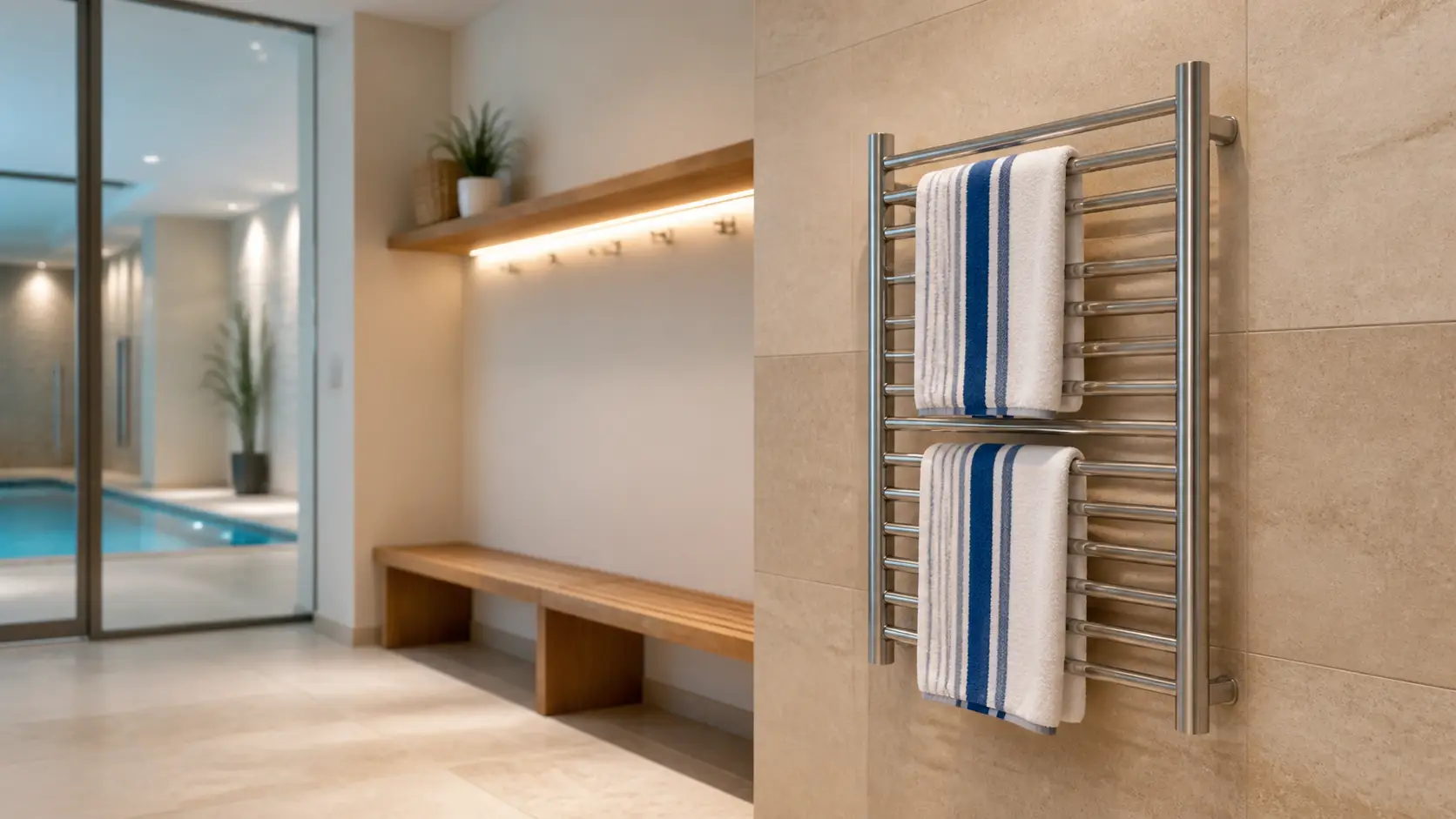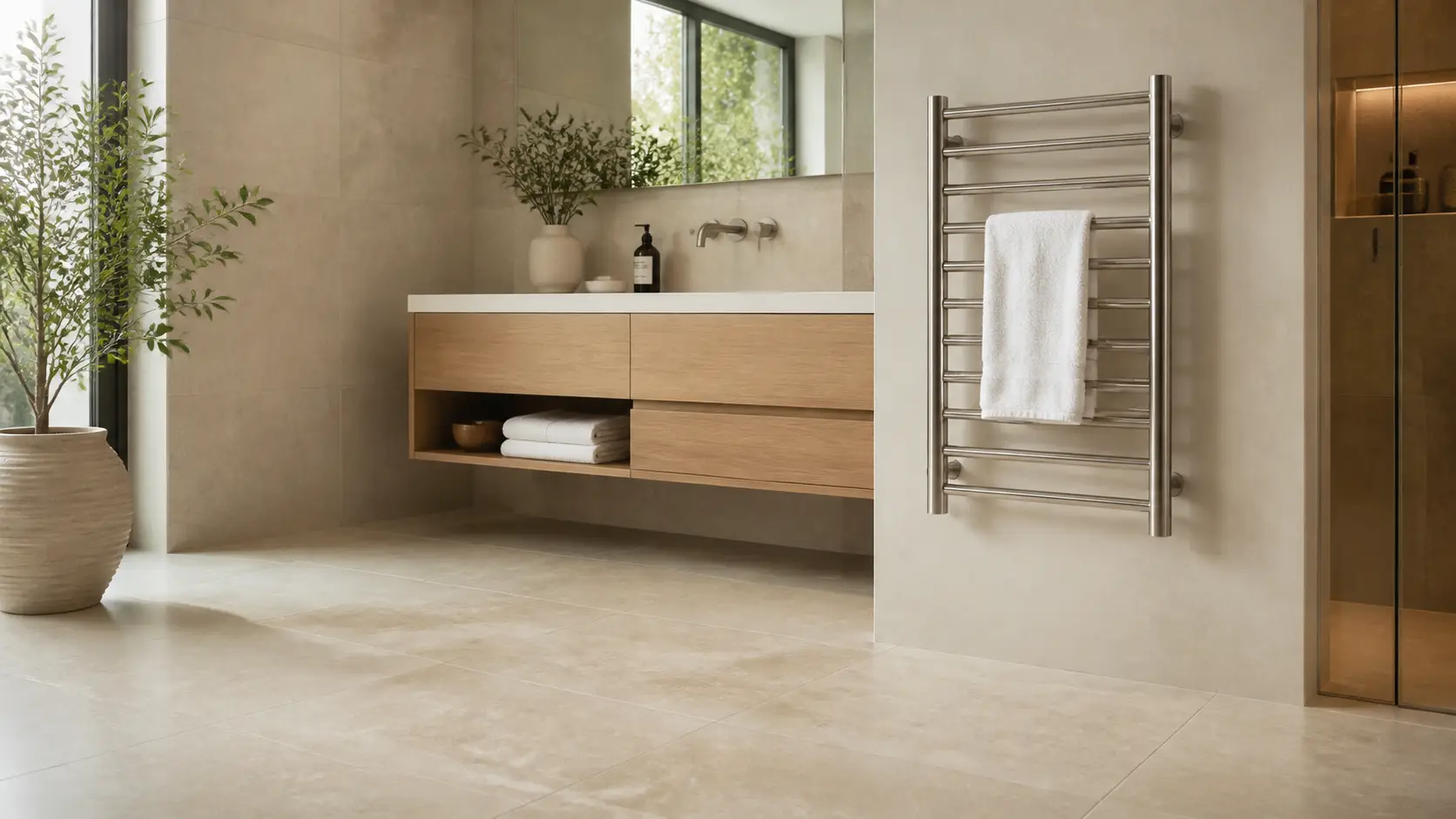
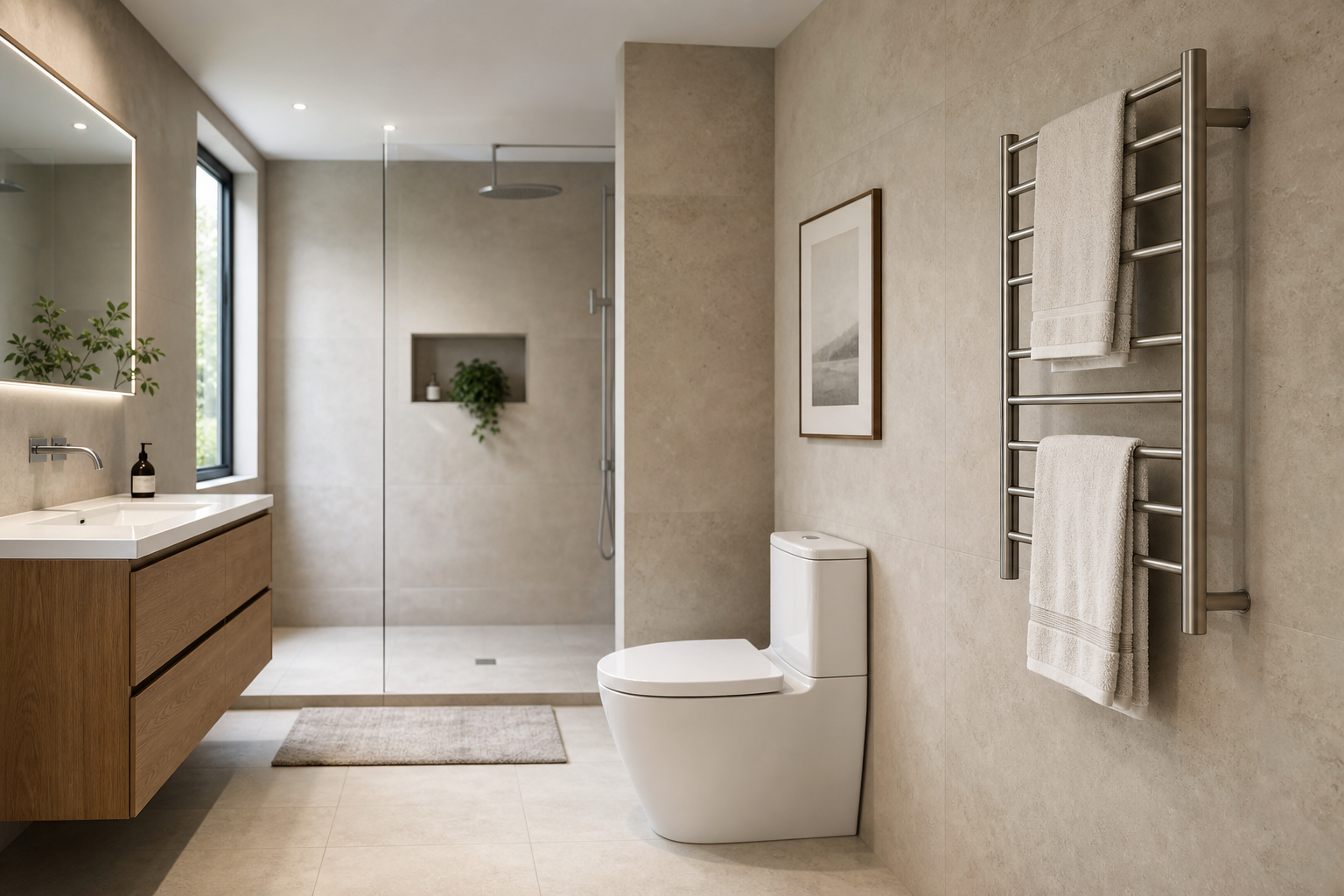
You can sometimes put a heated towel rack above or beside a toilet, but it is not an automatic space-saving win. The right location must let towels hang open, keep the rack easy to clean and reach, avoid shower spray and door swings, and follow the product instructions plus local electrical requirements. In many bathrooms, a nearby side wall works better than the wall directly above the toilet.
Start With the Towel, Not the Empty Wall
The wall above a toilet can look unused until a full bath towel is hanging there. A towel needs clearance below the rails and enough room at the sides to stay open. If it drapes onto the tank, lid, flush buttons, or toilet paper holder, the layout may feel tidy in a drawing but frustrating in daily use.
Stand where a person would use the toilet and imagine a damp towel hanging at full length. It should not brush the user’s shoulders, block access to the flush controls, or become a bulky visual obstacle in a narrow room. A rack can support towel drying only when the fabric has space around it; tightly folded or compressed towels lose the airflow that helps moisture leave the fabric.
| Layout choice | When it can work | Main check |
|---|---|---|
| Above the toilet | A deep, clear wall with a modest towel load | Towels do not touch the tank or interfere with use |
| Beside the toilet | A free side wall outside the wet zone | Keep a comfortable cleaning and walking path |
| Near the vanity | Users need towels after handwashing or bathing | Avoid drawer and door conflicts |
| Near the shower exit | Towels can be reached after bathing | Confirm product guidance and water exposure limits |
| On a separate towel wall | Several towels need open hanging space | Best option when the room has enough wall area |
Check the Real Clearances
Measure before deciding. You need more than the rack’s outer height and width. Include the distance from the toilet tank or lid, the projection of the rack and towels into the room, the reach to the controls, and the path for cleaning behind and around the fixture.
Also check what happens when the towel is thick, not neatly folded. Bath sheets and plush towels project farther than a product silhouette. If the rack will only hold hand towels, the wall above a toilet may be more realistic. If it will hold large damp bath towels, a side wall or a wider dedicated towel zone is usually easier to live with.
Do not mount where a towel can block a cabinet, strike a door, or catch on a toilet-roll holder. A quick painter’s-tape outline on the wall, followed by a real towel held in place, is often more useful than guessing from a plan.
Moisture and Cleaning Matter Too
A heated towel rack is intended to help towels dry; it is not a substitute for managing bathroom humidity. The U.S. Environmental Protection Agency identifies moisture control as central to preventing mold growth, while ENERGY STAR explains that adequate bathroom ventilation helps control moisture and odors. Keep using the fan or another effective ventilation path after showers.
The wall above a toilet also needs regular cleaning. Choose a position that leaves enough access to wipe the wall, clean the toilet, and remove towels without brushing them against the fixture. A damp towel should not be forced into a cramped corner just because that wall is available.
If the bathroom regularly has visible condensation, a slow fan, leaks, or damp surfaces, address those problems first. Adding heat near the toilet will not solve a room-wide moisture issue.
Plan Power Before You Choose the Spot
Electrical planning is not a detail to solve after mounting. The U.S. Consumer Product Safety Commission explains that GFCI protection is used where electrical equipment may be near water. Product instructions, the installation method, the wall construction, and local requirements all matter, so use a qualified professional when the setup is not straightforward.
A plug-in model can be practical where the outlet and cord path are appropriate. But a cord should not cross a walking path, pass behind a moving door, or become a workaround near water. The Electrical Safety Foundation International warns that extension cords are not permanent wiring. Do not use one to reach a convenient wall above a toilet.
Hardwired planning can make sense during a remodel because it removes the loose cord and lets the wall layout be considered before finishes are complete. It still needs qualified guidance; this article cannot determine the code requirements for a particular bathroom.
When Above the Toilet Is a Good Fit
This location can be worth considering when the bathroom is compact, the wall is genuinely clear, and the rack will carry one or two towels that can hang freely. It is often more successful in a secondary bath where the toilet zone is separate from the shower splash area and there is little competing storage on that wall.
It is less appealing when the rack would sit very low, towels would overlap the toilet, several family towels need to share the rails, or cleaning access is already tight. In those cases, a side wall, a towel bar plus hooks, or a larger towel zone may provide a better drying routine.
A Quick Decision Checklist
- Tape out the rack and hang the largest real towel from the proposed location.
- Confirm the towel clears the tank, lid, flush controls, and toilet-paper holder.
- Leave room to sit, stand, clean, and open nearby doors or drawers.
- Keep the rack outside unsuitable water-exposure areas described by its instructions.
- Plan ventilation for humid air; the rack helps the towel, not the whole room.
- Avoid extension-cord solutions.
- Ask a qualified installer to confirm the electrical and mounting plan when needed.
FAQ
Is it safe to put a heated towel rack above a toilet?
It can be possible, but safety depends on the exact product instructions, water exposure, mounting, electrical plan, and local requirements. A qualified professional should review any uncertain bathroom installation.
Will towels touch the toilet?
They may if the rack is too low or the towels are long. Test the largest towel before drilling and leave enough clearance for it to hang open.
Is a side wall better than above the toilet?
Often, yes. A side wall can give towels more room, keep them away from the fixture, and make the rack easier to reach and clean around.
Can I use an extension cord to reach this wall?
No. Do not treat an extension cord as permanent wiring. Plan an appropriate outlet or a professionally reviewed hardwired installation instead.
Does a heated towel rack replace the bathroom fan?
No. The rack helps towels dry while ventilation handles humid air in the bathroom. Both are important after showers.
Next Step
Before choosing a wall, compare your towel size, toilet clearance, ventilation routine, and power plan. Then explore the Calithrex heated towel rack collection by installation type, finish, and usable towel spacing. Choose a layout that makes drying easier every day, not one that only fills an empty wall.