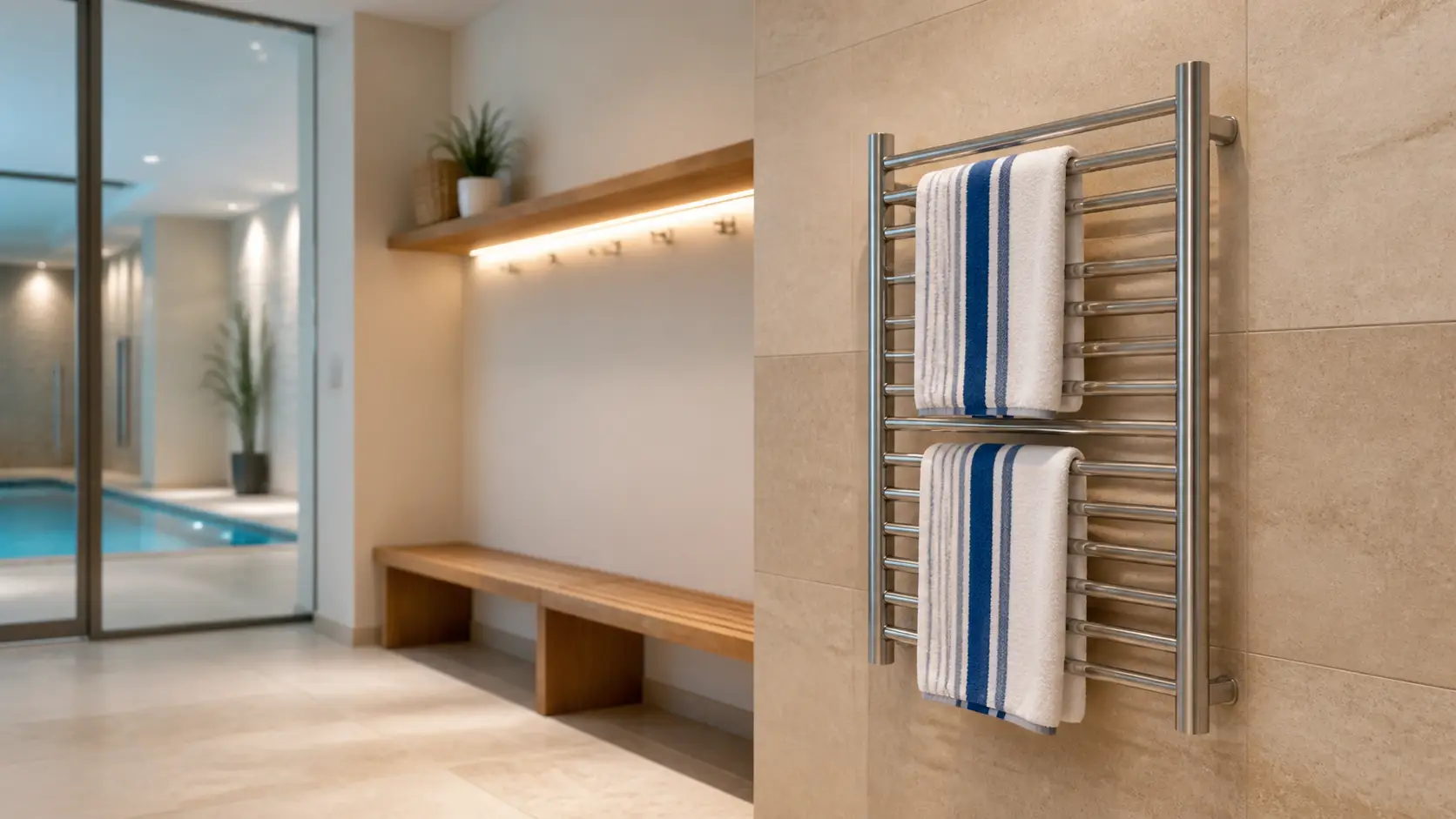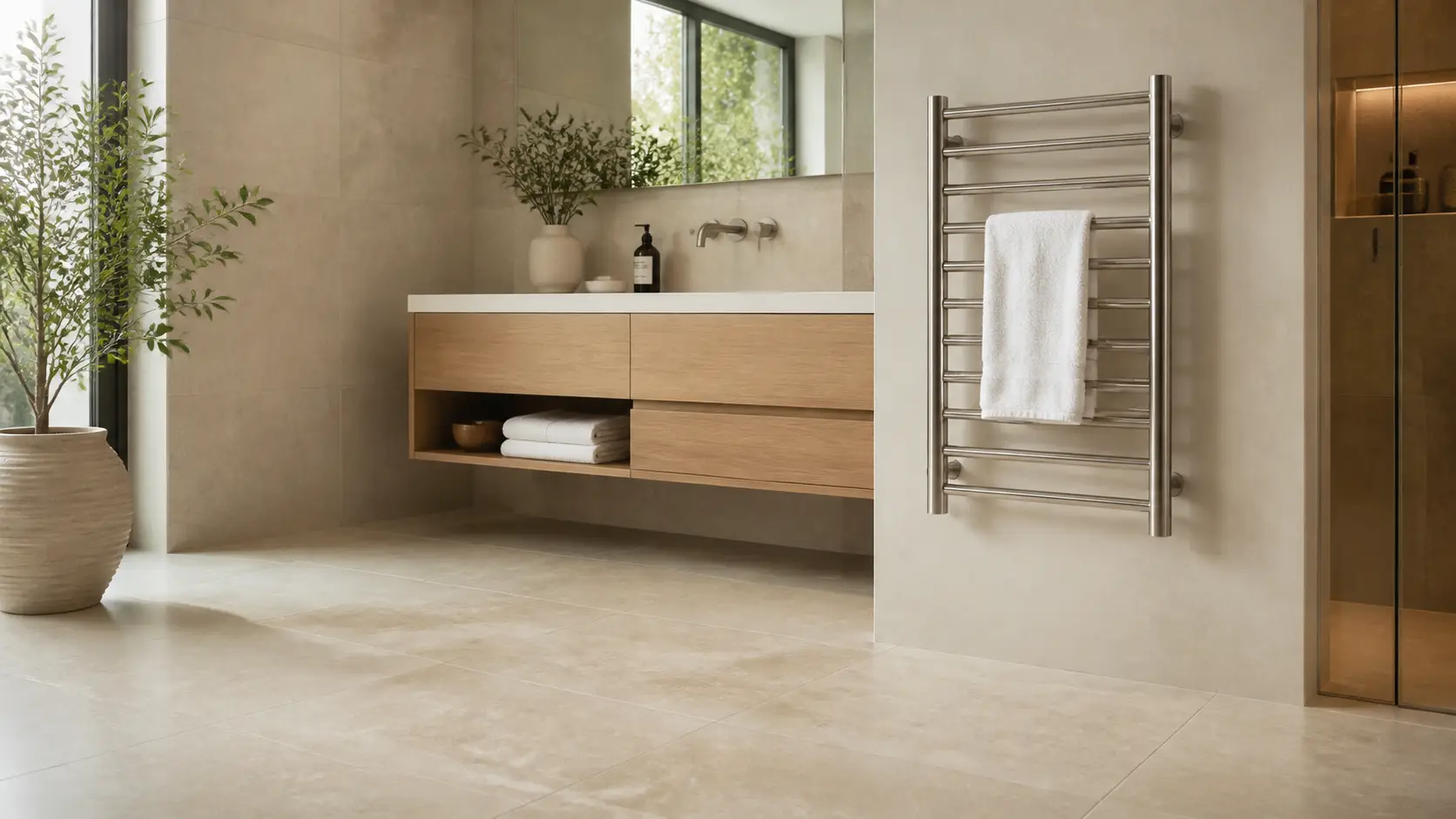
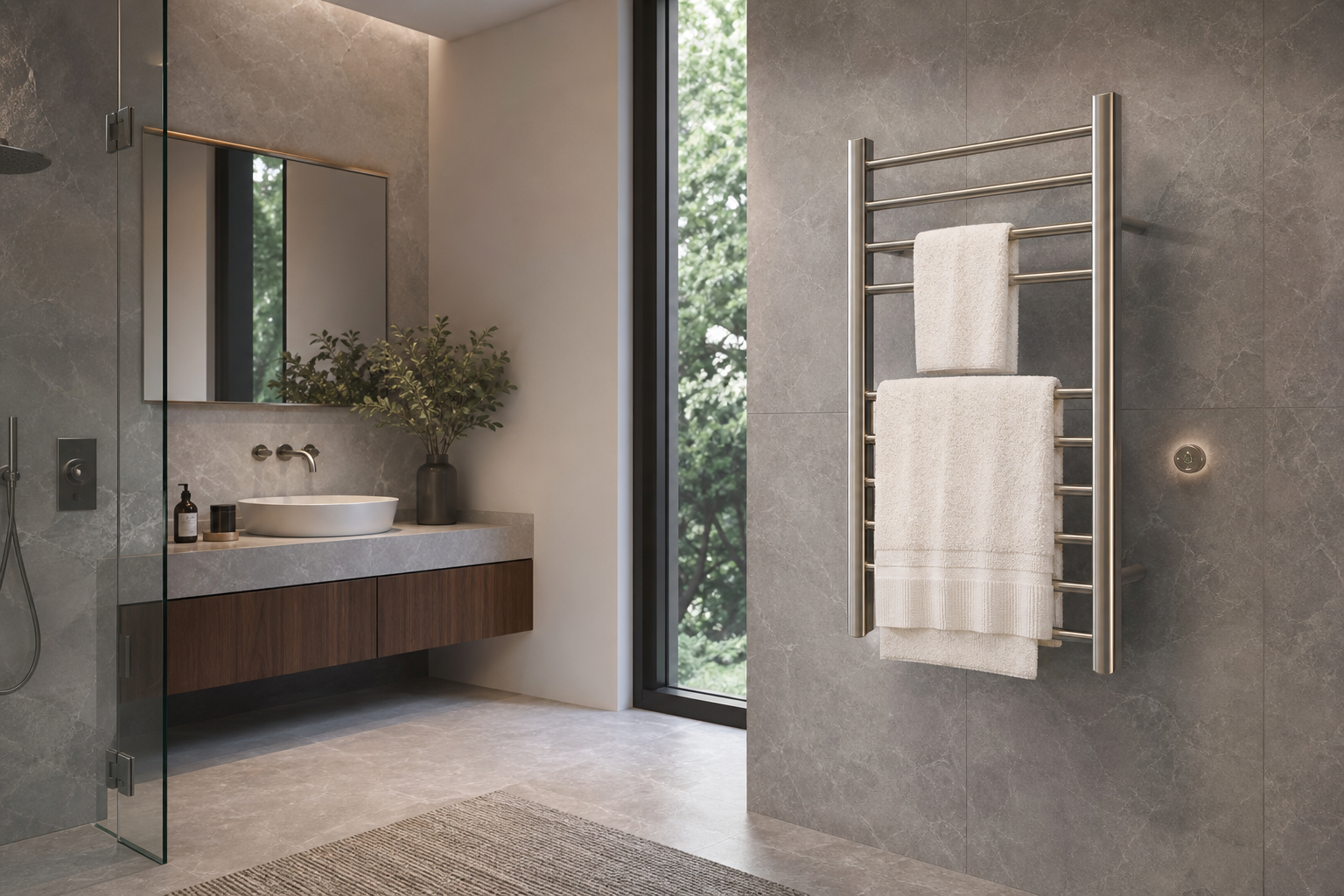
Most homeowners do not need to leave a heated towel rail on all the time. A better routine is to run it on a timer before and after shower time, so towels feel warm when you need them and dry more effectively afterward.
Leaving a heated towel rail on continuously may be acceptable for some models when installed and used correctly, but it is usually not the most efficient way to use the product. The right answer depends on wattage, towel load, bathroom humidity, ventilation, local electricity price, and the manufacturer’s instructions.
For everyday home use, the practical rule is simple: use scheduled heating, not constant heating.
Why people consider leaving a heated towel rail on all day
People usually ask this question for three reasons.
First, they want towels to feel warm at any time. This is a comfort issue, especially in colder bathrooms or winter climates.
Second, they want towels to dry faster. A damp towel can stay wet for hours if it is folded tightly, crowded on a small bar, or kept in a poorly ventilated bathroom.
Third, they worry that turning the unit on and off might reduce performance or shorten its life. In most normal home situations, a timer-based routine is a better balance of comfort, drying, and energy use.
The important distinction is that a heated towel rail is not meant to be treated like a bathroom space heater. It is mainly a towel warming and towel drying fixture.
Is it safe to leave a heated towel rail on?
A quality electric heated towel rail can be safe when it is designed for bathroom use, installed correctly, and used according to the manufacturer’s instructions. Safety problems usually come from poor installation, unsuitable products, overloaded rails, damaged wiring, or using the product in ways it was not designed for.
Before leaving any heated towel rail on for extended periods, check:
- Whether the model is designed for continuous operation
- Whether it is bathroom-rated for the installation location
- Whether a hardwired model was installed by a qualified electrician
- Whether plug-in wiring is kept away from wet zones
- Whether the circuit has appropriate protection
- Whether towels are hung normally and not packed too tightly
- Whether the unit has a timer, thermostat, or overheat protection
For hardwired towel rails, professional installation matters. Bathroom electrical products are installed in a wet environment, so local electrical code and proper protection are not optional details.
For more installation guidance, read CALITHREX’s guide: Towel Warmer Installation Mistakes to Avoid.
How much does it cost to leave a heated towel rail on all the time?
The running cost depends on wattage, daily operating hours, and your local electricity rate.
The basic formula is:
watts / 1000 x hours used x electricity rate = running cost
The U.S. Energy Information Administration’s Short-Term Energy Outlook estimates that the average price paid by U.S. residential electricity customers is about 18.2 cents per kilowatt-hour in 2026. Your local rate may be higher or lower, but this gives a useful benchmark.
Here is what continuous 24-hour use could look like at 18.2 cents per kWh:
| Towel rail wattage | Daily use | Estimated daily cost | Estimated monthly cost |
|---|---|---|---|
| 100W | 24 hours | about $0.44 | about $13.10 |
| 150W | 24 hours | about $0.66 | about $19.66 |
| 200W | 24 hours | about $0.87 | about $26.21 |
Now compare that with a timer-based routine of 4 hours per day:
| Towel rail wattage | Daily use | Estimated daily cost | Estimated monthly cost |
|---|---|---|---|
| 100W | 4 hours | about $0.07 | about $2.18 |
| 150W | 4 hours | about $0.11 | about $3.28 |
| 200W | 4 hours | about $0.15 | about $4.37 |
The difference is why timer control matters. Leaving the rail on all day is not usually expensive compared with large heating appliances, but it can still cost several times more than scheduled use.
For a deeper cost breakdown, read: Heated Towel Rack Energy Consumption: What It Actually Costs to Run.
When continuous use might make sense
Continuous use can make sense in a few specific situations.
Cold or humid bathrooms
If a bathroom stays damp for long periods, towels may need more drying support. A heated towel rail can help, but it should work together with ventilation. It should not be the only moisture-control strategy.
Hospitality and spa environments
Hotels, spas, and premium guest bathrooms may need towels ready throughout the day. In those settings, continuous or extended scheduled operation can be part of the guest experience. Commercial buyers should still consider wattage, controls, installation quality, and operating cost across many rooms.
Large households
If several people shower at different times, a longer operating schedule may be more useful than a short morning-only cycle. Even then, scheduled blocks are usually better than 24-hour operation.
Poor towel drying between uses
If towels stay damp overnight, a longer post-shower drying cycle may help. However, if the bathroom is poorly ventilated, the better solution is not only more heat. It is heat plus airflow.
Why a timer is usually the best solution
A timer gives you the comfort of warm towels without treating the towel rail like a device that must run all day.
A practical home schedule might be:
- 30 to 60 minutes before shower time
- 1 to 3 hours after shower time
- Longer cycles in humid weather
- Shorter cycles in dry, well-ventilated bathrooms
This routine gives you three benefits:
- Towels are warm when you need them
- Damp towels have time to dry after use
- Electricity use stays controlled
For most homes, this is the best balance.
Does leaving it on help prevent damp towel smell?
It can help, but it is not a complete solution by itself.
Damp towel smell happens when moisture lingers. Heat can speed evaporation, but towels also need airflow and enough space to dry. If a towel is bunched tightly over one bar, only part of the towel may warm effectively.
For better drying:
- Spread towels across multiple bars
- Avoid overloading a small rail
- Keep the bathroom ventilated
- Run the rail after showering, not only before
- Wash towels regularly
- Avoid leaving wet towels in a pile
The U.S. EPA states that moisture control is central to mold control and recommends drying wet or damp materials quickly. A towel rail is not a substitute for ventilation, but it can support a drier bathroom routine.
Heated towel rail vs bathroom heater
A heated towel rail should not be judged like a space heater.
Its job is to warm towels and help them dry. It may add mild warmth near the rail, but it is not designed to heat an entire cold bathroom. If the room itself is uncomfortable, solve that with proper bathroom heating, insulation, or ventilation planning.
This matters because some buyers leave the rail on all day expecting it to heat the bathroom. That is usually the wrong expectation and an inefficient use case.
B2B note: what hotels and projects should consider
For hotels, spas, apartments, and renovation projects, the question is not simply whether one towel rail can stay on all day. The better question is how the operating strategy works across many rooms.
B2B buyers should consider:
- Total wattage across the property
- Timer or central control options
- Guest comfort expectations
- Cleaning and housekeeping schedules
- Installation method
- Replacement and maintenance access
- Finish consistency across rooms
- Safety documentation and warranty support
In hospitality settings, heated towel rails can support a more premium bathroom experience. But operating them without control across many rooms can create unnecessary energy cost.
Best practice: use scheduled heating
For most homes, the best answer is:
Use a heated towel rail daily, but do not leave it on all the time unless there is a specific reason.
A timer-based routine is more practical:
- Warm towels before bathing
- Dry towels after bathing
- Reduce unnecessary energy use
- Keep the bathroom experience comfortable
- Avoid relying on the rail as a room heater
If your bathroom is humid or towels dry slowly, extend the drying cycle first. If that does not solve the problem, look at bathroom ventilation and towel spacing.
FAQ
Can I leave a heated towel rail on overnight?
Some models may allow extended operation, but check the manufacturer’s instructions first. For most homes, a timer is better than leaving the unit on overnight every day.
Is it cheaper to leave a heated towel rail on or turn it on only when needed?
It is usually cheaper to run it only when needed. A 150W towel rail used for 4 hours a day costs much less than the same rail running 24 hours a day.
How long should a heated towel rail be on?
Many users get good results from 30 to 60 minutes before showering and 1 to 3 hours after showering. Humid bathrooms or thick towels may need longer.
Will turning a heated towel rail on and off damage it?
Normal timer-based operation should not be a problem for products designed for regular use. Follow the manufacturer’s instructions and avoid unsafe electrical setups.
Does a heated towel rail dry towels completely?
It can help towels dry, but drying depends on towel thickness, airflow, humidity, rail size, and how the towel is hung. Ventilation still matters.
Should hotels leave heated towel rails on all the time?
Not automatically. Hotels should evaluate guest experience, energy cost, controls, housekeeping schedules, and room occupancy. Timed or controlled operation is often more efficient.
CTA
If you are choosing an electric heated towel rail for a home bathroom, hotel room, or renovation project, prioritize the right size, installation type, finish, and timer controls.
Explore CALITHREX bathroom comfort solutions here: https://calithrex.com/
Sources and references
- U.S. EIA: Short-Term Energy Outlook electricity data
- U.S. EPA: A Brief Guide to Mold, Moisture and Your Home
- ENERGY STAR: Ventilation Fans Key Product Criteria
- CALITHREX: Heated Towel Rack Energy Consumption: What It Actually Costs to Run
- CALITHREX: Do Heated Towel Racks Use a Lot of Electricity? A Data-Driven Answer
- CALITHREX: Towel Warmer Installation Mistakes to Avoid