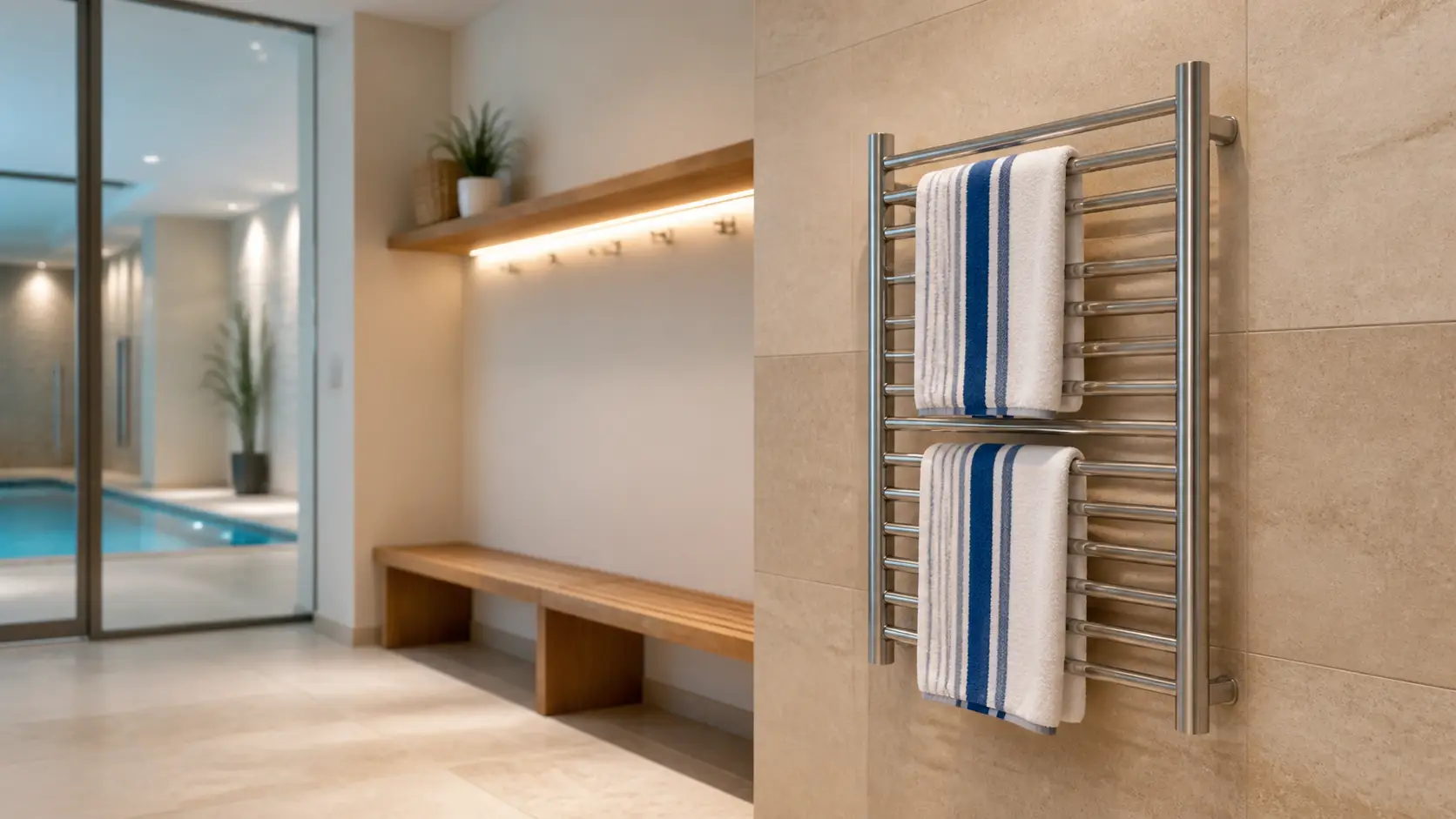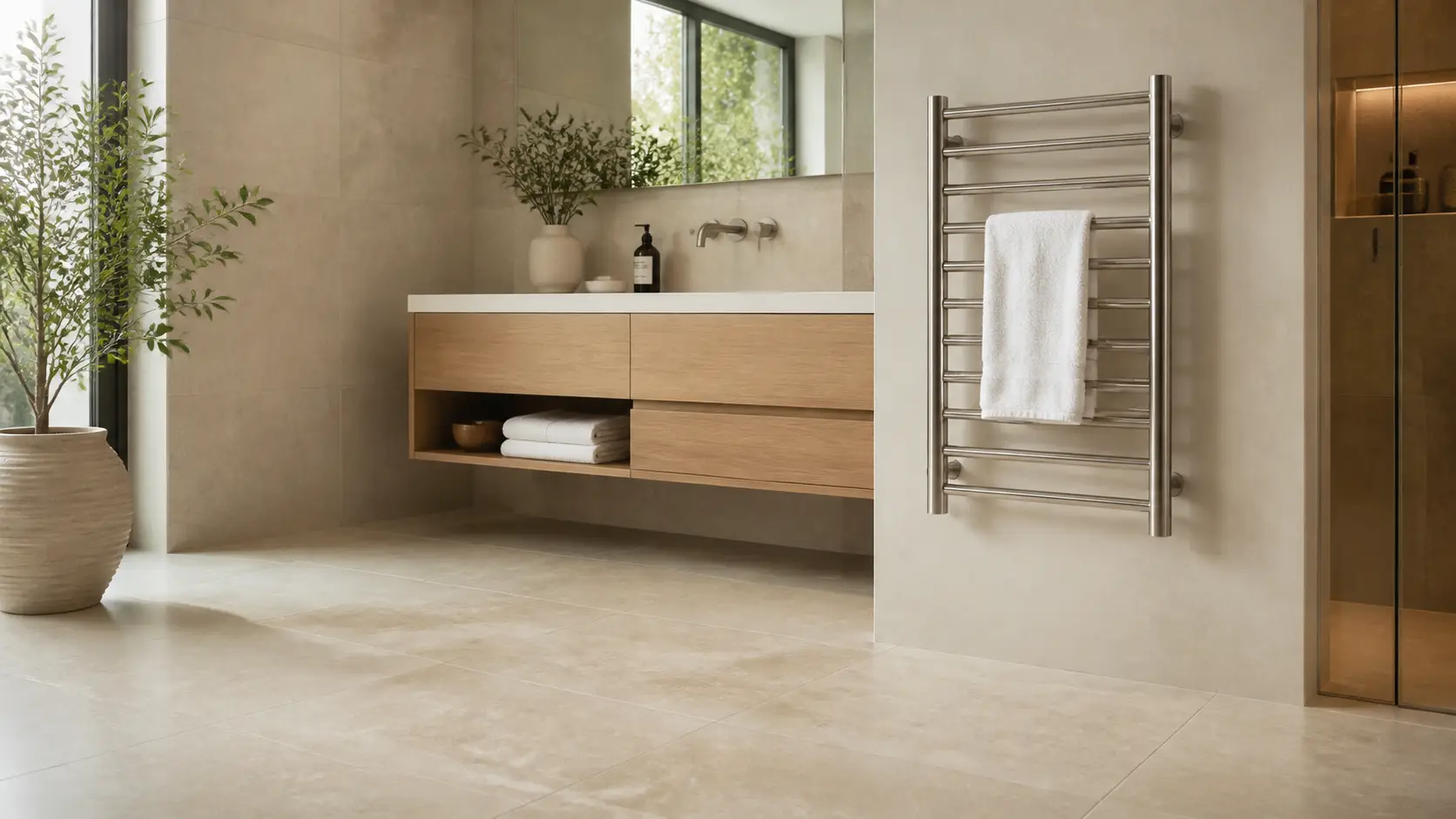
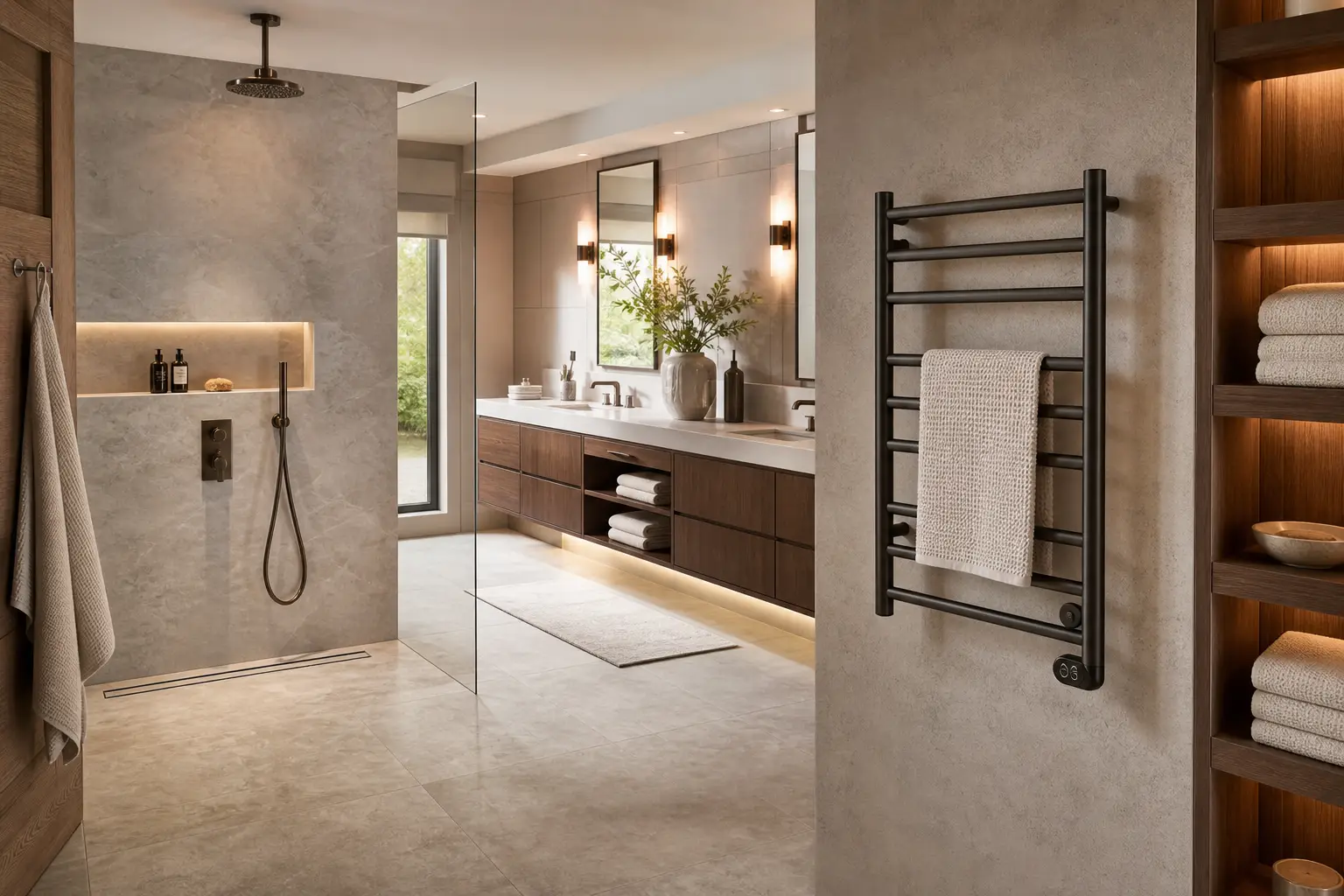
Bathroom remodeling trends in 2026 are moving toward bathrooms that feel calmer, safer, easier to maintain, and more comfortable every day. The most useful upgrades are not only visual. They include better lighting, ventilation, accessible layouts, durable materials, smart storage, and comfort details such as heated towel racks planned early enough for proper placement and wiring.
For homeowners, that means thinking beyond tile color. For designers, builders, hotels, spas, and multifamily projects, it means specifying comfort, safety, moisture control, and electrical details before walls are closed.
Quick answer: what bathroom remodelers should plan for in 2026
| Trend direction | What it means in practice | Where heated towel racks fit |
|---|---|---|
| Wellness bathrooms | Larger showers, calmer lighting, spa-like routines, warmer materials | Warm dry towels support daily comfort without changing the whole layout |
| Universal design | Curbless entries, wider movement paths, seating, reachable controls | Place towels and controls where users can reach them safely |
| Moisture control | Better exhaust fans, dry towel storage, mold-aware material choices | A towel rack helps towels dry, but does not replace ventilation |
| Durable low-maintenance finishes | Large-format tile, fewer grout lines, brushed or matte hardware | Match finish and material to bathroom hardware and cleaning expectations |
| Layered lighting and controls | Task, mood, night, and natural light planning | Coordinate towel rack controls with switches, timers, or smart routines |
| Hotel-style comfort | Residential bathrooms borrowing hospitality and spa cues | Towel warmers are a compact way to add hotel-bathroom comfort |
Why 2026 bathroom trends are more practical than decorative
Recent bathroom trend data points in the same direction: people want bathrooms that work better, not just bathrooms that photograph well. NKBA's 2026 bath trends coverage says the bath footprint is expected to grow to support wellness-centered spaces, universal design, and better storage. It also highlights hotel and resort inspiration, layered lighting, natural materials, and aging-in-place features that look more integrated than clinical.
Houzz's 2025 U.S. Bathroom Trends Study shows similar demand from actual remodeling projects. More than two-thirds of renovating homeowners considered special needs, more than a third included wellness-oriented features, and most hired professionals for the project. Wet rooms also continued to gain share, which makes drainage, ventilation, electrical placement, and towel storage more important.
The practical takeaway is simple: a 2026 bathroom remodel should be planned as a daily-use system. Tile, lighting, ventilation, storage, towel drying, and electrical comfort products should be specified together.
Trend 1: wellness bathrooms are becoming everyday spaces
A wellness bathroom does not have to mean a steam shower, sauna, cold plunge, or oversized tub. For many homes and projects, the stronger trend is a bathroom that supports quieter daily routines:
- Softer lighting in the morning and at night.
- Better shower storage and seating.
- Warm materials and less visual clutter.
- Towels that dry between uses.
- Surfaces that are easier to clean.
- Controls that are simple to reach.
This is where a heated towel rack naturally fits the remodel plan. It is not the main feature, but it improves the daily handoff after a shower or bath. For design context, see Calithrex's guide to spa bathroom comfort and warm towels.
Trend 2: safety and accessibility are part of mainstream design
Accessibility is no longer only a specialist requirement. It is becoming part of normal bathroom planning because households change over time. A bathroom that works for children, guests, older family members, and future mobility needs is easier to live with and easier to sell.
| Planning question | Why it matters | Practical specification note |
|---|---|---|
| Can users move from shower to towel without crossing a slippery path? | Wet paths increase fall risk | Put towel storage and towel warming close to the dry exit zone |
| Are controls reachable without leaning over a wet surface? | Controls should not create awkward reach | Coordinate switch, timer, and towel rack location early |
| Is there room for a bench, grab bar, or wider entry later? | Future needs are easier to support with early blocking and layout planning | Ask the contractor to plan wall support before tile is installed |
| Are warm towels reachable from seated or standing positions? | Comfort upgrades should not reduce usability | Avoid placing towel racks behind doors or too far from the shower exit |
For more detail on placement, use Calithrex's universal design bathroom guide.
Trend 3: wet rooms make moisture planning more important
Wet rooms can make a bathroom feel larger and more seamless, but they increase the importance of moisture planning. More open shower areas need correct slope, drainage, ventilation, waterproofing, and dry-side towel storage.
A heated towel rack can help towels dry after use, especially when towels are spread with enough airflow. It should not be sold or specified as a substitute for an exhaust fan. EPA mold guidance still points to moisture control, ventilation, quick drying, and low indoor humidity as the foundation.
| Moisture-control layer | What to specify | Common mistake |
|---|---|---|
| Exhaust ventilation | Fan capacity, sound level, duct path, switch or timer control | Choosing the fan after the ceiling is already planned |
| Shower drainage | Slope, drain location, waterproofing system | Prioritizing visual openness over water control |
| Towel drying | Enough towel space, airflow, heated towel rack placement | Hanging multiple wet towels in a tight stack |
| Materials | Mold-aware backing, durable surfaces, fewer hard-to-clean joints | Choosing porous or fussy materials in splash-heavy zones |
For a deeper moisture-control angle, read Calithrex's bathroom humidity control guide.
Trend 4: lighting is now a comfort and safety feature
Bathroom lighting is becoming more layered. A good remodel should not rely on one ceiling light. Task lighting helps grooming, ambient lighting softens the room, night lighting improves safety, and natural light supports a calmer space.
Heated towel rack planning should be coordinated with lighting and controls. If the rack uses a timer, smart switch, or hardwired connection, the control should be easy to see and reach. In hotels, spas, apartments, and senior-friendly homes, predictable controls are better than hidden switches or complicated app-only routines.
Trend 5: energy use is part of the buying conversation
Energy efficiency in a bathroom remodel is not only about one product. It includes ventilation fan efficiency, lighting, water use, appliance schedules, and whether comfort products run only when needed.
For heated towel racks, the practical energy question is run time. A timer or smart control can make a comfort upgrade more predictable and easier to manage. The U.S. Department of Energy's appliance-use formula is still useful: watts multiplied by hours used, divided by 1,000, equals daily kilowatt-hours. That makes it easier to compare a two-hour towel-warming routine with all-day operation.
If the project includes a towel warmer, specify:
- Rated wattage by model.
- Expected daily run time.
- Timer or control method.
- Whether the unit is plug-in or hardwired.
- Bathroom zone, IP rating, and installation requirements.
- Ventilation plan if towel drying is part of the user expectation.
For cost planning, see Calithrex's heated towel rack electricity cost calculator.
Trend 6: material and finish choices need maintenance logic
NKBA trend coverage points to natural materials, large-format floors, durability, fewer grout lines, and brushed or matte finishes. These are not only style choices. They affect cleaning, replacement consistency, and long-term guest or household experience.
For B2B projects, finish consistency matters across rooms. For residential projects, finish coordination helps the bathroom feel intentional. A heated towel rack should be selected with the rest of the hardware package, not after the room is visually finished.
| Finish planning item | Residential remodel | Hotel, spa, or multifamily project |
|---|---|---|
| Hardware color | Match faucets, shower trim, towel bars, and rack finish | Standardize finish codes across room types |
| Surface texture | Consider fingerprints, cleaning routine, and lighting | Ask for finish durability and cleaning guidance |
| Product material | Prioritize corrosion-resistant materials in humid rooms | Request technical sheets and warranty details |
| Replacement logic | Keep model and finish records | Confirm future availability before bulk purchase |
Calithrex has a separate guide on heated towel rack finishes.
How to plan a heated towel rack in a 2026 bathroom remodel
The best time to plan a heated towel rack is before the final electrical, tile, and vanity layout is approved. Late-stage decisions often lead to awkward placement, visible cords, poor towel reach, or missed blocking.
| Remodel stage | Decision to make | Why it matters |
|---|---|---|
| Concept layout | Wall-mounted, freestanding, plug-in, or hardwired | Affects wall space, outlet position, and visual finish |
| Electrical rough-in | Power location, control type, timer, code requirements | Hardwired models need early coordination |
| Tile and wall prep | Blocking, wall strength, wet-zone clearances | Prevents weak mounting and rework |
| Fixture selection | Size, finish, wattage, bar layout | Matches towel routine and design package |
| Final handover | User instructions, timer settings, cleaning guidance | Helps homeowners or guests use it correctly |
For installation questions, review Calithrex's heated towel rack installation height guide and bathroom IP rating guide.
Practical recommendation
If you are remodeling a bathroom in 2026, start with the daily routine: shower path, towel reach, lighting, ventilation, storage, and controls. Then choose materials and comfort products that support that routine.
For a homeowner, a heated towel rack can be a simple comfort upgrade when it is placed correctly. For a designer, hotel buyer, spa operator, or multifamily developer, it should be part of the specification package: model, finish, wattage, installation type, control method, safety requirements, and replacement plan.
FAQ
What are the biggest bathroom remodeling trends for 2026?
The strongest bathroom remodeling trends for 2026 are wellness-focused layouts, universal design, better storage, layered lighting, low-maintenance materials, wet rooms, energy-aware controls, and hotel-style comfort details.
Are heated towel racks part of 2026 bathroom trends?
Yes. Heated towel racks fit the broader trend toward comfort, wellness, and hotel-inspired bathrooms. They are most useful when planned early with towel placement, electrical scope, ventilation, and finish coordination.
Should I add a heated towel rack during a remodel or after?
Plan it during the remodel if possible. That allows cleaner wiring, better wall placement, correct mounting support, and easier coordination with tile, switches, and towel reach.
Do wet rooms need heated towel racks?
Wet rooms do not require heated towel racks, but they do need good towel planning. If a heated towel rack is used, it should be placed in a safe, practical dry-side location unless the product and installation method are rated for the intended wet area.
Can a heated towel rack replace bathroom ventilation?
No. A heated towel rack can help towels dry, but bathroom ventilation still handles room moisture. Use a suitable exhaust fan, proper ducting, and good drying habits to manage humidity.
What should hotels and developers ask before specifying towel warmers?
Ask for model dimensions, finish options, wattage, installation type, IP rating, safety documentation, warranty, packaging details, lead time, replacement consistency, and recommended room types.
Sources
- NKBA 2026 Bath Trends Report coverage
- NKBA 2026 Bath Trends Virtual Summit
- Houzz 2025 U.S. Bathroom Trends Study
- EPA mold and moisture prevention guidance
- ENERGY STAR ventilation fan criteria
Next step
For residential bathrooms, hotel guest rooms, spa suites, or multifamily projects, Calithrex can help compare heated towel rack sizes, finishes, installation types, and control options for your bathroom plan.