
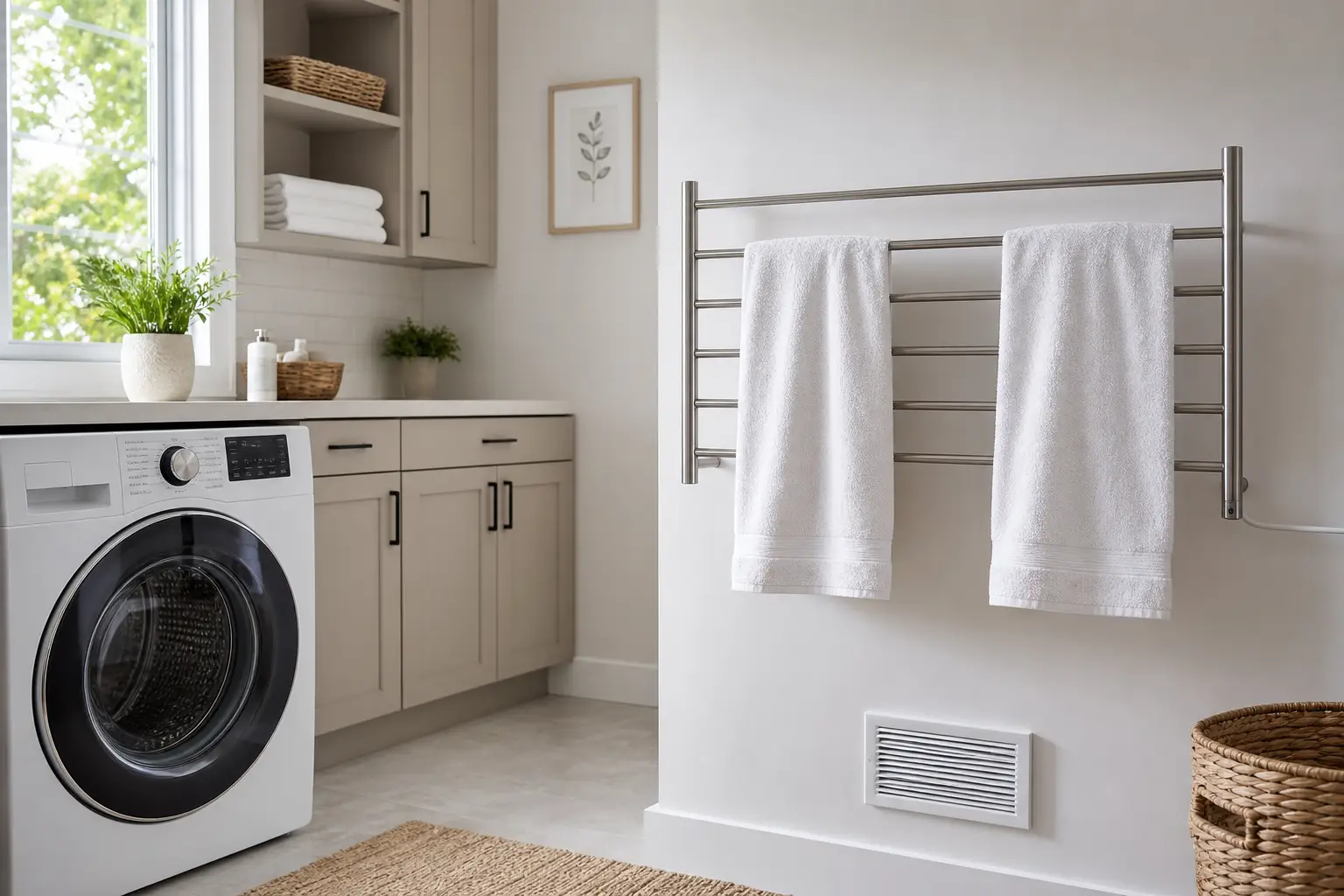
Yes, a heated towel rack can be useful in a laundry room when its job is modest: give a few towels, swim items, or light washable pieces an open place to finish drying. It is not a replacement for a clothes dryer, an exhaust path, or the care label on a garment. Start with airflow, safe power, and the amount of fabric you actually need to manage between loads.
Decide What the Rack Will Actually Dry
A laundry room can become a holding zone for damp towels, a hand-washed top, swimwear, or cleaning cloths. An open heated towel rack helps when each item has room around it; it is not for a family-size wash load draped in thick layers. If most textiles go straight to a dryer, it may add little value.
| Laundry-room situation | A heated towel rack can help when | Choose another approach when |
|---|---|---|
| Two bath towels after showers | Both can hang separately with air around them | They are folded together or need to dry urgently |
| Swimwear or workout gear | Care labels allow the drying method and pieces are lightweight | Items are dripping, heavy, or have unclear care instructions |
| Hand-washed delicate items | The label allows hanging dry and the rack is not overloaded | Flat drying is required or the fabric could stretch |
| Small utility room | A clear wall and safe power are already available | The rack would block the washer, door, or storage |
| Humid home | Ventilation already removes moisture from the room | Condensation, a leak, or stale air is unresolved |
The key is spacing. Keep the rack for finishing, and use a dryer, drying rack, or laundry line for bigger loads.
Read the Care Label Before Adding Heat
The Federal Trade Commission explains that textile care labels guide washing, bleaching, drying, ironing, and professional cleaning. Treat that label as the starting point for every non-towel item. A heated towel rack is still a heat source, so it is not an automatic match for every fabric.
For a light item that says “hang dry,” check that it can hang without stretching or crowding. For “dry flat” pieces or anything with unclear care instructions, use the garment maker’s guidance instead.
Towels are simpler, but they still need room. Put one towel on each usable area, smooth it open, and avoid adding layers merely because the rack has more bars. A rack that is packed tight becomes a warm storage spot instead of an effective drying zone.
Ventilation Does the Moisture Work
A heated towel rack helps fabric dry when it is hung openly. It does not remove the water vapor released into a laundry room. The U.S. Environmental Protection Agency recommends controlling moisture, including by venting dryers and other moisture-generating sources outside where possible, increasing ventilation, and using exhaust fans when appropriate.
That distinction matters in an enclosed utility room. If windows collect condensation, towels stay damp, or the room smells musty, investigate the dryer vent, exhaust fan, air path, plumbing, and leaks before adding another heated appliance. EPA guidance also notes that indoor humidity should stay below 60 percent and ideally between 30 and 50 percent when possible.
Use the rack as part of a routine: run the room’s normal ventilation as needed, hang items separately, and remove them when dry. Do not close a crowded laundry room with damp fabric and assume a warm rail alone will solve the moisture problem.
Plan the Wall and Power Route
The exact product instructions decide how and where a heated towel rack can be installed. Before shopping, measure a full towel, the wall, washer and dryer doors, cabinet clearance, and the walking path. A towel should not brush a hot appliance, drag on the floor, cover a vent, or turn a doorway into an obstacle.
Power needs the same care. A plug-in model still needs a suitable outlet and a cord route that remains visible and clear. The Electrical Safety Foundation International advises against using extension cords as permanent wiring. Do not run a cord behind appliances, under rugs, through doorways, or where it can be pinched or exposed to water.
For a hardwired installation, consult a qualified electrician and follow the exact product instructions plus local requirements. Do not assume the nearby laundry outlet, wall cavity, or circuit is appropriate simply because it is close. If the power route cannot be planned cleanly, keep the drying zone non-electrical.
Keep It Separate From the Dryer Workflow
A useful laundry room has zones. The washer and dryer handle loads; a hamper holds items waiting to be washed; a folding surface manages clean clothes; and a small drying zone handles the exceptions. Put the rack where it supports that sequence rather than competing with it.
Good candidates are towels after a shower, a few cleaning cloths, or light garments that the label says to hang dry. Poor candidates are heavy soaked blankets, large loads of wet clothing, and anything that would force you to stack fabric. A conventional freestanding rack may be a better fit when the amount of laundry changes widely from day to day.
Before deciding, test the routine with a full-size towel and the laundry-room doors open. Can you load the washer, empty the dryer, reach storage, and pass through the room without moving the towel? If not, revise the layout before buying anything.
Quick Pre-Purchase Checklist
- Confirm the article’s intended items are light enough and their care labels allow the chosen drying method.
- Measure wall space, a fully opened towel, appliance doors, vents, and the main walkway.
- Check that towels can hang separately instead of overlapping.
- Resolve condensation, leaks, poor exhaust, or a blocked dryer vent first.
- Follow the exact product’s mounting and electrical instructions.
- Use a qualified professional when the wall support or electrical route is uncertain.
FAQ
Can a heated towel rack replace a dryer in a laundry room?
No. It is best for a small number of towels or light items that can hang open. A dryer or another appropriate drying method remains necessary for regular loads and heavy textiles.
Can I dry clothes on a heated towel rack in the laundry room?
Only when the garment’s care label allows it and the piece can hang without crowding the rack. Use another method for heavy, dripping, delicate, or flat-dry items.
Will it solve a damp or musty laundry room?
No. Check ventilation, dryer exhaust, plumbing, condensation, and leaks. The rack supports fabric drying; it does not replace moisture control for the room.
Is a plug-in rack easier to install?
It can avoid in-wall wiring, but it still needs an appropriate outlet and a safe, unobstructed cord route. Never treat an extension cord as permanent installation.
Next Step
Measure your laundry room and map the towel path before choosing a fixture. If you have a clear wall, suitable power, working ventilation, and a regular small-load use case, explore the Calithrex heated towel rack collection by installation type and usable towel spacing.