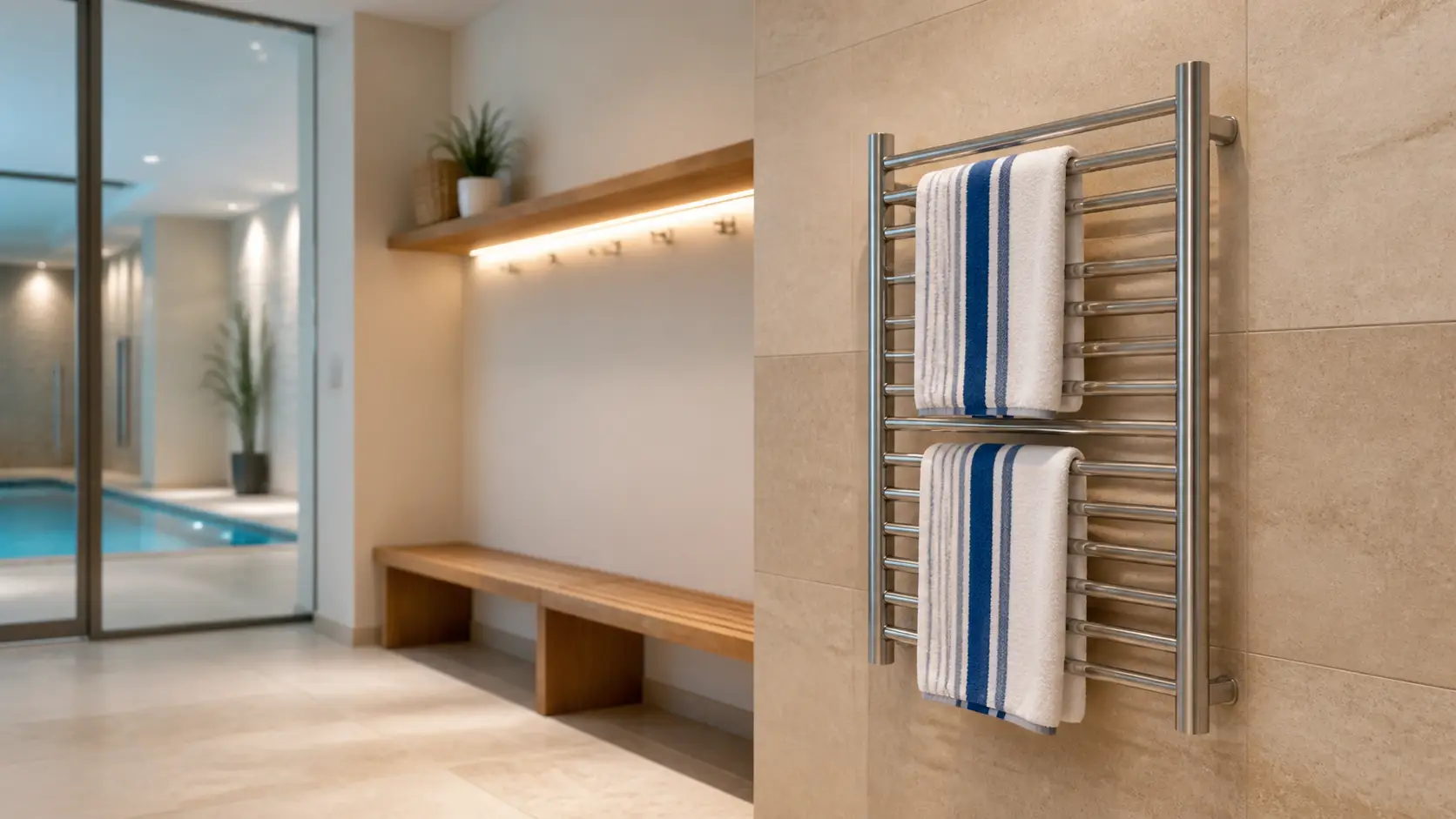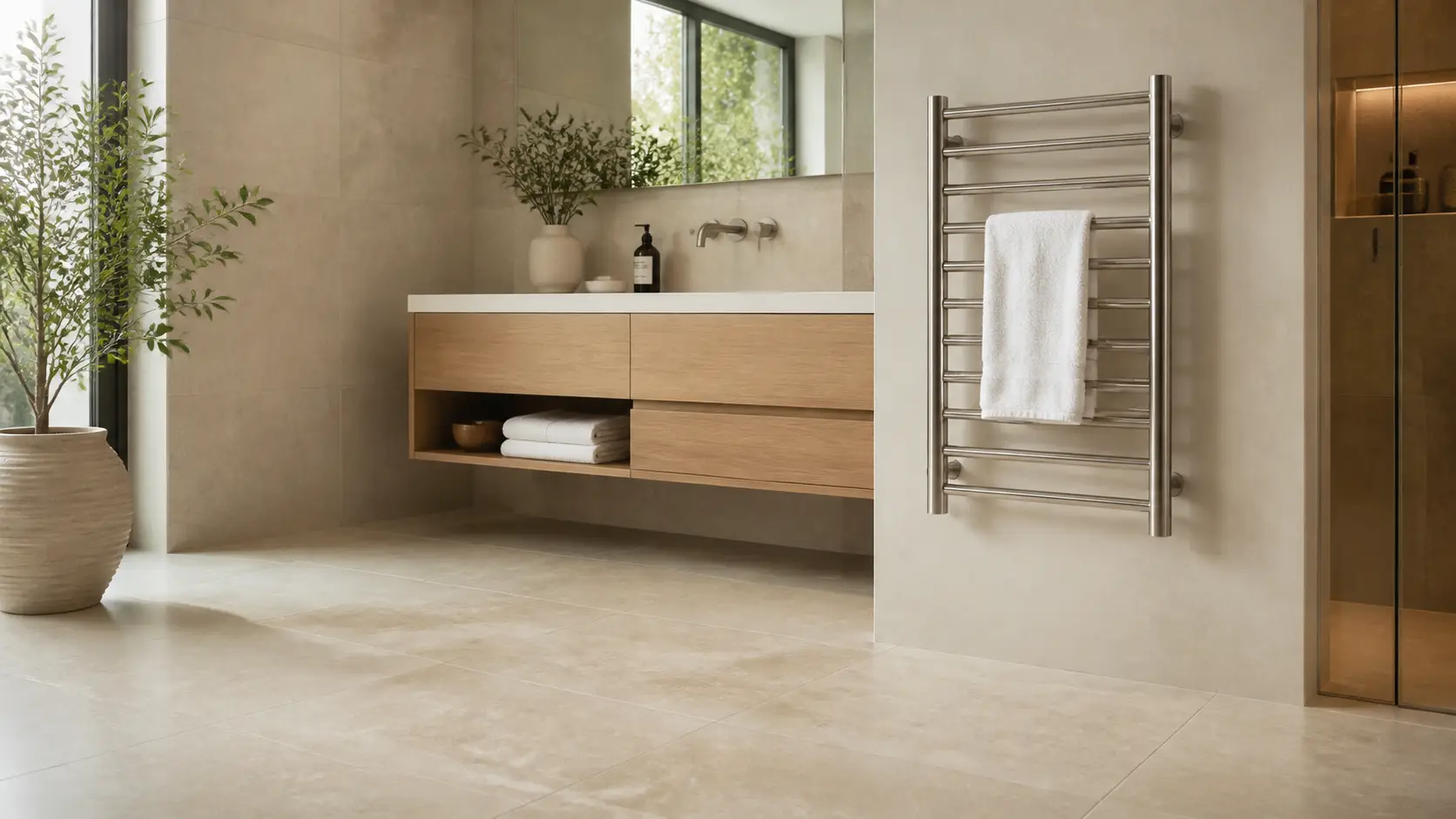
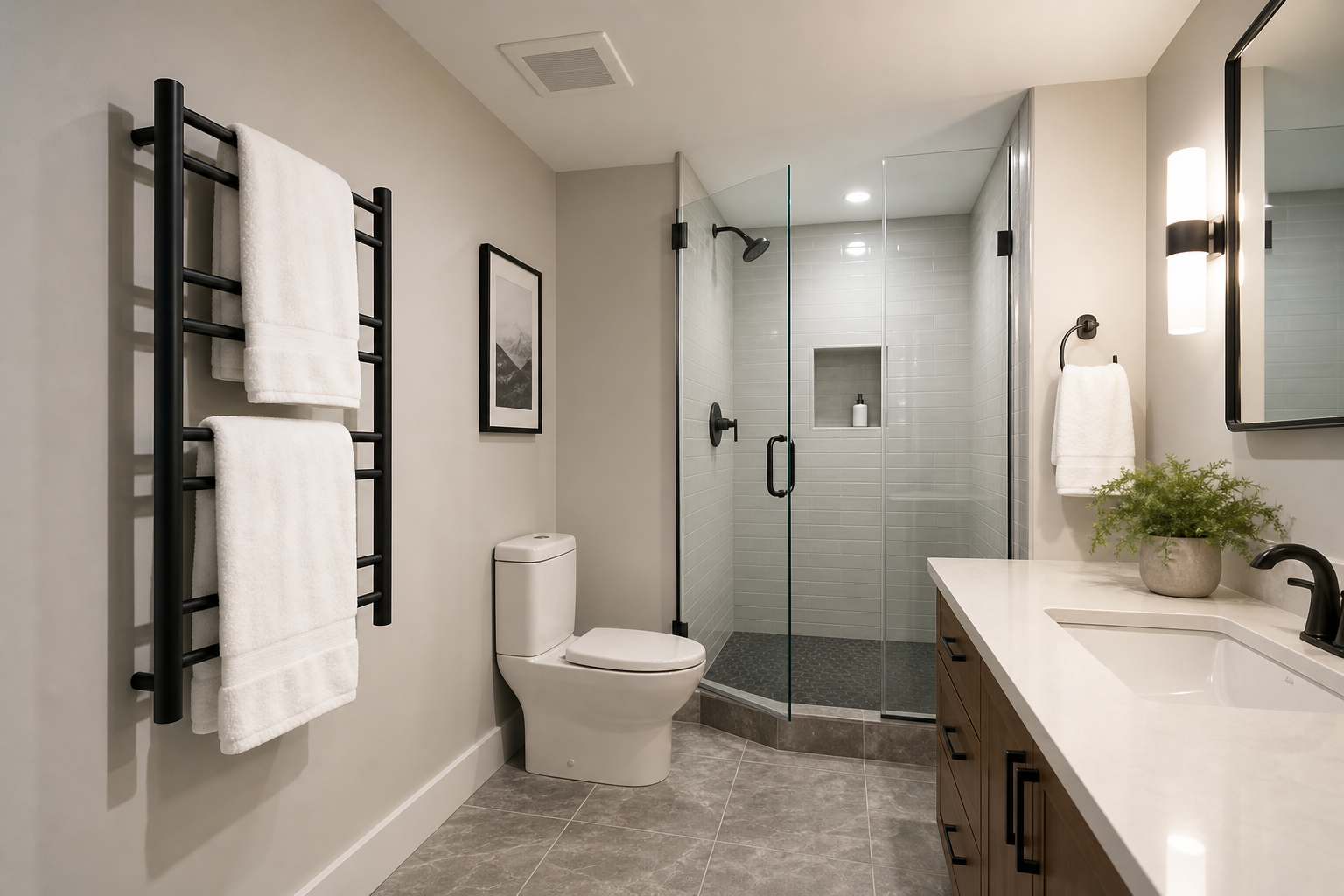
A heated towel rack can work very well in a basement bathroom, especially when towels stay damp longer than they do upstairs. The right plan starts with moisture management, a practical wall location, and electrical work that suits the room—not with the rack alone. Treat an open electric heated towel rack as a drying zone for towels and light garments, while ventilation and repairs handle the bathroom's overall moisture load.
Why basement bathrooms need a different check
Basements can feel cooler and may have fewer windows, so towels can remain damp after a shower. That does not mean a heated towel rack fixes every dampness problem. The U.S. Environmental Protection Agency (EPA) identifies moisture control as the key to limiting mold growth and notes that basement walls, bathrooms, condensation, and leaks all deserve attention. If the room smells musty, has water marks, peeling finishes, recurring mildew, or a plumbing leak, solve that underlying issue before adding any drying accessory.
An open rack is useful because it gives each towel exposure to warm bars and room air. It is most helpful for the daily rotation: bath towels, hand towels, swim towels, and light washable garments whose care labels permit the method. It is not a substitute for a dehumidifier, an exhaust fan that vents outdoors, or a repair to a wet foundation wall.
Start with the moisture-and-airflow plan
Before choosing wall space, check what happens after a typical shower. Does the fan actually move moist air outside? Does condensation linger on mirrors, cold pipes, or windows? EPA guidance recommends using a bathroom fan or opening a window when showering, keeping indoor humidity low, and addressing leaks promptly. In a basement, those basics matter even more because cool surfaces can make condensation easier to notice.
Use this quick decision table before you plan the rack.
| What you notice | First response | Where the rack fits |
|---|---|---|
| Towels feel damp the next morning, but walls stay dry | Improve towel spacing and run the fan during and after showers | A good use case for a drying zone |
| Mirror, pipes, or windows collect condensation | Check ventilation and humidity control first | Add only after airflow is working |
| A leak, wet drywall, or musty odor is present | Repair and dry the affected area | Wait until the moisture source is resolved |
| Several people use one compact bathroom | Map the towel load and hanging space | Choose an open layout that avoids bunching |
Leave air gaps between towels. Folding a thick bath sheet tightly over a single bar can slow drying because the inner layers receive less air. If the household uses several towels at once, a larger drying area, staggered towel rotation, or a second ordinary towel bar may be more useful than overloading one rack.
Choose a wall that works in real life
The best location is usually a dry, accessible wall near where towels are removed, with room to hang and remove them without brushing the toilet, vanity, shower door, or a storage cabinet. Stand where a wet towel would be used and test the movement with a tape measure or a full-size towel. You need clearance for the towel as well as the fixture.
Basement walls deserve an extra construction check. A finished wall may have plumbing, ductwork, insulation, or a foundation behind it. Confirm the wall can accept the mounting method and that the installer can route or connect power according to the product instructions and local requirements. Do not assume a convenient empty-looking wall is structurally or electrically simple.
Avoid treating the rack as a place for laundry piles. Its benefit comes from separated, lightweight daily loads. Do not cover controls or airflow, and keep any textiles away from a heat source unless their care labels allow the drying approach.
Plan power before you buy
Electrical safety is a design decision, not a last-minute detail. Bathroom electrical work should be assessed and completed by a qualified installer following the product instructions and local electrical requirements. The U.S. Consumer Product Safety Commission explains that ground-fault circuit interrupters (GFCIs) are designed to protect against shock in wet locations; a professional can confirm what applies to the circuit and installation method in your home.
Do not run an extension cord across a basement bathroom to reach a rack. The Electrical Safety Foundation International advises against using extension cords as permanent wiring. A clean plan has the needed power arrangement decided before the wall is finished, rather than relying on a temporary workaround after the fact.
Match the rack to your towel routine
Ask these four questions:
- How many towels are normally damp at the same time?
- Are they thin hand towels, standard bath towels, or thick bath sheets?
- Will the bathroom fan and door position allow air to move around them?
- Is the rack still easy to reach, clean around, and use when the room is busy?
For one or two daily towels, a compact open rack can create a simple drying habit: hang towels flat after use, run the fan, and remove them once dry. For a family or a frequently used guest bath, prioritize usable bars and spacing over a decorative footprint. A basement bathroom with good airflow and a manageable towel load is often a stronger fit than one with unresolved humidity or no practical wall location.
FAQs
Does a heated towel rack remove basement humidity?
No. It can help dry towels placed on it, but it does not replace outdoor-venting exhaust, dehumidification, or repairs to water intrusion.
Can I install one on an exterior basement wall?
Possibly, but confirm the wall construction, insulation, moisture condition, mounting method, and electrical route with a qualified installer before choosing that location.
Is a heated towel rack useful if the bathroom has no window?
It can be, provided the room has effective mechanical ventilation and the towel load is realistic. A window is not a substitute for an exhaust path that handles shower moisture.
Can I dry clothes on it too?
Use it only for towels and light garments when the garment care label allows it. Keep items separated and do not overload the bars.
What should I fix before adding a rack?
Address leaks, recurring mold, standing water, wet wall finishes, or a fan that does not exhaust outdoors. A drying rack works best after those room-level issues are under control.
Build a drying routine, not just a feature list
For a basement bathroom, the most useful upgrade is a routine that combines hanging towels open, running effective ventilation, and keeping the room dry. Once the wall, power plan, and towel load make sense, an electric heated towel rack can give towels and light permitted garments a dedicated drying place without pretending to solve every basement-moisture issue. Explore Calithrex heated towel racks when you are ready to compare an open drying layout with your bathroom's real wall space and daily towel routine.