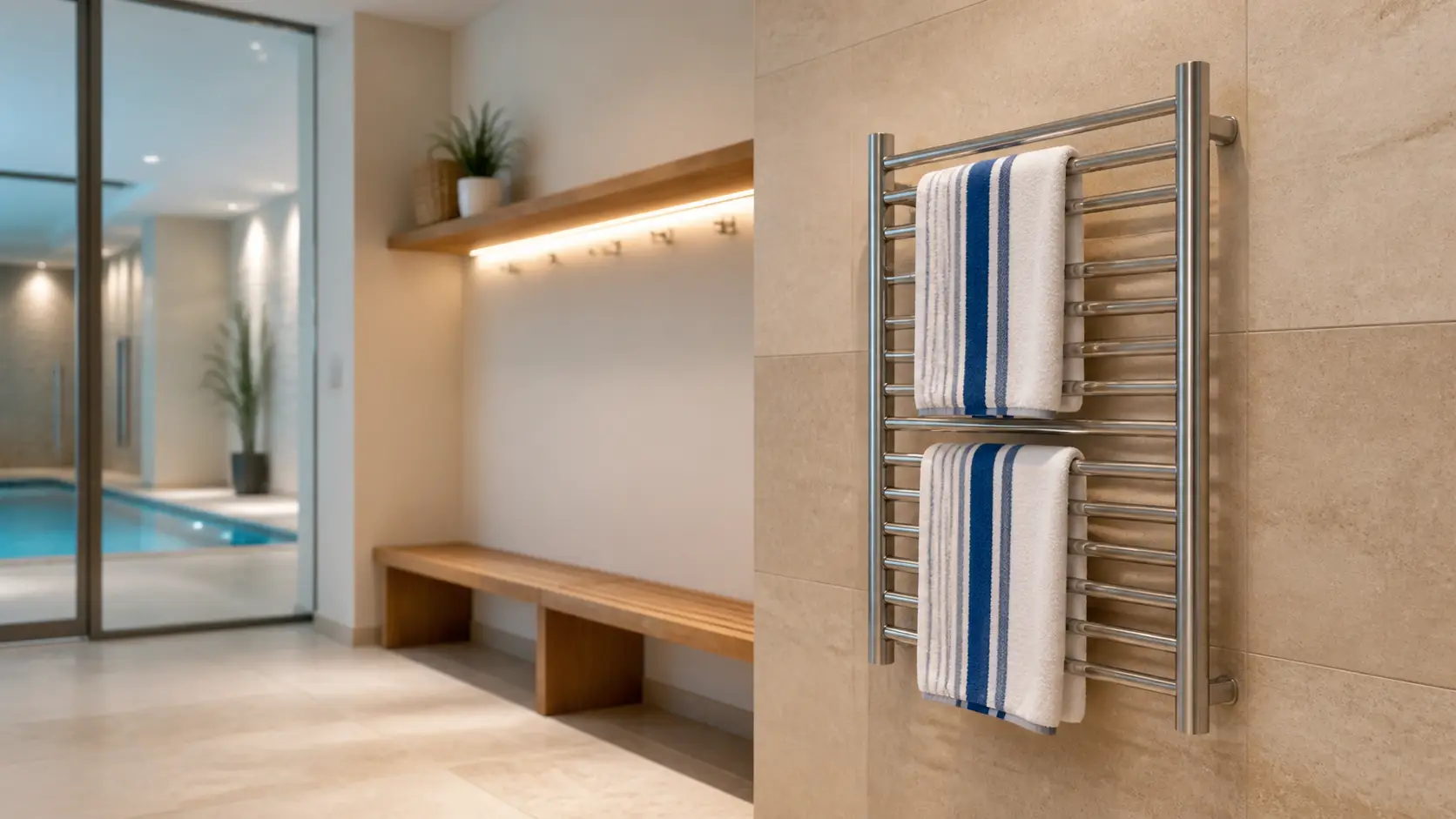
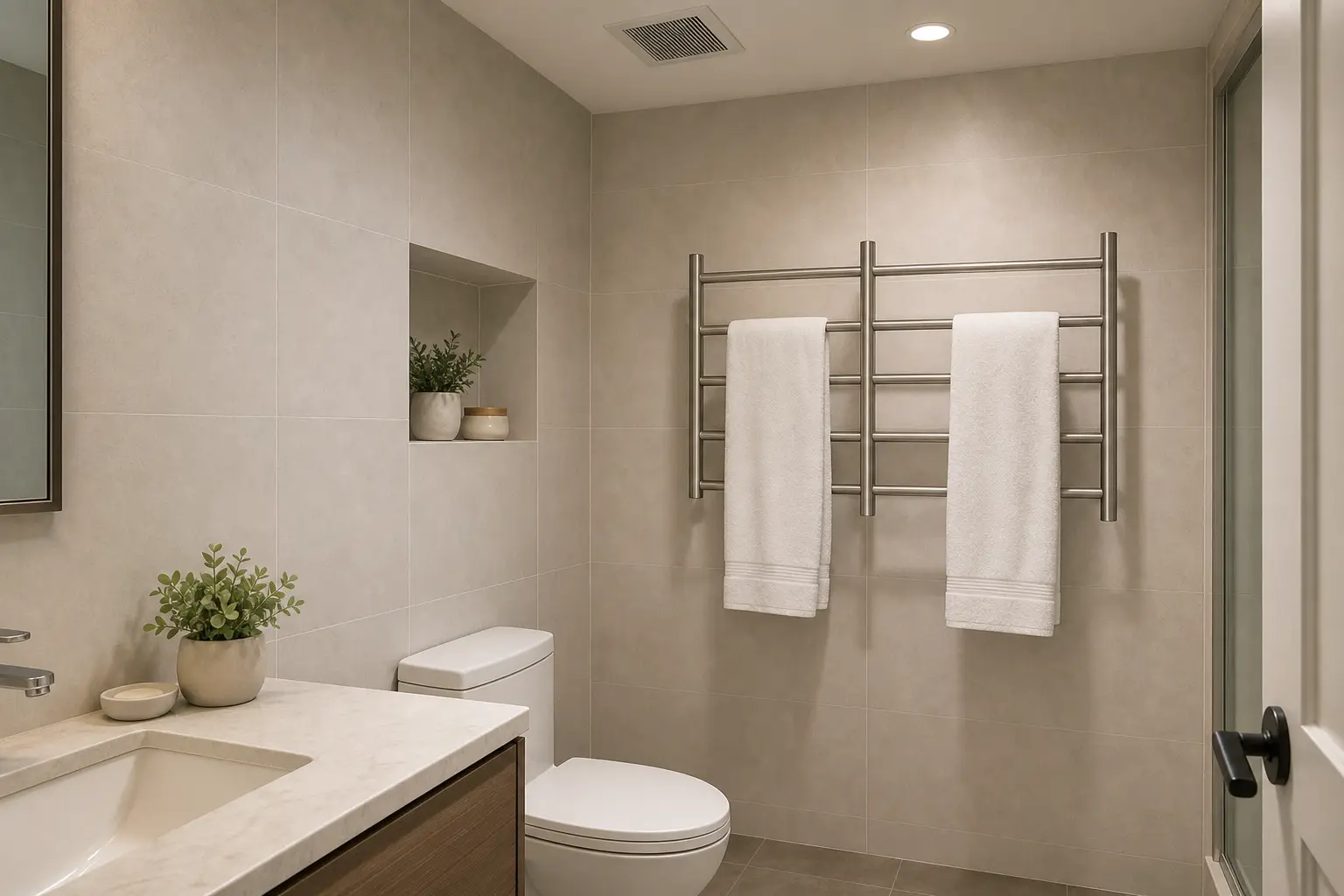
A heated towel rack can be useful in a windowless bathroom, but only when the room has a real way to manage shower moisture. Its job is to give towels and light, care-label-approved garments an open drying zone; it does not replace an exhaust fan, moisture repairs, or safe electrical planning. Start with ventilation and towel spacing, then decide whether the available wall and daily towel load make an electric heated towel rack a practical addition.
Why a windowless bathroom needs a drying plan
Without a window, every shower leaves the room relying on mechanical ventilation and ordinary air movement. That can make a wet bath towel linger longer, especially if it is folded over a crowded bar or left in a heap. The U.S. Environmental Protection Agency identifies moisture control as the essential step in limiting mold growth and advises dealing with leaks and damp materials promptly. A rack can help the towel routine; it cannot solve a room that stays humid or has water damage.
An open heated towel rack works best when each towel has space around it. Warm bars and room air can support drying for daily towels, hand towels, swim towels, and light garments when their care labels allow that method. It is different from an enclosed towel warmer or bucket, which is primarily for warming dry fabric rather than managing a damp towel load.
Before choosing a fixture, look at a normal post-shower hour. Does the mirror stay fogged? Does the fan sound as though it is moving air, and does it actually exhaust outdoors? Are there water marks, peeling paint, a musty smell, or recurring mildew? Those observations tell you whether the first purchase should be a drying accessory or a ventilation and repair solution.
Check ventilation before choosing wall space
For a no-window bathroom, an exhaust path matters more than a decorative fan grille. EPA guidance recommends using a bathroom fan or opening a window during showers, keeping humidity low, and fixing leaks promptly. With no window to open, confirm that the fan is appropriate for the room and that it sends moist air outside rather than into an attic, wall cavity, or another interior area. If you are renovating, ENERGY STAR's ventilation guidance is a useful starting point for planning a quiet, effective fan with a qualified professional.
Use the table as a quick decision check.
| What you notice | Do this first | Where the rack fits |
|---|---|---|
| Towels are damp the next morning, while surfaces dry normally | Hang towels flatter and run the fan consistently | A strong drying-zone use case |
| Mirror and walls stay wet long after a shower | Check fan performance and humidity control | Wait until airflow is working |
| Musty odor, peeling finishes, or a leak | Repair and dry the affected area | Do not use a rack as the fix |
| Several towels share a compact room | Count the towels and map open hanging space | Choose usable bars over a crowded layout |
Good ventilation and an open rack work together: the fan manages moisture in the room, while the rack helps prevent a towel from staying bunched and damp. Neither part does the other one's job.
Size the towel load, not just the empty wall
Measure with real towels. A wall can look generous until a bath sheet hangs from it, a door swings open, or someone needs to reach the vanity. Leave enough clearance to place and remove towels without brushing the toilet, shower door, cabinets, or controls. In a small windowless bath, one or two separated towels often dry more effectively than several thick towels layered on the same bars.
Ask four practical questions:
- How many damp towels are normally present at the same time?
- Are they hand towels, standard bath towels, or thick bath sheets?
- Can each towel hang with an air gap instead of being folded tightly?
- Will the rack remain reachable and easy to clean around when the bathroom is busy?
If the answer is a large family load, add a normal towel bar or plan a rotation instead of assuming one heated rack should carry every textile. The best result is a simple daily habit: spread towels after use, run the fan, and remove or rotate them once dry.
Treat power as part of the layout
Do not leave electrical planning until after the wall location is chosen. Bathroom electrical work should follow the product instructions and applicable local requirements, with a qualified installer deciding the suitable connection and location. The U.S. Consumer Product Safety Commission explains that ground-fault circuit interrupters (GFCIs) are designed to help protect against shock in wet locations. A professional can assess what applies to the existing circuit and to the intended installation.
Avoid using an extension cord as a permanent solution in a bathroom. The Electrical Safety Foundation International warns against treating extension cords as permanent wiring. If reaching a receptacle requires a cord crossing the room, the layout is not ready. Decide the power route, wall construction, and mounting approach before selecting a rack.
Know when a rack is the right answer
A windowless bathroom can be a good fit for a heated towel rack when the fan works, surfaces dry normally, the wall location is practical, and the household has a modest towel load. It is not the right first step when the room has a leak, persistent condensation, wet finishes, poor exhaust, or visible mold. Solve the moisture source first, then use the rack as part of a better drying routine.
When you are ready to compare open drying layouts, explore Calithrex heated towel racks with your actual towel count, wall measurements, and electrical plan in hand. The most useful choice is the one that keeps towels separated, the room manageable, and the daily routine easy to repeat.
FAQs
Is a heated towel rack useful in a bathroom with no window?
Yes, if the room has effective mechanical ventilation and enough wall space to hang towels openly. It helps with towel drying but does not replace ventilation.
Does a heated towel rack remove bathroom humidity?
No. It dries the items placed on it. Exhaust ventilation, dehumidification where appropriate, and repairs manage moisture in the room itself.
Can I run a bathroom fan while using a heated towel rack?
That is usually part of a sensible drying routine. Follow the product instructions and have a qualified installer confirm the bathroom's electrical arrangement.
Can I hang several bath sheets on one rack?
Only if the bars and spacing allow them to remain separated. Overlapping thick towels slows airflow and can reduce the drying benefit.
Should I use an extension cord for a heated towel rack?
No. Do not use an extension cord as permanent bathroom wiring. Plan the approved electrical connection before installation.