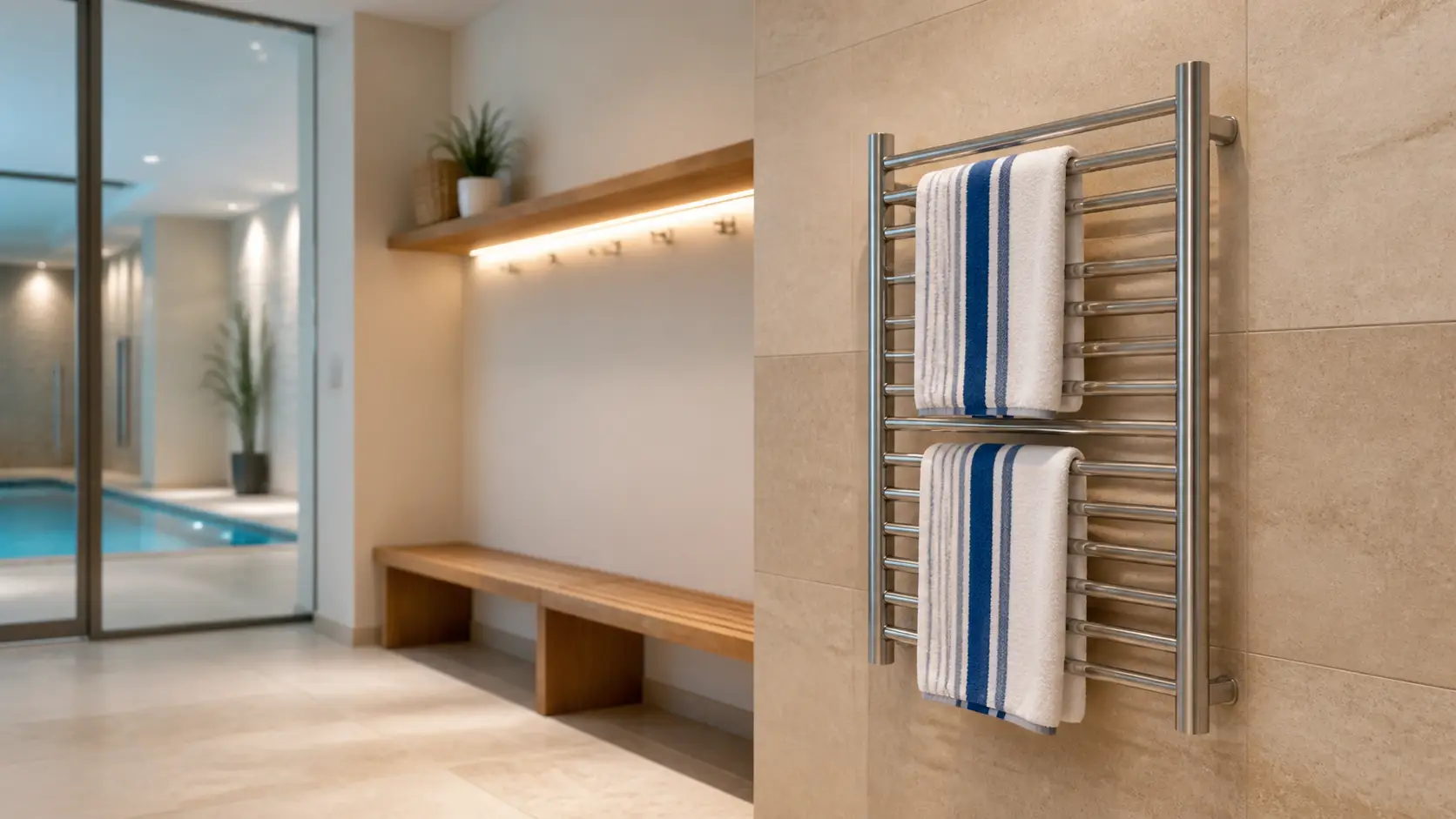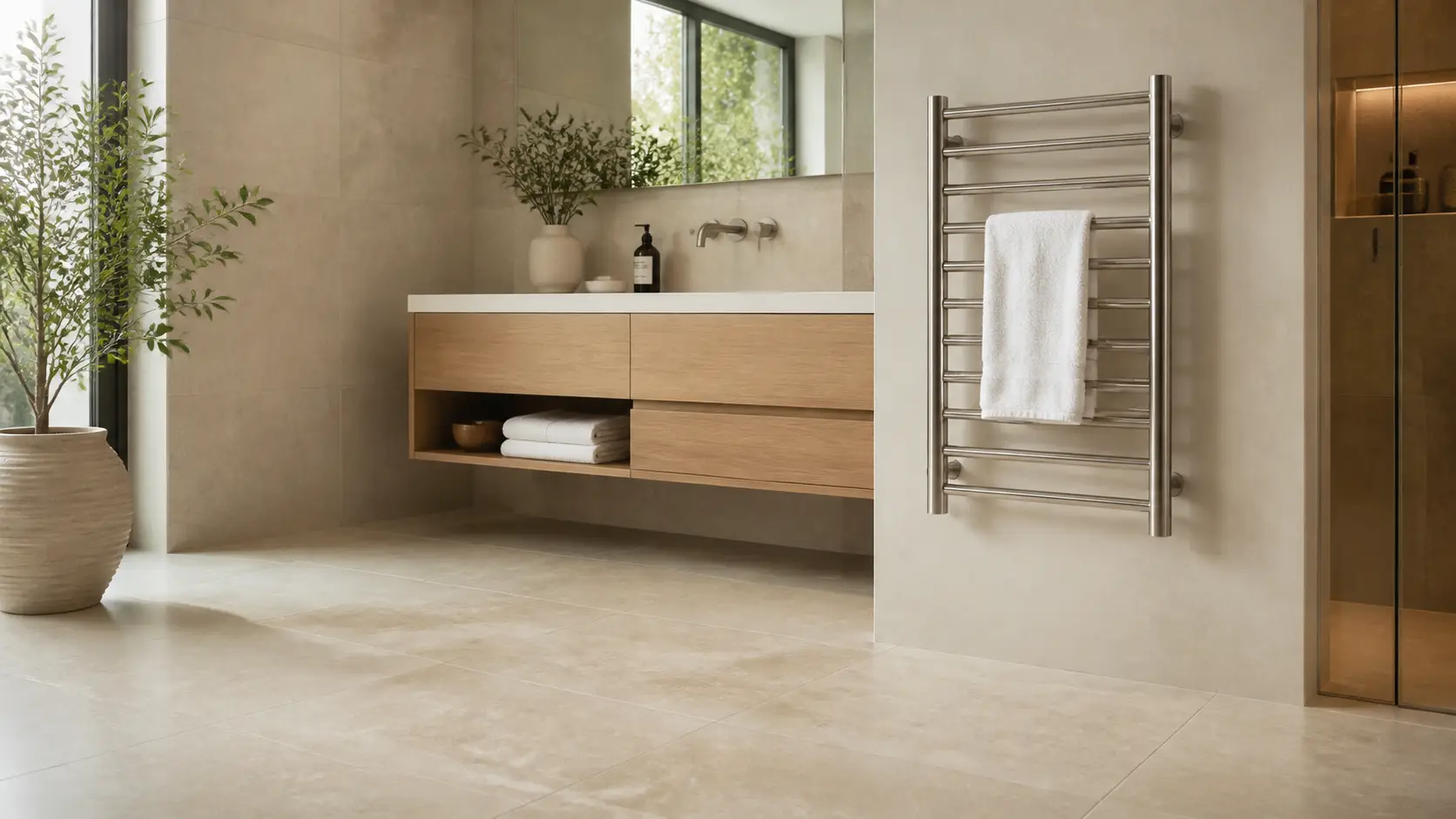

Bathroom humidity control works best when ventilation removes moist air, surfaces are allowed to dry, and towels are kept open to airflow. A heated towel rack can help towels dry faster and feel fresher, but it should not be treated as a replacement for an exhaust fan, window, or correctly designed ventilation system.
The simple rule is this: remove steam from the room first, then help towels and wet surfaces dry. That combination matters in residential bathrooms, hotel bathrooms, spa rooms, apartments, and renovation projects because moisture affects comfort, odor, cleaning workload, finishes, and long-term maintenance.
Quick Answer: What Controls Bathroom Humidity?
| Moisture task | Best solution | What a heated towel rack can do |
|---|---|---|
| Remove steam after a shower | Exhaust fan, open window, or mechanical ventilation | Not a substitute for room ventilation |
| Dry bath towels | Airflow, open hanging, towel spacing, gentle heat | Helps towels dry more evenly than a hook or pile |
| Reduce condensation on mirrors and walls | Ventilation and surface drying | Helps only around towels, not the whole room |
| Improve daily bathroom comfort | Ventilation, heat planning, dry textiles, good storage | Adds warm towel comfort and supports drying routines |
| Support hotel or spa housekeeping | Correct fan sizing, durable finishes, towel management | Helps reduce damp towel feel between uses |
If the bathroom feels wet, smells musty, or has recurring mold, start with the moisture source and ventilation. If the room ventilates well but towels stay damp for hours, then towel spacing, towel weight, airflow, and a heated towel rack become more important.
Why Bathroom Humidity Is a Design Issue, Not Just a Cleaning Issue
Bathrooms create short bursts of moisture. A shower can leave steam in the air, water on tile, droplets on glass, damp bath mats, and wet towels. If that moisture remains trapped, the room becomes harder to keep clean and less comfortable to use.
The EPA's mold guidance is direct: moisture control is the key to mold control. The same guidance notes that if bathroom mold keeps returning, increasing ventilation by running a fan or opening a window usually helps keep it from recurring.
That is why bathroom humidity control should be part of the design plan, not an afterthought. It affects:
- Mirror fog and condensation.
- Odor after showers.
- Damp towel smell.
- Paint, grout, sealant, and cabinet durability.
- Housekeeping time in hotels and spas.
- User comfort in small bathrooms, wet rooms, and enclosed shower areas.
For Calithrex buyers, this is also where heated towel racks fit naturally. They are not a whole-room dehumidifier, but they can make towel drying more predictable when the bathroom already has reasonable airflow.
Step 1: Remove Moist Air From the Room
The first job is to move humid air out of the bathroom. In most homes and projects, this means an exhaust fan vented outdoors. In some bathrooms, a window can help, but a window depends on weather, user behavior, privacy, and room layout.
When planning ventilation, check:
- Whether the fan is properly sized for the bathroom.
- Whether it vents outside, not into an attic or enclosed cavity.
- Whether users actually run it during and after showers.
- Whether air can enter the room under the door or through another path.
- Whether a humidity sensor or timer would improve consistency.
ENERGY STAR's certified ventilating fan directory shows that bathroom and utility-room fans are a major product category, with many certified options across airflow ranges. For homeowners, that confirms there are efficient fan choices. For contractors, hotels, and multifamily projects, it reinforces that fan selection should be treated as a specification item, not a generic accessory.
Step 2: Let Wet Surfaces Dry
Ventilation removes humid air, but surfaces still need a chance to dry. A glass shower door, tile niche, grout line, bath mat, and folded towel can all hold water after the fan starts.
Useful habits include:
- Keep the shower door or curtain open after use.
- Pull towels open rather than leaving them folded on a hook.
- Avoid stacking wet towels together.
- Use bath mats that dry quickly or can be hung.
- Wipe obvious standing water from shower ledges and enclosed corners.
- Keep vanity storage away from frequent splash zones.
Wet rooms and larger shower areas can make the drying plan even more important. Houzz's 2025 U.S. Bathroom Trends Study notes that wet rooms account for 1 in 6 renovated bathrooms. These layouts can feel open and spa-like, but they still need practical airflow and drying routines.
Step 3: Dry Towels With Airflow, Space, and Gentle Heat
A towel dries when moisture can leave the textile. That needs surface area, airflow, time, and sometimes heat. A towel bunched on a robe hook has less exposed surface area, so it often stays damp longer. A towel spread across a bar has more exposure and can dry more evenly.
For everyday towel drying, compare the options:
| Towel storage method | Drying performance | Best use |
|---|---|---|
| Hook | Slowest for thick towels because fabric bunches together | Quick hanging, robes, guest towels |
| Single towel bar | Better than a hook, but limited capacity | One towel in a small bathroom |
| Multiple bars | Better spacing and more surface exposure | Family bathrooms and shared bathrooms |
| Heated towel rack | Adds gentle warmth plus open hanging | Daily-use towels, spa-style comfort, hotel rooms |
| Towel warmer bucket | Warms towels before use but does not hang them open to dry | Short warm-towel ritual, not drying after use |
A heated towel rack is most useful when towels are hung with space between layers. If a thick towel is folded several times over one bar, heat may warm the outside while the inner fold stays damp. For better drying, spread the towel across more bar contact or use multiple bars.
Does a Heated Towel Rack Reduce Bathroom Humidity?
A heated towel rack can help reduce moisture held inside towels, but it does not remove humid air from the bathroom. It warms the towel and supports evaporation from the fabric. That moisture still needs somewhere to go, which is why ventilation remains necessary.
The right answer is:
- Use a fan or window to control room humidity.
- Use a heated towel rack to help towels dry and feel more comfortable.
- Use towel spacing and airflow so the rack can work effectively.
- Do not rely on a towel warmer to fix a poorly ventilated bathroom.
This distinction is useful for SEO and for buyer expectations. Many people ask whether a heated towel rack "dries the bathroom." It helps with towels; it does not replace the building's ventilation system.
Residential Bathrooms: What Homeowners Should Do
For a normal home bathroom, start with daily behavior before buying anything new. Run the fan during showers and leave it running afterward if the room still feels damp. Open the shower enclosure. Hang towels flat. Check whether the fan actually moves air and whether the grille is blocked by dust.
Then consider upgrades:
| Problem | First fix | Upgrade to consider |
|---|---|---|
| Mirror stays foggy for a long time | Run or improve ventilation | Timer or humidity-sensing fan |
| Towels smell damp by the next day | Spread towels open | Heated towel rack with enough bars |
| Bathroom feels cold after showering | Check heating and drafts | Heated towel rack for towel comfort |
| Mold returns in the same area | Fix moisture source and increase airflow | Better fan, window routine, surface drying |
| Small bathroom feels crowded | Improve storage and towel placement | Wall-mounted heated towel rack |
If the bathroom is being renovated, decide the fan location, towel rack location, electrical point, and storage plan together. That prevents the common problem of placing towel storage where towels have little airflow.
Hotel, Spa, and Multifamily Projects
In commercial and multi-room projects, bathroom humidity control is not only about comfort. It affects housekeeping, guest reviews, maintenance calls, textile turnover, and the life of finishes.
Project teams should define:
- Fan airflow and control method.
- Whether the fan runs by switch, timer, occupancy sensor, or humidity sensor.
- Towel rack location relative to shower splash, power supply, and cleaning access.
- Towel size, towel weight, and expected drying time.
- Finish choices that tolerate moisture and repeated cleaning.
- Maintenance instructions for dust, grille cleaning, and towel rack surfaces.
The NKBA 2026 Bath Trends coverage reports that 77% of respondents expect hotel or resort experience to influence residential bath design, while wellness, technology, and sustainability merge into a single design direction. For Calithrex, that trend supports content and product positioning around hotel-style comfort, warm towels, efficient controls, and practical daily use.
Energy Use: Use Controls Instead of Guesswork
Humidity control and towel drying should not mean leaving every device on all day without a plan. A bathroom fan needs enough run time to clear moisture. A heated towel rack needs enough warm-up and drying time to help the towel. Both can benefit from controls.
Good control choices include:
- Fan timer switch.
- Humidity-sensing exhaust fan.
- Scheduled towel rack operation.
- Smart switch or timer where code and installation allow.
- Clear instructions for hotel housekeeping or property managers.
For homeowners, a practical routine may be simple: run the fan during and after showers, then run the heated towel rack during the period towels need help drying. For hotels or apartments, standard schedules and clear operating instructions reduce user confusion.
Buyer Checklist: What to Ask Before Choosing a Heated Towel Rack
Before choosing a heated towel rack as part of a humidity-control plan, ask:
- Does the bathroom already have reliable ventilation?
- How many towels need to dry at the same time?
- Are towels thick, oversized, or fast-dry?
- Will the rack be wall-mounted or freestanding?
- Is the installation location away from unsuitable wet zones?
- Is the electrical setup hardwired or plug-in?
- Does the selected model have the right size, wattage, IP rating, and finish?
- Will users have a timer or clear operating routine?
For related Calithrex planning, pair this topic with the heated towel rack size guide, IP rating guide, installation-height guide, and energy-use content. Those decisions work together; a rack that is too small, poorly placed, or difficult to operate will not solve damp towels.
Common Mistakes
| Mistake | Why it causes problems | Better approach |
|---|---|---|
| Treating a towel warmer as a dehumidifier | It does not exhaust room moisture | Use ventilation for the room and the rack for towels |
| Hanging towels in thick folds | Moisture stays trapped inside fabric | Spread towels across bars with space |
| Turning the fan off immediately | Steam remains after the shower | Use a timer or leave the fan running longer |
| Ignoring fan maintenance | Dust reduces airflow | Clean grilles and verify airflow |
| Choosing rack size by looks only | Too few bars limit drying capacity | Match size to towel count and bathroom layout |
FAQ
What is the best way to control humidity in a bathroom?
The best method is a working exhaust fan or other ventilation path that removes moist air, combined with habits that let wet surfaces and towels dry. A heated towel rack can help with towel drying, but ventilation controls the room.
Does a heated towel rack help towels dry faster?
Yes, when towels are hung open with enough spacing. The rack adds gentle warmth and can reduce the damp towel feel, especially in bathrooms where towels otherwise stay wet for hours.
Can a heated towel rack prevent mold?
It can help towels dry, but it cannot prevent mold by itself. Mold prevention depends on controlling moisture sources, improving ventilation, drying wet areas, and cleaning affected surfaces.
Should I run the bathroom fan with a heated towel rack?
Yes. The fan removes humid air from the room, while the heated towel rack helps dry towels. They solve different parts of the moisture problem.
What should hotels look for in bathroom humidity control?
Hotels should specify fan performance, control method, towel storage layout, towel rack placement, cleaning access, and operating instructions. The goal is consistent guest comfort and lower maintenance risk across many rooms.
Is a towel warmer bucket good for drying towels?
A towel warmer bucket is mainly for warming towels before use. For drying used towels, open hanging on bars, airflow, and a heated towel rack usually make more sense.