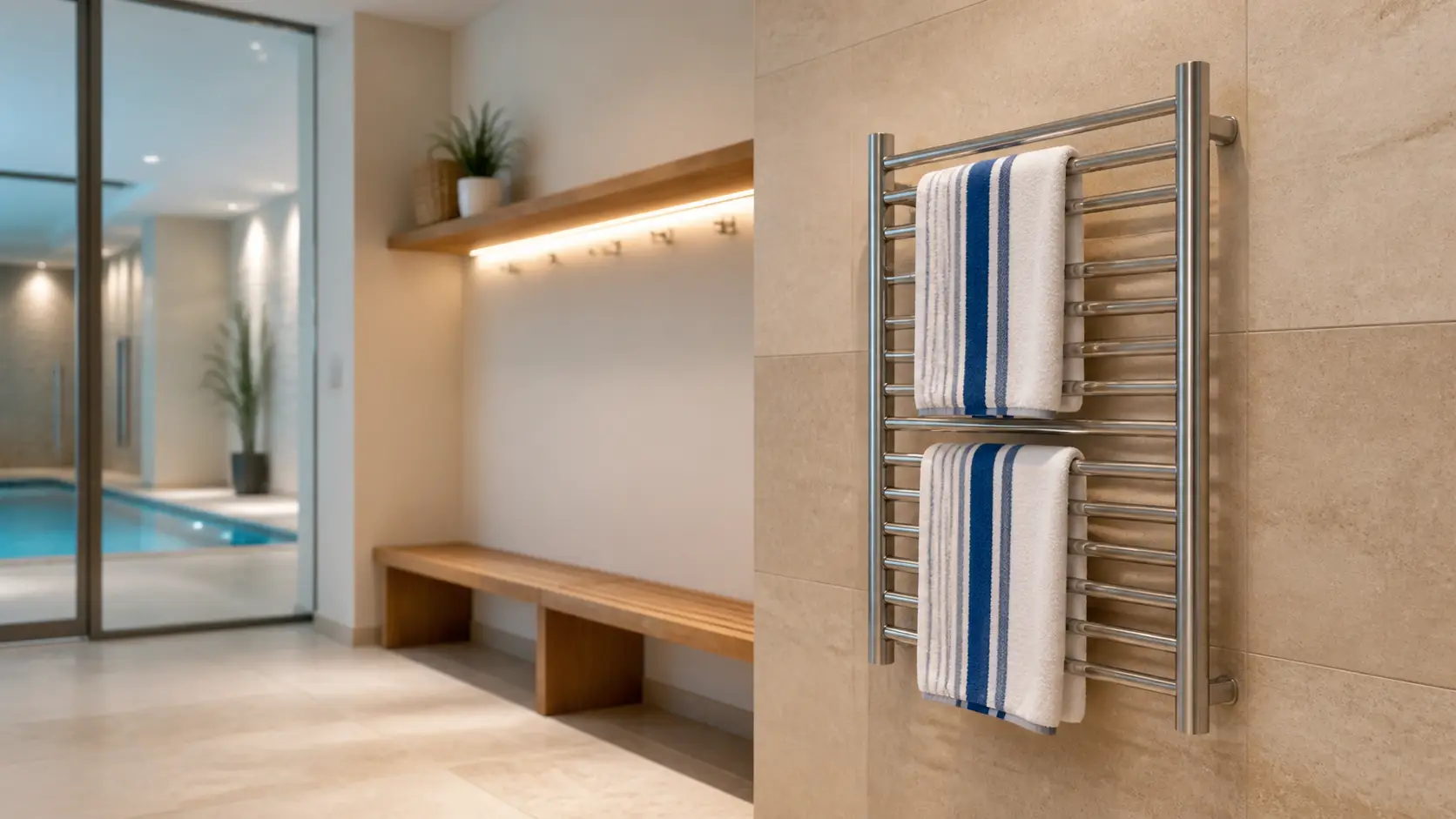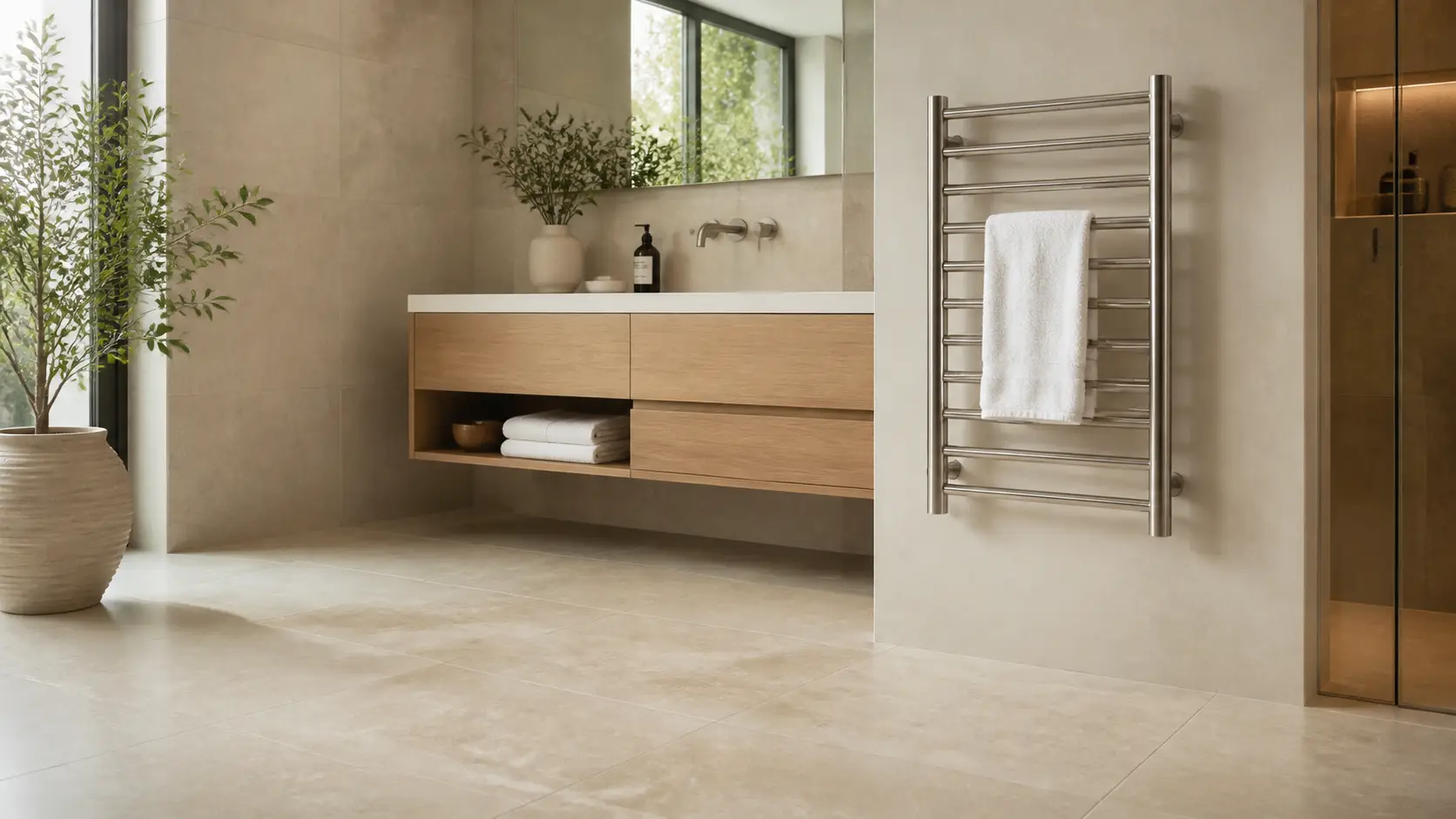
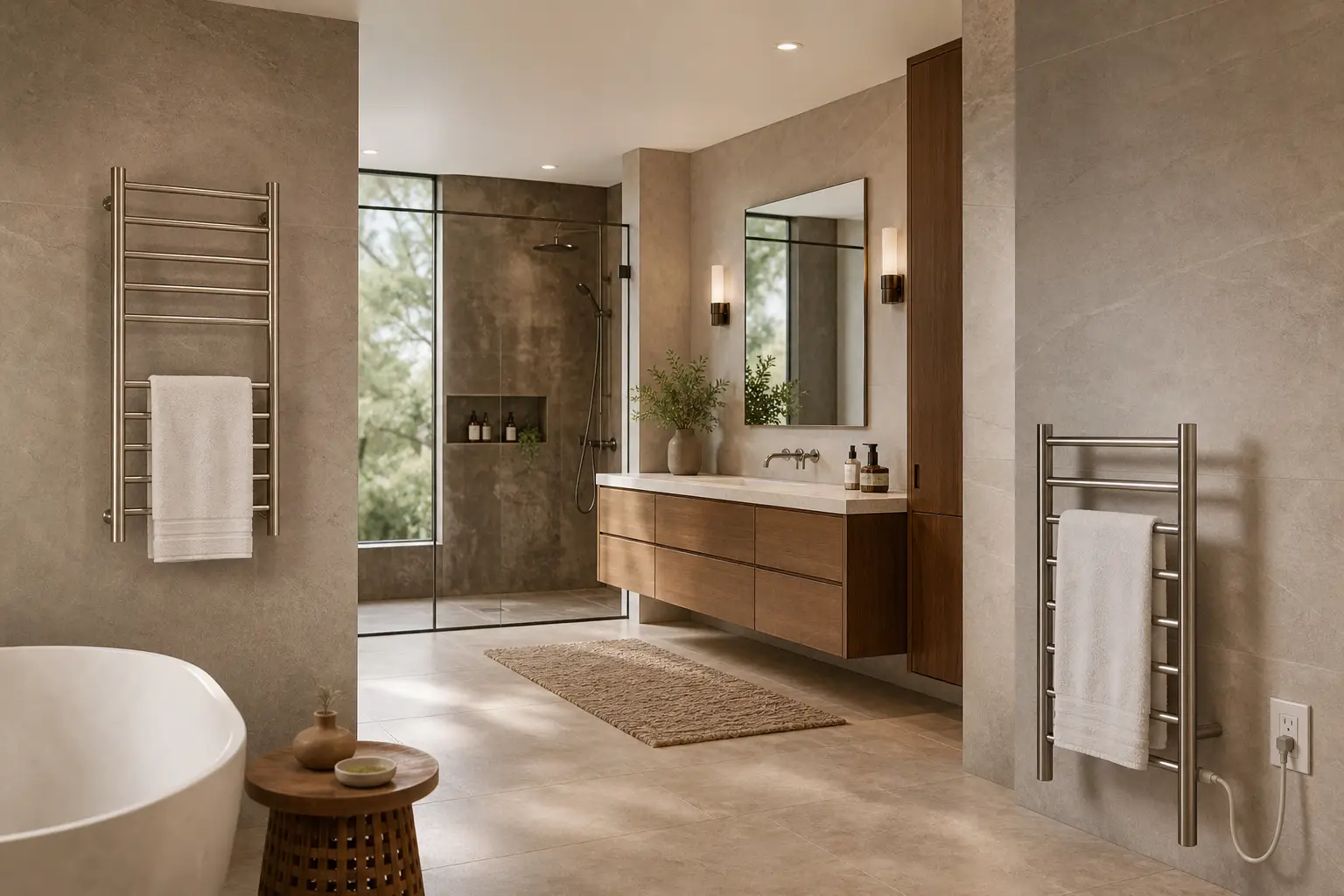
Hardwired and plug-in heated towel racks can both warm towels and support towel drying, but they fit different projects. A hardwired heated towel rack is usually the better choice for renovations, hotels, premium bathrooms, and clean visual designs. A plug-in heated towel rack is usually better for existing bathrooms, faster upgrades, renters, and buyers who want less electrical work.
The right choice depends on five things: bathroom layout, outlet location, local electrical code, desired appearance, and whether the project is a one-room home upgrade or a multi-room commercial specification.
Quick comparison
| Decision point | Hardwired heated towel rack | Plug-in heated towel rack |
|---|---|---|
| Best for | Remodels, hotels, premium bathrooms, new construction | Existing bathrooms, quick upgrades, renters, flexible placement |
| Appearance | Cleanest look, no visible cord | Cord and outlet must be planned |
| Installation | Usually requires a licensed electrician | Easier if a suitable bathroom outlet already exists |
| Portability | Fixed in place | Easier to move or replace |
| Project planning | Better for planned renovation drawings | Better for after-market installation |
| B2B fit | Strong for hotels, apartments, spas, and spec projects | Useful for test rooms, smaller projects, and low-disruption upgrades |
If the bathroom is being renovated, choose hardwired unless there is a clear reason not to. If the bathroom is already finished and has a suitable GFCI-protected outlet in the right location, a plug-in model may be the more practical choice.
What is a hardwired heated towel rack?
A hardwired heated towel rack connects directly to the building's electrical system through a junction box or concealed wiring route. The power connection is hidden inside the wall or behind the fixture.
This creates a cleaner bathroom appearance because there is no visible cord running to an outlet. It also makes hardwired installation attractive for:
- Primary bathroom remodels
- Luxury residential projects
- Hotels and serviced apartments
- Spas and wellness suites
- Multifamily projects
- Designer-led bathroom upgrades
Hardwired installation should be planned before walls, tile, or vanity layouts are finalized. Once the wall is finished, changing the power location can add cost and time.
What is a plug-in heated towel rack?
A plug-in heated towel rack uses a power cord and connects to a standard outlet. It is easier to add to an existing bathroom if the outlet location, cord route, and electrical protection are suitable.
Plug-in models work well when:
- The bathroom is already finished
- The buyer wants faster installation
- The user may move the unit later
- The project does not justify opening walls
- A freestanding or wall-mounted plug-in style fits the space
The main tradeoff is visual. A visible cord can make a premium bathroom look less finished if it is not planned carefully. Cord length and outlet position matter.
Choose hardwired when appearance and permanence matter
Hardwired installation is usually the stronger choice when the fixture is part of the bathroom design rather than an afterthought.
Choose hardwired if:
- You are remodeling the bathroom
- You want a clean wall with no visible cord
- The towel rack will stay in the same place long term
- A designer, contractor, or electrician is already involved
- The project needs consistent installation across multiple rooms
- You want the product to feel integrated into the bathroom specification
For hotels, apartments, and premium residential projects, hardwired models also reduce visual variation between rooms. That matters when a buyer is specifying dozens or hundreds of bathrooms.
Choose plug-in when speed and flexibility matter
Plug-in installation is usually more practical when the bathroom is already complete.
Choose plug-in if:
- You do not want to open walls
- You need a faster upgrade
- You are testing demand in a guest room or rental unit
- You may move the towel rack later
- A suitable outlet is already in a practical location
- The cord can be routed cleanly and safely
Plug-in models can be a good choice for homeowners who want a comfort upgrade without a full remodel. They can also work for small hospitality trials before a larger hardwired rollout.
Safety: what matters for both installation types
The most important rule is simple: a heated towel rack is an electrical product used in a bathroom, so installation must respect water, power, clearance, product instructions, and local code.
For both hardwired and plug-in models, check:
- Product certification or listing relevant to your market
- Manufacturer installation instructions
- Bathroom zone and wet-location requirements
- GFCI protection where required
- Outlet or junction box location
- Distance from direct water spray
- Cord routing if plug-in
- Load on the circuit
- Whether a licensed electrician is required
The Electrical Safety Foundation International explains that GFCI protection helps protect against electric shock. That is especially relevant in bathrooms and other areas where water and electricity may be close together.
For hardwired installation, use a licensed electrician. For plug-in installation, do not use extension cords, do not route cords through wet areas, and do not force a cord behind tile, vanity units, or trim in a way the product was not designed for.
Cost and installation planning
The product price is only one part of the decision.
Hardwired costs may include:
- Electrician labor
- Wall opening or rough-in work
- Junction box placement
- Timer or switch planning
- Tile or finish coordination
- Inspection or code compliance requirements
Plug-in costs may include:
- A suitable GFCI-protected outlet if one is not already present
- Cleaner cord management
- Possible outlet relocation
- A freestanding model if wall mounting is not practical
In a remodel, hardwired may be cost-effective because electrical work is already happening. In a finished bathroom, plug-in may save disruption if the outlet location is right.
Which looks better?
Hardwired usually looks better in a finished bathroom because the power connection is concealed. This is why designers often prefer hardwired towel warmers for high-end bathrooms.
Plug-in can still look good if the layout is planned. The best plug-in installations usually have:
- A nearby outlet
- A short and tidy cord route
- A finish that matches the rack and bathroom hardware
- No cord crossing walkways, wet zones, or visual focal points
If the bathroom design is minimal, spa-like, or hotel-inspired, a visible cord may be more noticeable. In that case, hardwired is usually worth considering.
Which is better for B2B projects?
For B2B buyers, the decision should be based on repeatability, maintenance, guest experience, and installation control.
Hardwired is usually better for:
- Hotels
- Spas
- Apartments
- New construction
- Large renovation programs
- Premium guest bathrooms
Plug-in can still be useful for:
- Pilot rooms
- Small boutique properties
- Temporary upgrades
- Rooms where opening walls is not practical
- Projects where speed is more important than a fully concealed finish
For a multi-room project, ask the supplier for consistent finish options, product documentation, packaging reliability, installation guidance, and after-sales support. The installation type is only one part of the procurement decision.
Which is better for homeowners?
For homeowners, the answer depends on the bathroom stage.
If you are renovating, hardwired is usually the cleaner long-term choice. It can be planned with the vanity, shower, switches, lighting, and towel position.
If your bathroom is already finished, plug-in is often easier. You can still get warm towels and better towel drying support without turning the project into a larger electrical renovation.
If you rent, plug-in or freestanding is usually more realistic because it does not require permanent wiring changes. Always check lease rules and product instructions before installation.
Buyer checklist before choosing
Before you order, answer these questions:
1. Is the bathroom being renovated, or is it already finished? 2. Is there a suitable outlet near the desired towel rack location? 3. Will the cord be visible, and does that matter for the design? 4. Does local code or the product manual require a licensed electrician? 5. Is the circuit suitable for the towel rack load? 6. Is the fixture close to direct water spray? 7. Does the product have relevant safety certification for your market? 8. Do you need a timer, switch, or smart control? 9. Will this be a single bathroom or a multi-room project? 10. Is long-term appearance more important than short-term installation speed?
If you are unsure, choose the installation type only after checking the product manual and asking a qualified electrician.
Practical recommendation
Choose hardwired if you want the cleanest look, are already renovating, or are specifying a premium bathroom project. Choose plug-in if you need a faster upgrade in an existing bathroom and have a safe, practical outlet location.
For CALITHREX buyers, the best installation type should be decided together with size, finish, towel capacity, wattage, controls, and bathroom layout. The goal is not just to install a heated towel rack. The goal is to make the product feel natural in the space and useful every day.
FAQ
Is a hardwired heated towel rack better than plug-in?
Hardwired is better for clean appearance, renovations, and permanent installations. Plug-in is better for faster installation, existing bathrooms, and flexible placement.
Do plug-in heated towel racks need a special outlet?
They need a suitable outlet that matches the product instructions and local bathroom electrical requirements. In many bathroom situations, GFCI protection is important. If you are unsure, ask a qualified electrician.
Do you need an electrician for a hardwired heated towel rack?
Yes. Hardwired installation should be handled by a licensed electrician because it connects directly to the building's electrical system.
Can a plug-in heated towel rack look premium?
Yes, but only if the outlet and cord route are planned well. If the cord is highly visible, crosses the wall awkwardly, or sits near wet zones, it can weaken the bathroom's visual quality.
Which installation type is better for hotels?
Hardwired is usually better for hotels because it looks cleaner and is easier to standardize across rooms. Plug-in can be useful for pilot rooms or low-disruption upgrades.
Can I convert a plug-in heated towel rack to hardwired?
Only if the product is designed and approved for that installation method. Do not cut cords or modify wiring unless the manufacturer instructions allow it and a qualified electrician performs the work.