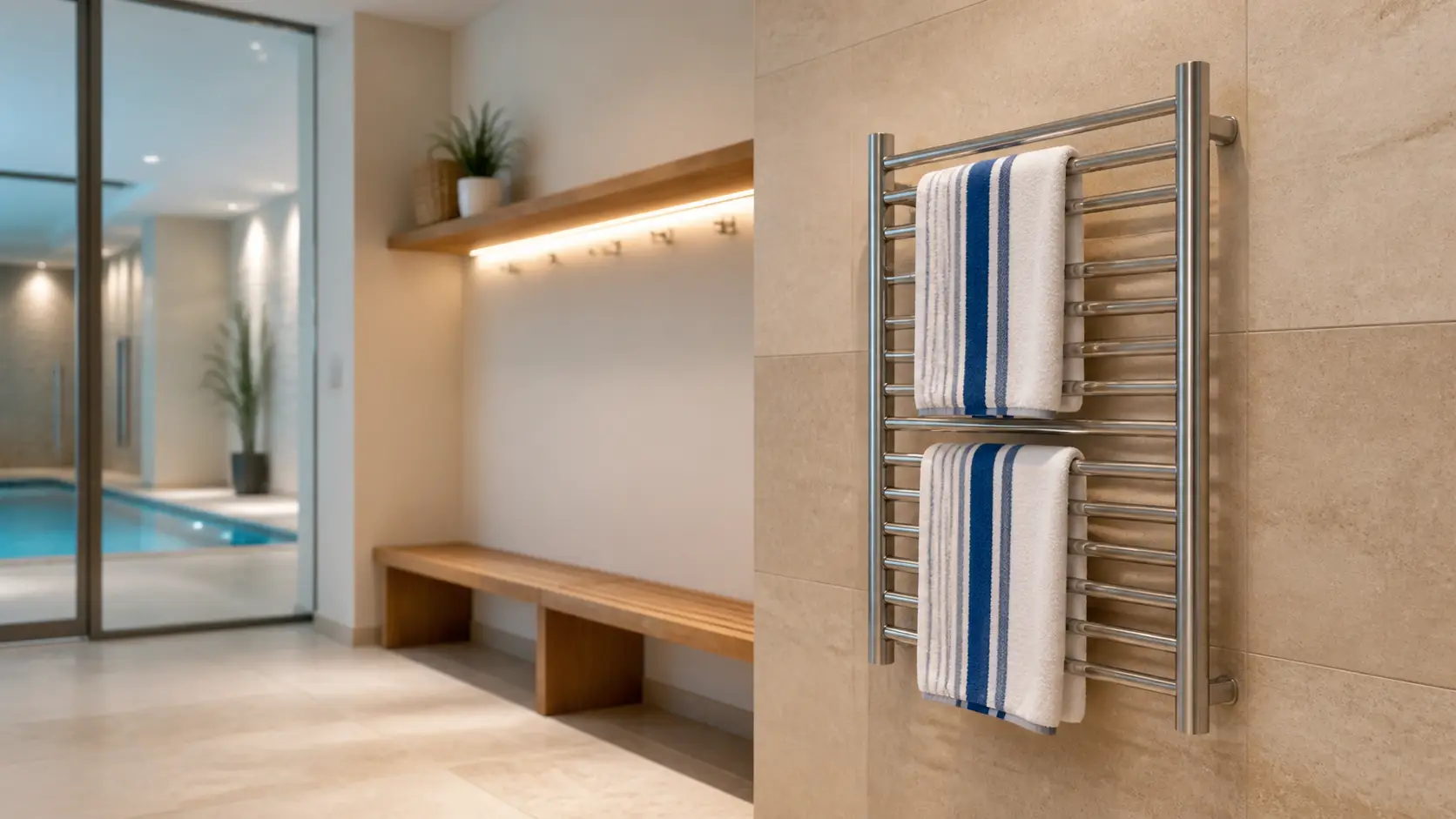
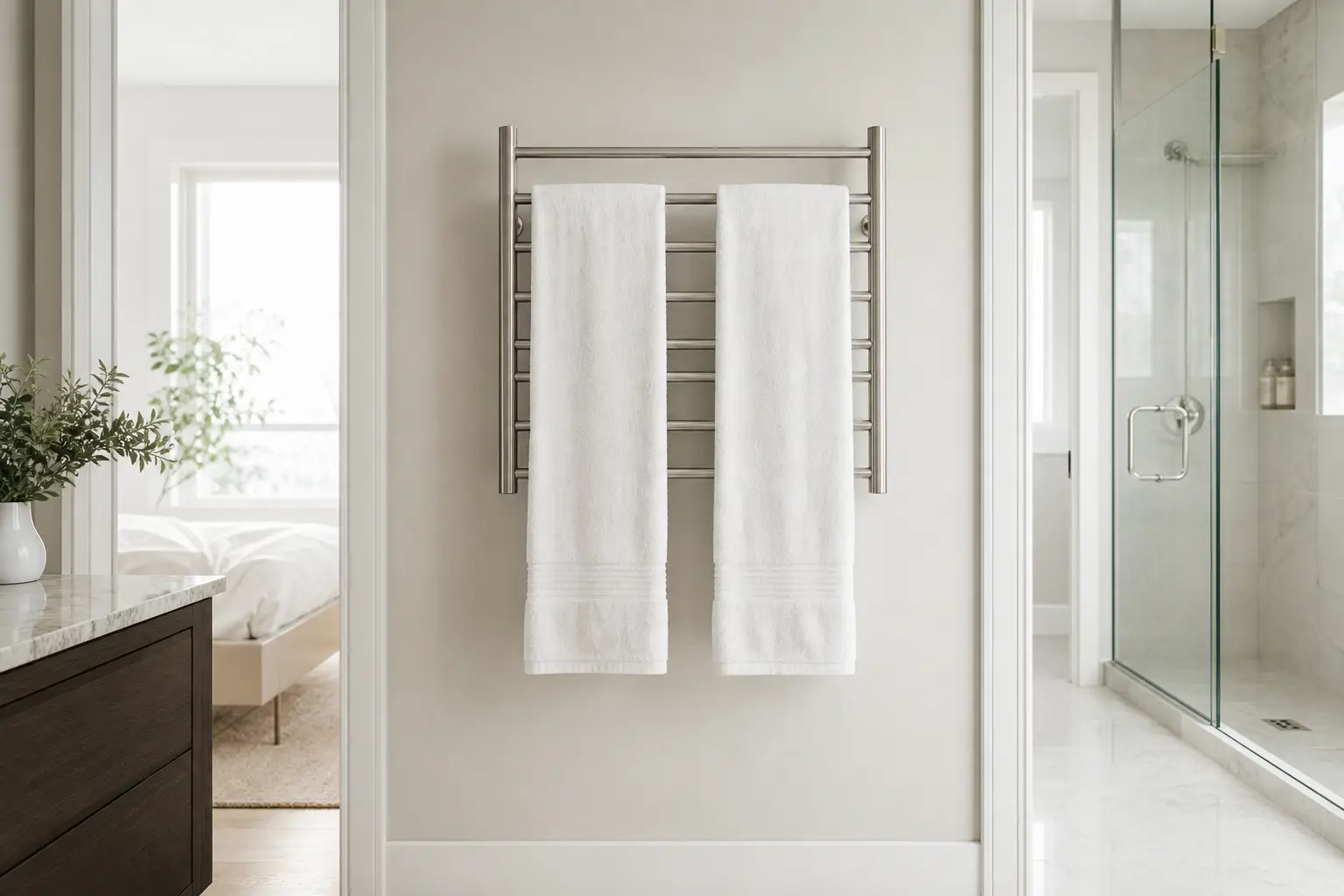
A heated towel rack can suit a Jack and Jill bathroom when it gives each user a clear, open place to hang a towel without blocking either doorway, the vanity, or the route to the shower. It supports towel drying; it does not replace ventilation or solve a crowded layout. Start with traffic flow, towel count, moisture control, and a safe electrical plan before choosing a rack.
Why a shared bathroom needs a different plan
A Jack and Jill bathroom serves two bedrooms through separate doors. Two people may shower at similar times, both doors may be moving during the morning rush, and an apparently open wall can disappear once the vanity, shower glass, storage, switches, and towel length are included.
An open electric heated towel rack works best as a defined towel zone. Warm bars can support evaporation from towels hung open with space between them, but they do not pull humid air out of the room. The U.S. Environmental Protection Agency recommends controlling moisture and drying wet materials promptly; here that means planning both the towels and the room air.
Use this shared-bathroom decision table
| Bathroom condition | A heated towel rack may fit when | Pause and solve this first |
|---|---|---|
| Two regular users | There is room for two towels to hang separately | Both towels would overlap on one bar |
| Two entry doors | A dry wall stays clear of both door swings | A door can hit the rack or a hanging towel |
| Busy vanity area | The rack is outside drawer and cabinet clearance | Towels will brush the sink, counter, or toiletries |
| Shower moisture | The fan or another ventilation path is working | Condensation, leaks, or persistent musty odor remain |
| Electrical route | The exact model and local installation requirements support the location | The plan depends on an extension cord or uncertain wiring |
| Small shared room | Users can reach towels without blocking the walking path | The only available position crowds the toilet or shower entry |
Treat the table as a layout test, not a universal installation rule. Exact clearances, permitted locations, and electrical requirements come from the specific product instructions and applicable local requirements.
Give each towel a real drying space
Count the towels that are actually used at the busiest time of day. In a two-user bathroom, that is often two bath towels plus occasional hand towels or a robe. Then mock up the proposed location with full-size towels, not just a tape measure. A wall can look open until damp fabric hangs from it.
Good shared-use placement usually has four qualities:
- It is near enough to the shower or tub to be convenient, but outside direct spray and puddles.
- It leaves a clear route through both doors when towels are hanging.
- It keeps towels off the vanity, toilet, floor, shower glass, and cabinet handles.
- It lets each user take down or rehang a towel without moving someone else's towel.
If the rack cannot provide separation, use fewer towels on it or choose a different routine. Layering towels tightly can trap moisture in the middle layers, even when the outside feels warm. A second conventional towel bar or hook in a dry, ventilated area can be more useful than overloading one heated fixture.
Keep door swings and controls in the measurement
Open each bedroom door, vanity drawer, medicine cabinet, and shower glass. Hold a towel at the proposed rack height. It should not be caught by a door, dragged through a walkway, or pressed against a cabinet. Keep the switch, timer, or model control visible and reachable. Do not let a placement create a cord route through a doorway, across the floor, or behind a moving door; ESFI advises that extension cords are not permanent wiring. For a remodel, plan the rack, backing, electrical route, switch location, and wall finish before closing the wall. For any uncertain electrical or damp-area detail, ask a qualified electrician to assess the actual room and model.
Pair towel drying with ventilation
Heat helps moisture leave a towel, but it does not remove that moisture from the bathroom. EPA guidance recommends using a bathroom fan or opening a window when showering, where practical, and increasing ventilation or air movement when needed. In a Jack and Jill bathroom, this matters because two showers close together can load the room with more moisture than a single-user routine.
Use the fan or another effective ventilation path during and after showers. If a mirror stays fogged, paint peels, water stains appear, mildew recurs, or the room smells musty, repair the moisture source first. A heated towel rack is a towel-care tool, not a cure for a ventilation problem.
A simple routine is usually the most durable one:
1. Run the bathroom ventilation during the shower routine. 2. Shake out each towel and hang it open in its assigned area. 3. Keep only the intended number of towels on the rack. 4. Keep door paths, controls, and the floor clear. 5. Use the exact model's timer or controls as instructed rather than treating the rack as a room heater. 6. Investigate lingering humidity instead of adding more towels to the bars.
FAQ
Can two towels dry on one heated towel rack?
Often, yes, when the rack has enough usable space for the two towels to hang open and separated. Avoid folding both towels over the same bars or layering them tightly.
Where should a heated towel rack go in a Jack and Jill bathroom?
Choose a dry, reachable wall near the towel-use area that remains clear of both door swings, shower spray, vanity drawers, and the normal walking path. Confirm the exact model instructions and local requirements before installation.
Does a heated towel rack replace the bathroom fan?
No. The rack supports towel drying, while a fan, open window, or other effective ventilation path manages humid room air. Keep using ventilation during and after showers.
Can I run a cord through one of the bedroom doors?
No. A cord should not cross a doorway, sit in a walking path, or become a workaround near moisture. Do not use an extension cord as permanent wiring.
Next step
Draw the bathroom with both doors open, then tape the proposed rack size and a full bath towel onto the wall. If towels stay separate, circulation remains clear, and the electrical and ventilation plans are sound, compare heated towel rack options by usable hanging space and installation type.